The software landscape has shifted toward “open-core” models, where the most robust features are often available for free to those who host their own systems. Finding reliable Free enterprise SaaS alternatives in 2026 means looking beyond “lite” trials and toward platforms that offer unlimited users and deep customization.
From decentralized communication to AI-powered project tracking, these alternatives prove that you don’t need a massive subscription budget to run a global operation.
In 2026, the cost of maintaining a “modern” tech stack has reached an all-time high, with many organizations suffering from “SaaS sprawl.” Choosing Free enterprise SaaS alternatives is no longer just a budget-friendly move for startups; it is a strategic decision for established enterprises looking to reclaim control over their data and overhead.
By leveraging open-core and community-driven platforms, you can access professional-grade features without the “per-seat” pricing that often cripples scaling teams.
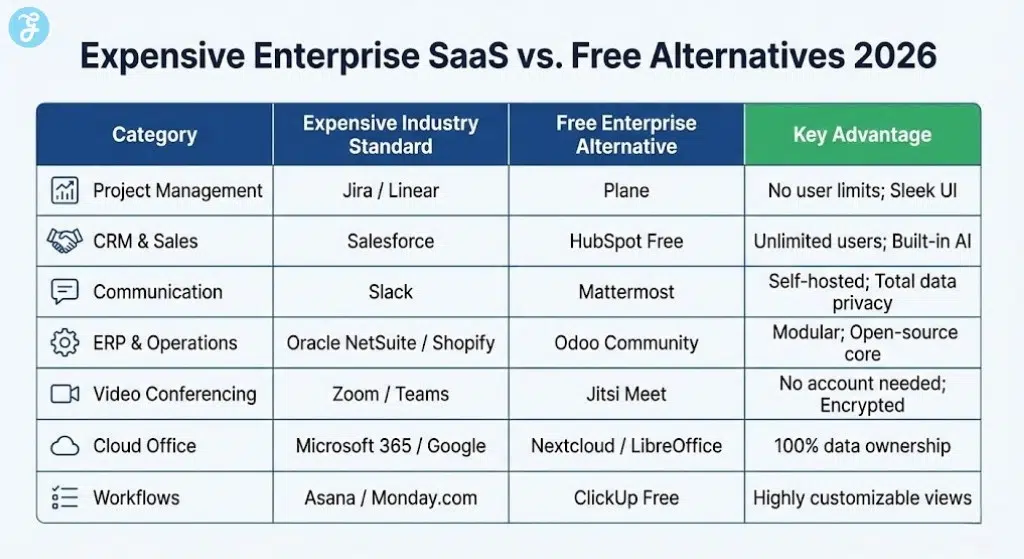
Enterprise SaaS vs. Free Alternatives Overview
Understanding where your money goes is the first step in optimizing your stack. This table compares the industry standard tools against their most powerful free counterparts.
| Category | Expensive Industry Standard | Free Enterprise Alternative | Key Advantage |
| Project Management | Jira / Linear | Plane | No user limits; Sleek UI |
| CRM & Sales | Salesforce | HubSpot Free | Unlimited users; Built-in AI |
| Communication | Slack | Mattermost | Self-hosted; Total data privacy |
| ERP & Operations | Oracle NetSuite / Shopify | Odoo Community | Modular; Open-source core |
| Video Conferencing | Zoom / Teams | Jitsi Meet | No account needed; Encrypted |
| Cloud Office | Microsoft 365 / Google | Nextcloud / LibreOffice | 100% data ownership |
| Workflows | Asana / Monday.com | ClickUp Free | Highly customizable views |
Switching to these alternatives can reduce your annual software spend by thousands while offering more flexibility. Let’s look at which tools are best for your specific needs.
Before we dive into the details, here is what we looked for in these recommendations.
What Things Did We Consider When Choosing Our List?
To ensure these are truly viable Free enterprise SaaS alternatives, we evaluated each platform based on 2026 benchmarks for performance and security.
When selecting these seven platforms, we weighed the following factors:
-
Scalability: We prioritized tools that don’t cap your user count or project volume in their free tiers.
-
Ease of Migration: We looked for platforms with built-in importers for the “expensive” tools they are replacing.
-
Data Sovereignty: We favored open-source projects that allow you to host your own data, ensuring total privacy.
-
Active Development: Every tool on this list has a massive community and frequent 2026 updates, ensuring it won’t become “abandonware.”
With these criteria in mind, here are the top seven free alternatives to the world’s most expensive software.
7 Essential Free enterprise SaaS alternatives
Transforming your business operations doesn’t have to be expensive. The following list provides a roadmap for replacing your high-cost subscriptions with powerful, modern alternatives.
1. Plane (The Modern Alternative to Jira)
Plane is a project management tool built for the next generation of product teams. It mirrors the power of Jira and the speed of Linear but offers an open-core Community Edition that is free to self-host without any user or project limits.
-
Best For: Product-led teams and engineering-heavy organizations.
-
What We Liked: The interface is significantly cleaner than Jira; it features a “Cycles” system that makes sprint planning effortless.
-
Things to Consider: While the core is free, advanced enterprise features like SSO and SAML require a paid commercial license.
2. HubSpot Free CRM (The Alternative to Salesforce)
While Salesforce is the enterprise standard, HubSpot’s free tier is famously generous. It offers a 360-degree view of your customers, including lead tracking, landing pages, and basic email automation for unlimited users.
-
Best For: Startups and sales teams that need a functional, easy-to-use CRM without the Salesforce learning curve.
-
What We Liked: The “Meeting Links” and live chat features are included for free; it scales perfectly as your marketing needs grow.
-
Things to Consider: As you move into advanced AI-driven lead scoring, you will eventually hit a paywall.
3. Mattermost (The Alternative to Slack)
Mattermost provides a high-security, self-hosted messaging platform that looks and feels exactly like Slack. It is designed for technical teams who need to keep their internal communication entirely within their own infrastructure.
-
Best For: Organizations in regulated industries (Finance, Healthcare) or those who want to avoid Slack’s data-mining.
-
What We Liked: It supports multi-node clustering for high availability; the “Playbooks” feature allows you to automate incident response.
-
Things to Consider: It requires internal DevOps resources to set up and maintain the server.
4. Odoo Community Edition (The Alternative to NetSuite/Shopify)
Odoo is a modular ERP that covers everything from inventory and accounting to e-commerce. The Community Edition is open-source and free, allowing you to pick and choose exactly which “apps” your business needs to function.
-
Best For: Manufacturers, wholesalers, and multi-channel retailers.
-
What We Liked: The modular structure means you only use what you need; the open-source community provides thousands of free custom modules.
-
Things to Consider: The “Accounting” and “Studio” modules are reserved for the Enterprise edition, though community workarounds exist.
5. Jitsi Meet (The Alternative to Zoom/Teams)
Jitsi Meet is a fully encrypted, open-source video conferencing solution. Unlike Zoom, it requires no account, has no meeting time limits on self-hosted versions, and allows for high-definition screen sharing and recording.
-
Best For: Privacy-conscious teams and quick, low-friction meetings with external clients.
-
What We Liked: It is completely browser-based with no forced software downloads; it features “blurred background” and AI noise suppression natively.
-
Things to Consider: For very large meetings (100+ people), the server requirements for self-hosting become significant.
6. ClickUp Free (The Alternative to Asana/Monday)
ClickUp aims to be the “one app to replace them all.” Its free tier includes unlimited tasks and users, offering dozens of “views” (Gantt, Board, Mind Map) that are typically locked behind expensive Asana tiers.
-
Best For: Creative agencies and operational teams that need highly visual project management.
-
What We Liked: The sheer number of built-in features (Docs, Whiteboards, Dashboards) is staggering for a free tool.
-
Things to Consider: Because it does so much, the interface can feel “cluttered” or overwhelming for new users.
7. Nextcloud & LibreOffice (The Alternative to Microsoft 365)
If you want to move away from Microsoft or Google, Nextcloud is the ultimate solution. It provides a shared “Cloud Drive,” calendar, and mail, while the integrated LibreOffice Online allows for real-time collaborative document editing.
-
Best For: Organizations that require 100% data ownership and want to build a private cloud.
-
What We Liked: You control the hardware and the encryption keys; the “Apps” marketplace allows you to add features like polls and password managers.
-
Things to Consider: It is a full ecosystem that requires a dedicated server and regular security updates.
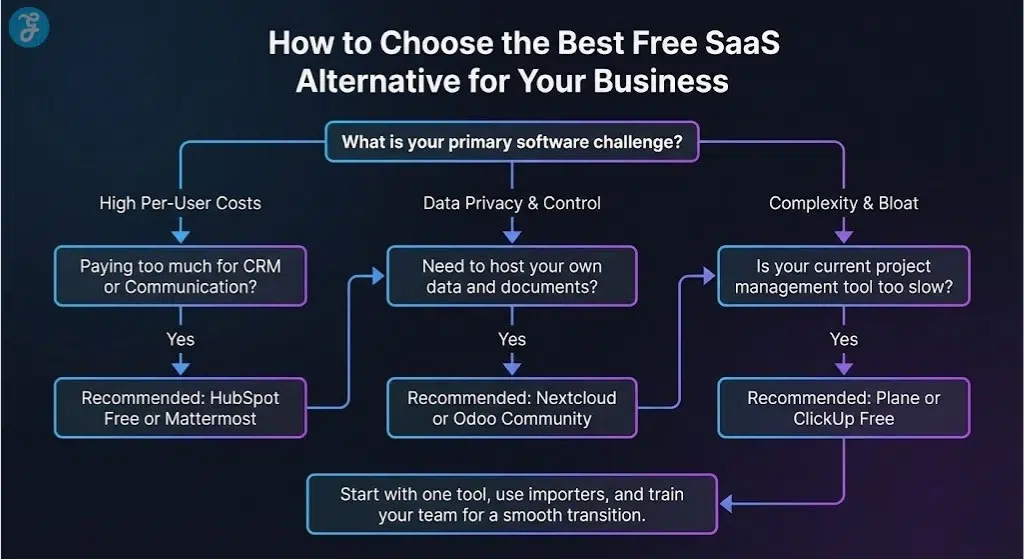
How to Choose the Best Free Alternative for Your Business
The best way to begin your transition to Free enterprise SaaS alternatives is to identify your most expensive “per-seat” bill. If you are paying for 50 Slack seats, moving to Mattermost can save you thousands overnight. If you are struggling with Jira’s complexity, a move to Plane will improve both your budget and your team’s velocity.
Start with one tool at a time, use the built-in data importers, and ensure your team is trained on the new interface.
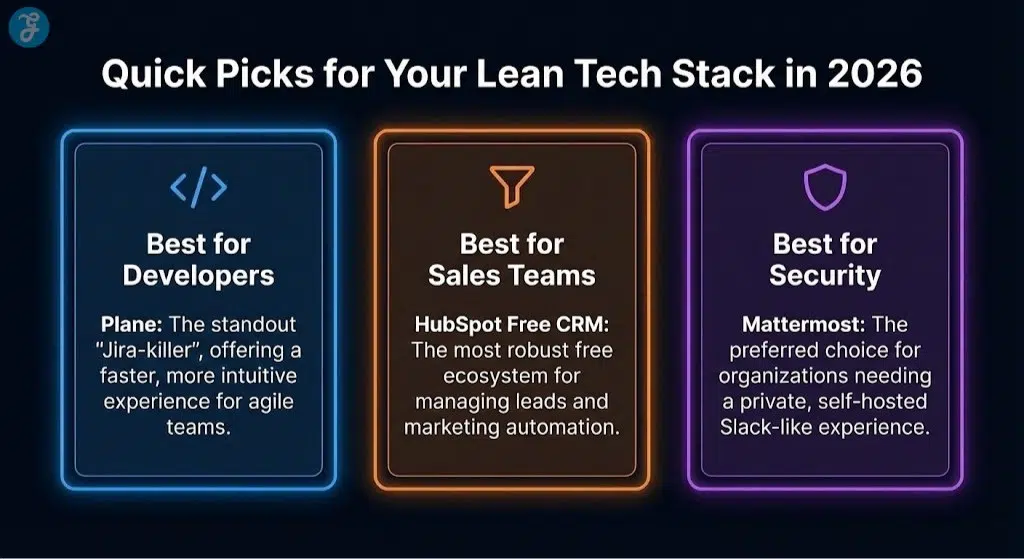
If you are still looking for an immediate replacement for a specific tool, these three platforms are the current 2026 leaders in the free software space:
-
Best for Developers: Plane is the standout “Jira-killer” of 2026, offering a faster, more intuitive experience for agile teams.
-
Best for Sales Teams: HubSpot Free CRM remains the most robust free ecosystem for managing leads and marketing automation.
-
Best for Security: Mattermost is the preferred choice for organizations that need a Slack-like experience behind a private firewall.
Wrap-Up: Reclaiming Your Budget and Your Data
Adopting Free enterprise SaaS alternatives is a powerful way to future-proof your organization. In 2026, the flexibility of open-source and open-core tools often outweighs the convenience of proprietary clouds. By choosing tools that respect your budget and your data privacy, you ensure that your technology stack remains an asset rather than a liability.