
First-party data is information a business collects directly from customers, users, subscribers, prospects, or website visitors. It can include account details, purchase history, website activity, product usage, survey responses, support conversations, and communication preferences.
That definition is straightforward. The harder question is whether the business had a good reason to collect the information and whether the person understood what would happen to it.
I often see first-party data described as if “collected directly” also means accurate, private, or ethically obtained. It does not. The label tells us where the data came from. It does not tell us whether the collection was necessary, transparent, secure, or expected.
What makes first-party data valuable is the direct relationship behind it. What makes it ethical is how responsibly the business handles that relationship.
What Counts as First-Party Data?
First-party data can come from online and offline interactions. The defining feature is that the business collects it through its own relationship with the person rather than obtaining it from an unrelated outside source.
Common examples include:
- Names, email addresses, phone numbers, and account details
- Products purchased, returned, or added to a cart
- Subscription plans and loyalty activity
- Pages viewed and searches performed on a website
- Features used inside an app or software product
- Newsletter subscriptions and email engagement
- Survey responses and customer feedback
- Support emails, chat messages, and call records
- Language, communication, and product preferences
- Attendance at webinars, events, or in-store activities
This information generally falls into three groups:
- Provided data is information a person enters or states directly, such as an email address, delivery address, survey answer, or account preference.
- Observed data records what happens during an interaction, such as a purchase, page view, app session, or support request.
- Inferred data is a conclusion produced from other information. A company might estimate that someone is likely to cancel a subscription, prefer a particular category, or respond to an offer.
That final category deserves more caution than it usually receives. An inference is a prediction, not a confirmed fact. If a business treats every prediction as true, it can create irrelevant personalization, unfair decisions, or uncomfortable customer experiences.
The system used to store the information does not determine whether it is first-party data. A company may keep directly collected customer information in a CRM, analytics platform, email service, or customer data platform. It can still be first-party data for that company, although giving vendors access creates additional privacy and security responsibilities.
How Is First-Party Data Different From Other Data?
The language around customer data can become confusing, especially when several companies are involved.
Zero-party data
It is information a person intentionally shares about preferences, needs, or plans. Examples include preferred clothing sizes, content interests, purchase intentions, or email frequency. It is often described as a separate category, although it can also be viewed as a particularly transparent form of directly collected data.
Second-party data
It is another organization’s first-party data obtained through a direct arrangement. For example, a hotel might receive customer information from an airline for a joint promotion.
Third-party data
It comes from a source that does not have a direct relationship with the person. It may be gathered from several places, combined into audience profiles, and sold or licensed to other businesses.
The classification depends on perspective. Purchase information collected by a retailer is first-party data for that retailer. If a different company receives the same information through a partnership, it does not become that recipient’s first-party data.
Why First-Party Data Matters
First-party data can be more relevant than broad audience information because it reflects actual interactions with a business.
When managed properly, it can help a company:
- Understand how customers use a product or service
- Improve customer support
- Identify service and checkout problems
- Create more useful recommendations
- Segment customers by meaningful behavior
- Measure retention and repeat purchases
- Develop products based on real usage
- Reduce dependence on external data sellers
- Understand where information came from
However, direct collection does not guarantee quality.
Customers may enter incorrect information. Records become outdated. Shared devices can distort behavioral data. Separate accounts may be merged incorrectly. Predictive models can reach the wrong conclusion.
First-party data can also provide a narrow view of a market. Existing customers do not necessarily represent everyone who might use the product. A business that relies too heavily on its current audience can end up reinforcing what it already believes.
The real advantage of first-party data is not that it is perfect. It is that the business has clearer knowledge of its source, context, and intended purpose.
How to Collect First-Party Data Ethically
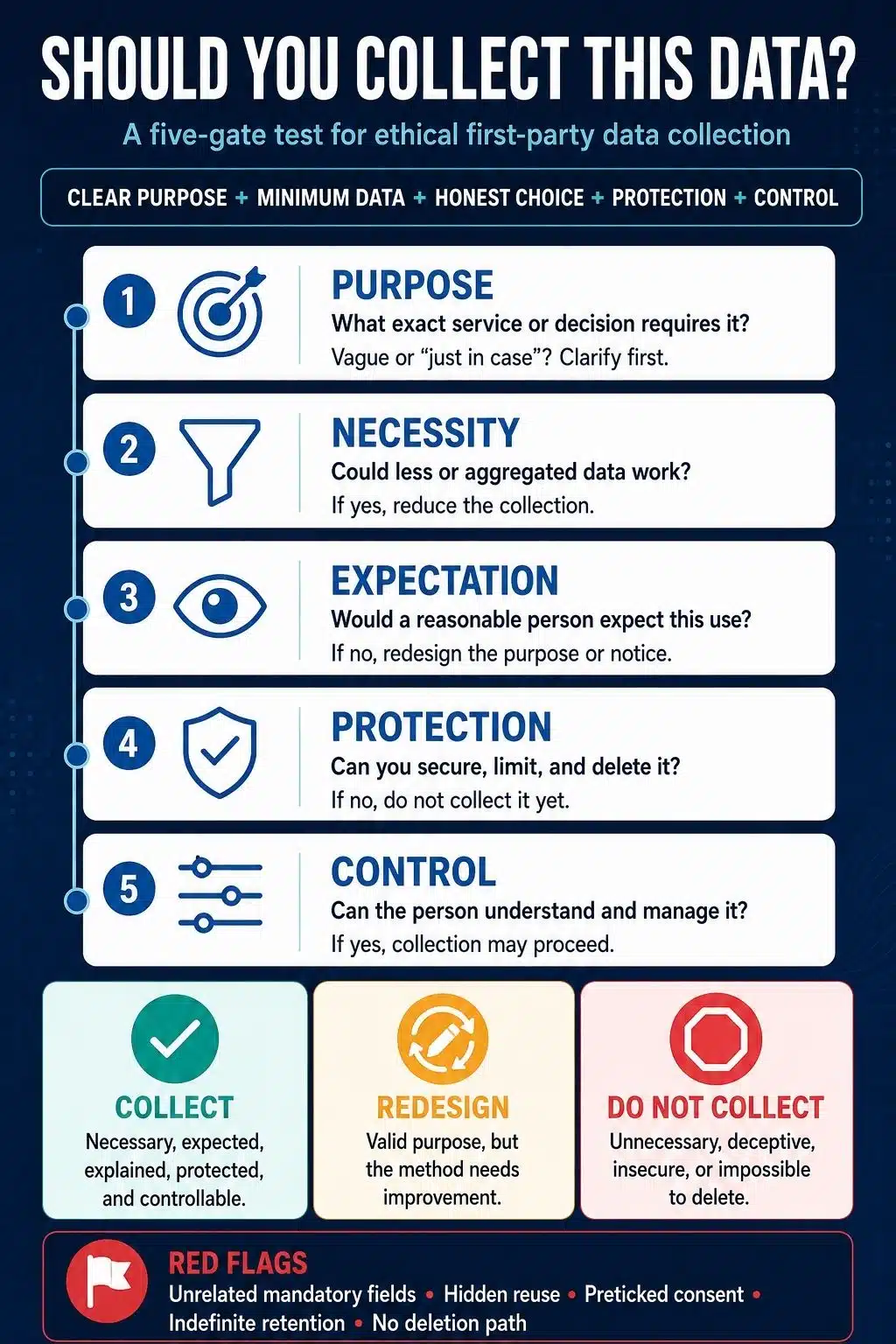
I do not think an ethical data strategy should begin with, “What else can we collect?” It should begin with, “What do we genuinely need?” The following principles keep that question at the center.
Start With a Specific Purpose
Every form field, tracking event, cookie, and customer profile should support a clear purpose. “Improve our marketing” is too broad. A useful purpose is more specific:
- Send the newsletter someone requested
- Process and deliver an order
- Remember items placed in a shopping cart
- Detect failed checkout attempts
- Recommend articles based on selected interests
- Understand whether a new product feature is useful
Defining the purpose first makes it easier to decide which information is necessary. It also reduces purpose creep, where data collected for one reason quietly gets reused for something unrelated.
Collect the Minimum Amount Necessary
More information does not automatically produce better decisions. Sometimes it only creates more security risk, compliance work, and customer suspicion.
Before adding a field or tracking event, I would ask:
- Can this task be completed without identifying the person?
- Would aggregated information be enough?
- Do we need a precise location, or would a broad region work?
- Does this field need to be mandatory?
- Can the information be deleted sooner?
- Are we collecting it because it is useful or because the software makes it easy?
A newsletter signup may need an email address. It probably does not need a phone number, date of birth, home address, company size, and job title.
A simple ethical newsletter form might ask for an email address, explain that one newsletter will arrive each week, and provide an easy unsubscribe option. An excessive version would demand several unrelated personal details and quietly add the subscriber to multiple marketing lists.
Explain the Collection at the Right Moment
A privacy policy is important, but it should not carry the entire burden of explanation. People should receive a short, clear explanation near the form, setting, or feature collecting the information. They should be able to understand:
- What is being collected
- Why it is needed
- Whether providing it is optional
- How it will be used
- Whether another organization will receive it
- How long it may be retained
- How they can change their choice
This is more useful than expecting someone to search through a long legal document to understand a single checkbox.
Use Consent Properly When It Is Required
Consent is not the only possible legal basis for handling personal information. A business may need certain data to complete a transaction, provide a requested service, comply with the law, or prevent fraud.
When consent is required or chosen as the basis, however, it should represent a genuine decision.
That means avoiding:
- Preticked boxes
- Bundled permissions
- Hidden rejection options
- Misleading button colors
- Repeated prompts after a person refuses
- Making optional tracking appear necessary
- Requiring unrelated information to access a basic service
Withdrawing consent should also be reasonably easy. If joining a marketing list takes one click but leaving requires an account login, several menus, and repeated confirmations, the choice is not being treated fairly.
Collect Information Progressively
Long forms often ask for information before the business has established a reason to need it.
Progressive collection is usually more sensible. A company might first ask for an email address to send a requested resource. Later, it can invite the subscriber to select preferred topics. If the person becomes a customer, the company can collect the details needed to complete the transaction.
Each request appears when it becomes relevant, and optional questions remain optional. This reduces friction and gives the customer a clearer reason to provide accurate information.
Use the Data for the Promised Purpose
Ethical collection cannot be separated from ethical use.
A delivery address collected to ship an order should not automatically become part of an unrelated advertising profile. A support conversation should not quietly become AI training material. A survey about product satisfaction should not be used to make sensitive assumptions about the respondent.
If a company wants to introduce a materially different use, it should assess whether that use is compatible with the original purpose, update its explanation, and obtain a new choice where required.
Protect the Information You Keep
A company should not ask people to trust it with information that it cannot reasonably protect.
Safeguards should match the sensitivity and possible harm involved. They may include:
- Encryption where appropriate
- Multifactor authentication
- Role-based access
- Limited employee permissions
- Secure backups
- Audit logs
- Vendor security reviews
- Employee training
- Regular security testing
- A documented incident-response process
Access should follow the principle of least privilege. A customer-service employee may need an order history to solve a problem, but that does not mean every employee needs access to the complete customer database.
Set Real Retention and Deletion Rules
“Keep it in case we need it later” is not a proper retention policy.
Each important data category should have a retention period based on a genuine business or legal need. Once that need ends, the information should be deleted, securely disposed of, or properly anonymized.
Deletion may also need to reach connected systems. Removing a profile from the main database while leaving permanent copies in marketing platforms, spreadsheets, and forgotten exports does not solve the problem.
Give People Practical Control
Depending on the law and context, people may have rights to access, correct, delete, download, or object to certain uses of their information.
The GDPR provides several rights concerning personal data. California privacy law gives eligible residents rights involving access, correction, deletion, sensitive information, and certain sales or sharing by covered businesses. Other jurisdictions have their own requirements.
Even where a particular control is not legally required, giving customers reasonable options is usually good practice.
A useful preference center might allow someone to:
- Update contact details
- Select topics of interest
- Reduce message frequency
- Turn off personalization
- Withdraw marketing permission
- Request account deletion
These controls need to affect the underlying systems. A privacy page that looks reassuring but does not honor the person’s choice creates only the appearance of control.
Practical First-Party Data Collection Methods
Different collection methods create different expectations. The ethical approach needs to match the context.
Newsletter Signups
Explain what the subscriber will receive and how often. Ask only for the information needed to deliver it, and do not treat one signup as blanket permission for every type of promotion.
Preference Centers
Let customers state what they want instead of trying to infer everything from their behavior. Preferences should be optional, editable, and used as promised.
Surveys and Feedback
Tell respondents whether their answers are anonymous, connected to an account, used for product improvement, or added to a customer profile. Avoid sensitive questions unless they are genuinely necessary.
Website and Product Analytics
Collect events that answer real product or performance questions. Avoid recording passwords, payment details, private messages, or unrestricted form text. Use aggregated or less identifiable information where it can provide the same answer.
Transactions and Customer Accounts
Use purchase and account information to complete orders, manage subscriptions, prevent fraud, and provide support. Do not quietly repurpose operational records for unrelated advertising.
Loyalty Programs
Make the exchange clear. Customers should understand what information the program collects and what they receive in return. Ordinary discounts should not require an unnecessarily detailed personal profile.
Customer Support
Support conversations can contain financial, health, family, or account-security information. Record only what is needed to resolve the issue, inform people when calls are recorded, and restrict access to those records.
First-Party Data Is Not the Same as a First-Party Cookie
This distinction is frequently misunderstood. First-party data describes the source of information. A first-party cookie describes the domain responsible for placing or accessing a cookie on a person’s device.
A first-party cookie might maintain a login session, remember a shopping cart, store a preference, or track behavior. First-party data can also exist without cookies, such as an in-store purchase or a support call.
Most importantly, a first-party cookie is not automatically exempt from privacy or consent requirements. Strictly necessary cookies may be treated differently from cookies used for analytics, advertising, or profiling. The applicable rules depend on the technology, purpose, jurisdiction, and people being monitored.
Moving tracking to a first-party cookie or server-side system does not remove the underlying responsibility. Transparency, necessity, sharing, security, and user choice still matter.
Some Data Requires a Higher Standard
Certain information can cause much greater harm if it is exposed, misused, or interpreted incorrectly.
This may include:
- Health information
- Precise geolocation
- Financial account details
- Biometric and genetic information
- Racial or ethnic origin
- Religious or political beliefs
- Sexual orientation
- Immigration status
- Private communications
- Information about children
Sensitive information can also be inferred. Purchases, location history, or browsing patterns might reveal a medical condition, pregnancy, religion, financial difficulty, or political affiliation even when the business never asked directly.
Children’s data requires particular caution. In the United States, COPPA applies to certain online services directed to children under 13 and services with actual knowledge that they collect personal information online from children under 13. Other countries use different age limits and requirements.
Large-scale profiling, biometric identification, systematic monitoring, and automated decisions that significantly affect people may require a formal privacy impact assessment.
A Better First-Party Data Strategy Starts With Restraint
I do not believe a business needs to know everything about its customers to serve them well. It needs the right information, collected for a clear reason and handled with care.
The strongest first-party data strategy is not the one with the largest customer profiles. It is the one a business can explain, protect, and use without surprising the people behind the information.
Collect only what serves a real purpose. Explain the exchange honestly. Protect what remains. Delete what is no longer needed. That is how first-party data becomes useful without turning a direct customer relationship into an excuse for unnecessary surveillance.
Frequently Asked Questions on First-Party Data
1. Is first-party data considered personal data?
It often is. Names, email addresses, purchase histories, IP addresses, cookie identifiers, location data, and customer inferences may qualify as personal information when they relate to an identifiable person. Truly anonymous, aggregated information may be treated differently.
2. Do businesses always need consent to collect first-party data?
No. Consent is only one possible legal basis. A business may need information to complete a transaction, provide a requested service, comply with the law, or prevent fraud. Marketing, tracking, cookies, sensitive information, and secondary uses may create separate consent or opt-out requirements.
3. What is the difference between first-party and zero-party data?
First-party data includes information collected through direct customer interactions. Zero-party data is information a customer intentionally shares about preferences, needs, or plans. A purchase record is first-party data, while a customer selecting preferred product categories is usually described as zero-party data.
No. A first-party cookie can support an essential function, but it can also track behavior or contribute to profiling. Its privacy impact depends on its purpose, duration, connected information, and the choices available to the user.
Sometimes, but direct collection does not provide unlimited permission to share. The company must consider the original purpose, customer expectations, applicable law, contractual safeguards, sensitive information, and whether consent or an opt-out is required.