As cities swell and streets become more congested, urban residents are seeking smarter ways to move. Personal mobility is evolving rapidly and among the most talked-about innovations are electric scooters. With their blend of efficiency, accessibility and sustainability, they’re becoming more than a tech trend —they’re transforming the way we commute.
The Electric Scooter Surge in Cities
Urban commuters are increasingly turning to the electric scooter as a go-to solution for beating congestion and cutting down commute times. Their lightweight design allows commuters to navigate narrow lanes and get to school or work with minimum hassle.
In Nigeria, scooters are rapidly emerging as a viable personal mobility option due to the incessant traffic jams in Lagos and Abuja. On a global scale, Paris, Madrid and Berlin have embraced scooters equipped with dedicated tracks, parking spaces and shared-use systems.
The demand for high-performance models such as the Tron Ride and Mantis X, as well as other multitasking scooters that are designed for speed and stability during lengthy rides, has increased. Whether it’s a compact model or a powerful scooter for adults, the variety of choices is helping broaden their appeal.
Boosting Environment and Economy Efficiency
The environmental benefits of electric scooters are understated. The absence of tailpipe emissions makes them imperative for cities seeking to combat pollution and carbon levels. The World Health Organization claims, “Almost 99% of the world is exposed to air that is considered unhealthy,” rendering clean means of transportation a necessity.
Scooters also tend to be more economical when compared to cars. The exorbitant cost of fuel alongside traffic in Nigeria makes charging an electric scooter a far more reasonable option. Electric scooters have lower maintenance expenses as well since the motor has fewer moving parts compared to a combustion engine.
An example of this would be a scooter rider commuting 10 kilometers per day. Their weekly expenses would be less than ₦1,000, which is strikingly lower than the cost of private vehicles and ride-hailing services. This makes the adult electric scooter highly appealing.
A Case in Point: The Case of E-Scooters
Younger workers in Lagos have begun using scooters as a means of overcoming traffic congestion for short-range excursions to offices, markets and universities. Commuters are reporting exercise time savings of 30-50% in places such as Ikeja, Yaba and Surulere.
Globally, cities like Paris and Tel Aviv report similar results — with e-scooters making up nearly 10% of all inner-city trips. It’s not just a matter of convenience; it’s becoming a central part of how cities manage mobility.
The increasing adoption of foldable electric scooter models has made storage and multi-modal travel easier for office workers, students and small business owners.
Smart Solutions for Smart E-Scooters
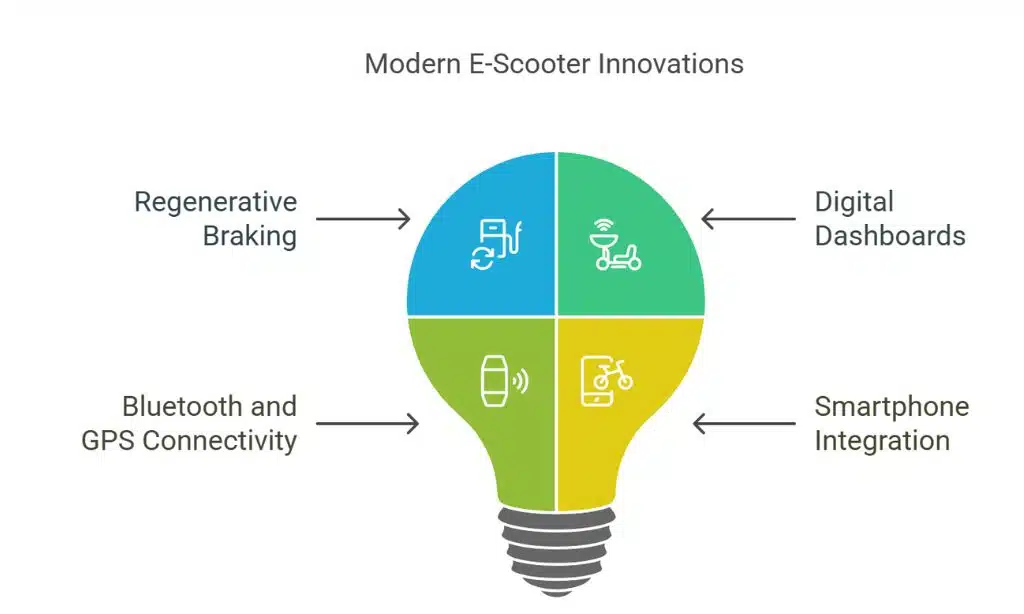
Current e-scooters are a far cry from their simpler versions. One of the modern innovations includes regenerative braking, which allows the reclaiming of energy through braking to extend the range. Through digital dashboards, battery life and speed are displayed in real time and with Bluetooth- and GPS-enabled devices, users can track their rides, lock their scooters from a distance and keep track of maintenance schedules.
People can plan their routes, navigate around traffic, or even unlock shared scooters in designated areas with smartphones. These adjusted features aren’t supplementary functions; they are essential components tailored toward making e-scooters more efficient, functional and secure for day-to-day activities.
Fast Facts: The Electric Scooter Market in 2024
- The global market is projected to reach $50.15 billion by 2032 [Fortune Business Insights]
- Scooter ranges are now surpassing an astounding 70 km per charge.
- Nigeria’s internet subscribers reached 134.78 million as of October 2024.
- Maintenance cost savings can be as high as 40% compared to combustion engine two-wheelers.
- E-scooters have a locally emitted CO₂/km figure of 0g.
Infrastructure and Connectivity Problems
Cities need to keep up with the growing demand for scooters. Infrastructure is still one of the greatest challenges to the acceptance of scooters. Without dedicated lanes, proper parking zones, or safe crossings, scooters are often forced to use sidewalks, competing with vehicles, which increases the chances of accidents.
As of January 2025, Nigeria’s broadband penetration stood at 45.61%. This represents a digital milestone given the app-based nature of most e-scooter services, but further integration into public transport planning and road policies is required.
It will also be necessary for urban planners to create micro-mobility areas and install city center charging hubs, as well as work with other stakeholders to build accessible urban infrastructure that serves riders, pedestrians, drivers and cyclists.
Rules of the Ride: How To Address Safety and Regulation
In terms of safety, specific and clear scooter policies need to be set in place. These policies include speed limits [which are most commonly 25 km/h for scooters in busy cities], helmets, age limits and parking regulations.
Manual laws also need to be implemented to decide if the scooter is considered a bicycle, motorcycle, or a new type of vehicle. Having the same law for all riding devices prevents legal complications and enhances safety regulations, ultimately keeping pedestrians and riders on sidewalks safe.
All riders need to be equally educated on the same level. Campaigns that promote riding safety, visibility and responsibility help ensure that e-scooters can be featured as a superior resource in the urban mobility framework instead of seeing them as a drawback.
Where We’re Headed
Electric scooters are no longer a trend. They are becoming a key feature in city life as the urban population surges and the need for faster and cleaner transportation increases. Frog Global Urban Mobility focuses on the restricted carbon emission changes and space reserved dimensions and recognizes scooters as significant contributors towards lessening urban climate change and traffic conditions.
Advanced transport systems offer a remarkable opportunity for Nigeria, among other emerging economies, to advance. Local governments can pave the way towards smarter, more efficient and eco-friendly commuting by adding scooters into the mobility plans, prompting home-grown solutions and filling in the infrastructural voids.
Summary
With the advent and integration of electric scooters, numerous urban areas have begun to rethink and restructure individualized modes of transport. It is self-evident that scooters can reduce urban congestion and diminish carbon footprints. If Nigeria fosters the right policies and civic enthusiasm, scooters can transform from an alternative option to the primary mode of transport for millions of users in urban settings.