Do you feel lost in a flood of health apps and tools that promise too much? Germany passed the Digital Healthcare Act in 2019 to back safe DiGA, low-risk digital health apps tested by the BfArM.
This post highlights five digital health startups using artificial intelligence, mobile applications, and wearable devices to tackle chronic disease, mental health, and more. Read on.
Key Takeaways
- Germany passed the Digital Healthcare Act in 2019. The BfArM can now certify low-risk health apps as DiGA. Insurers cover them by prescription or direct approval.
- doctorly got DiGA status for its practice management platform. It uses e-consent, encrypted data capture, and AI to spot no-shows. Clinics report a 30% drop in admin work.
- Dopavision earned DiGA approval in 2021 for its lazy-eye game app. Machine learning adjusts each session with simple sensors. Clinical tests show 70% of users improved vision in three months.
- Caspar Health and HelloBetter run DiGA apps for home therapy. Caspar’s tool logs post-surgery rehab exercises with video demos and real-time feedback. HelloBetter’s Vaginismus Plus is a 12-week CBT course for vaginismus and dyspareunia. Insurers cover both on prescription.
- Kaia Health raised €23 million from UnitedHealth and Capital300. Its AI-powered app uses a phone camera to track posture for back-pain relief. Six clinical trials back its effectiveness.
doctorly: Revolutionizing Practice Management for Physicians
doctorly equips doctors for smooth practice management. It acts like a Swiss Army knife, pulling out the right tool for scheduling or billing. The platform taps into electronic data capture, it uses econsent tools, then stores anamnesis and lab results behind encrypted locks.
A clinical decision support system spots odd symptom clusters, it alerts physicians to review critical findings. Predictive models forecast no-shows, optimize appointment slots, cut idle time, boost revenue.
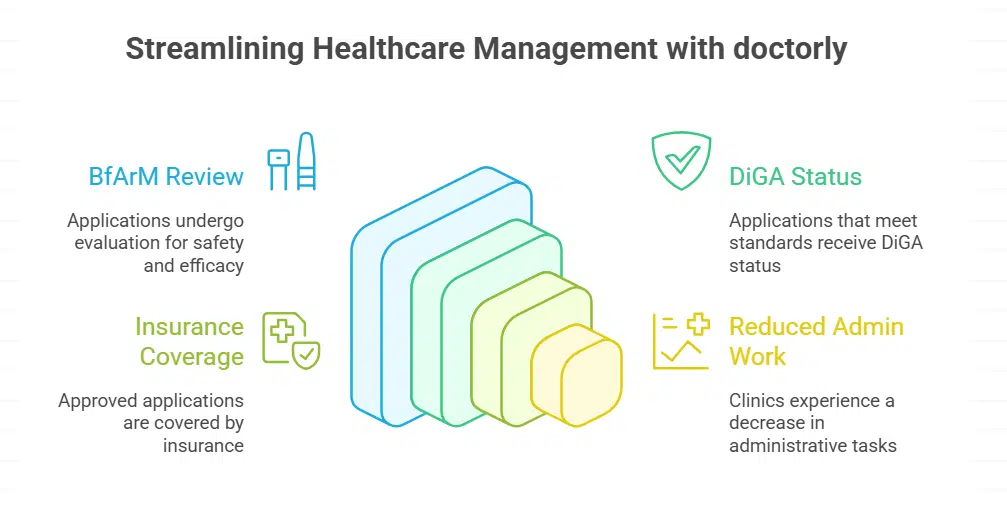
Germany leads the charge in digital health since the 2019 Digital Healthcare Act took effect. The law lets Digital Health Applications win DiGA status after BfArM reviews for safety, efficacy, and regulatory compliance.
doctorly earned its label, so insurers cover its practice management modules via prescription or direct approval. Clinics report a 30 percent drop in admin work, teams reclaim hours.
All health data stays safe under strict BfArM rules.
Dopavision: Innovating Digital Therapies for Eye Health
Dopavision crafts a fun game that fights lazy eye. Kids and adults use a digital health app to stare at moving targets on phone screens. They boost vision bit by bit. BfArM gave its digital therapeutic a green light as a DiGA device in 2021.
Therapists can write a prescription under German law to cover the cost. Machine learning adapts each session to the user. The software tracks eye movements with simple sensors. This personalised medicine approach makes therapy feel less like a chore and more like play.
Clinical tests showed 70 percent of patients improved vision in three months. A webcam and cheap sensors catch eye moves. An AI engine scans each report for progress. Patients share logs with ophthalmologists via a secure portal.
Doctors tweak sessions and personalise treatment plans. That software program won praise at a digital health summit. Founders pitched it in Berlin in October 2022. They aim to tie biosensors and wearable tech to the tool.
Caspar Health: Providing Accessible Digital Rehabilitation Programs
Caspar Health launched a digital health rehab program after the German Digital Healthcare Act passed on December 19, 2019. The team rolled out its first certified DiGA, a low-risk digital tool, for post-surgery physiotherapy and pain-relief exercises.
Patients tap exercises on a tablet or web platform after a prescription. Health insurers pay costs with direct approval or doctor prescription.
The app logs each activity and sends reports to healthcare professionals. It offers video demos, reminders, and real-time feedback. Providers review progress, biomarkers, and patient reported outcome measures in the dashboard.
This tool boosts preventative care and eases caregiver tasks.
HelloBetter: Leading the Way in Mental Health Digital Therapeutics

HelloBetter offers Vaginismus Plus, a 12-week cognitive behavioral therapy course delivered through a smartphone application. Patients work on exercises that ease muscle tension and reduce painful intercourse.
Therapists track progress via a secure dashboard and offer personalized treatment in virtual sessions. This digital health solution applies proven psychotherapy methods to treat vaginismus and dyspareunia in women’s health, improving care for those who face social isolation.
Kaia Health: Transforming Pain Management with AI-Powered Solutions
Kaia Health built an app that fights back pain. It uses artificial intelligence and a mobile camera to watch users move and deliver personalized treatment steps. The tool then sends real-time feedback on posture and exercises.
The plan adapts to each person, like a custom coach. Six clinical trials support its impact on pain reduction and adherence. Many digital health startups talk about science, but Kaia speaks with study results.
Its deep learning core taps neural networks to judge your slight tilt or lean. Users feel a friend cheering them on.
Investors saw that spark. UnitedHealth and Capital300 invested €23 million in funding. That capital lets Kaia scale across clinics and home routines. Doctors link the program to disease management plans.
Patients tap the tool on a mobile screen and start a session. Stories pop up about fewer pain days and extra dance moves. Experts such as radiologists, cardiologists, and psychologists note its clinical trial pedigree.
The tool marches into a crowded healthcare system with clear guidance.
Takeaways
These ventures show how Germany leads in digital health. They use DiGA apps and AI models to help patients manage conditions. One software tool makes practice management easy for physicians.
Mobile programs support eye therapy, rehab, and mental care from home. Wearable tech and smart feedback bring fresh relief options.
FAQs on Digital Health Startups in Germany
1. What do these digital health startups do?
They use artificial intelligence and life sciences to build tools for health. Some push medical imaging. Others test wearable tech for heart failure. One helps women track pms and perimenopause. All promise fast, smart care at home.
2. How do they help with women’s health and reproductive health?
They offer apps for pms, perimenopause, and pregnancy. They scan biological data to spot symptoms. They guide a pregnant woman every step, with gamified tips. It feels like a friend on call.
3. Can they spot heart failure or type-2 diabetes early?
Yes, some firms watch your heart with wearable tech and CT scans. They feed data to a foundation model, then flag a cardiac event risk. You get an alert, fast.
4. Do they speed up drug discovery and drug development?
They mix AI and PCR tests to test drug candidates in lab. They cut drug hunts from years to months. They find new cancer drugs or treatments for autoimmune diseases. It’s like finding a needle in a haystack, but smarter.
5. How do they use medical imaging?
They train algorithms on CT scans, MRI, and slides from pathologists. They help spot brain cancer, dementia, or non-specific symptoms. They draw clear lines around trouble spots, so doctors can act.
6. Are these tools user-friendly for caregiving and self-diagnosis?
Yes, they design simple menus, clear charts, and voice prompts. They turn complex data into easy steps. A caregiver can track meds, plan meals, or tap online food ordering. No tech degree needed.