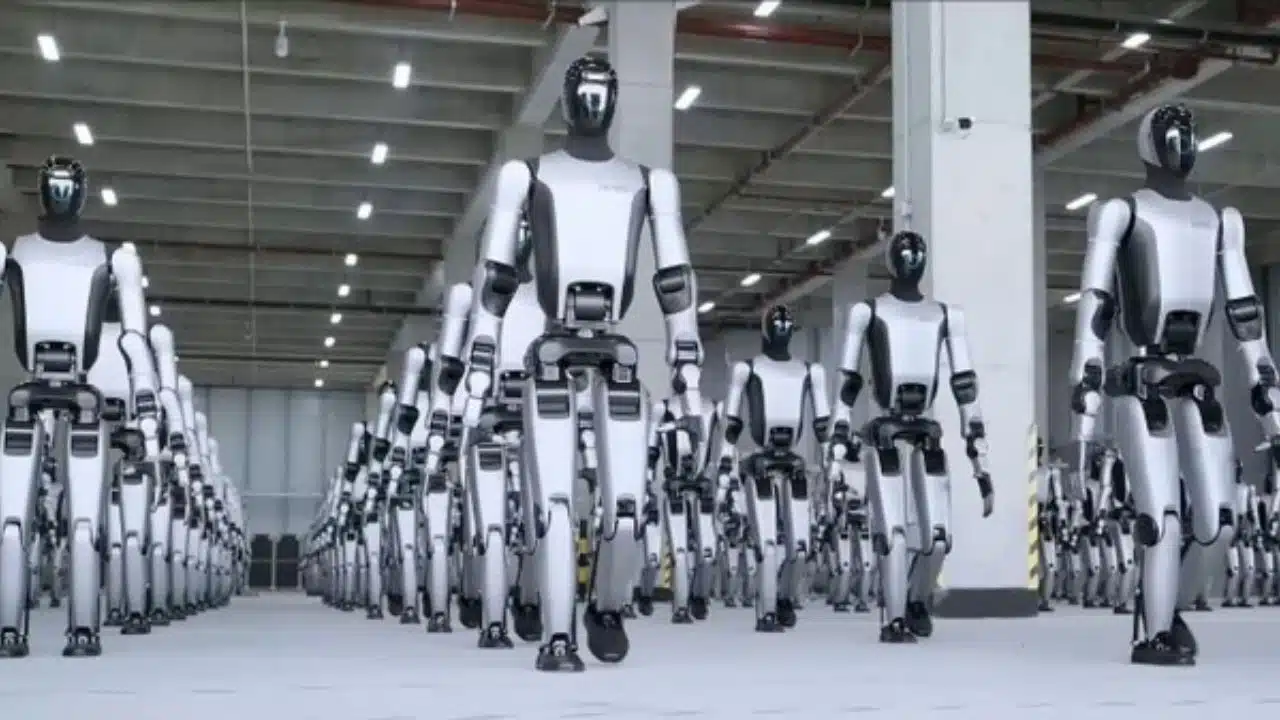
China deploys humanoid robots at Vietnam border crossing points in Guangxi, starting a trial to guide travelers, manage queues, support patrols, and handle logistics, as local production of the Walker S2 model in Guangxi reaches 1,000 units in six months.
What’s happening at the border
China’s rollout centers on UBTech Robotics’ Walker S2 humanoid robots, which are being prepared for use at border ports in Guangxi, the Chinese region that borders Vietnam.
The deployment follows a 264 million yuan (about US$37 million) contract linked to a humanoid robotics center in Fangchenggang, a coastal Guangxi city near the Vietnam border, with deliveries scheduled to begin in December.
Planned tasks include guiding travelers, managing passenger flow and queues, assisting patrol and inspection routines, and supporting logistics and commercial services at busy checkpoints.
Why the robots matter operationally
A key feature highlighted for this project is autonomous battery swapping, designed to reduce downtime and support longer, more continuous shifts in high-traffic settings.
UBTech describes Walker S2 as an industrial-grade humanoid built for practical work in complex environments such as border operations and factories, rather than short demonstrations.
At the same time, UBTech has not publicly clarified whether border-deployed units will operate with full on-device AI autonomy or be remotely assisted, leaving the exact “how” of real-world operations to be demonstrated during the trial.
The second headline: Guangxi hits 1,000 robots
Guangxi’s manufacturing ramp-up is becoming part of the story: the 1,000th industrial humanoid robot made in Guangxi rolled off the production line after production of the Walker S2 began in Liuzhou six months earlier.
This milestone signals faster scaling in the same region now linked to border-port trials, strengthening the local supply chain for additional deployments.
Xinhua’s report frames the 1,000-unit milestone as a regional production achievement tied directly to Walker S2 output in Liuzhou.
What the contract says about scale
Local reporting in Shenzhen Daily says the 264 million yuan deal is aimed at deploying Walker S2 units for passenger flow management and patrol inspections at border ports, alongside logistics and commercial services.
The same report adds that the robots are also slated for facility monitoring tasks at large steel, copper, and aluminum production bases, indicating the project spans border operations and heavy-industry inspection use cases.
Separately, coverage of the broader contract details describes the deal as one of the larger practical government-linked applications for humanoid robots currently underway in China.
How China’s broader humanoid push connects
The border-crossing trial aligns with a wider national push to accelerate humanoid robotics development, with public-sector scenarios increasingly used as stress tests for real deployments.
One widely cited market forecast referenced in reporting projected China’s humanoid robotics industry could reach 82 billion yuan in 2025, underscoring why companies and local governments are racing from prototypes to contracts.
UBTech has also said its Walker series has generated 1.1 billion yuan in sales so far this year, suggesting demand is not limited to pilot showcases.
What “real-world trials” usually test
In border settings, trials typically test whether robots can safely interact with travelers, keep operations moving during peak congestion, and reliably perform repetitive assistance tasks without creating new bottlenecks.
They also test whether uptime claims hold in practice—especially if robots are expected to cycle power frequently, operate in long shifts, and maintain stable performance over weeks.
For operators, another key question is staffing design: how many human supervisors are still needed per robot to manage exceptions, maintenance, and safety escalation.
Key data at a glance
The following table consolidates the main verified project facts reported across multiple sources.
| Item | Verified detail |
| Robot model | UBTech Walker S2 humanoid robot. |
| Contract value | 264 million yuan (about US$37 million). |
| Location tied to the project | Fangchenggang, Guangxi (near the Vietnam border). |
| Start of deliveries (reported) | December (following the contract announcement). |
| Border-use tasks cited | Traveler guidance, queue/passenger flow management, patrol/inspection support, logistics and commercial services. |
| Additional use cases cited | Facility monitoring/inspection at steel, copper, and aluminum production bases. |
| Guangxi production milestone | 1,000th industrial humanoid robot rolled off the line; Walker S2 production began in Liuzhou six months earlier. |
| Market forecast referenced in coverage | China humanoid robotics industry projected at 82 billion yuan in 2025 (forecast cited in reporting). |
Timeline of the two linked developments
This timeline shows how the border deployment story and the Guangxi production story overlap.
| Date (reported) | Development |
| Nov. 26, 2025 | Reporting describes a trial plan after UBTech says it struck a US$37 million deal with a humanoid robotics testing center near China’s border with Vietnam. |
| December 2025 (scheduled) | Deliveries of Walker S2 units for the Guangxi border-related project are expected to begin. |
| Dec. 27, 2025 | Xinhua reports the 1,000th industrial humanoid robot made in Guangxi rolled off the line, six months after Walker S2 production began in Liuzhou. |
Final thoughts
If the Guangxi border trial performs reliably, it could become a template for where humanoid robots fit best in public-facing infrastructure: repetitive guidance, traffic flow support, and logistics coordination under human oversight.
The bigger signal from the paired headlines is that Guangxi is not only a deployment site but also a fast-scaling production base, which lowers friction for expanding from pilots to sustained operations.
What happens next will depend on measurable outcomes—uptime, safety, throughput impact, staffing needs, and total operating cost—rather than announcements, especially as production volumes rise.