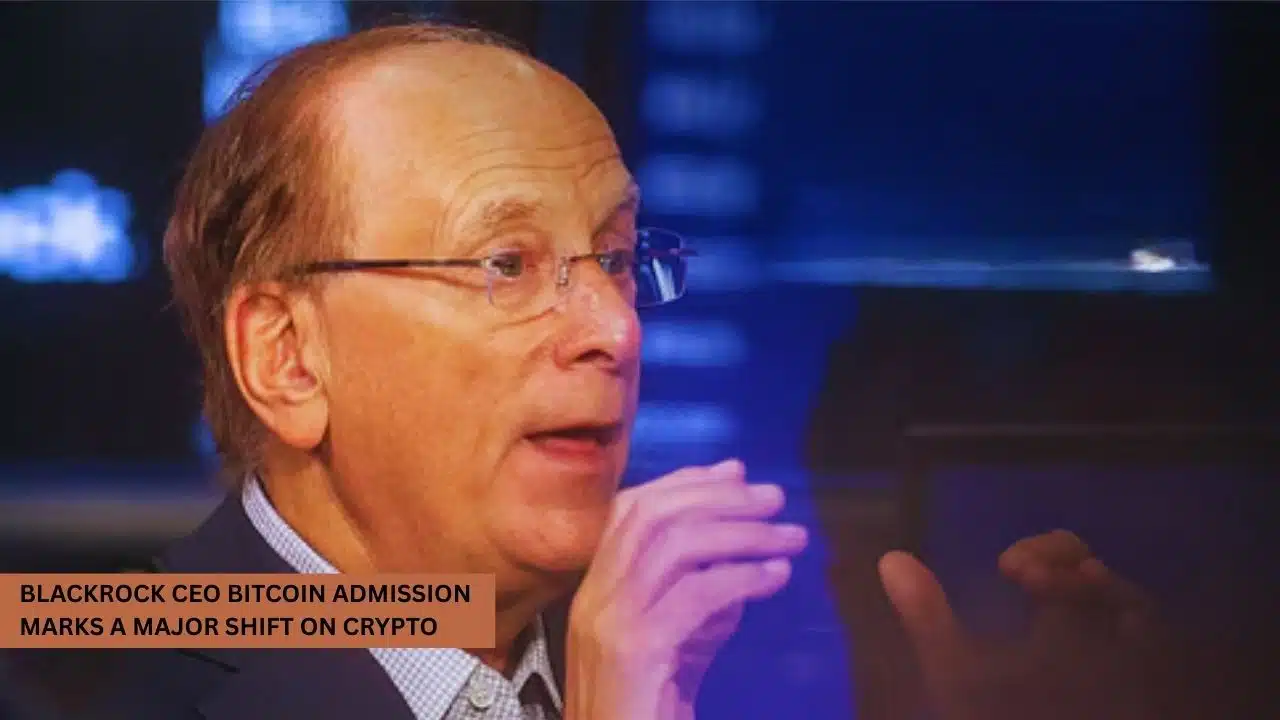
Larry Fink, the CEO of BlackRock, has made headlines by openly admitting he was wrong about Bitcoin during a discussion at the New York Times DealBook Summit. This is a monumental shift from his highly critical view back in 2017, when he publicly called Bitcoin “an index of money laundering”. At the summit, Fink sat next to Coinbase CEO Brian Armstrong and explained how his perspective on Bitcoin completely changed over the years. He described Bitcoin as “an asset of fear”, noting that investors now choose to buy it as a hedge against economic insecurity, geopolitical tensions, and fears of currency devaluation.
Fink was candid about his evolution, stating, “I have very strong views but that does not mean I am not open.” For the world’s largest asset manager, which stewards a massive $13.5 trillion in assets, this reversal isn’t just symbolic—it’s a watershed moment for mainstream finance. BlackRock now manages one of the largest and fastest-growing Bitcoin ETFs on the market: the iShares Bitcoin Trust (IBIT). As of December 2, 2025, IBIT held approximately 775,703 Bitcoins—making it a dominant force in the industry and demonstrating real commitment as institutional capital continues to pour into the digital asset space.
Fink attributed his dramatic change of heart to extensive discussions with global clients and policymakers each year. He emphasized that Bitcoin is increasingly being used by sophisticated investors as a form of portfolio insurance—a safe haven against systemic risk. However, he did warn traders about volatility, saying that those who buy Bitcoin for speculative purposes need to be prepared for dramatic price swings and risks if their market-timing skills aren’t sharp.
Institutional Momentum and Crypto’s Maturing Market
The conversation with Armstrong and Fink also highlighted the tremendous momentum behind institutional adoption of Bitcoin and other digital assets. Fink and Armstrong called concerns over a prolonged Bitcoin downturn overblown. Despite recent volatility—with Bitcoin falling from highs over $126,000 in October 2025 to around $92,000 in early December—Armstrong insisted that “there is no chance” Bitcoin will crash to zero. Fink echoed this sentiment, underscoring a growing institutional belief in the technology and saying, “I see a big, large use case for Bitcoin”.
Key to this enthusiasm is improved regulatory clarity. In early 2024, the Securities and Exchange Commission approved Bitcoin ETFs, paving the way for mainstream investors to access the asset class through traditional channels. In July 2025, Congress passed the GENIUS Act, which established a comprehensive federal regulatory framework for stablecoins and digital assets. These developments were cited by both Fink and Armstrong as major catalysts responsible for transforming crypto from a niche, “gray market” to a fully-fledged sector in global finance.
Institutional inflows have also redefined the role of assets like Bitcoin in diversified portfolios. Fink sees Bitcoin’s future less as a speculative play and more as a form of “portfolio insurance” against market instability, echoing a view increasingly held by banks, pension funds, and asset managers who see digital currencies as part of long-term investment strategies. The fact that BlackRock’s IBIT has rapidly accumulated such a large Bitcoin holding is proof of how deeply established institutions are entering this space.
The Next Phase: Digital Transformation of Finance
Fink’s remarks did not stop at Bitcoin. He predicted rapid and widespread “tokenization” in financial markets—a process where traditional securities like stocks and bonds, as well as cryptocurrencies, will increasingly be represented and traded as blockchain-based tokens. According to Fink, this technological shift could transform how global finance works, making transactions faster, more transparent, and accessible to a broader range of investors. He compared this wave of innovation to the internet revolution, suggesting that digital wallets capable of storing and managing every type of asset—from bonds to crypto—will soon become the norm, fundamentally altering how institutions and individuals interact with capital markets.
This transformation is already underway with the unprecedented surge in demand for Bitcoin ETFs and other blockchain-backed assets. Industry analysts credit BlackRock’s pivot as a powerful endorsement of crypto’s potential, noting that the firm’s resources and credibility are accelerating mainstream adoption. Fink’s new public enthusiasm is not just talk—it’s matched by BlackRock’s aggressive expansion in the Bitcoin market and a broader strategic vision to reshape finance itself.
As more institutional investors follow BlackRock’s lead and as regulatory frameworks mature, the global financial landscape is being redrawn. What started as a fringe technology now sits at the heart of a new era in asset management, portfolio construction, and monetary policy worldwide.