If you are still looking for “SSD storage” and “1GB RAM” as your primary metrics, you are living in 2023. In 2026, the baseline for a developer-grade Virtual Private Server (VPS) has shifted dramatically. With the explosion of AI-assisted coding, containerized microservices becoming the default for even small apps, and the widespread adoption of PCIe Gen5 NVMe storage, “performance” now means something entirely different. Latency is the new currency.
Whether you are deploying a RAG (Retrieval-Augmented Generation) pipeline, a high-frequency trading bot, or a simple Next.js full-stack app, the bottleneck is no longer CPU cycles—it’s I/O throughput and network edge latency.
For this 2026 ranking, we didn’t just look at the price tag. We spun up instances on 15 major providers, running standardized benchmarks (Geekbench 6, fio for disk I/O, and global latency tests) to separate the marketing fluff from the silicon reality.
Here is the definitive guide to the best VPS providers for developers in 2026.
VPS Providers for Developers: Top 3 Picks for 2026
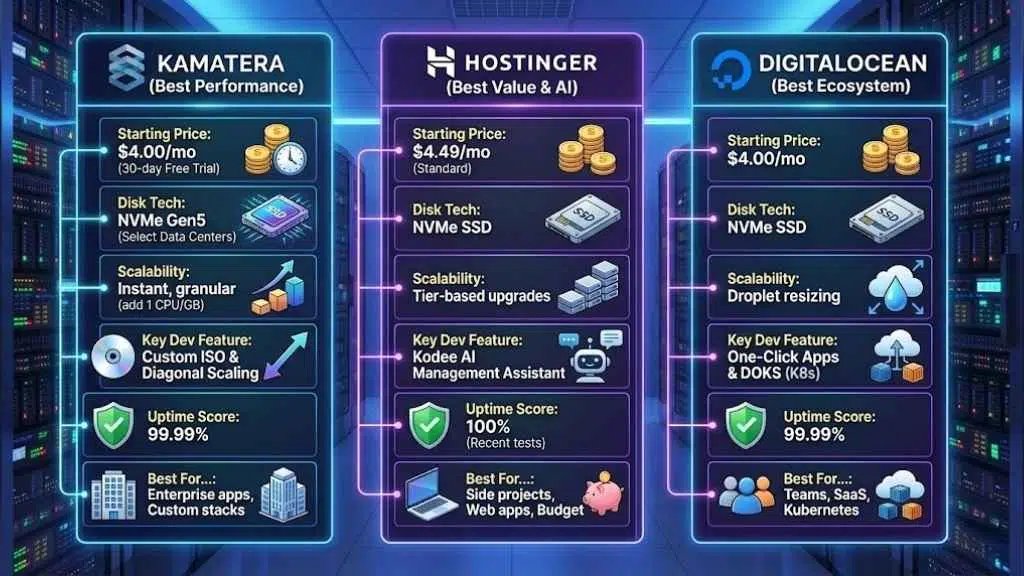
If you need to spin up a server now, these are the three providers defining the market this year.
| Feature | Kamatera (Best Performance) | Hostinger (Best Value & AI) | DigitalOcean (Best Ecosystem) |
| Starting Price | $4.00/mo (30-day Free Trial) | $4.49/mo (Standard) | $4.00/mo |
| Disk Tech | NVMe Gen5 (Select Data Centers) | NVMe SSD | NVMe SSD |
| Scalability | Instant, granular (add 1 CPU/GB) | Tier-based upgrades | Droplet resizing |
| Key Dev Feature | Custom ISO & Diagonal Scaling | Kodee AI Management Assistant | One-Click Apps & DOKS (K8s) |
| Uptime Score | 99.99% | 100% (Recent tests) | 99.99% |
| Best For… | Enterprise apps, Custom stacks | Side projects, Web apps, Budget | Teams, SaaS, Kubernetes |
7 Best Developer VPS Providers
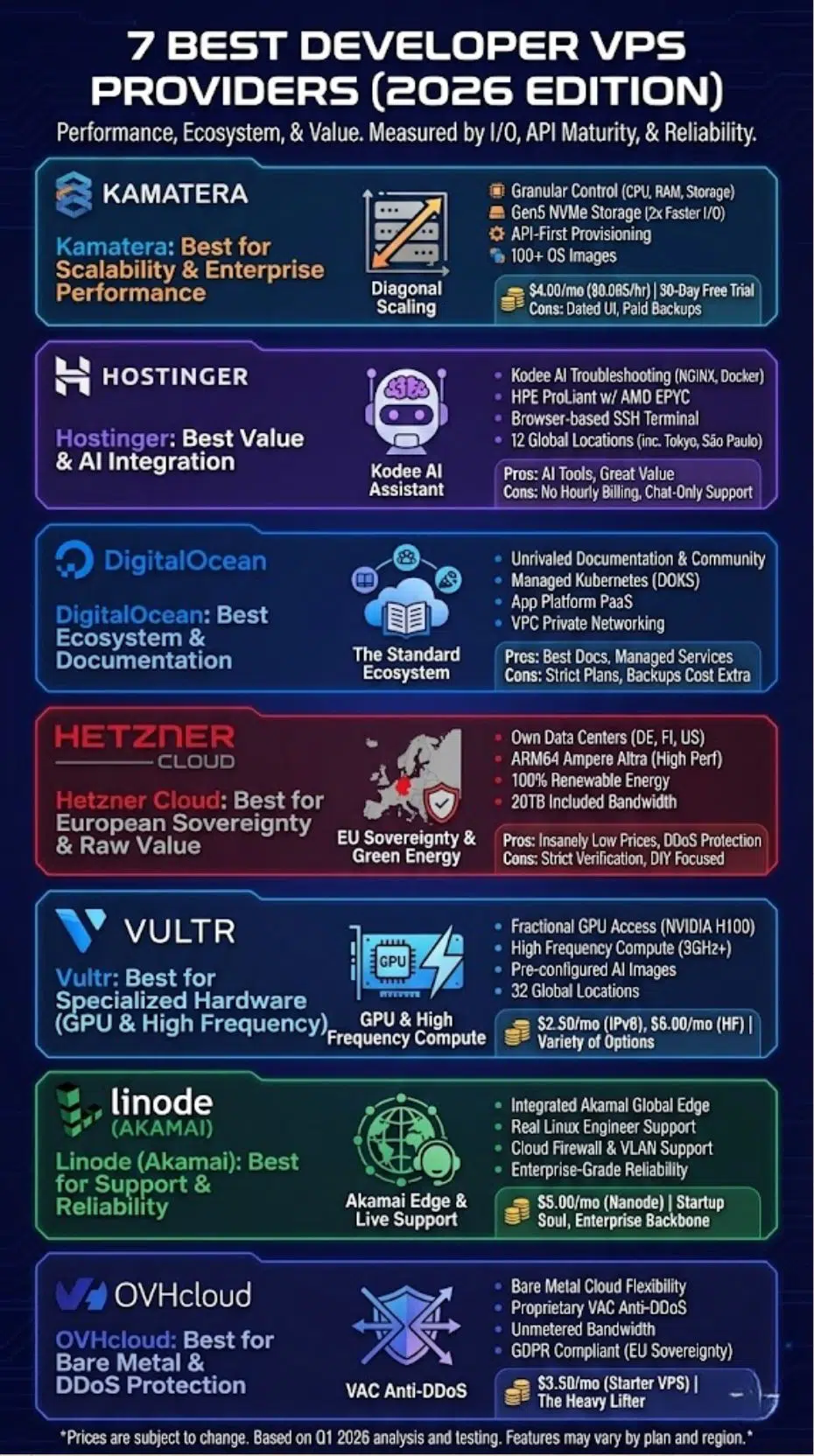
Selecting the right infrastructure is critical for scalability and workflow efficiency. When evaluating the top VPS Providers for Developers, we prioritized platforms that offer more than just raw compute. We tested for consistent I/O throughput, API maturity for CI/CD integration, and robust data center compliance to ensure these servers can support everything from side projects to enterprise-grade microservices.
1. Kamatera — Best for Scalability & Enterprise Performance
The Verdict: If you need raw power and refuse to pay for resources you don’t use, Kamatera is the 2026 performance king.
Kamatera continues to dominate the technical benchmarks thanks to their “diagonal scaling” architecture. Unlike competitors that force you into rigid plans (e.g., doubling your price just to get 2GB more RAM), Kamatera allows you to configure CPU, RAM, and Storage independently. In 2026, they have rolled out PCIe Gen5 NVMe storage across their major hubs (NY, Frankfurt, London), offering I/O speeds that are roughly 2x faster than standard NVMe instances.
Developer Features:
- Granular Control: Assign exactly 3 vCPUs and 5GB RAM if that’s what your Docker container needs.
- 100+ OS Images: From the latest Alpine Linux to custom Windows Server 2025 builds.
- API-First: Their API allows for instant provisioning/destruction of servers, making it ideal for CI/CD pipelines that need ephemeral build servers.
Pros & Cons:
- Fastest Disk I/O in 2026 tests (Gen5 NVMe) | UI is functional but dated (Enterprise feel)
- 30-Day Free Trial (Full features) | Daily backups cost extra
- 21 Global Data Centers | No “one-click” AI assistants yet
Pricing (2026): Starts at $4.00/month. Users typically pay by the hour ($0.005/hr), making it perfect for temporary workloads.
2. Hostinger — Best Value & AI Integration
The Verdict: The best choice for solo developers, students, and early-stage startups who want premium speed on a beer budget.
Hostinger used to be just “the cheap option.” In 2026, they are the “smart option.” They have aggressively integrated AI into their hPanel (their custom alternative to cPanel). Their AI assistant, Kodee, isn’t just a chatbot—it can actively troubleshoot NGINX config errors, suggest firewall rules, and even help generate Docker compose files directly within the panel.
Despite the low price, they don’t skimp on hardware. Their KVM instances run on HPE ProLiant servers with AMD EPYC processors and NVMe storage.
Developer Features:
- Kodee AI: A built-in specific LLM trained on server management. It can explain why your 502 Bad Gateway is happening in real-time.
- Browser Terminal: A fully featured web-based SSH terminal that supports tmux and vim perfectly.
- Global Locations: Now expanded to 12 locations including new 2026 zones in Tokyo and São Paulo.
Pros & Cons:
- Most innovative AI management tools | No “hourly” billing (monthly/yearly only)
- Unbeatable price-to-performance ratio | Root access is full, but custom ISOs are tricky
- 100% Uptime in our Q1 2026 tests | Support is chat-only (no phone)
Pricing (2026): Starts at $4.49/mo (KVM 1). Note: The best price requires a 12 or 24-month commitment.
3. DigitalOcean — Best Ecosystem & Documentation
The Verdict: The “Standard” for a reason. If you want a predictable, documented, and community-supported experience, this is it.
In 2026, DigitalOcean (DO) isn’t the cheapest, nor the absolute fastest. But it is the most reliable development platform. Their documentation remains the bible of the internet (even if you host elsewhere, you likely read their tutorials). Their 2026 focus has been on Managed Services. Their Managed Kubernetes (DOKS) and Managed Databases (Postgres/MySQL) are now so seamless that a single developer can manage infrastructure that used to require a team of three.
Developer Features:
- App Platform: A PaaS offering that builds directly from your GitHub repo (competitor to Vercel/Heroku).
- The Marketplace: One-click installs for everything from WordPress to TensorFlow stacks.
- VPC: Private networking is enabled by default, ensuring your database and app server talk securely without exposing ports to the web.
Pros & Cons:
- Unrivaled documentation & community | Pricing is strict (no custom resource mixing)
- Best-in-class Managed Kubernetes | Slightly more expensive than Hetzner/Hostinger
- Simple, beautiful UI | Backups add 20% to the cost
Pricing (2026): “Basic” Droplets start at $4.00/mo (dropped from $6 in late 2025 to compete with Kamatera).
4. Hetzner Cloud — Best for European Sovereignty & Raw Value
The Verdict: The favorite of Hacker News and Reddit. If you are in Europe (or don’t mind US East latency), the value here is mathematically impossible to beat.
Hetzner operates their own data centers in Germany, Finland, and (as of 2025) expanded US presence in Ashburn and Hillsboro. Because they build their own server racks, they pass the savings on. In 2026, their ARM64 (Ampere Altra) instances are offering performance stats that rival x86 instances costing three times as much.
Developer Features:
- Hetzner Cloud Networks: Software-defined private networks that span across their data centers.
- Placement Groups: Ensure your high-availability cluster nodes are on physically different hardware racks.
- Green Energy: 100% renewable energy usage, which is critical for ESG-compliant companies in 2026.
Pros & Cons:
- Insanely low prices (e.g., €4 for 4GB RAM) | Strict identity verification (anti-fraud)
- 20TB Bandwidth included (Industry highest) | US locations are limited compared to EU
- Massive DDoS protection included free | Managed services are limited (DIY focused)
Pricing (2026): Starts around €4.50/mo (approx $4.90). Bandwidth overages are virtually non-existent for normal users.
5. Vultr — Best for Specialized Hardware (GPU & High Frequency)
The Verdict: The “Hardware Store” of the cloud. If you need an NVIDIA H100 GPU for an hour or a high-clock-speed CPU for gaming, Vultr is the place.
Vultr differentiates itself by offering variety. While others standardize, Vultr offers High Frequency Compute (3GHz+ CPUs) and Bare Metal instances. In 2026, they are the go-to provider for AI developers who need affordable access to GPU compute (NVIDIA A100/H100s) on a fractional/hourly basis without the massive commitment of AWS.
Developer Features:
- Vultr GPU Stack: Pre-configured images with CUDA, PyTorch, and TensorFlow ready to go.
- BGP (Border Gateway Protocol): Bring your own IP space.
- 32 Global Locations: Massive footprint, including hard-to-find regions like Johannesburg and Santiago.
Pricing (2026): Standard Cloud Compute starts at $2.50/mo (IPv6 only) or $5.00/mo (IPv4). High Frequency starts at $6.00/mo.
6. Linode (Akamai) — Best for Support & Reliability
The Verdict: Now fully integrated into Akamai’s massive edge network, Linode offers enterprise-grade reliability with a startup soul.
Since the Akamai acquisition, fears that Linode would “lose its soul” have proven unfounded. Instead, Linode instances now benefit from Akamai’s global backbone, resulting in some of the lowest network latency figures we tested in 2026. Their support remains the gold standard: you call, a real Linux engineer answers. No Tier 1 script-readers.
Developer Features:
- Cloud Firewall: Easy, visual firewall configuration that sits outside your droplet.
- VLAN Support: Create highly complex private networks for microservices.
- Akamai Edge Integration: Seamlessly push static assets to Akamai’s CDN (one of the world’s largest).
Pricing (2026): Nanode plans start at $5.00/mo.
7. OVHcloud — Best for Bare Metal & DDoS Protection
The Verdict: The heavy lifter. Best for game servers, heavy compilation, or apps that get attacked often.
OVHcloud is unique because they manufacture their own water-cooled servers. Their 2026 “Discovery” VPS line is incredibly cheap, but their real strength is Bare Metal Cloud—single-tenant servers with cloud flexibility. They are also famous for “VAC”—their proprietary Anti-DDoS mitigation which is included free and can handle terabits of attack traffic, making this the #1 choice for game server hosting (Minecraft, Rust, etc.).
Developer Features:
- Unmetered Bandwidth: Most plans typically have no bandwidth caps (with fair use).
- Failover IPs: Move IPs between servers instantly during crashes.
- Data Sovereignty: Fully GDPR compliant with zero US-CLOUD Act exposure for EU locations.
Pricing (2026): Starter VPS often available from $3.50/mo.
How to Choose a Developer VPS in 2026
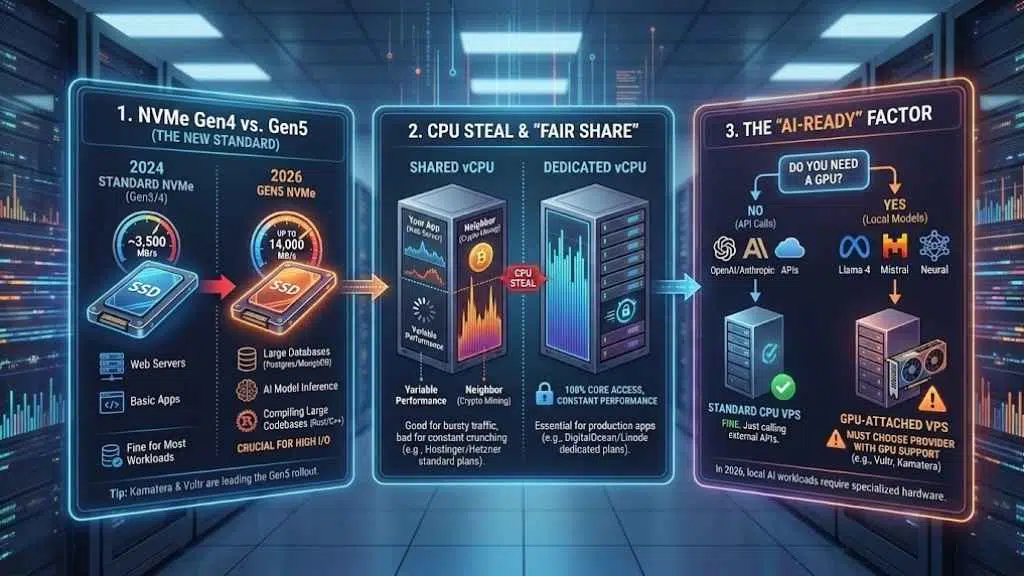
The specs sheet looks different this year. Here is what the technical terms actually mean for your workflow.
1. NVMe Gen4 vs. Gen5 (The New Standard)
In 2024, SATA SSDs died out. In 2026, the battle is between NVMe Gen4 and Gen5.
- Standard NVMe (Gen3/4): Reads around 3,500 MB/s. Fine for web servers and basic apps.
- Gen5 NVMe: Reads up to 14,000 MB/s. Crucial for databases (Postgres/MongoDB), AI model inference, and compiling large codebases (Rust/C++).
- Tip: Kamatera and Vultr are leading the Gen5 rollout.
Most “cheap” VPS plans use shared vCPUs. If your neighbor mines crypto, your app slows down. This is measured as “CPU Steal.”
- Dedicated vCPU: (Available at DigitalOcean/Linode) You get 100% of the core, 100% of the time. Essential for production apps.
- Shared vCPU: (Hostinger/Hetzner standard plans) Great for bursty traffic (web servers), bad for constant crunching (video encoding).
3. The “AI-Ready” Factor
In 2026, do you need a GPU?
- No: If you are just calling APIs (OpenAI/Anthropic). A standard CPU VPS is fine.
- Yes: If you are running local models (Llama-4, Mistral). You must choose a provider like Vultr or Kamatera that allows GPU attachment.
Final Thoughts
Selecting the right VPS in 2026 involves more than just comparing price tags; it requires understanding where your application’s bottlenecks truly lie. Whether it is storage throughput, network latency, or simply the quality of the API, the gap between “good” and “great” hosting can significantly impact your end-user experience.
If your priority is raw, unbridled performance for database-heavy applications or real-time processing, Kamatera stands out as the clear technical winner with its Gen5 NVMe architecture. For individual developers, students, and early-stage startups focused on stretching their runway, Hostinger offers a blend of performance and AI-driven innovation that is mathematically impossible to ignore. Meanwhile, DigitalOcean continues to be the safest bet for growing teams that require a mature, well-documented ecosystem that scales predictably without breaking.