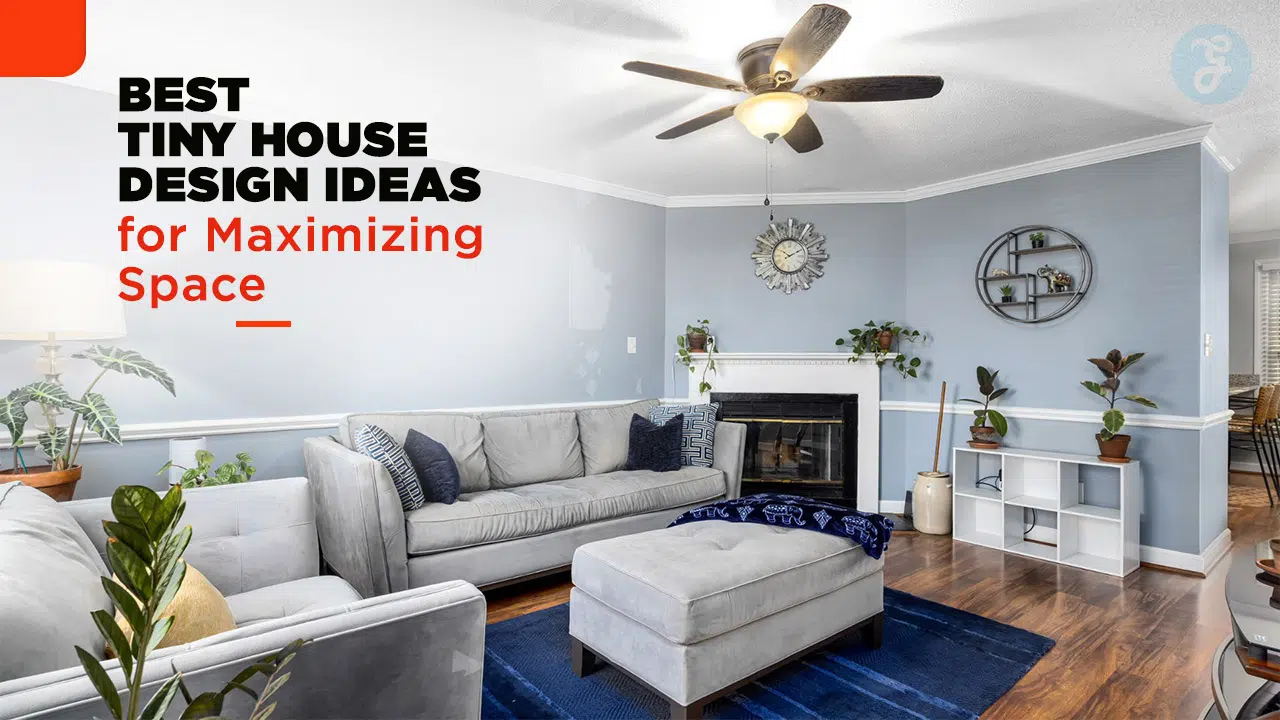
Struggling with a small footprint? You aren’t alone. The “tiny house movement” has evolved from a niche trend into a masterclass in architectural efficiency. In 2026, the secret to a comfortable tiny home isn’t just about having less stuff—it’s about making your square footage work four times harder.
Whether you are building a DIY getaway or moving into a 200-square-foot permanent residence, these 15 tiny house design ideas will help you maximize every inch without sacrificing the comforts of a traditional home.
Why Smart Design is the “Square Footage” of Tiny Living
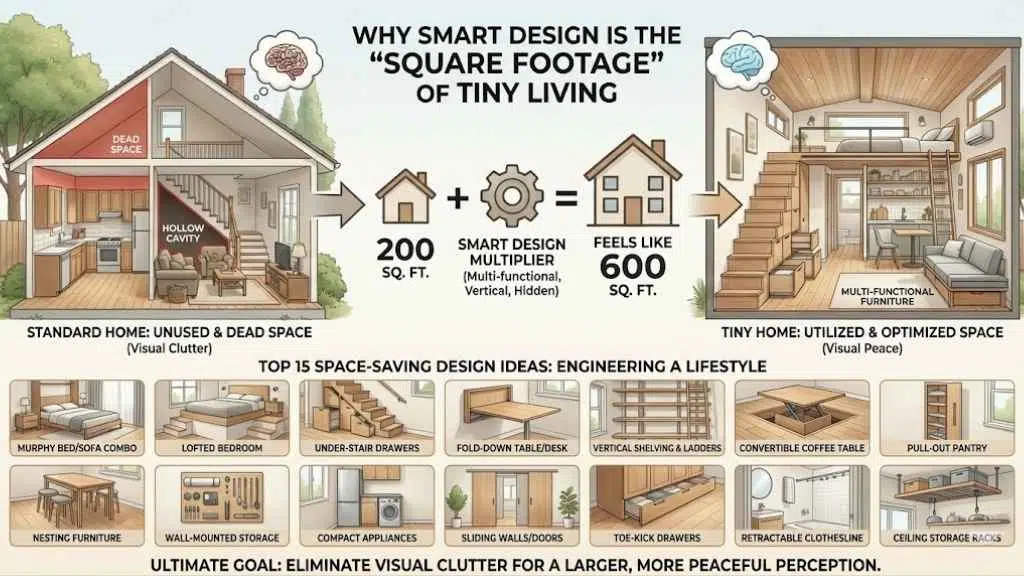
In a standard home, space is often “dead.” Think about the empty air above your cabinets or the hollow cavity under your stairs. In a tiny house, dead space is a luxury you can’t afford.
Smart design acts as a multiplier. When you use multi-functional furniture and vertical storage, a 200-square-foot home can feel and function like a 600-square-foot apartment. The goal is to eliminate visual clutter, which tricks the brain into perceiving a room as larger and more peaceful.
Top 15 Space-Saving Design Ideas
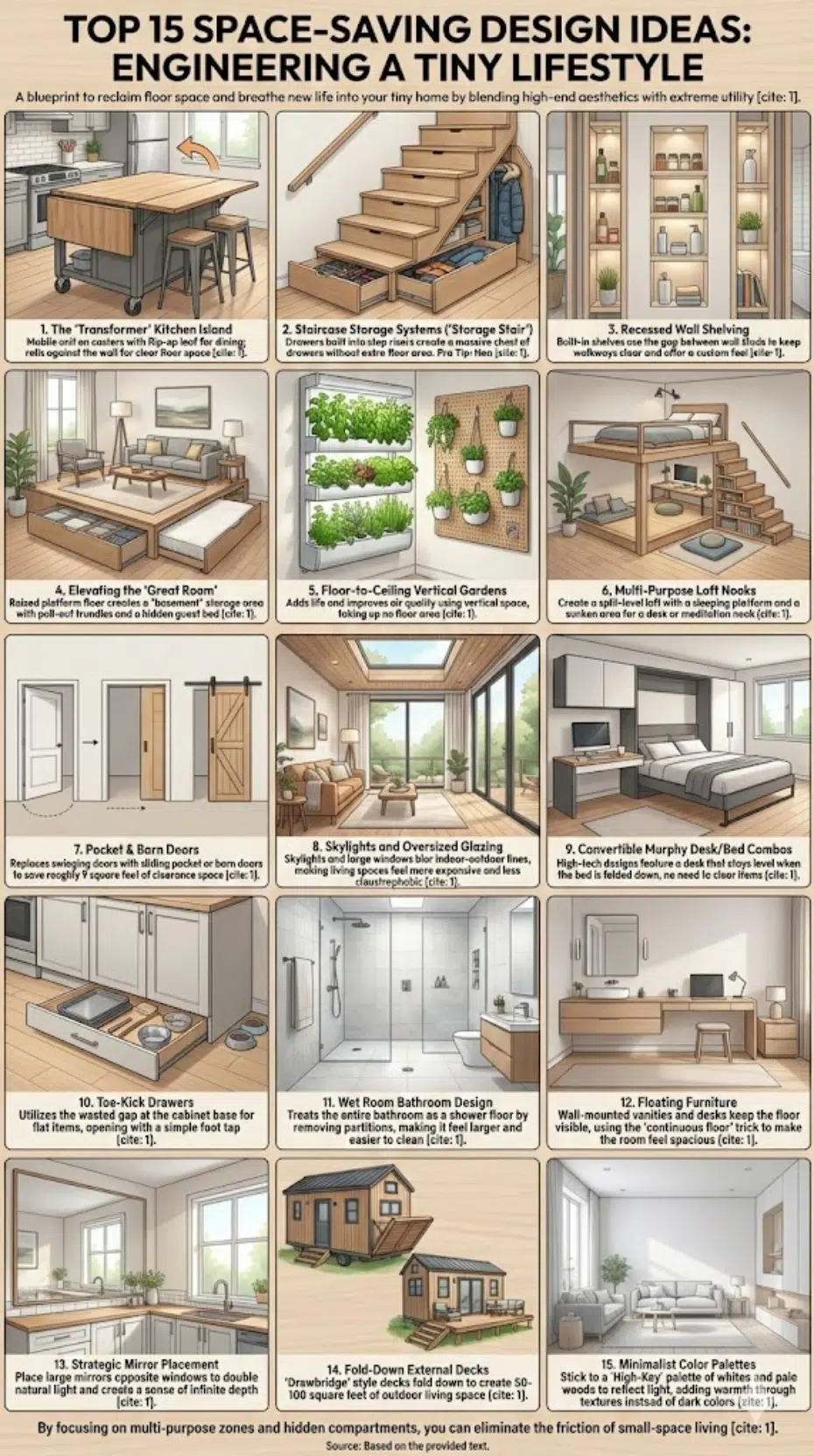
Implementing these design strategies requires a shift in perspective: you aren’t just choosing furniture, you are engineering a lifestyle. By focusing on multi-purpose zones and hidden compartments, you can eliminate the friction of small-space living. The following list represents the pinnacle of modern micro-architecture, blending high-end aesthetics with extreme utility. Use these ideas as a blueprint to reclaim your floor space and breathe new life into your tiny home.
1. The “Transformer” Kitchen Island
Kitchens are notorious space-wasters. A “Transformer” island is a mobile unit on heavy-duty casters that features a flip-up leaf. During the day, it’s your food prep station. At night, flip the leaf up, pull up two bar stools, and it becomes your dining room table. When you need clear floor space for yoga or cleaning, simply roll it against the wall.
2. Staircase Storage Systems (The “Storage Stair”)
Ladders save space, but stairs offer storage. By building drawers into the “riser” (the vertical part) of each step, you create a massive chest of drawers that doesn’t take up any extra floor area.
- Pro Tip: Use the deepest, bottom steps for heavy items like tools or winter coats, and the top steps for lighter items like linens.
3. Recessed Wall Shelving
Instead of hanging bulky shelves on the wall, build them into the wall. By using the 3.5-inch gap between your wall studs, you can create recessed niches for spices, toiletries, or books. This keeps your walkways clear and gives the home a sleek, custom-built feel.
4. Elevating the “Great Room”
One of the most innovative trends in 2026 is the raised platform floor. By raising your living room area by just 12 to 18 inches, you create a massive “basement” storage area accessible via pull-out trundles. You can even hide a full-size guest bed that slides out from under the platform when needed.
5. Floor-to-Ceiling Vertical Gardens
Bringing nature indoors can sometimes feel like adding more clutter. Use a vertical hydroponic wall or a simple pegboard with hanging planters. This adds “life” and improves air quality without taking up a single square inch of your precious floor.
6. Multi-Purpose Loft Nooks
If your tiny house has a high ceiling, don’t just use the loft for sleeping. Create a “split-level” loft. One side can be a sleeping platform, while the other is a sunken footwell area that serves as a desk or a meditation nook.
7. Pocket & Barn Doors
A standard swinging door requires about 9 square feet of “clearance” to open and close. In a tiny house, that’s a tragedy. Switch to pocket doors that slide into the wall or stylish barn doors that slide along the outside. This allows you to place furniture directly next to the doorway.
8. Skylights and Oversized Glazing
The “Big Window” illusion is a classic design trick. By installing skylights or floor-to-ceiling windows, you blur the line between the indoors and outdoors. Your “living room” suddenly feels like it extends to the horizon, effectively curing claustrophobia.
9. Convertible Murphy Desk/Bed Combos
The Murphy bed has been around for a century, but the 2026 versions are high-tech. Modern designs feature a desk that stays level even when the bed is folded down—meaning you don’t even have to clear your computer or coffee mug to go to sleep.
10. Toe-Kick Drawers
Look at your kitchen cabinets. That 4-inch gap between the bottom of the cabinet and the floor is usually wasted. Install “toe-kick” drawers that open with a simple tap of your foot. These are perfect for flat items like baking sheets, pet bowls, or emergency supplies.
11. Wet Room Bathroom Design
Traditional shower stalls take up a lot of visual and physical space. A “wet room” treats the entire bathroom as the shower floor. By removing the glass partitions and using a central floor drain, the bathroom feels much larger and is significantly easier to clean.
12. Floating Furniture
Keep the floor visible! When you use wall-mounted “floating” vanities, desks, and nightstands, the eye can see all the way to the wall-floor junction. This “continuous floor” trick is one of the most effective ways to make a room feel spacious.
13. Strategic Mirror Placement
A large mirror placed opposite a window can double the amount of natural light in your home. In a tiny house, consider a mirrored backsplash in the kitchen or mirrored closet doors to create a sense of infinite depth.
14. Fold-Down External Decks
Your living space shouldn’t stop at the walls. Many modern tiny houses feature “drawbridge” style decks that fold up for travel and fold down to create an outdoor patio. This effectively adds 50-100 square feet of usable space for lounging or entertaining.
15. Minimalist Color Palettes
While dark colors are cozy, they absorb light and “shrink” a room. Stick to a “High-Key” palette—whites, light greys, and pale woods. Use different textures (like a wool rug or a wood-grain wall) to add warmth without visual weight.
Traditional Storage vs Tiny House Storage
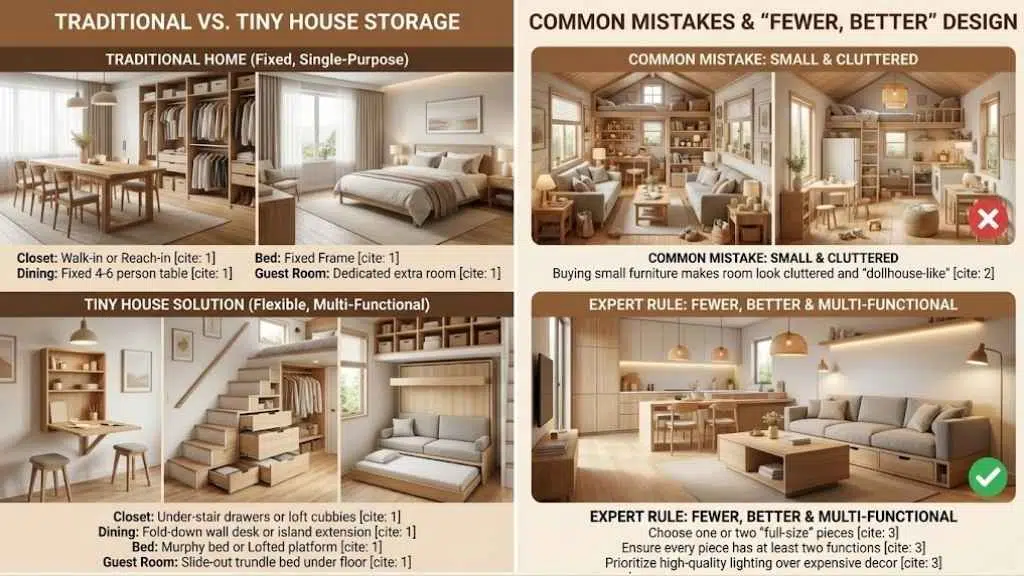
| Feature | Traditional Home | Tiny House Solution |
| Closet | Walk-in or Reach-in | Under-stair drawers or loft cubbies |
| Dining | Fixed 4-6 person table | Fold-down wall desk or island extension |
| Bed | Fixed Frame | Murphy bed or Lofted platform |
| Guest Room | Dedicated extra room | Slide-out trundle bed under floor |
Common Mistakes in Tiny House Space Planning
When people first start designing their tiny home, they often make the mistake of buying small furniture. Paradoxically, filling a small room with many small pieces of furniture makes it look cluttered and “dollhouse-like.”
Instead, experts recommend the “Fewer, Better” rule:
- Choose one or two “full-size” pieces (like a comfortable sofa).
- Ensure every piece has at least two functions.
- Prioritize high-quality lighting over expensive decor.
Final Thoughts
Maximizing space in a tiny house is an art form. It requires you to look at every wall, floor, and ceiling as a potential tool for organization. By implementing even three or four of the ideas above—like storage stairs or pocket doors—you can transform a cramped trailer into a functional, breathable sanctuary.