The Australian labor market has reached a significant milestone in 2026, as the Right to Disconnect laws now officially apply to every business across the country, regardless of size. While the headlines often focus on “banning after-hours emails,” the reality of the legislation is far more nuanced and centers on the concept of “reasonableness.” For employees and employers navigating this new landscape, understanding the fine print is the difference between a healthy boundary and a legal dispute.
How We Selected Our 7 Key Insights on the Australia Right to Disconnect Law 2026
To ensure these insights provide the most practical value, we analyzed the Fair Work Act amendments and the latest 2026 guidance from the Fair Work Ombudsman. Our selection focused on the areas where misconceptions are most common and where the legal risk is highest for businesses.
-
Legislative Scope: We prioritized facts that apply to the 2026 environment, specifically focusing on small businesses.
-
Practical Application: We looked at how “reasonableness” is defined in real-world scenarios.
-
Risk Management: We evaluated the consequences of non-compliance and the role of the Fair Work Commission.
The following criteria served as the foundation for our breakdown of the current legislative environment.
| Criteria | Importance | Focus Area |
| Business Size | High | Small business compliance status |
| Third-Party Contact | High | Client and customer interactions |
| Compensation | Medium | Salary level vs. disconnection rights |
| Legal Protections | High | Adverse action and retaliation |
7 Vital Facts: Australia Right to Disconnect Law 2026
Understanding the nuances of this law is essential for maintaining workplace harmony. These seven points highlight the most misunderstood aspects of the legislation as it stands today.
1. Small Businesses are Now Fully Included
While larger organizations have navigated these rules since 2024, the 12-month reprieve for small businesses officially ended in late 2025. In 2026, every employer in Australia with fewer than 15 staff members is now legally bound by the same “reasonable refusal” standards. This means a small retail shop or a local trade business must respect these boundaries just as strictly as a multinational corporation.
Best for: Small business owners and employees who may have previously felt exempt.
Why We Chose It: The conclusion of the small business “grace period” is the most significant change for 2026.
Things to consider: Small businesses often have less formal communication channels, making clear policies even more critical.
2. It Covers Contact from Clients, Not Just Bosses
A common misconception is that the law only applies to your direct manager. In reality, the Australia Right to Disconnect Law 2026 protects employees from unreasonable contact from any third party related to their work. This includes persistent clients, demanding customers, or external vendors trying to reach you on a Saturday afternoon.
Best for: Client-facing professionals in sales, account management, or service industries.
Why We Chose It: It addresses the reality that work pressure often comes from outside the internal hierarchy.
Things to consider: Employers are expected to manage client expectations to ensure their staff aren’t being harassed after hours.
3. The “Reasonable Refusal” Test is Multi-Factored
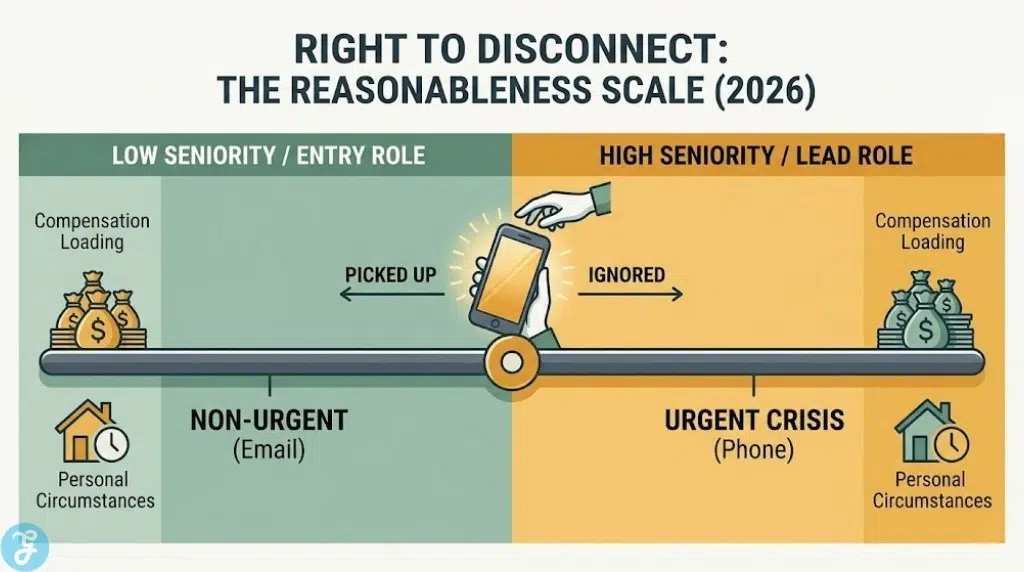
The law doesn’t provide a blanket “no” to all after-hours contact. Instead, it relies on a “Reasonableness Test.” If a manager calls you at 8:00 PM, whether you can ignore it legally depends on several factors, including the urgency of the matter, your level of responsibility, and how much you are paid to be “on call.”
Best for: Managers needing to know when it is safe to reach out in an emergency.
Why We Chose It: It is the core mechanism that prevents the law from being too rigid for high-stakes industries.
Things to consider: A senior executive with a high salary has a much higher bar for “reasonable refusal” than a junior administrator.
4. Sending a Message is Not Illegal—Ignoring it is Protected
The law does not actually ban an employer from sending an email or text message after hours. Many managers use “scheduled send” out of courtesy, but they are technically allowed to hit send whenever they like. The legal protection rests entirely with the employee’s right to not read or respond to that message until their next shift starts, provided their refusal is reasonable.
Best for: Employers who prefer to clear their inbox late at night but don’t expect instant replies.
Why We Chose It: This distinction clears up the “criminalization” myths that circulated during the bill’s early stages.
Things to consider: To avoid stress, managers should explicitly state that a late-night email does not require an immediate response.
5. Personal Circumstances Tip the Legal Scales
When the Fair Work Commission evaluates a dispute, they look closely at the employee’s personal life. If an employee has significant caring responsibilities—such as looking after young children or an elderly parent—their right to disconnect is significantly strengthened. The law recognizes that “unreasonable contact” is more disruptive to someone with high personal demands.
Best for: Working parents and caregivers who need to protect their personal time.
Why We Chose It: It highlights the law’s focus on psychosocial safety and work-life balance.
Things to consider: Employees should be open with their employers about their caring responsibilities to set clear boundaries.
6. The Fair Work Commission Uses “Stop Orders” First
If an employer and employee can’t agree on after-hours boundaries, they can’t simply go to court for a fine immediately. The first step is usually applying to the Fair Work Commission (FWC) for a “Stop Order.” The FWC can order an employee to stop unreasonably refusing contact, or order an employer to stop making unreasonable requests. Only a breach of these specific orders leads to heavy financial penalties.
Best for: HR departments looking to resolve conflicts before they become expensive legal battles.
Why We Chose It: It explains the actual enforcement process, which is designed to be corrective rather than punitive.
Things to consider: Always attempt to resolve the issue internally first, as the FWC will check for evidence of workplace discussion.
7. It is a Protected “Workplace Right”
The Right to Disconnect is categorized as a “workplace right” under the Fair Work Act’s General Protections. This is crucial because it means an employer cannot take “adverse action”—such as firing, demoting, or bullying an employee—because they chose to exercise their right to ignore a late-night Slack message. If a manager cuts an employee’s hours because they wouldn’t answer the phone on a Sunday, it could lead to an expensive legal claim.
Best for: Employees who fear that setting boundaries will hurt their career progression.
Why We Chose It: This provides the “teeth” to the legislation, ensuring that the right isn’t just a suggestion.
Things to consider: Documentation is key; keep a record of any “adverse action” that follows a disconnection.
An Overview Of Australia Right to Disconnect Law 2026
The impact of this law varies significantly depending on your role and compensation. The following comparison illustrates how the “Reasonableness” threshold shifts across different workplace archetypes in 2026.
| Employee Archetype | Salary Level | “Reasonable” to Contact? | Right to Refuse? |
| Junior Admin | Award / Entry | Rarely (Emergencies only) | Very High |
| Mid-Level Manager | Mid-Range | Occasionally (Time-sensitive) | Moderate |
| Senior Executive | High / Over-Award | Frequently (Strategic/Global) | Low |
| On-Call Technician | Includes Loading | Yes (Within contract) | Very Low |
Our Top 3 Picks and Why?
-
The Third-Party Rule: This is a top pick because it forces businesses to rethink their “always available” promises to clients. It protects the employee from the pressure of “client-first” cultures that often lead to burnout.
-
The Protections Against Retaliation: We chose this because, without it, the law would be ignored by employees who are afraid of being seen as “not a team player.” It provides real security.
-
The Inclusion of Small Businesses: This is essential for 2026. Since small businesses make up the bulk of the Australian economy, their inclusion ensures the culture of work in Australia shifts universally, not just in large offices.
Adapting to this law requires a proactive approach from both sides of the employment contract. Use the following framework to establish boundaries that are legally sound and operationally practical.
The Selection Framework
-
Review Your Contract: Does your salary include a “loading” or a flat amount specifically for being available after hours? If so, your right to refuse is reduced.
-
Define “Urgency”: Establish clear examples within your team of what constitutes a genuine emergency (e.g., safety risk, massive financial loss) versus a non-urgent query.
-
Audit Communication Channels: Use “Do Not Disturb” settings on work phones and ensure managers know the preferred channel for true emergencies (usually a phone call over a text).
-
Open the Dialogue: Don’t wait for a dispute. Use a team meeting to discuss expectations for 2026.
The following matrix helps you decide how to handle an after-hours notification based on the current law.
| If the contact is… | And your role is… | The recommended action is… |
| Low Urgency (Email) | Junior / Mid-level | Ignore until your next shift. |
| High Urgency (Phone) | Technical / Lead | Answer, then discuss the necessity later. |
| Frequent / Non-Urgent | Any | Discuss a formal “Stop Order” or internal policy change. |
| Client-Generated | Sales / Service | Escalate to your manager to set client boundaries. |
The Final Checklist
-
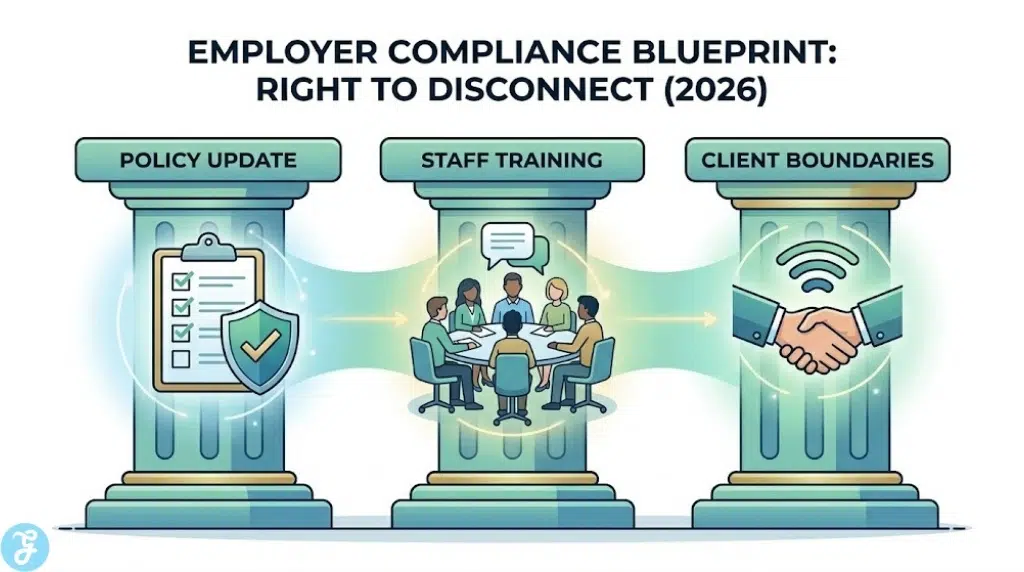
Have you updated your workplace policy to include “Right to Disconnect” guidelines?
-
Are your managers trained on the “Reasonableness Test” factors?
-
Have you checked your relevant Industry Award for specific disconnection clauses?
-
Is there a clear internal process for resolving disputes before they reach the FWC?
-
Do your employees know that exercising this right will not lead to negative career impact?
Embracing a New Workplace Culture
The Australia Right to Disconnect Law 2026 is not about stopping work; it is about reclaiming the “mental space” required to perform work well. By 2026, the most successful businesses will be those that view these boundaries as a tool for productivity rather than a hurdle to efficiency. When employees feel safe to switch off, they return to their roles with greater focus and less burnout, ultimately benefiting the Australian economy as a whole.
Frequently Asked Questions About Australia’s Right to Disconnect Law 2026
Can my boss still call me if there is a real emergency?
Answer: Yes. If the contact is regarding a genuine emergency or a health and safety issue, it is almost certainly “unreasonable” for an employee to refuse the contact, regardless of their role.
Does this apply to casual employees?
Answer: Yes, casual employees have the same right to disconnect as permanent staff. However, their “working hours” are often defined by their rostered shifts.
What happens if I’m paid a high salary—do I lose my right?
Answer: You don’t lose the right, but the “reasonableness” bar shifts. High-income earners are often compensated for the expectation that they remain available for strategic or time-critical global matters.
Can a client sue me for not responding?
Answer: No. A client has no direct legal standing against an individual employee under this law. It is the employer’s responsibility to manage the client relationship and ensure work-life boundaries are respected.
Is this law unique to Australia?
Answer: No, similar laws exist in France, Spain, and several other European nations. Australia’s 2026 model is considered one of the most comprehensive because of how it integrates with the national Fair Work system.