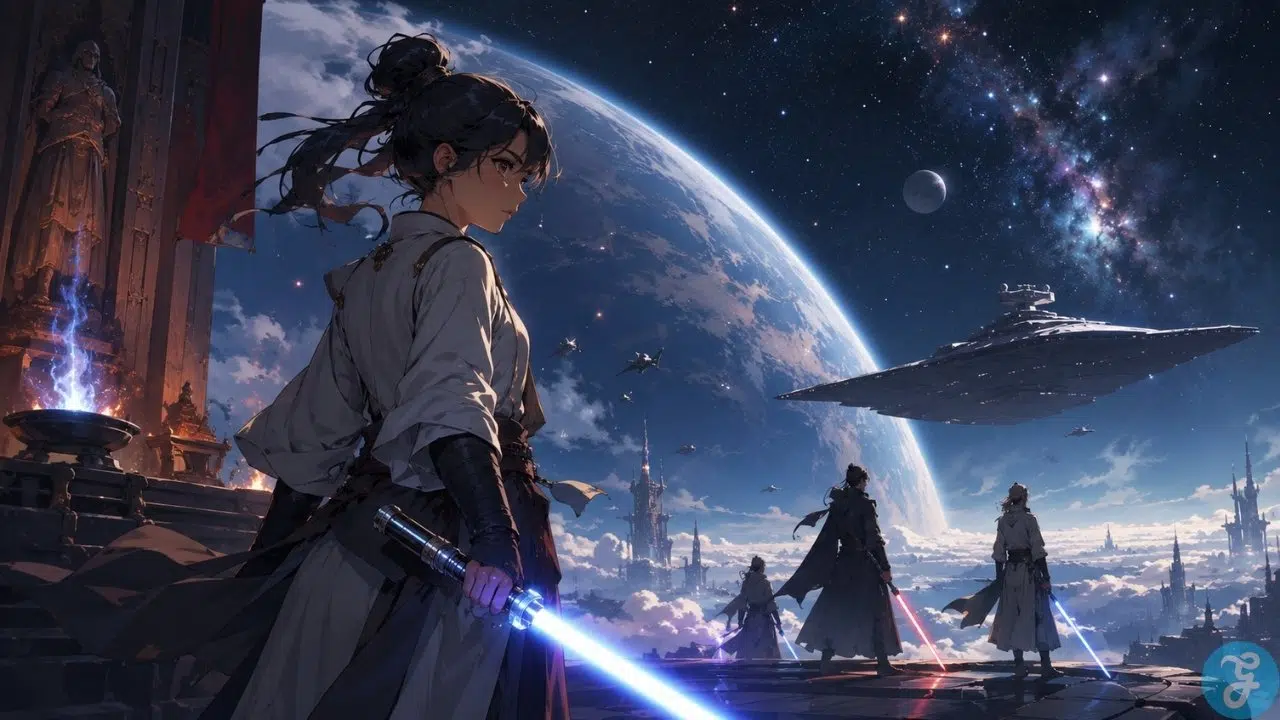
Star Wars did not suddenly discover anime. The franchise has carried pieces of Japanese cinema in its bones from the beginning, from samurai-style duels to lonely warriors, old masters, spiritual codes, and blades that feel heavier than weapons. Anime simply gives those ideas a sharper visual language.
That is why the growing demand for an anime star wars series feels natural. Star Wars: Visions proved that the galaxy does not need to stay locked inside the same familiar live-action rhythm. With Star Wars Visions Volume 3 already released and the Ninth Jedi full anime series on the way, Lucasfilm seems more willing to let anime do what it does best: make myth feel dangerous, emotional, strange, and alive.
The bigger question is whether this is still a stylish side project or the beginning of a serious Star Wars anime branch on Disney Plus.
Why the Anime Star Wars Series Conversation Matters Now
Star Wars animation has carried some of the franchise’s strongest storytelling for years. The Clone Wars, Rebels, The Bad Batch, and Tales of the Jedi gave fans character work, political tension, and emotional continuity that live-action did not always have enough room to handle.
Star Wars: Visions added something different. It gave animation studios space to interpret Star Wars without turning every episode into timeline management. The result felt freer. Some shorts leaned into samurai drama. Some played like folk tales. Others felt closer to sci-fi action, fantasy adventure, or emotional coming-of-age stories.
That creative freedom is the main reason fans keep asking for more anime Star Wars. The format does not only change how Star Wars looks. It changes what kinds of Star Wars stories can exist.
How Star Wars: Visions Broke the Galaxy Open
George Lucas always carried the DNA of Japanese cinema in his storytelling. When he sat down to write the original space fantasy in the 1970s, his text was not pulled from traditional American science fiction Westerns alone. It was deeply rooted in Akira Kurosawa’s The Hidden Fortress and Yojimbo.
The vocabulary of the galaxy itself bears this imprint. The word “Jedi” is often connected to Jidaigeki, Japanese period dramas. The wandering ronin, the spiritual weight of a master-apprentice dynamic, the ceremonial execution of a duel, and the idea of a blade carrying personal history were all borrowed from the traditions of samurai lore.
Because of this deep-seated lineage, the intensifying fan interest in a dedicated anime Star Wars series does not feel like a modern marketing gimmick. It feels like a definitive homecoming.
For decades, the franchise has flirted with these aesthetics, but animation finally allows the narrative wrapper to match the underlying visual philosophy. Anime gives these classic concepts the visceral space they need to breathe, stretching the kinetic motion of lightsaber fights, heightening Force-driven phenomena, and offering quiet character vignettes in worlds that do not look like another recycled desert outpost or Imperial corridor.
When Star Wars: Visions debuted on Disney Plus, it functioned as a beautiful statement of intent, treating the galaxy as a canvas for shared myth rather than a rigid timeline puzzle. The project eventually expanded into a global celebration of international animation styles, but the arrival of Star Wars Visions Volume 3 pulled the experiment back to its distinct cultural roots.
By returning the focus to prominent Japanese animation powerhouses, Volume 3 had a new, much tougher assignment: to prove that this anthology is not just a playground for disposable one-offs but a legitimate incubator for the franchise’s future.
What makes this playground work so well is the creative liberation of a non-canon sandbox. Traditional live-action projects carry an immense continuity burden. Writers are constantly checking the galactic calendar to see which characters are alive, which political factions are active, and which future movies they might accidentally contradict.
Visions bypasses that corporate red tape entirely. It allows a studio to imagine a tragic dark side story, a musical band performing for Jabba the Hutt, or a galaxy where lightsabers are forged by hand under a broken sky, without needing permission from a lore committee.
The arrival of Star Wars Visions Volume 3 carried more weight than a simple anthology return. This volume showed that Lucasfilm understands which creative risks actually matter to the audience.
The third volume brought the project back to Japanese studios and continued the anthology’s strongest habit: giving each studio enough room to build its own version of the galaxy. That matters because Star Wars can look surprisingly small when every story circles the same eras, families, and conflicts. Visions opens the frame again, proving that Lucasfilm is not treating every short as disposable. Some concepts can return, characters can grow, and unique stories can move beyond the short-film format without losing their identity.
Why The Ninth Jedi Stands Out
Most short films are built to make a quick, sharp point and exit before the concept wears thin. Kenji Kamiyama’s original contribution felt different. It carried the structural bones, character depth, and thematic weight of a sweeping epic.
Developing this specific concept into The Ninth Jedi full anime series is the most logical step Lucasfilm could take toward establishing a permanent animated ecosystem.
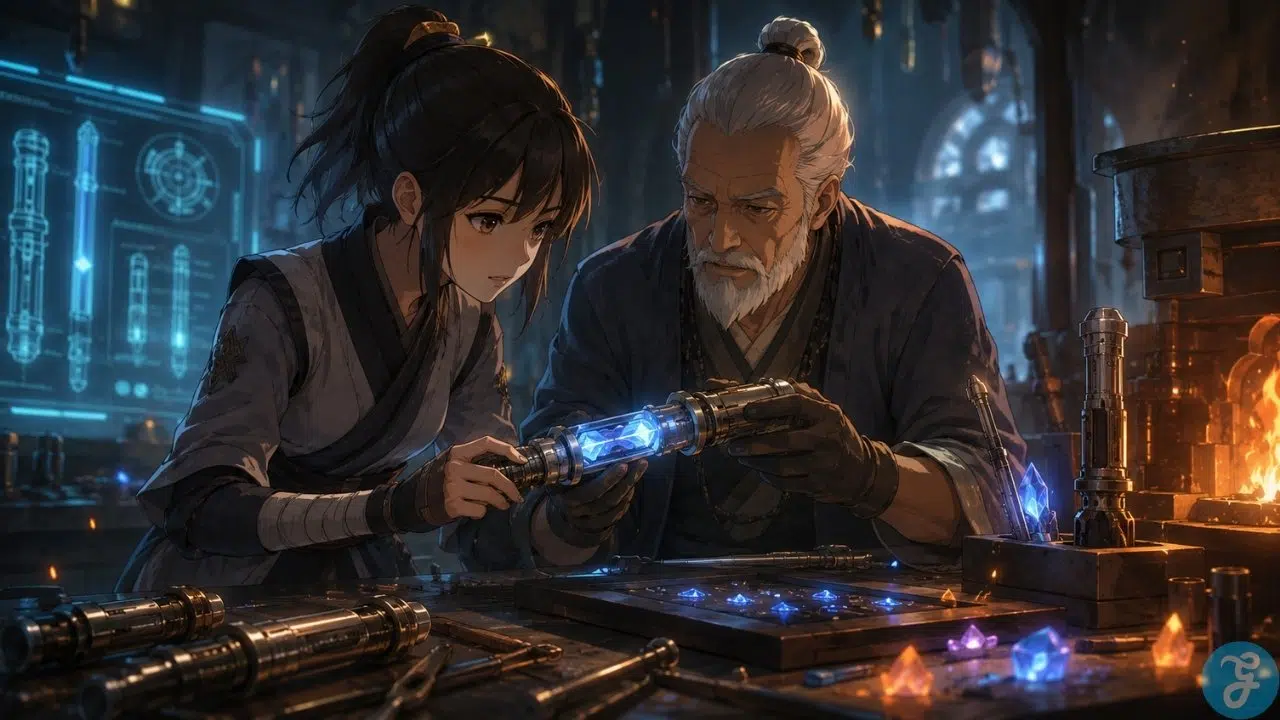
The original short introduced Kara, a young woman tied to the galaxy’s mythos not through an illustrious, universe-altering bloodline like the Skywalkers, but through her father’s practical, endangered craft as a lightsaber smith. This choice immediately grounds the fantasy.
The narrative engine does not rely on empty lore bait or familiar cameos. Instead, it thrives on immediate, claustrophobic tension. In an era where the Jedi Order is fractured and lightsabers change color based on the user’s specific connection to the Force, who can actually be trusted when a weapon is finally ignited?
What to Expect From The Ninth Jedi Full Anime Series
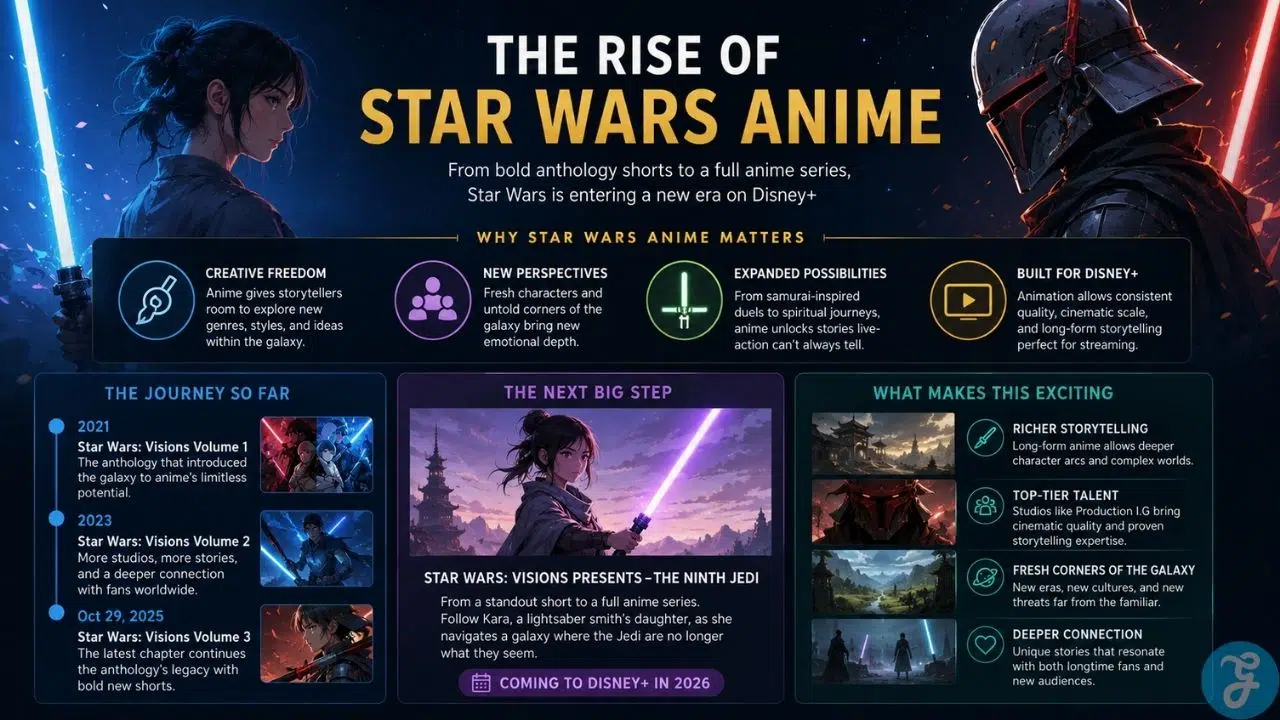
The strongest sign of Star Wars anime’s future is the development of The Ninth Jedi full anime series, officially titled Star Wars: Visions Presents – The Ninth Jedi.
The original short stood out because it felt bigger than its runtime. It introduced Kara, the daughter of a lightsaber smith, in a galaxy where Jedi history feels broken, dangerous, and uncertain. While many Visions shorts work beautifully as one-off stories, The Ninth Jedi had the bones of a full series: a strong lead, a family craft tied to Jedi lore, a dangerous power struggle, and a world where people are not always what they claim to be.
A full series gives that premise room to breathe. Kara can become more than a cool protagonist from a short film. The narrative can explore what lightsabers mean when the Jedi are scattered, what trust looks like in a broken order, and whether hope survives when the old symbols no longer protect anyone.
Atmosphere Over Action: Inside the Production IG Star Wars Show
Studio choice can make or break a project of this scale, which is why the Production IG Star Wars show carries so much weight.
Production I.G is not just a recognizable anime name attached for marketing; the studio’s reputation for atmospheric, mature storytelling fits exactly what this narrative needs. This series cannot survive on lightsaber fights alone. It requires restraint, tension, meticulous character work, and a galaxy that feels older than the episode in front of us.
This is where anime can fundamentally elevate Star Wars. A quiet pause before a duel can say more than a long paragraph of exposition. A lightsaber’s color, weight, and movement can carry deep emotional weight. A character’s silence can feel like history instead of empty screen time. The best version of this show won’t try to imitate live-action; it will let anime shape the pacing, action, and symbolism.
Anthology Blueprint vs. Serialized Future
The move from short-form anthology to longer-form storytelling matters because it changes what Visions can do. The anthology model gives creators freedom. The Visions Presents model gives the strongest ideas enough space to develop.
| Visions Anthology Model | Visions Presents Spinoff Model |
|---|---|
| Loose, experimental shorts | Deep, character-driven arcs |
| Total timeline independence | Structured world-building |
| Visual showcase focus | Narrative-first execution |
| Compact creative statements | Longer emotional development |
| Low continuity pressure | More room for character stakes |
A serialized format gives this premise the runway it deserves. Under the new Visions Presents branding, Lucasfilm can signal to audiences that a concept has earned the narrative weight to stand alone.
This pivot provides Disney Plus with a more dynamic content strategy. It creates a way to expand the universe without endlessly recycling legacy characters or leaning on cheap nostalgia. By treating the original short as an uncredited pilot, the studio has opened a healthier pipeline for organic storytelling.
The Star Wars Anime Series Release Date
Navigating the Star Wars anime series release date requires looking at two distinct projects, as fans are often searching for different things under the same phrase.
To clear up the timeline: Star Wars Visions Volume 3 premiered on Disney Plus on October 29, 2025, meaning the latest batch of anthology shorts is already available to stream. Meanwhile, the longer-form Star Wars: Visions Presents – The Ninth Jedi series is formally tracking a Disney Plus release window in 2026. While Lucasfilm has confirmed the year, a specific day and month have not been locked in.
The Disney Plus Star Wars Anime Spinoff
The shift toward a dedicated Disney Plus Star Wars anime spinoff changes the fundamental purpose of the Visions project.
At first, Visions worked mainly as an isolated creative showcase. The anthology format let studios experiment without forcing every story into the same continuity puzzle. However, utilizing a Disney Plus Star Wars anime spinoff gives Lucasfilm a dynamic new option: Visions can stay experimental while simultaneously serving as an incubator where the strongest ideas earn more space.
When a story clearly has more life in it, the studio now has a clear path to expand it. This is a significantly healthier approach for the franchise than endlessly returning to the same legacy characters.
Why the Formula Connects With Fans
The Ninth Jedi works because it uses familiar Star Wars ingredients without feeling like a recycled saga entry. There are lightsabers, but they are treated as crafted objects with history and meaning. There are Jedi concepts, but the world does not feel safely organized around a known order. Kara does not feel like a carbon copy of Luke, Rey, or Ahsoka.
The lightsaber-smithing angle gives the series a practical emotional hook. Star Wars often presents lightsabers as finished symbols, but making the creation of those weapons part of the narrative opens the door to questions about identity, inheritance, and responsibility. For anime, that is incredibly rich ground.
The Lore of the Smith: Deepening the Fabric of the Force
To understand why this specific story caught fire among fans, it helps to look at how it redefines the mechanics of the universe.
In traditional lore, a lightsaber’s color is largely determined by the kyber crystal chosen during a Jedi’s rite of passage. It is a fixed symbol. The Ninth Jedi changes the rules in a way that feels beautifully suited to anime. The blade’s color, clarity, and length fluctuate dynamically based on the wielder’s current alignment, intent, and spiritual stability.
When the mysterious warriors gather in Juro’s sky sanctuary, their blades remain clear, almost like colorless glass. They are blank slates, mirroring hidden motives and uncertain allegiances.
This mechanical twist turns every combat stance into a psychological profile. The moment a blade shifts to deep crimson or brilliant green, it is not just a visual indicator of a faction. It is an internal confession made visible on screen.
A full-length series allows the narrative to explore the socio-political realities of this broken era. Viewers can see a galaxy where the infrastructure of the old Republic has crumbled, leaving behind a vacuum where the knowledge of weapon-crafting has become a forbidden guild secret.
Kara’s journey is not a standard hero’s journey about mastering a superpower. It is a story about preserving a cultural legacy, understanding the weight of industrial responsibility, and discovering what happens when the literal tools of peace fall into hands that only know exploitation.
The Power of Production I.G
The announcement of a dedicated Production IG Star Wars show raises the creative stakes significantly.
The studio behind works such as Ghost in the Shell, Jin-Roh: The Wolf Brigade, and the animated segments of Kill Bill brings an undeniable reputation for mood, cinematic restraint, and calculated tension.
Anime allows Star Wars to master the art of the pause. It can hold on the quiet breath before a weapon is drawn, where silence carries more historical weight than a paragraph of clunky exposition.
This creative partnership suggests the upcoming series will not simply look like standard Star Wars with a superficial anime coat of paint. Production I.G has spent decades mastering the intersection of high-concept philosophy and hyper-detailed mechanical design.
In the studio’s hands, a starship hangar is not just a background asset. It is a textured, lived-in space shaped by industrial grime, realistic lighting, and heavy shadow.
That technical precision can transform the pacing of action. A lightsaber duel in a traditional live-action series often feels hurried by the practical realities of choreography and green-screen production. Animation allows for a different rhythm.
A standoff can linger on the subtle shifting of a duelist’s weight, the pooling of rain on a hilt, or the sudden distortion of air as plasma ignites. Kamiyama’s return means the atmospheric DNA of the original short has a stronger chance of surviving the transition to a full season.
That matters because the project should prioritize deliberate world-building over relentless, empty action beats.
Visual Freshness and Future Scope
Anime fits Star Wars because the franchise has never been plain science fiction; it is myth, war drama, fantasy, and spiritual conflict. Anime handles that mixture perfectly, making a duel feel ceremonial or a planet feel haunted through color and silence.
Too many recent live-action projects return to familiar deserts, hangars, and grey corridors. Anime gives artists permission to stretch scale, motion, architecture, and combat in ways live-action often avoids due to budget or production limits.
The upcoming series needs to protect what made the original short work. It must keep Kara at the center, let the smithing lore matter, and avoid overexplaining the galaxy too quickly. Mystery is what helped it stand out in the first place.
Avoiding the Corporate Trap: Pitfalls the Spinoff Must Evade
For this new branch of storytelling to maintain its integrity, it must avoid the systemic traps that have hurt many recent Hollywood expansions. The temptation to corporate-monetize a creative breakthrough is always present, and The Ninth Jedi will face pressure to conform to typical franchise mandates.
The Overexplanation Fallacy
The original short worked because it left massive gaps in the lore.
Viewers did not need a long opening crawl explaining the exact geopolitical collapse of the galactic senate or the scientific origin of the color-changing crystals. The series must trust the audience to lean into the mystery instead of drowning them in unnecessary exposition.
The Cameo Crutch
The story must remain protective of Kara and her supporting cast.
The moment a legacy character, ancient droid, familiar alien species, or Force ghost appears only to validate the storyline, the unique identity of this universe weakens. It shrinks the world back into a marketing vehicle.
Surface-Level Aesthetics
Animation cannot be treated as decoration. If the production team prioritizes standard Western storytelling rhythms and simply applies a superficial anime style over the top, the project will ring hollow. The show must commit to the pacing, visual metaphors, and emotional gravity that make anime more than a cosmetic choice.
Timelines and Fan Expectations
Managing the public tracking of the Star Wars anime series release date requires separating two distinct phases of this rollout. Because the franchise uses the Visions umbrella for multiple experimental formats, general audiences often face search friction when looking for concrete timelines.
| Project Title | Format Structure | Release Status / Window |
| Star Wars Visions Volume 3 | 9-episode anthology short series | Released on October 29, 2025 |
| Star Wars: Visions Presents – The Ninth Jedi | Serialized long-form season | Announced for 2026 |
To clear up the timeline, Star Wars Visions Volume 3 is already out and streaming on Disney Plus. It serves as the latest showcase of short-form creative swings from various Japanese directors and studios.
Meanwhile, the longer-form serialized continuation of Kara’s journey is tracking its premiere window in 2026. While the specific day and month remain unconfirmed by Lucasfilm executives, this deliberate production runway gives the animators time to craft a fluid, premium season without relying on rushed assets or compromised frames.
This release strategy will become a litmus test for the streaming service. Audiences will judge whether a self-contained anime concept can genuinely sustain an episodic narrative arc without losing the spark that made its brief debut so memorable.
Where the Anime Star Wars Series Goes From Here
The future of the anime Star Wars series depends entirely on whether Lucasfilm trusts the format beyond surface style. We have already seen the creative potential of this medium; the arrival of Star Wars Visions Volume 3 proved that independent animation studios still have plenty of fresh energy to inject into the franchise.
Moving forward, the success of this ecosystem won’t just rely on short anthologies. With the Star Wars anime series release date locked for 2026, eyes are turning toward how a full-length narrative handles the transition. If executed correctly, this upcoming Disney Plus Star Wars anime spinoff could provide a blueprint for a healthier, more experimental galaxy, one where major projects like the Production IG Star Wars show give creators the keys to build something genuinely new.
Ultimately, expanding The Ninth Jedi full anime series into a serialized drama is a gamble, but it’s exactly the kind of risk the franchise needs. The safest hope is that it tells a focused, beautiful, emotionally sharp story about a galaxy where hope has to be made by hand. If it does that, Star Wars anime will no longer feel like a side experiment; it will feel like the path forward.