Ever watch a game, see a stat flash on the screen, and still feel like you’re guessing? That is why AI Sports Predictions: How Smarter Analytics Are Changing The Way Fans Analyze Games has become such a big deal for fans who want clearer answers.
You do not need a front-office job to use smarter sports analytics well.
This guide shows how predictive modeling, machine learning, and real-time insights help you read games with more confidence. I’ll walk you through what these tools do, where they still miss, and how to use the numbers without getting lost in them.
How AI Sports Predictions Are Revolutionizing Sports Analytics
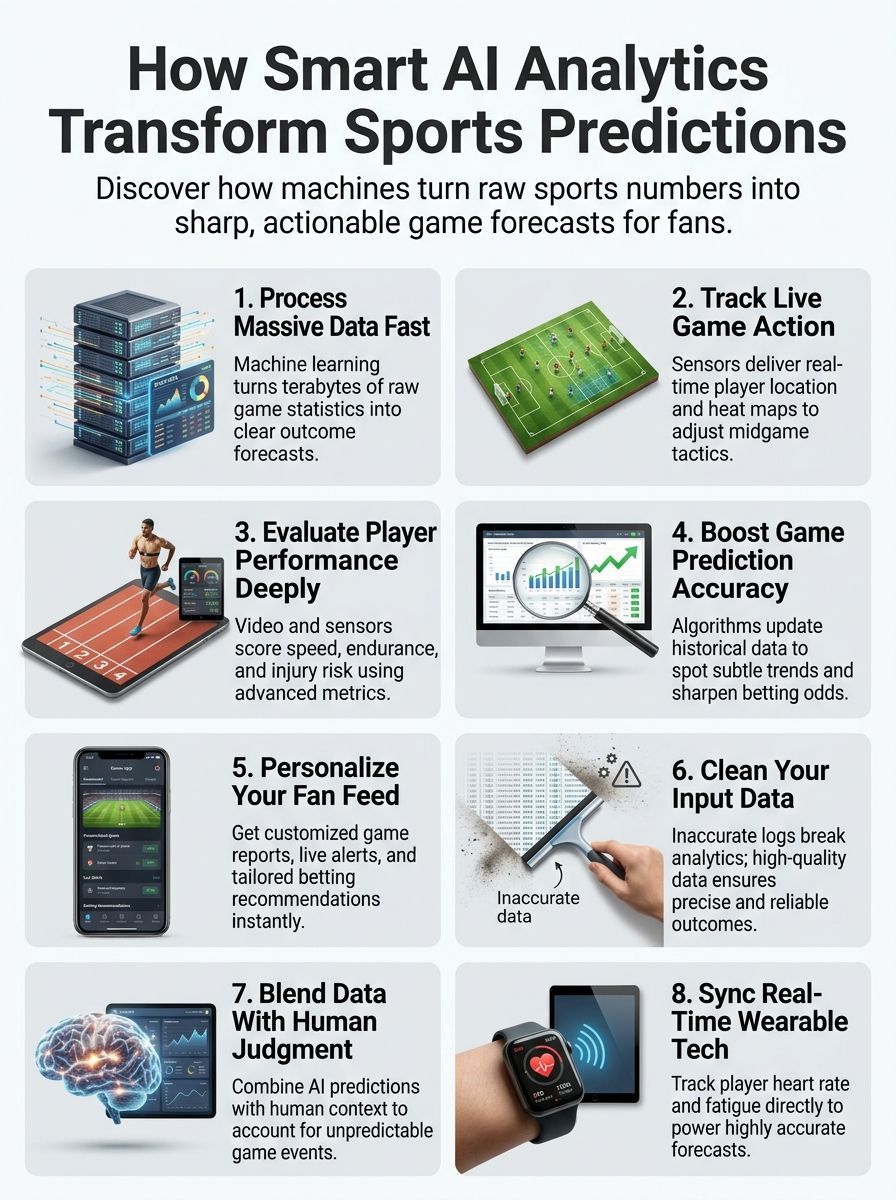
AI sports predictions work best when they can process more information than a human can hold in mind at once. That means player tracking, video, injuries, game state, and historical data all get pulled into one live view.
Increased data processing capabilities
The NFL says its Next Gen Stats system runs on AWS and turns more than 500 million data points per season into insights for teams, players, and fans. For you, that matters because a win probability graphic or route chart is built from the same tracking stream teams use to study performance.
Baseball is moving the same way. In March 2026, MLB added Scout Insights to Gameday, and Google Cloud said the feature uses Gemini models to parse hundreds of petabytes of league data and game-time scenarios, which helps explain why a matchup matters instead of just showing the score.
- For fans: live probabilities and matchup notes become easier to trust when you know the data comes from league-grade tracking.
- For fantasy players: usage, pace, and role changes show up faster than they do in box scores alone.
- For bettors: the value is not more numbers, it is earlier context on what may move the game.
Good analytics do one simple thing: they shrink the gap between what happened and what it means.
Real-time data analysis during games
Basketball gives you a clear example. NBA player tracking uses cameras in every arena to follow all 10 players and the ball 25 times per second, so live stats can show speed, distance, touches, and shot context instead of a plain points total.
On the training side, Catapult says its wearables can record more than 1,000 data points per second in real time and sync those readings with video. That helps coaches spot fatigue before it becomes a problem, and it helps fans understand why a rotation suddenly changes late in a game.
Smarter Statistics for Enhanced Context
Raw stats tell you what happened. Smarter statistics tell you whether it is likely to happen again.
Improved player performance insights
That is why tracking metrics matter so much. NBA.com lists PIE as a quick measure of player and team impact, and its tracking pages add layers like average speed, distance covered, drives, touches, and defensive impact.
If a player scores 30 points on a hot shooting night but his touches, paint drives, or movement trend are slipping, you should read that line with caution. The better move is to pair box-score production with a workload or location stat before you call it a trend.
| Stat type | What it tells you | Best way to use it |
|---|---|---|
| Box score | Points, rebounds, assists, turnovers | Use it for the result, not the full story |
| Tracking stat | Speed, distance, touches, shot quality, spacing | Use it to see how the result was created |
| Model output | Win probability, matchup edge, forecast range | Use it to judge likelihood, then compare with fresh news |
Tactical analysis for teams
PFF launched Key Insights in January 2025 to surface matchup edges for fans, analysts, bettors, and fantasy players, and it says the tool is built on charting trusted by all 32 NFL teams and 134 FBS programs. That is useful because it pushes you past simple “Team A is better” talk and into specific mismatch questions.
- Is a defense weak in the slot or on play action?
- Is a team giving up clean catch-and-shoot looks?
- Has a pitcher lost velocity or command across recent starts?
- Does the second unit change the team’s pace when a star sits?
Those are the kinds of questions that make sports analytics feel practical. They turn a prediction into a reasoned case you can explain to someone else.
Predictive Models and Game Forecasting
Predictive modeling works best when you treat it like a probability tool, not a crystal ball. The goal is to estimate what is likely, then compare that with what the public assumes.
Higher accuracy in outcome predictions
A 2025 preprint on NBA game prediction reported 72.35% accuracy for an LSTM model across multiple seasons, beating several standard machine learning baselines. A 2024 Frontiers study on the 2022 World Cup found its best neural network model reached 75.42% accuracy, which shows why richer models keep gaining ground.
That does not mean every 70% call wins. It means you should take model probabilities more seriously when they are backed by broad inputs like lineup data, recent form, pace, shot profile, and rest.
The smartest fan question is not “Who wins?” It is “What probability would make this prediction useful?”
Advanced trend identification
One of the biggest upgrades in modern forecasting is trend detection. Models can catch slow changes, like a team playing faster with a new bench group, before the standings make it obvious.
A 2023 study on machine learning for sports betting argued that calibration matters as much as raw accuracy. In plain English, if a model says a team has a 65% chance to win, that number should behave like a real 65% over time, or the forecast is less helpful than it looks.
- Track whether the trend comes from a role change, not just a hot shooting night.
- Check whether the sample covers several games or only one outlier.
- Compare the forecast with current injury news and weather.
- Be careful when a model swings hard after one strange result.
Personalized Fan Experiences
The best fan tools do not dump every stat on your screen. They filter for the details you care about and show them at the moment they matter.
Customized game insights
In March 2026, MLB rolled out Scout Insights in Gameday, which uses Google Cloud AI to add short, situational explanations during games. That makes the feed more useful for casual fans because you get a plain-language reason a plate appearance matters, not just another number flashing by.
Tennis offers a similar preview of where this is going. IBM says the US Open app and website bring AI-powered features to more than 14 million fans, using win-likelihood tools, alerts, and highlight generation to keep each person focused on the matches and players they care about.
| Platform | What fans get | Why it helps |
|---|---|---|
| MLB Gameday Scout Insights | AI game context during live at-bats | Helps you understand leverage and matchup logic faster |
| NFL Next Gen Stats | Player speed, separation, motion, and win probability | Turns broadcast graphics into actionable football context |
| PFF Key Insights | Matchup-driven notes for fans, fantasy players, and bettors | Shows where a prediction comes from, not just the pick |
Personal recommendations for fans
Personal recommendations work best when they learn your habits without becoming noisy. If you mostly follow one team, one player market, or one style of stat, the app should get better at surfacing that lane instead of blasting every alert.
A common complaint in sports app reviews and fan forums is simple: too many alerts make people ignore all of them. The practical fix is to keep notifications focused on lineup news, major probability swings, and the small set of metrics you actually use.
- Starting lineup confirmations
- Late scratches and minutes restrictions
- Weather shifts for outdoor games
- Role changes, like red-zone work or fourth-quarter usage
Limitations of AI in Sports Predictions
AI can sharpen your read of a game, but it cannot remove chaos. The cleaner your inputs, the more useful the forecast, and sports are full of messy inputs.
Dependence on data quality
Data gaps show up more often than most fans realize. NBA.com notes that advanced stats go back to 1996-97, while some base stats were not recorded from the league’s earliest years, and player tracking is not available for every game. That kind of uneven history matters because models trained on mixed eras can overstate certainty.
If you use predictions for betting or fantasy, start with a simple check: is the model reading current injury, lineup, and tracking data, or is it leaning too hard on season averages? Weak data can still produce polished-looking dashboards.
Challenges in accounting for unpredictable factors
The official NBA injury report requires teams to post participation statuses by 5 p.m. local time the day before most games, but even that does not eliminate late changes, minutes limits, or warmup decisions. One update can flip usage, pace, and matchup value across an entire slate.
That is why experienced bettors in sports forums keep repeating the same warning: general AI tools can sound confident while missing the newest injury or lineup detail. Use the model for structure, then make one last pass on official reports, weather, travel, and starting lineups before you trust the forecast.
Use AI for signal, then use human judgment for the last mile.
The Future of AI in Sports Analytics
The next phase is not just better predictions. It is faster feedback, wider access, and tools that explain themselves more clearly.
Integration with wearable technology
Wearables are getting more useful because they no longer sit in a silo. Catapult’s Vector system combines movement sensors with live analysis and video, which lets coaches connect a fatigue spike to the exact drill, sprint, or collision that caused it.
For fans, the real payoff is better context around rest days, workload limits, and late-game drop-offs. You may never see every private team metric, but the public story around performance will keep getting smarter.
Expanding accessibility for fans and analysts
In the latest update from Genius Sports, the company said its March 17, 2026 Pac-12 partnership will deploy GeniusIQ across every venue for football and men’s and women’s basketball, creating one AI foundation for tracking data, video capture, real-time insights, and betting integrity tools. That is a strong sign that advanced analytics are moving from a luxury add-on to standard sports infrastructure.
- Fans will see clearer live explanations, not just raw charts.
- Independent analysts will have more public data to test ideas.
- Smaller schools and teams will get tools that used to belong only to big-budget clubs.
- Broadcasts will keep turning complex metrics into simple, watchable stories.
That is good news for readers, because sports analytics gets better the moment it becomes easier to question, compare, and understand.
Final Thoughts
AI sports predictions already help fans read games with more context, better metrics, and faster updates.
The real win is not blind faith in algorithms, it is knowing which numbers deserve your attention and which ones need a second look.
AI Sports Predictions: How Smarter Analytics Are Changing The Way Fans Analyze Games comes down to this, smarter tools help you ask smarter questions.
Whether you watch for fun, talk strategy with friends, or make the occasional bet, you now have better ways to turn data into insights.
FAQs about AI Sports Predictions
1. What are AI sports predictions and how do they help fans analyze games?
AI sports predictions use machine learning and predictive models to read player stats, team trends, and real-time data. They help fans analyze games, spot angles, and plan fantasy moves, like a fast scout in your pocket.
2. Do smarter analytics always get it right?
No, smarter analytics boost accuracy when models have clean, deep data, but they are not perfect. Human sense still matters, and surprises happen in every game.
3. Can fans use AI for fantasy sports or betting?
Yes, many apps turn player data and predictive models into simple picks for fantasy sports and betting. They speed research, show trends you might miss, and save time, just don’t blame the app for bad luck.
4. Do I need special skills to use these tools?
No, most tools aim for easy dashboards and clear picks, so fans can jump in fast. Learn a few stats basics, and you will get more from the smarter analytics.