
When a company announces layoffs and mentions AI in the same statement, the story almost writes itself. The company is becoming more efficient. Technology has made certain roles unnecessary. The cuts are simply part of progress.
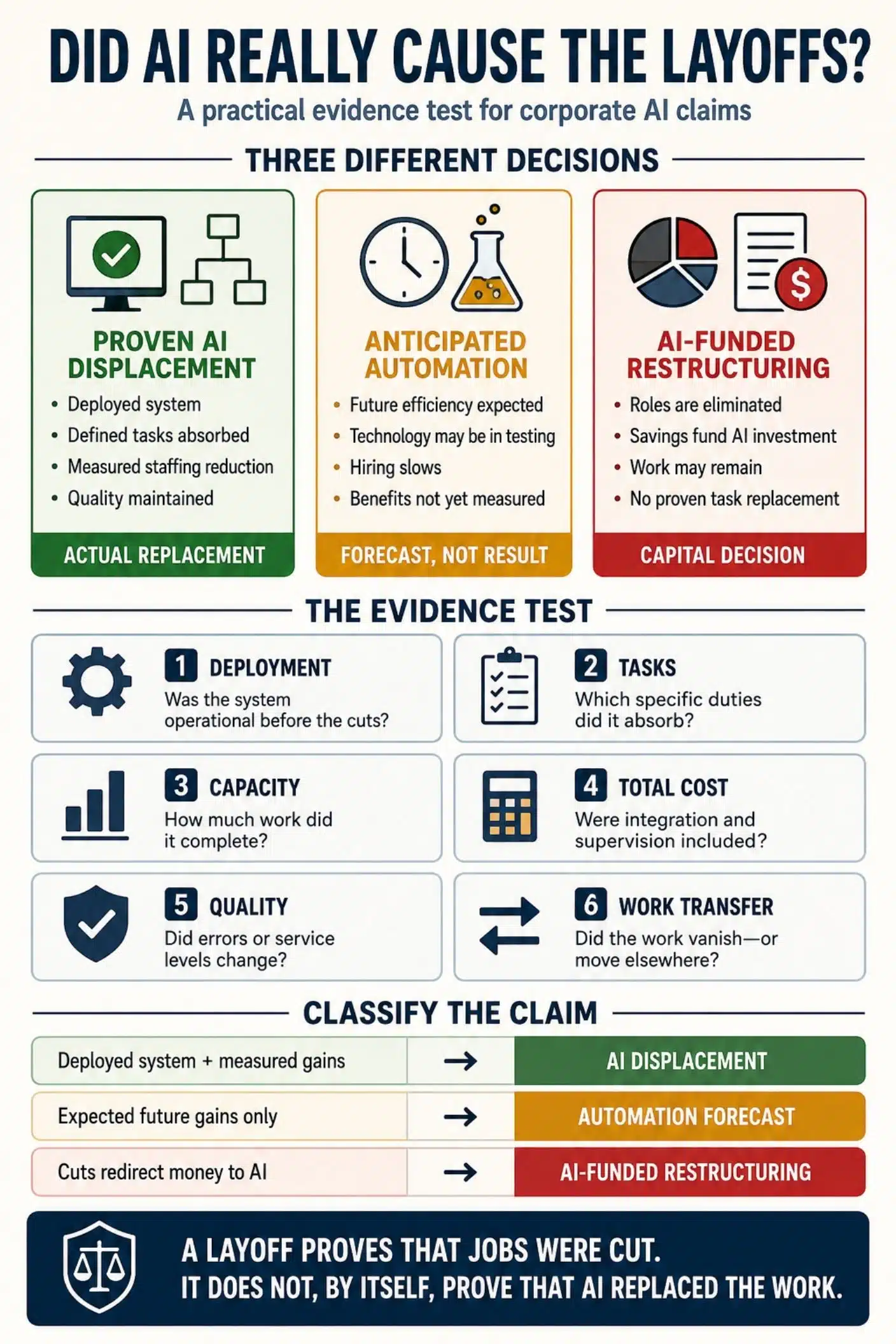
But AI layoffs are not always evidence that AI replaced anyone. Sometimes a working system has genuinely absorbed the work. Sometimes management expects that to happen later. And sometimes jobs are cut simply to free money for AI investment.
Those are different decisions, and companies should stop presenting them as one.
I am not arguing that AI will leave employment untouched. It is already changing customer support, administration, software development and other forms of digital work. What I reject is the habit of presenting anticipated efficiency as a result that has already been achieved.
An AI Label Does Not Prove What Caused the Cut
Through July 2026, employers cited AI in 112,713 announced job cuts, according to Challenger, Gray & Christmas. That represented roughly 24% of all cuts the firm tracked during the period. The key word is cited.
A company may reduce staff after software successfully takes over specific tasks. It may stop replacing departing employees because executives expect greater automation. It may cut one department to fund an AI team. Or it may be responding to weak growth, investor pressure, earlier overhiring or a broader restructuring.
In all four cases, AI may appear in the announcement. Only the first shows that the technology had already replaced the work.
If jobs are cut to finance AI development, that is a capital decision. If hiring is reduced because automation is expected to improve, that is a bet on the future. Neither should be presented as proof that AI has already made workers unnecessary.
Some AI-Related Job Losses Are Real
Denying genuine displacement would make this argument dishonest. Salesforce CEO Marc Benioff said the company cut 4,000 customer-support positions because AI reduced its staffing requirements. That is a direct claim involving a defined business function.
Klarna also reported that its AI assistant was doing work equivalent to 700 full-time customer-service agents. That figure is often repeated as though the company fired exactly 700 people and replaced each of them with a chatbot. That is not what happened. Klarna’s wider workforce reduction occurred largely through attrition, and the company later placed more emphasis on balancing automation with service quality and human support.
The distinction matters. Equivalent capacity is not the same as employment history.
AI may answer routine questions more quickly, but speed is only one measure of useful service. A system may still struggle with unusual cases, distressed customers or problems that require judgment. When the remaining employees must correct its mistakes and handle every difficult case, part of the workload has been moved rather than removed.
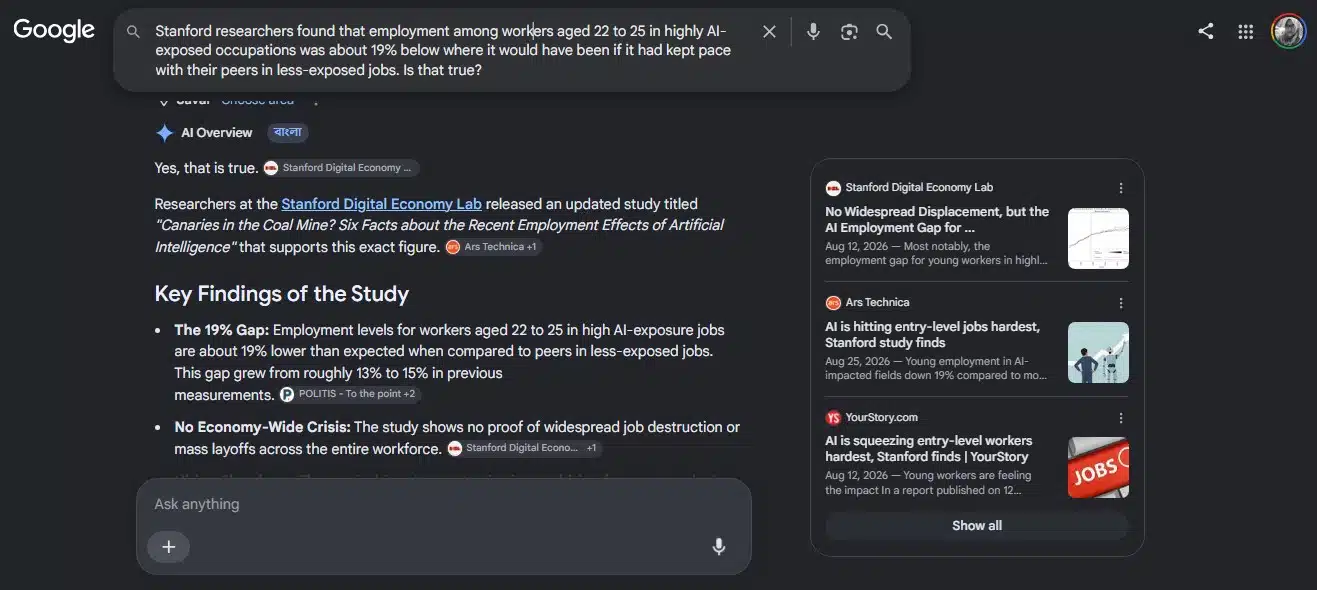
We also need to look beyond announced layoffs. Stanford researchers found that employment among workers aged 22 to 25 in highly AI-exposed occupations was about 19% below where it would have been if it had kept pace with their peers in less-exposed jobs. The researchers did not claim that AI caused the entire difference, but they found that the gap was appearing mainly through reduced hiring.
The first sign of displacement may not be someone losing a job. It may be an entry-level position that is never created.
That creates a longer-term problem. Junior work is often repetitive, but it is also where people learn judgment, context and professional habits. If companies automate the apprenticeship stage, they may later discover that they have fewer experienced workers to promote.
The Corporate Story Is Running Ahead of the Results
The broader evidence does not yet support the idea that AI is replacing employees throughout the economy on the scale suggested by some announcements.
A 2026 study involving nearly 6,000 executives in the United States, United Kingdom, Germany and Australia found that around 70% of firms were using AI. Yet more than 80% reported no effect on employment or productivity during the previous three years.
Executives expected stronger productivity and modest employment reductions in the future. Those expectations may guide investment, but a forecast is not a measured result.
Meta’s experience offers a useful warning. According to a Reuters investigation, the company considered reducing some teams by as much as 60% and reorganizing work around AI-supported groups. Plans for further broad cuts were later abandoned after internal evidence suggested that the technology was not meeting productivity expectations and operational problems were increasing.
Atlassian provides a different example. When it announced approximately 1,600 job cuts, the company said the restructuring would help fund investment in AI and enterprise sales while improving its financial position. It also said its approach was not simply about replacing people with AI.
That may be a legitimate business choice. But cutting employees to pay for AI is not evidence that AI was already doing their jobs.
The AI Layoffs Story Makes a Management Decision Sound Inevitable
This is where the language becomes more than a technical detail.
Calling layoffs an “AI strategy” can make a management choice sound like an unavoidable technological event. It shifts attention away from who approved the cuts, what alternatives were considered and whether previous business decisions contributed to the problem.
There is also an obvious incentive to frame reductions this way. Investors want evidence that enormous spending on AI will eventually produce higher margins. When Block announced more than 4,000 job cuts as part of an AI-focused overhaul, its shares rose sharply in after-hours trading. That reaction was not solely about the layoffs, but anticipated efficiency clearly formed part of the story.
I am not suggesting that every company mentioning AI is deliberately misleading people. I am saying that when the market rewards an AI efficiency narrative, the evidence behind that narrative deserves closer scrutiny.
Otherwise, cutting jobs can start to look like proof of innovation, even when the promised technology is still being tested.
If AI Caused the Layoffs, Show the Evidence
Companies publicly attributing significant workforce cuts to AI should be subject to a formal disclosure standard.
They should explain:
- Which tasks were automated and how much work the system absorbed
- Whether the technology was fully operational or still being tested
- How productivity changed before and after deployment
- Whether error rates, customer satisfaction or service quality changed
- How much human review and correction the system still requires
- Whether work moved to contractors or the employees who remained
- What retraining or redeployment options were offered
- Whether savings remained after infrastructure, integration and supervision costs
Companies should then report six or twelve months later on whether the promised gains appeared.
This would not prevent automation or force businesses to preserve every existing role. It would simply require companies to support a serious public claim with serious evidence.
Workers should also be consulted before systems are used to redesign their jobs. Employees often understand the exceptions, failure points and informal responsibilities that do not appear in a process diagram. Their involvement can help a company decide where AI is useful, where human oversight is still necessary and which employees can be retrained rather than dismissed.
I Support AI Adoption, Not AI as an Alibi
I support using AI to remove repetitive work, improve services and help employees focus on work that requires judgment. Jobs have never remained unchanged forever, and responsible AI adoption does not mean protecting every task from automation.
My concern is who carries the risk when the promised efficiency fails.
Executives can describe layoffs as a strategy and move on to the next quarterly report. Workers carry the loss of income, disrupted careers and the suspicion that they were removed for a future that had not actually arrived.
That imbalance makes honest disclosure the minimum companies should owe them. AI will change how work is done. It may reduce some roles and create others. What it should not provide is an easy way to rebrand ordinary cost-cutting as technological progress.
Technology can change the world. It cannot accept responsibility for a management decision. If AI caused the layoffs, show the evidence. If it did not, call the decision what it was.