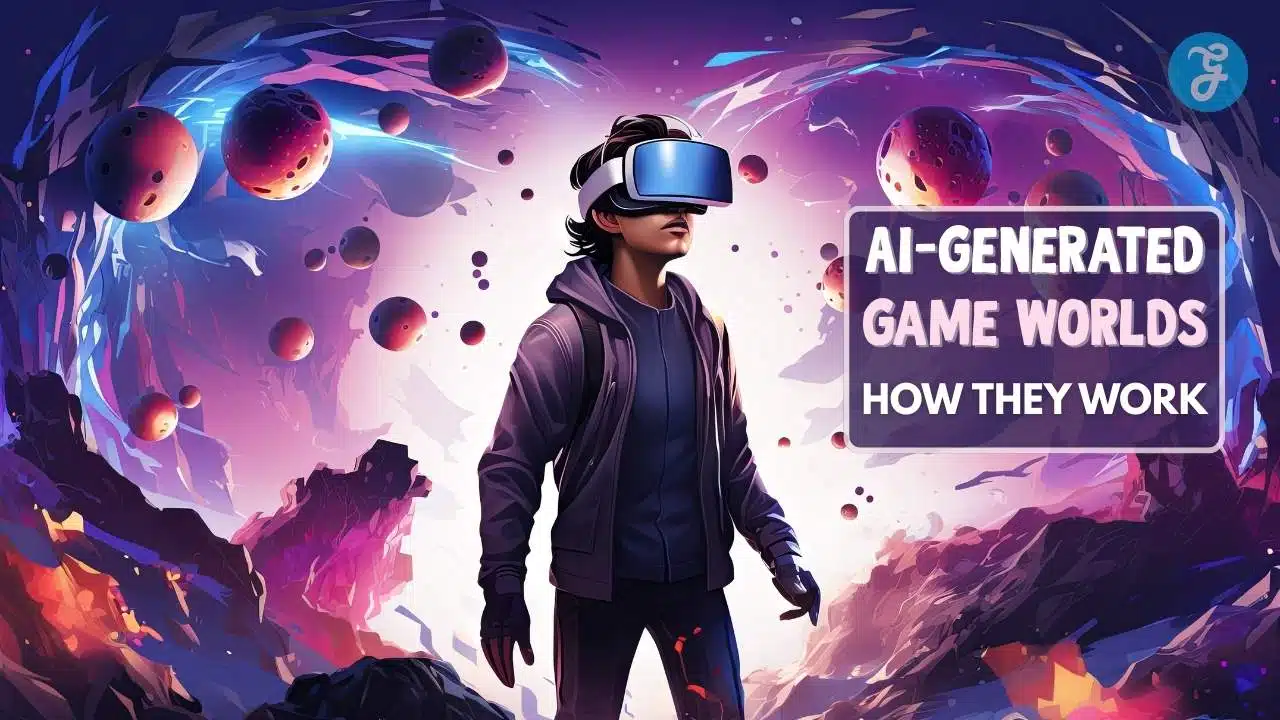
For most of gaming history, worlds were finite. Designers built a map, placed every tree, tuned every enemy encounter, and wrote every line of dialogue. Once you finished the story and cleared the side quests, there was little left to discover.
Now, that model is breaking.
With AI-generated game worlds, environments can keep changing after launch. Cities can expand, factions can rise and fall, and new stories can appear even years into a game’s life. The promise is simple but radical: worlds that feel less like static products and more like living spaces.
This shift builds on older ideas like procedural content generation, which used mathematical rules to create dungeons, maps, and loot. Today, generative AI and machine learning push this further. Instead of only randomising layout or enemy positions, AI can help shape the terrain, write quests, simulate societies, and power NPCs that talk and react in real time.
AI-generated game worlds will not just make games bigger. They will change how games are made, how players experience them, and how the business of gaming works. The stakes are high: done well, AI in gaming could unlock creativity and new genres; done badly, it could flood the market with low-effort, generic “AI slop.”
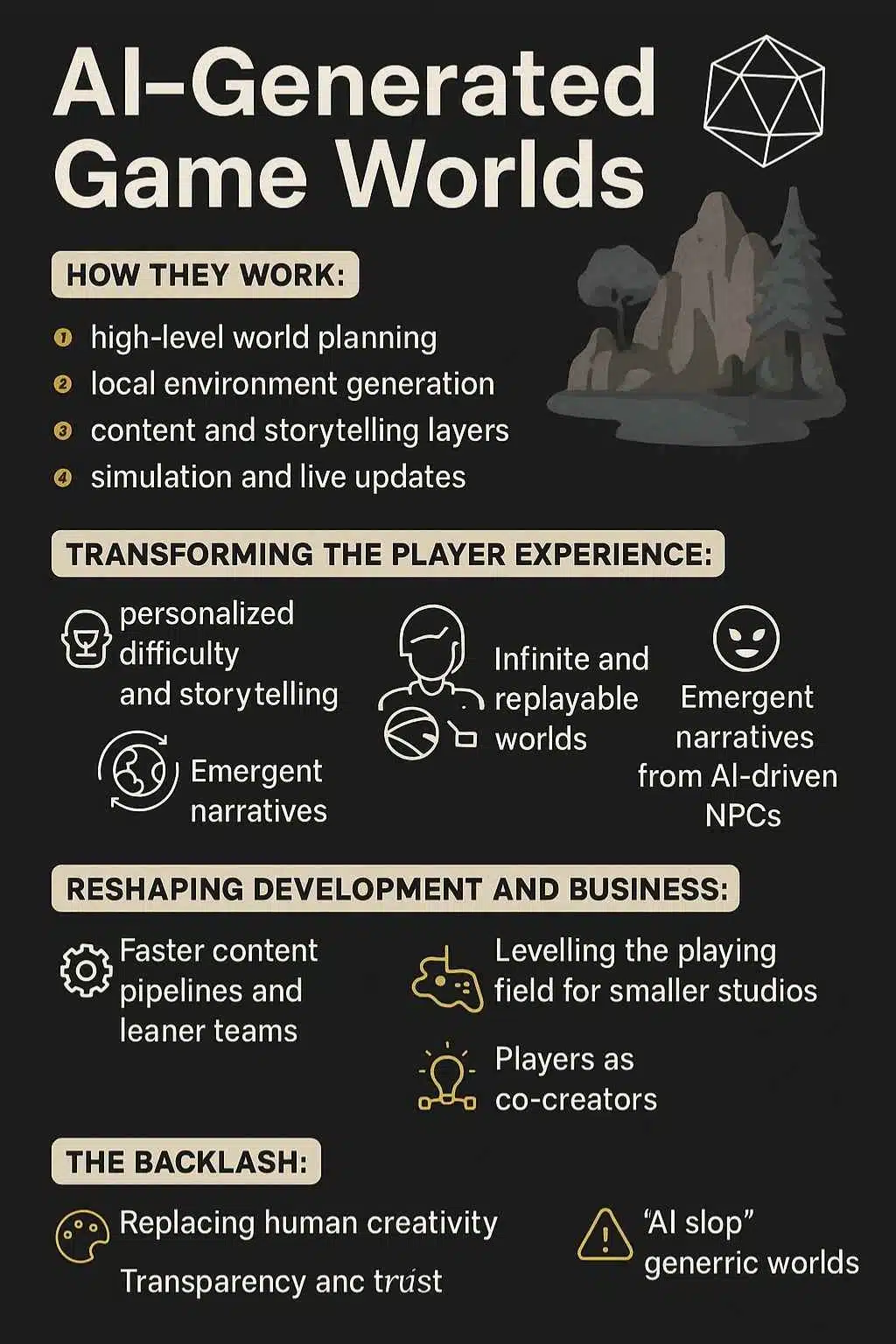
How AI-Generated Worlds Actually Work
Let’s break down the technology behind AI-generated game worlds—showing how generative models, procedural systems, and simulations combine to build environments, stories, and NPC behavior.
From Rules to Models
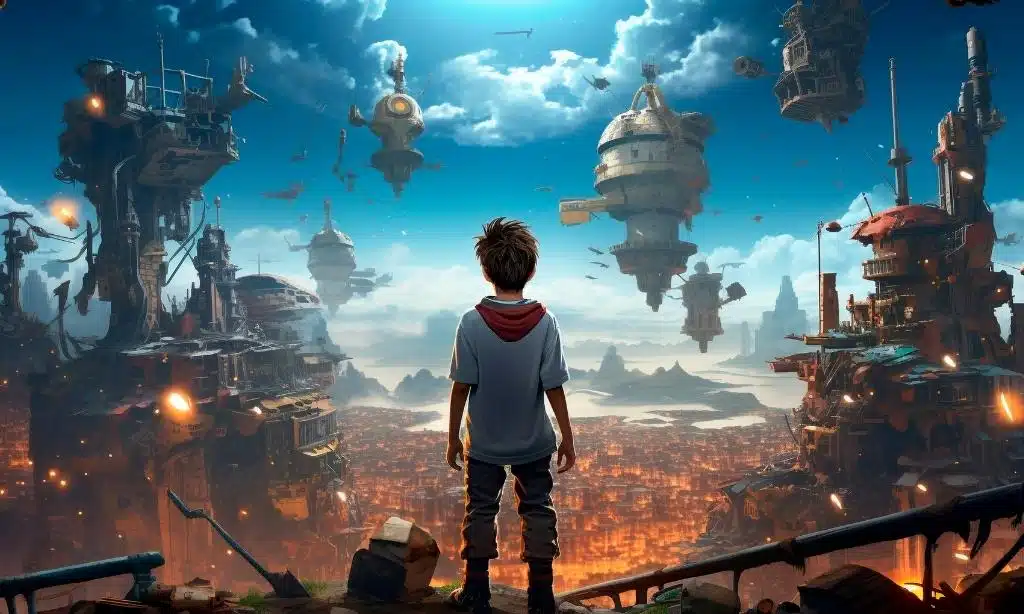
Traditional procedural content relied on fixed rules. Designers wrote algorithms that told the game how to generate a cave, a forest, or a city. These systems were powerful but limited. They needed heavy manual tuning and still tended to feel repetitive over time.
AI-generated game worlds build on this foundation but swap hard-coded rules for learned patterns. Instead of telling the system exactly how a castle must look, developers train models on thousands of examples. The AI then learns the style and structure and can propose new castles, cities, or biomes that follow the same logic but are not simple copies.
In practice, this often means combining:
- Generative models for geometry and layout.
- AI tools for textures, lighting, and atmosphere.
- Procedural systems that stitch everything into a coherent world.
The result is not magic. It is a layered pipeline where AI is one of many tools. But it enables variety and speed at a scale that manual workflows cannot reach.
The Tech Stack Behind AI-Generated Game Worlds
Inside a modern engine, AI-generated worlds often follow a staged process:
- High-level world planning
- The system decides where continents, regions, or major zones should be.
- It assigns climate, biomes, and rough resource distribution.
- Local environment generation
- Terrain models sculpt mountains, valleys, and rivers.
- AI-assisted tools place vegetation, roads, and settlements based on believable rules.
- Content and storytelling layers
- AI systems propose dungeons, quests, events, and loot tables.
- Generative models help write item descriptions, codex entries, and flavour text.
- Simulation and live updates
- Background agents simulate trade, weather, conflicts, and population movement.
- Events react to what players actually do in the world.
Major engines already integrate AI across this stack. Tools for level design, worldbuilding, and asset generation can suggest layouts, fill in detail, or upscale art. Designers still guide the process, but they no longer need to place every rock by hand.
NPCs as Part of the World Fabric
AI-generated worlds are not only about landscapes. Non-player characters are becoming part of the same generative fabric.
Instead of static dialogue trees, AI-driven NPCs can:
- Respond to free-form player questions.
- Remember past interactions and refer back to them.
- React to events in the world, such as a town being attacked or a faction gaining power.
These AI-driven NPCs turn the world into a network of relationships and stories. A player’s choices can ripple through the game in ways that feel less scripted, even if developers still set strong guardrails.
How AI-Generated Worlds Transform the Player Experience
AI-driven environments can adapt to your actions, play style, and decisions. Here, we explore how intelligent worlds create infinite replayability, personalized challenges, and emergent stories that feel truly alive.
Infinite and Replayable Worlds
One of the strongest promises of AI-generated game worlds is replayability. When a game can generate new dungeons, towns, or planets on demand, “game completed” becomes a softer concept.
Players might experience:
- New regions appear in a familiar map after in-game events.
- Seasonal changes that alter not only visuals but also gameplay.
- Entirely new storylines in long-running games without massive patches.
Instead of playing the same campaign twice, you might return to see how your world has changed. An old town could have been rebuilt after a war. A faction you weakened months ago might finally collapse.
That sense of continuity and surprise keeps players engaged over longer periods. It also supports live-service models, where games evolve over years instead of releasing rigid sequels.
Personalised Difficulty and Storytelling
AI in gaming also opens the door to personalisation. AI-generated game worlds can quietly adapt to each player’s behaviour.
A game might:
- Adjust enemy placement and tactics based on your play style.
- Tune the difficulty in the background to hit a “flow state” rather than abrupt spikes.
- Propose different quest paths depending on whether you favour combat, stealth, or exploration.
Narrative systems can also personalise stories. If you often help certain factions, the game’s AI can push more content that aligns with that choice. If you frequently explore side areas, AI can seed more secrets and discoveries where you tend to roam.
For accessibility, AI-generated worlds can modify pace and structure. Players who struggle with complex navigation can get clearer paths or more frequent checkpoints. Those who enjoy a challenge can experience tougher encounters and deeper systems.
Emergent Narratives from AI-Driven NPCs
When AI-generated worlds and AI-driven NPCs work together, emergent narratives become possible. Instead of only following a predefined campaign, players can experience stories that arise from the interaction between systems.
Examples include:
- A trader NPC raises prices after a monster invasion disrupts supply routes.
- A guard captain who becomes more suspicious of you if you are often seen sneaking around.
- A village that celebrates your victories—or fears your power—based on your actions.
These moments can feel less like scripted quests and more like anecdotes from a tabletop RPG session. They give players something valuable in the age of social media and streaming: unique stories worth telling.
How AI-Generated Worlds Reshape Game Development and Business
Faster Content Pipelines and Leaner Teams
Behind the screen, AI-generated game worlds change the economics of development.
Generating high-quality content is one of the most expensive parts of making a game. Every new zone, quest, or asset requires hours of work from artists, writers, and designers. AI can cut down the time required for many of these steps.
Studios can use AI to:
- Prototype levels and environments quickly.
- Generate early passes on art, then let human artists refine.
- Automate repetitive tasks like placing foliage or adjusting lighting.
- Run testing scenarios by simulating players, bots, and edge cases.
This does not mean games instantly become cheaper to make. Ambition tends to rise as tools improve. But it does mean teams can try more ideas, iterate faster, and support games for longer with more frequent content updates.
Levelling the Playing Field for Smaller Studios
For indie teams and smaller studios, AI-generated game worlds are especially attractive. They allow small teams to create worlds that once required AAA budgets.
A handful of developers can now:
- Build large maps with believable variation.
- Use AI to help write side quests, item descriptions, and lore.
- Experiment with complex systems, such as dynamic ecosystems or simulated economies.
This may lead to a wave of experimental titles that focus on clever use of AI-generated worlds rather than sheer production scale. It can also push larger studios to differentiate on creativity, polish, and brand, not just on how many hours of content they can afford.
Players as Co-Creators
AI-generated game worlds also blur the line between developer and player. With AI tools integrated into user-generated content systems, players can act as co-creators.
In practice, players might:
- Use in-game editors powered by AI to sketch a level that the system then fleshes out.
- Describe the kind of dungeon they want, and let AI build a prototype.
- Create factions, stories, or custom NPCs through guided AI prompts.
For studios, this can turn the game into a platform. Instead of shipping a fixed set of content, they host a growing ecosystem of AI-assisted creations. The challenge will be moderation and quality control, but the upside is a long tail of fresh content that keeps communities alive.
The Backlash: Jobs, Quality, and Trust
AI-generated content also raises concerns—from job displacement to worries about low-quality worlds. This section covers the challenges, skepticism, and trust issues developers must address.
The Fear of Replacing Human Creativity
As AI-generated game worlds become more common, so does concern about jobs and the future of human creativity. Many artists, writers, and designers fear being replaced by automated systems that can generate content faster and cheaper.
Reality is more complex. Some tasks will be automated. Repetitive work, such as creating many small variations of similar props or filling large spaces with background details, is already under pressure.
At the same time, new roles appear:
- AI tool specialists.
- World directors who guide AI systems instead of micro-managing every detail.
- Reviewers and curators who refine AI output and ensure coherence.
The core creative vision still needs humans. A model can generate ideas, but it cannot decide what a game should mean, what themes it should explore, or how a world should feel in emotional terms. The risk is not that AI ends creativity, but that some studios use it mainly for cost-cutting rather than to support creative ambition.
“AI Slop” and Generic Worlds
Another major concern is quality. If AI-generated game worlds become cheap to produce, the market could flood with shallow, formulaic games. Players have already reacted negatively when they feel AI has replaced human effort without care.
Common pitfalls include:
- Repetitive, soulless environments that feel assembled by a machine.
- Dialogue that sounds generic or inconsistent.
- Visual styles that mimic trends without any clear identity.
If studios rely too heavily on AI without strong art direction, the result will be “AI slop” — technically impressive, but emotionally empty. Players are already sensitive to this risk, especially in games that heavily advertise their use of AI.
Transparency and Player Trust
Trust will become a key competitive factor. Many players simply want to know where and how AI is used. They do not necessarily reject AI-generated game worlds, but they dislike feeling misled.
Studios can respond by:
- Being clear in marketing about the role of AI in development.
- Explaining which elements are AI-generated and how they are reviewed.
- Listening to community feedback on when AI use goes too far.
The more AI becomes a normal part of game production, the more valuable honest communication will be.
Ethical and Legal Questions Around AI-Generated Worlds
Training data, copyright, bias, and safety all become more complex when AI creates game assets. This section explains the major ethical and regulatory debates shaping the future of AI in gaming.
Copyright and Ownership
AI-generated game worlds raise difficult copyright questions. Game studios need data to train models. That data often includes art styles, code snippets, and design patterns created by others.
Key questions include:
- Were the training datasets collected and licensed fairly?
- Does AI-generated content infringe on existing works if it closely imitates them?
- Who owns a level or quest created partly by AI and partly by a player using in-game tools?
Different jurisdictions are experimenting with different answers. In the meantime, studios that rely on AI must think not only about what is technically possible, but also about reputational risk and long-term legal exposure.
Bias, Representation, and Safety
AI systems learn from human data, including human bias. In AI-generated game worlds, this can lead to skewed representations of cultures, genders, or social roles.
Potential issues include:
- NPC behaviours that reinforce stereotypes.
- World demographics that sideline certain groups by default.
- Generated dialogue that reproduces toxic language or harmful tropes.
To handle this responsibly, studios must add guardrails:
- Curated, diverse training data.
- Human review of AI-generated content.
- Tools to detect and filter problematic output.
Without safeguards, AI-generated worlds risk repeating the worst parts of the internet instead of offering fresh, inclusive experiences.
Regulation and Age-Rated Content
Because AI-generated game worlds can change constantly, regulators and ratings boards face new challenges. Age ratings usually evaluate a relatively fixed set of content. AI complicates that.
Future policy discussions will likely focus on:
- How to rate games where content can vary widely between players.
- Whether some AI systems need to be disabled or limited for younger audiences.
- How to log and review AI-generated events and dialogue for compliance reasons.
Studios that get ahead of these issues — with clear controls and transparent logs — will be in a stronger position than those that wait for regulations to catch up.
The Next Decade of AI-Generated Game Worlds
From early-use tools to fully persistent universes, this section outlines how AI-generated worlds may evolve—and how these technologies could redefine long-term game design.
Short Term: AI-Assisted, Human-Directed
In the near term, AI-generated game worlds will mostly assist existing workflows.
Designers will still define the core structure of a game, but AI will help:
- Block out levels.
- Populate spaces.
- Propose variations during playtesting.
Players may not always notice that AI is involved, beyond occasional mentions in marketing. The main benefits will be more content and quicker updates, especially in live-service titles.
Medium Term: Persistent, Player-Responsive Worlds
Over the next few years, the impact will become more visible.
AI-generated game worlds are likely to become:
- Persistent, with changes that carry over between sessions.
- Heavily shaped by collective player behaviour.
- Supported by AI systems that run simulations even when no one is online.
Events might be less scripted and more systemic. A war between in-game factions, for example, could unfold over months based on the outcome of thousands of player actions, guided by AI agents that interpret those actions.
Long Term: Living, Cross-Media Universes
Further ahead, AI-generated game worlds may extend beyond a single game client. The same world could appear in a mainline RPG, a mobile spin-off, and an immersive VR experience — all updated by shared AI-driven systems.
In that scenario:
- Characters you meet in one medium might remember you in another.
- Events in one game could reshape the lore across an entire franchise.
- Worlds would feel less like products and more like ongoing digital societies.
Whether this vision becomes reality will depend not only on technology but also on business models, regulation, and player appetite for such deep immersion.
How Studios Can Harness AI-Generated Worlds Responsibly
AI is powerful, but it must be used cleanly and transparently. This section explains how studios can integrate AI ethically while keeping human creativity at the center of worldbuilding.
Keep Humans in Charge of the Vision
The most promising path for AI-generated game worlds keeps human creatives firmly in control. AI should support a vision, not define it.
Practical steps include:
- Using AI for exploration and iteration, not final decisions about tone or themes.
- Setting clear artistic guidelines that AI tools must follow.
- Treating AI as a collaborator that can be overridden at any time.
When players can feel a coherent voice behind a world, they are more likely to accept AI’s role in building it.
Build Ethical and Transparent AI Pipelines
Responsible studios will approach AI-generated game worlds as part of a broader governance framework.
That means:
- Documenting where AI is used in the pipeline.
- Training teams on bias, safety, and copyright concerns.
- Running regular reviews of AI-generated assets and systems.
Transparency is not only a moral issue but a brand asset. Being open about how AI in gaming works can build trust with players, partners, and regulators.
Involve the Community
Finally, AI-generated game worlds offer a chance to rethink how communities participate in development. Instead of quietly rolling out AI features, studios can involve players in the process.
They can:
- Share roadmaps for AI features and ask for feedback.
- Offer opt-in modes for experimental AI systems.
- Highlight community stories born from AI-driven events and NPCs.
If players feel included and respected, AI-generated worlds can become a selling point rather than a controversy.
Final Thought: The New Frontier of Game Worlds
AI-generated game worlds mark a turning point for interactive entertainment. They take the old dream of infinite, reactive worlds and make it more practical than ever.
For players, AI-generated game worlds promise more dynamic, personalised experiences. For developers, they offer new tools to create ambitious projects and support games over longer lifespans. For the industry, they raise serious questions about labour, ethics, and quality.
The technology alone will not decide the outcome. What matters is how studios choose to use it, how communities respond, and how rules and norms evolve.
If handled with creativity, care, and transparency, AI-generated game worlds can help gaming move from static maps to genuinely living universes — places that grow with us, remember our stories, and keep surprising us long after the credits should have rolled.