International payments can stall after the sender clicks “pay.” Banking hours, currency conversion, compliance checks, and local payout systems all affect when the recipient can actually use the money. The growing use of stablecoins in international payments is changing parts of that process, particularly the settlement step between financial institutions.
Recent developments show the difference between a promise and a working service. Visa reported a live cross-border settlement pilot with Lloyds in September 2026, followed by a separate commercial rollout of stablecoin prefunding through Inyo Global in October. Neither announcement means every international transfer now arrives instantly.
For businesses, freelancers, and families, stablecoin cross-border payments raise a practical question: does the complete route deliver usable money at a better cost, with acceptable risk? These seven changes explain where the technology helps and where ordinary payment problems remain.
How Stablecoins in International Payments Work
A stablecoin is a digital token designed to maintain a value linked to a reference asset, often a national currency. A dollar-linked token aims to stay close to $1. That target does not guarantee its market price, redemption availability, or the safety of every service handling it. Stablecoins also use different backing arrangements, so they should not be treated as interchangeable.
A payment can involve three stages:
- Funding: The sender or a payment provider converts conventional money into a supported stablecoin.
- Settlement: The token moves between compatible wallets or institutions over a blockchain.
- Payout: A provider converts it into the recipient’s preferred currency and delivers the money through a supported local channel.
Some recipients choose to keep the token instead. Others never see it because their provider manages the digital asset in the background. Circle’s managed payments service is one documented example of institutions using stablecoin settlement while continuing to work in conventional currencies.
Each stage has its own timing, fees, and eligibility requirements. A completed blockchain transfer therefore does not, by itself, prove that a recipient’s bank account has been credited.
1. Moving Settlement Beyond Banking Hours
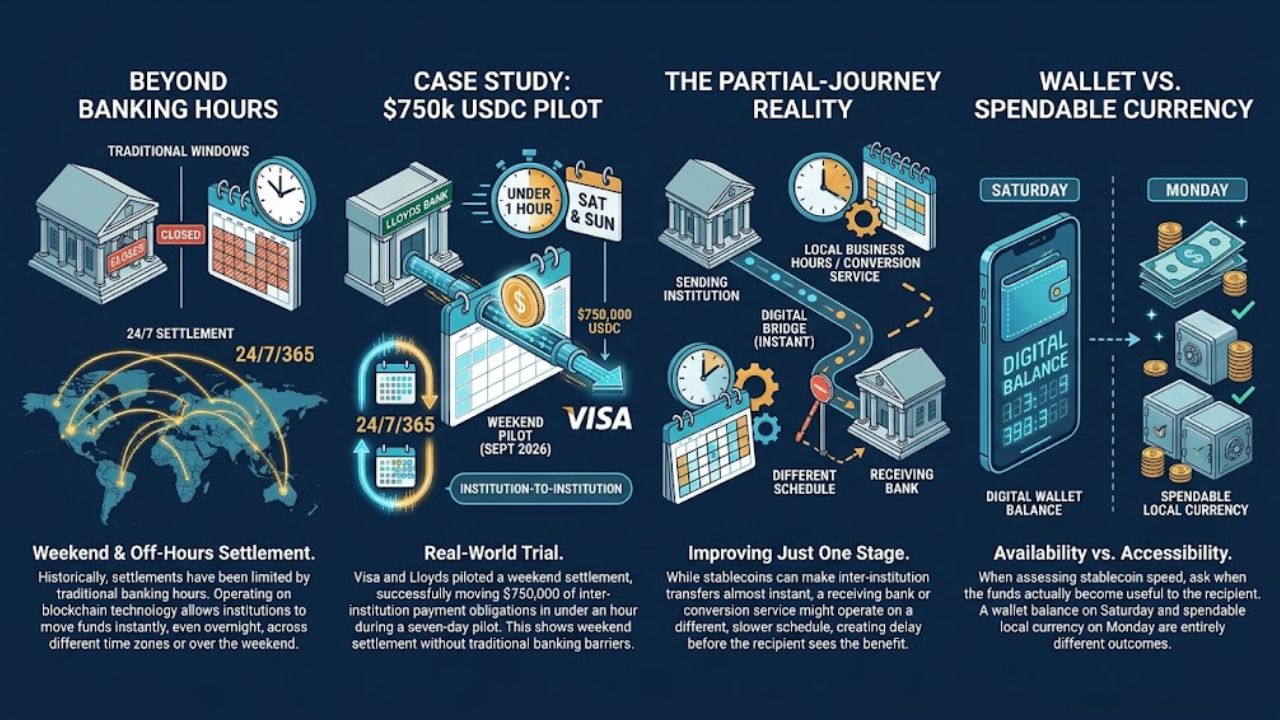
The most visible change is the ability to move settlement funds outside traditional banking windows. That can matter when two institutions operate in different time zones or need to settle an obligation over a weekend.
In a September 30, 2026 announcement, Visa said Lloyds had used USDC to settle $750,000 of payment obligations during a seven-day pilot. Funds reached Visa in under an hour, including over the weekend. The trial concerned settlement between institutions, rather than a new consumer payment method.
This illustrates how stablecoins in international payments can improve one part of the journey. A receiving bank or conversion service may still operate on a different schedule.
When comparing stablecoin cross-border payments, ask when funds become available in the form the recipient needs. A wallet balance on Saturday and spendable local currency on Monday are different outcomes.
2. Putting More Pressure on Transfer Costs
A low blockchain fee can make a payment look inexpensive. The full bill may also include buying the token, currency conversion, provider charges, and withdrawing into a bank account.
An October 19, 2026 BIS working paper compared banks, fintech money transfer operators, and stablecoin routes. Its findings show that conversion and withdrawal costs can substantially increase the total price of a token-based transfer. Established fintech services can also be competitive. The paper does not support a universal claim that stablecoins are cheapest.
The competitive value of stablecoins in international payments depends on the particular route. A well-supported currency pair can produce a different result from a market with limited conversion liquidity.
Compare stablecoin cross-border payments using the amount the recipient receives after every charge. Request quotes for the same sending amount, destination, payout currency, and delivery method. Comparing a wallet transfer with a bank deposit can hide meaningful differences.
3. Giving Payment Providers More Flexible Funding Options
Before a provider pays recipients, it needs access to funds. Keeping money ready for payouts is called prefunding. Traditional funding windows can make that task harder around holidays or sudden changes in payment demand.
On October 15, 2026, Visa announced that Inyo Global had brought Visa Direct’s stablecoin-enabled prefunding capability into commercial production. Eligible clients could fund cross-border payouts with USDC in near real time, subject to availability and geographic restrictions.
For providers, stablecoins in international payments offer another way to supply settlement funds when needed. More flexible funding may help operations respond to demand, although the announcement does not establish a universal reduction in working capital.
Stablecoin cross-border payments still require liquidity somewhere in the system. A local payout partner needs the relevant currency, and a sender must obtain the tokens. Faster movement changes how funding can be managed; it does not create money or remove those obligations.
4. Adding Payout Choices for Eligible Freelancers and Sellers
Global platforms need ways to pay people across multiple markets. A supported stablecoin wallet can become another payout destination alongside conventional account options.
Stripe’s Connect documentation provides a specific example. Its stablecoin payout feature lets approved US-based platforms keep their platform balance in conventional currency while Stripe handles conversion and pays supported recipients in USDC. The documentation checked for this article labels the feature a private preview and limits recipients to eligible individuals or sole proprietors in supported countries. Companies and nonprofits are not currently supported through that feature.
Those restrictions matter when assessing stablecoins in international payments. A platform’s technical capability does not establish that every freelancer can legally receive or withdraw funds through it.
For workers considering stablecoin cross-border payments, local access matters as much as the incoming transfer. Confirm the permitted receiving method, conversion route, withdrawal fees, and records required for income reporting. Editorialge’s guide to fintech tools for freelancers receiving global payments offers related conventional options to compare.
5. Bringing Blockchain Settlement Behind Familiar Interfaces
Using a stablecoin payment route does not always require a customer to choose a blockchain or manage a wallet. A provider can handle those tasks between a conventional sending account and a conventional receiving account.
Circle announced CPN Managed Payments on April 8, 2026. The company says the service allows participating institutions to work in conventional currencies while it manages functions including USDC issuance and redemption, payment orchestration, compliance controls, and blockchain infrastructure. These are documented provider capabilities, rather than evidence that every supported payment has the same cost or delivery time.
This makes stablecoins in international payments relevant even to businesses that do not want direct digital asset exposure. They may buy a payment service whose internal settlement method changes while their accounting remains in familiar currencies.
With managed stablecoin cross-border payments, the contract deserves close attention. Establish who holds funds at each stage, who handles a failed payout, and which company owes the customer a refund. A simple interface can still sit above a complex chain of responsibilities.
6. Connecting Payment Instructions More Closely to Software
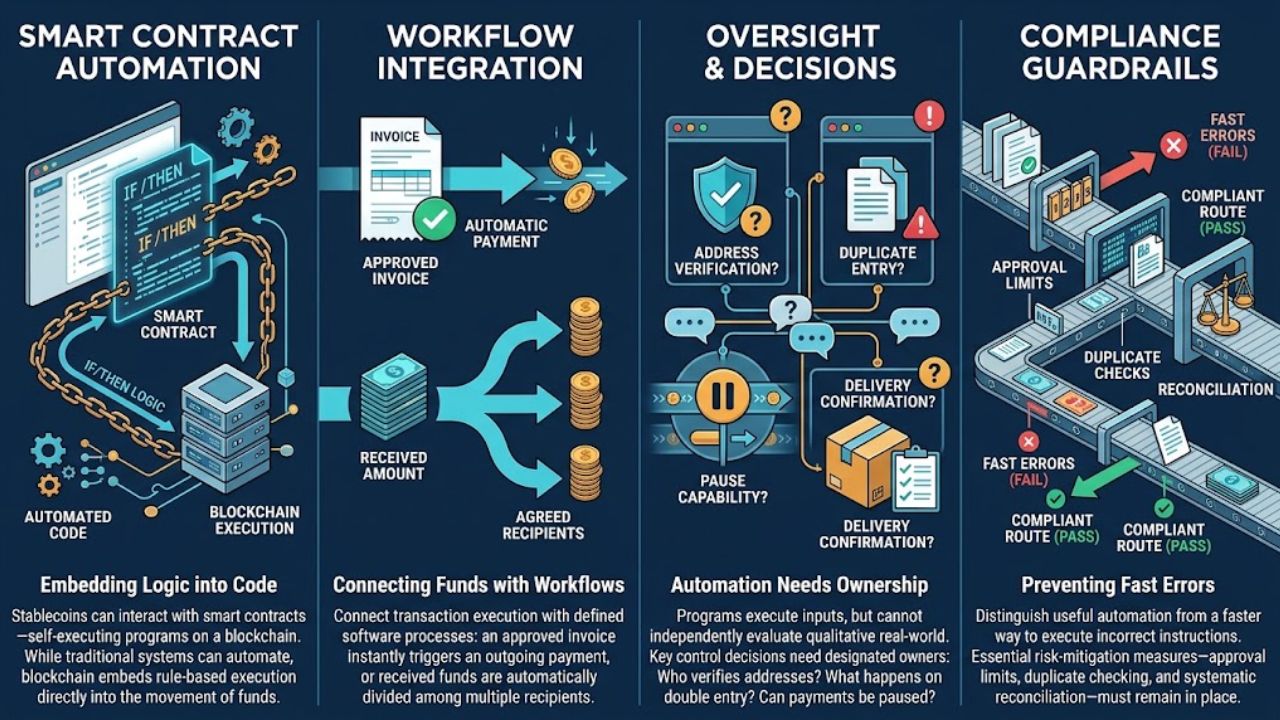
Stablecoins can work with smart contracts, which are programs that execute specified instructions on a blockchain. The BIS identifies this programmability as a feature of the technology, while also noting that many automated functions can be implemented through conventional infrastructure.
The practical opportunity for stablecoins in international payments is to connect movement of funds with a defined workflow. As an illustrative design, an approved invoice could trigger a payment instruction, or software could divide a received amount among agreed recipients. These are possible applications, rather than claims that every provider offers them.
Automation also creates decisions that need an owner. Who approves the destination address? What happens if an invoice is entered twice? Can a payment be paused before submission? A smart contract cannot independently determine whether a supplier delivered acceptable work unless it receives reliable information.
Businesses evaluating stablecoin cross-border payments should distinguish useful automation from a faster way to execute an incorrect instruction. Approval limits, duplicate checks, and reconciliation still belong in the process.
7. Changing What Payment Teams Need to Verify
A bank account number and currency are no longer the only details that may matter. Token-based payments can also require checks on the asset, blockchain, custody arrangement, issuer, and conversion provider.
The change is especially important when a transfer goes wrong. Circle states that completed USDC and EURC transfers cannot be reversed or recalled by Circle. Its ability to block certain addresses is a separate mechanism, used in limited circumstances. Freezing an address should not be confused with recovering a mistaken payment.
For stablecoin cross-border payments, operational checks should cover:
- The exact token and network accepted by the recipient.
- The provider’s authorization and availability in both jurisdictions.
- The recipient’s ability to convert or spend the proceeds.
- The agreed process for failed, delayed, or disputed payments.
Relevant foreign-exchange, sanctions, tax, and reporting rules must also be checked for the actual transaction. Access to a wallet is not evidence that a payment route is permitted locally.
Compare the Whole Payment Journey Before Switching
The useful comparison is between two complete services for the same payment. Set the sending amount, destination, recipient currency, and required arrival time before requesting quotes.
| Check | What to establish |
| Total cost | How much local currency arrives after every fee and conversion |
| Delivery | When the recipient can use the money, including weekends |
| Eligibility | Whether the sender, recipient, and payment purpose are supported |
| Responsibility | Which provider handles delays, failures, complaints, and refunds |
| Risk | Who bears token-price, custody, and conversion exposure |
| Records | Which documents show the invoice, payment, conversion, and final receipt |
Consider a simple illustrative comparison. If one route costs $12 in total and another costs $18 for the same $1,000 payment and equivalent payout, the difference is $6. A tiny network fee does not change that arithmetic if conversion makes the overall route more expensive.
For recurring business payments, keep the quote and compare it with the actual amount received. Check the first payment’s records before scaling up. That gives the finance team evidence about the route it will use, rather than a broad claim about the technology.
Final Thoughts
The clearest changes from stablecoins in international payments are more flexible settlement hours, new funding methods, and additional ways to build payout services. Their value varies by market, provider, and the recipient’s needs.
Evaluate stablecoin cross-border payments by the money that arrives, when it becomes usable, and the protections available if something fails. For some routes, the result may be a useful improvement. For others, a conventional bank or fintech service may offer a better overall outcome.
Frequently Asked Questions
Are Stablecoins in International Payments Safe?
Safety depends on the issuer, custody provider, network, and payout route. Risks include losing the currency peg, account restrictions, fraud, and mistaken transfers. A token’s stable-price target does not guarantee the safety of the whole transaction.
Are Stablecoin Cross-Border Payments Cheaper Than Bank Transfers?
Sometimes, but conversion spreads, provider fees, and withdrawal charges can remove the advantage. Compare the recipient’s final amount with both a bank quote and a conventional money transfer service.
How Long Does a Stablecoin Transfer Take?
Timing depends on the network, provider, and compliance process. Blockchain settlement may complete before the recipient receives local currency, so ask for the expected end-to-end delivery time.
Can a Stablecoin Payment Be Reversed?
Do not assume it can. Circle says completed USDC and EURC transfers cannot be recalled by Circle. A refund generally requires a separate return payment or another recovery process; address blocking is different from reversal.
Can Stablecoins Be Sent to a Bank Account?
A supporting provider can convert tokens into conventional currency and arrange a bank payout. The bank deposit depends on supported countries, currencies, verification requirements, fees, and local processing times.