
You land at Noi Bai at 11 p.m., your Grab won’t load, and the SIM counter just pulled its shutter down. Fun. Getting online in Vietnam is cheap. Really cheap. But the rules changed in 2026, a popular messaging app got blocked in 2025, and the “best” carrier in Ho Chi Minh City can leave you with zero bars on a Ha Giang mountain pass.
This Vietnam travel connectivity guide covers what to buy, where to buy it, and the small mistakes that leave travelers offline at the worst possible moment.
The Quick Answer: What Most Travelers Should Do
If you’re going anywhere north of Hanoi (Sapa, Ha Giang, Cao Bang), get a Viettel SIM or eSIM. If you’re sticking to Hanoi, Hoi An, Da Nang, and Ho Chi Minh City, any of the big three carriers works, and a prepaid travel eSIM set up before you fly is the easiest path. That’s the core of any Vietnam travel connectivity guide worth reading, and everything below explains the why.
| Your Trip | Best Pick | Why |
|---|---|---|
| Cities only, short stay | Travel eSIM bought before you fly | Works the second you land |
| North loop (Sapa, Ha Giang) | Viettel SIM or eSIM | Strongest rural coverage |
| Two weeks or longer | Local Viettel tourist SIM | Cheapest data per GB |
| Late night arrival | eSIM, then local SIM later | Airport counters may be closed |
Vietnam’s Three Carriers [Compared Honestly]
Vietnam has three carriers that matter. Here’s how they actually stack up in this Vietnam travel connectivity guide:
Viettel is the giant, with more than half the market, and it’s the one travelers keep recommending for good reason. It’s often the only signal on remote roads. Viettel launched Vietnam’s first commercial 5G in October 2024 and claimed 90% outdoor 5G coverage by December 2025.
Vinaphone (run by VNPT) posts the fastest median 5G speeds in recent tests and works great in cities. In the mountains? Much weaker.
MobiFone does fine in towns and the Mekong Delta. Travelers report weak indoor signal in some city hotels and dead zones in rural Quang Binh, so it’s the one to skip if you’re heading off the main tourist trail.
There’s also Vietnamobile, which is cheap but has no 5G and mostly works only in Hanoi and Ho Chi Minh City.
Local SIM vs eSIM: The Real Math
Here’s the catch: the eSIM ads make it sound like a local SIM is some painful ordeal. It isn’t. It’s 10 minutes at a counter with your passport.
The difference is price. Local Viettel tourist plans run roughly 120,000 VND (about $5) for 30 days with 2 GB of fast data per day plus calls, while some data plans cost even less. Prices shift often, and airport counters charge roughly 10 to 15% more than city stores. Still cheap.
International eSIMs cost more per GB. Airalo, for example, lists about $11.50 for 5 GB over 30 days. That’s still pocket change, and for many travelers the convenience is worth it. You land, switch it on, and order your Grab before you reach baggage claim.
One thing most eSIM shoppers miss: many international eSIMs ride on Vinaphone or MobiFone, not Viettel. In cities, you won’t notice. On the Ha Giang loop, you will. Check which network a plan uses before you pay, and pick a Viettel option if you’re heading north.
My Advice: Before buying an eSIM, check your phone. It can’t be locked to your home carrier, and it has to support eSIM. Most iPhones from the XR and XS onward, plus recent Samsung Galaxy and Google Pixel models, support it.
The 2026 SIM Rules Nobody Warns You About
This part of any Vietnam travel connectivity guide changed this year, and most older articles haven’t caught up.
Vietnam has required SIM registration for years. Now it’s stricter. A circular that took effect on April 15, 2026 (Circular 08/2026/TT-BKHCN) requires facial biometric verification when new subscriptions activate, and it requires users to verify their face again when they move a SIM to a different phone. Miss that second check and your outgoing calls and texts stop within two hours.
What does that mean for you?
- Bring your physical passport to the counter: A photocopy or a photo on your phone won’t work, and you should expect staff to take your picture.
- Skip street sellers: A SIM registered under someone else’s name might work for a day, then die mid trip.
- Don’t swap the SIM between phones: If your phone breaks, a new handset can trigger a fresh face check.
- Buy from official carrier counters or stores: Convenience stores sell top ups, but they usually can’t register new SIMs.
Older phones have another problem. Vietnam shut down 2G in October 2024 and plans to close 3G in 2028, so a phone without 4G is close to useless here.
City-by-City Coverages From Hanoi to Phu Quoc
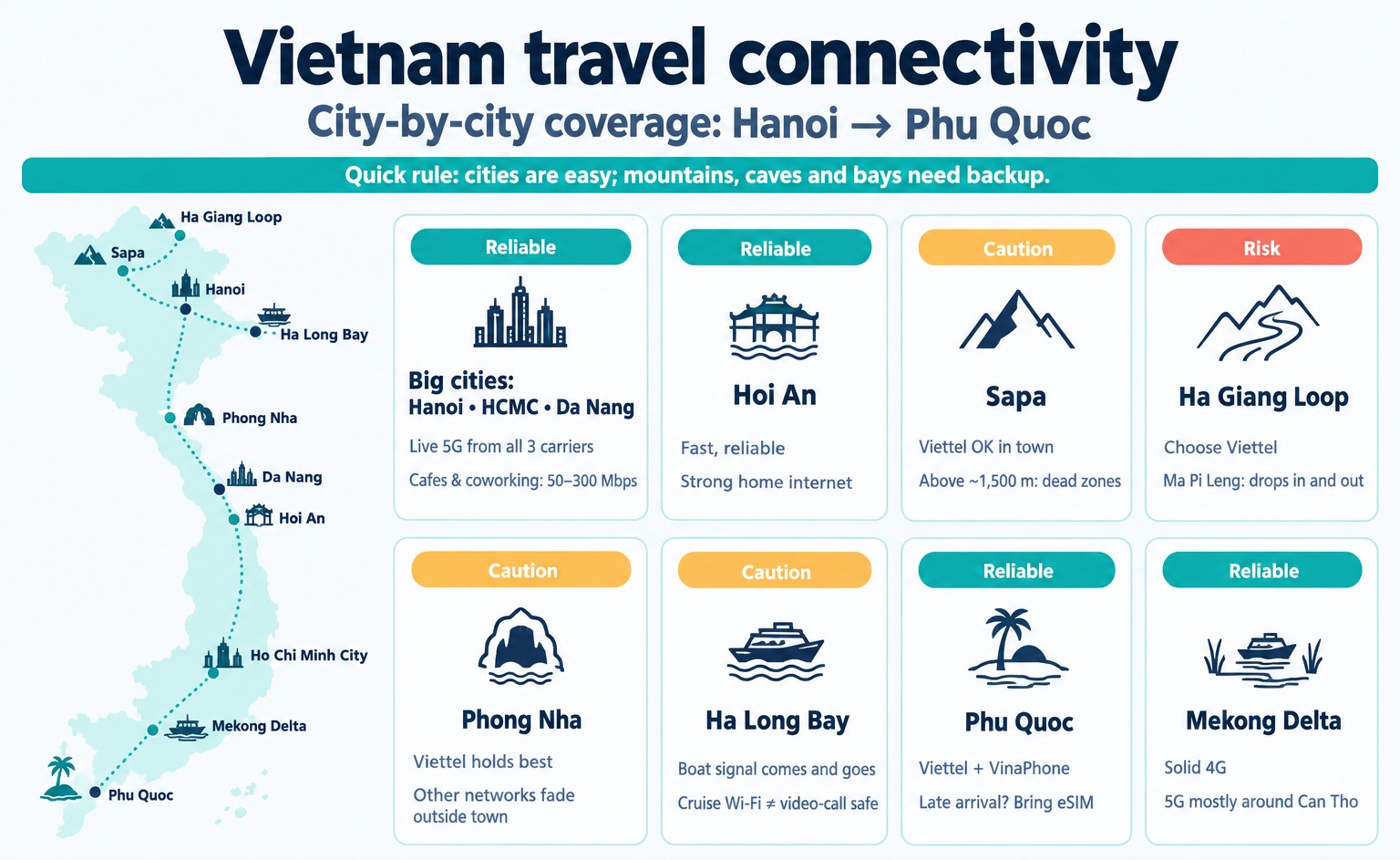
Coverage varies more than people expect, so this section of the Vietnam travel connectivity guide goes stop-by-stop.
- Hanoi, Ho Chi Minh City, and Da Nang: All three carriers have live 5G. Cafe Wi-Fi in Hanoi and Ho Chi Minh City often hits 50 to 300 Mbps at coworking spaces and chain cafes. You won’t have problems here.
- Hoi An: Fast and reliable. Da Nang and Hoi An post strong home internet speeds too, which matters if you’re working remotely.
- Sapa: Viettel works fine in town. Once you trek above roughly 1,500 meters or stay in homestay villages, expect dead zones. Download your maps the night before.
- Ha Giang Loop: Viettel is the only reliable choice. Towns get basic 4G, but stretches like the Ma Pi Leng Pass drop in and out. Tell someone your route each morning.
- Phong Nha: Viettel again. Other carriers fade once you leave town.
- Ha Long Bay: Signal comes and goes as boats move deeper into the bay. Many cruises advertise Wi-Fi, but don’t count on it for video calls.
- Phu Quoc: Viettel and Vinaphone both run on the island. The airport kiosks are small and keep limited hours, so arriving late with no eSIM is risky.
- Mekong Delta: Solid 4G from all three carriers, though 5G there is mostly limited to Can Tho.
Apps That Work (and the One That Doesn’t)
Good news first, and the part of this Vietnam travel connectivity guide most people skim past. Google, YouTube, Facebook, Instagram, WhatsApp, and TikTok all work normally in Vietnam.
Telegram doesn’t. Vietnam’s Ministry of Science and Technology ordered carriers to block it in May 2025, saying the company didn’t cooperate with criminal investigations. If your tour group or work team uses Telegram, set up a VPN before you leave home. Some VPN provider websites have been blocked locally, so downloading one after you land can be a hassle.
- Ride apps: Grab is the easy pick for foreigners because it takes foreign visas and Mastercard right in the app. Xanh SM, the electric taxi brand, edged past Grab in market share by late 2024, but foreigners generally need a Vietnamese phone number and often cash to use it. That’s one more reason a local number helps.
- Maps and translation: Download Google Maps offline areas and the offline Vietnamese pack in Google Translate before you go. DeepL doesn’t support Vietnamese, so don’t plan around it.
- Payments: Apple Pay and Google Wallet both work in Vietnam. Local wallets like MoMo need a Vietnamese number, and new 2025 rules add biometric checks that favor residents. Most short-term visitors just use a card plus some cash.
Overpriced Stuff You Can Skip
Travel shops love upselling connectivity. Honestly, the cheapest setup in this Vietnam travel connectivity guide beats most of what they sell.
- “Unlimited” premium eSIMs: Holafly’s monthly unlimited plans start around $39.90. A Viettel tourist SIM giving you multiple GB per day costs a fraction of that.
- Pocket Wi-Fi rentals: One more device to charge, carry, and return. A phone hotspot does the same job, and most Viettel tourist plans allow hotspot use.
- International roaming from your home carrier: Daily roaming passes add up fast over a two-week trip. Turn roaming off before takeoff.
Where should the money go instead? A good power bank and a universal plug adapter. Vietnam runs on 220V, and outlets take Type A, C, and F plugs (with some older hotels using Type D). Power cuts also hit Ha Giang, Sapa, and the Mekong during storm season, so a charged power bank matters more than an extra 20 GB.
Small Mistakes That Leave Travelers Offline
Most beginners make the mistake of pulling out their home SIM entirely, and no Vietnam travel connectivity guide can save you from that one. Then their bank texts a login code and it goes nowhere. If you have a dual SIM phone, keep your home line active (with roaming off) so you still get those codes.
Other common slip-ups:
- Not testing data before leaving the counter: Load a web page right there. Fixing a dead SIM later costs you an hour.
- Buying the shortest plan: Check that validity covers your whole trip, plus a few extra days.
- Assuming hotel Wi-Fi works for work calls: City hotels usually do fine, but rural homestays often top out at 5 to 30 Mbps.
Frequently Asked Questions (FAQs)
Do I need a SIM card for Vietnam?
Not strictly. As this Vietnam travel connectivity guide shows, though, you’ll want data for Grab, maps, and translation. A local SIM or travel eSIM costs a few dollars and saves a lot of stress.
Which SIM card is best for Vietnam?
Viettel, for most travelers. It has the widest rural coverage and is often the only signal in the northern mountains.
Can I buy a SIM card at the airport in Vietnam?
Yes. Noi Bai, Tan Son Nhat, and Da Nang airports all have carrier counters. Prices run slightly higher than in the city, and some counters close overnight.
Does WhatsApp work in Vietnam?
Yes. WhatsApp, Facebook, and Google all work normally. Telegram is blocked without a VPN.
Is an eSIM better than a local SIM in Vietnam?
An eSIM wins on convenience, especially for late arrivals. A local SIM wins on price and gives you a Vietnamese number for local apps.
Final Thoughts
Connectivity in Vietnam is cheap and fast, as long as you match the carrier to your route and follow the new registration rules. Use this Vietnam travel connectivity guide as your checklist: Set up an eSIM before you fly or grab a Viettel SIM with your passport, install a VPN at home if you use Telegram, and download offline maps before any mountain trip.
Comparing destinations? Our Thailand travel connectivity guide covers the same setup next door. And if you’re staying long-term, sort out coverage early with our roundup of health insurance providers in Vietnam.