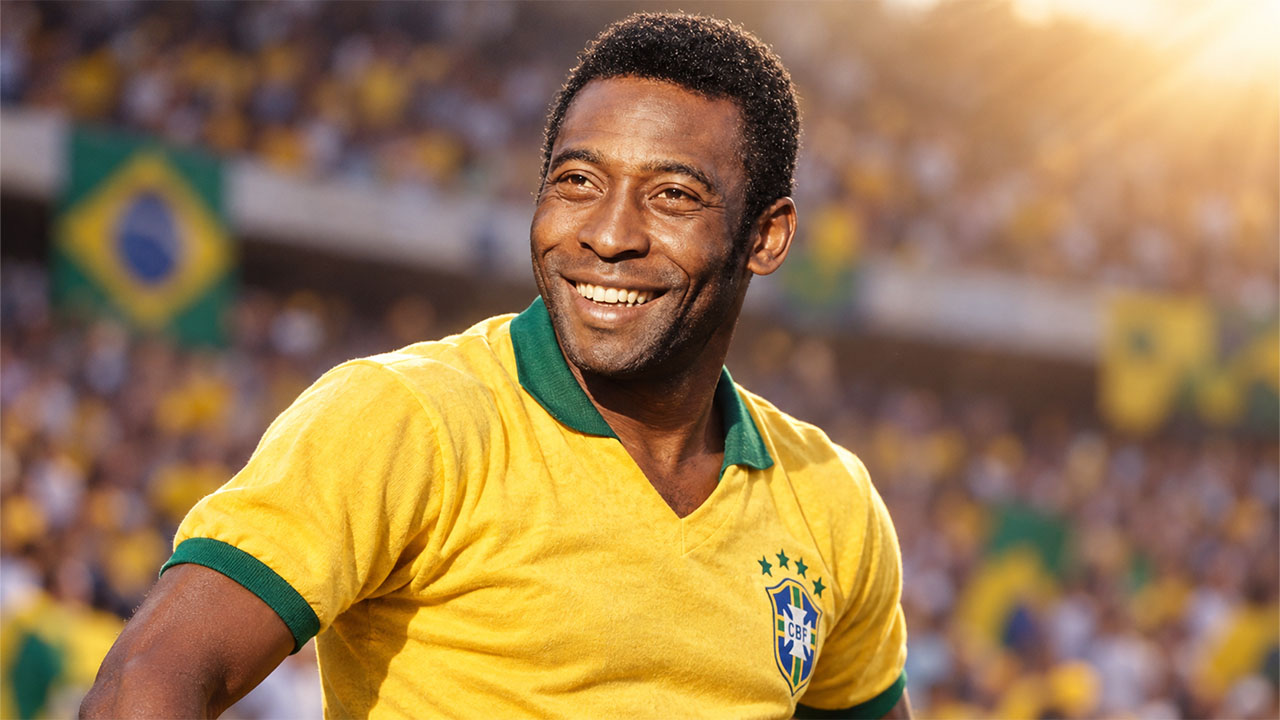
I never saw Pele play. Not in a stadium, not on live television, not even in a replay broadcast the next morning. By the time I was old enough to understand football, the King had long since hung up his boots. And yet today, on October 23, as the world marks the 86th birth anniversary of Pele, I feel the same tug in my chest that people feel for a grandfather they barely knew but somehow love completely.
That’s because I didn’t discover Pele. I inherited him.
A Love Handed Down
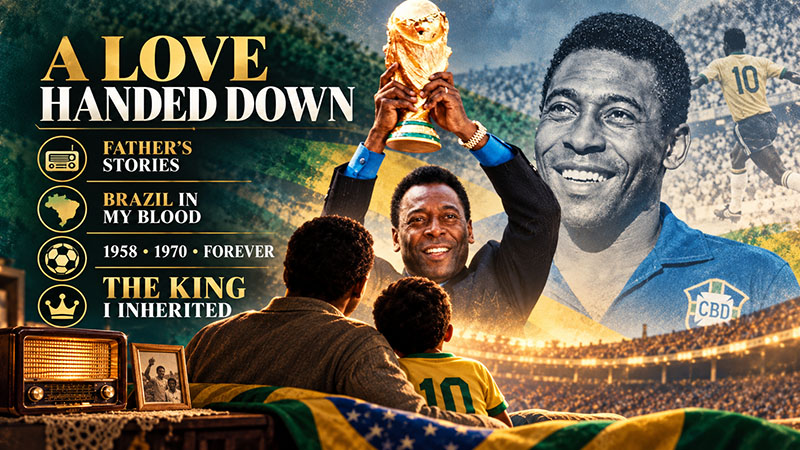
My father watched Pele play. He was a Brazil fan long before I was born, and he never stopped being one. In our house, the yellow shirt wasn’t just a team jersey. It was close to a family religion, and Pele was the man who started it.
When my father talked about him, he didn’t sound like a man reading statistics. He sounded like a witness. My uncles were the same. Get them together and the stories would start, each one adding a detail the others had forgotten, each one insisting his version was the right one. I sat in the middle of those conversations as a boy and soaked up every word.
Some of those stories I could check later. Others I simply believed, because my father said so. That was enough for me.
A Promise From One Son to His Father
It took me years to learn that Pele’s own story begins with a father, too.
He was born Edson Arantes do Nascimento on October 23, 1940, in Três Corações, a small town in Minas Gerais. His father, Dondinho, was a footballer whose career faded after a knee injury. The family didn’t have much. Young Edson shined shoes in Bauru to earn a little money, and he learned the game kicking whatever he could find, sometimes a sock stuffed with rags, because a real ball cost more than they could spare.
Then came July 16, 1950. Brazil hosted the World Cup and needed only a draw against Uruguay at the Maracanã to win it. They lost 2 to 1. The whole country went silent. Brazilians still call that day the Maracanazo.
Nine-year-old Edson found his father crying beside the radio. The boy had never seen him cry. So he made him a promise: one day, he would win the World Cup for him.
When I first read that story, I had to stop for a moment.
Here was the greatest footballer in history, and his legend began the same way my love for him did. A son. A father. A feeling passed between them that was bigger than the game itself. Pele spent his life keeping a promise to his father. In a much smaller way, I’ve spent mine keeping my father’s love for Pele alive.
Seventeen Years Old in Sweden
Eight years after that promise, Pele kept it. At the 1958 World Cup in Sweden, he was 17, the youngest player in the tournament. He scored the winner against Wales in the quarterfinal, a hat trick against France in the semifinal, and then two goals against Sweden in the final. Brazil won 5 to 2. The boy who had watched his father cry was now weeping on the shoulders of his teammates, a world champion before he was old enough to vote.
My uncles loved telling that part. A teenager, they’d say, shaking their heads, as if it still didn’t make sense decades later. It doesn’t. Even now, with all the money and science in modern football, a 17-year-old winning a World Cup final with two goals sounds made up.
It isn’t. It’s on film. I’ve watched it more times than I can count.
The Hard Years: 1962 and 1966
What my father’s stories taught me, and what the highlight reels often skip, is that Pele’s path wasn’t all trophies. In 1962 in Chile, he got injured in Brazil’s second match and missed the rest of the tournament. Garrincha carried the team, and Brazil won anyway. Pele had his second winner’s medal, but he’d spent most of the tournament watching.
In 1966 in England, defenders targeted him relentlessly. He was kicked out of the tournament, battered and limping, and Brazil went home early. He reportedly said afterward he didn’t want to play another World Cup.
I think about that whenever someone tells me greatness comes easy to the gifted. It doesn’t. Pele had every reason to walk away from the national team. He came back anyway.
1970: The Team That Became a Legend
And what a comeback it was. The 1970 World Cup in Mexico was the first broadcast widely in color, and the world watched Brazil play football that still feels like it came from another planet. Pele, Jairzinho, Tostão, Rivelino, Gérson, and captain Carlos Alberto. Many people still call it the greatest team ever assembled.
Watch the final against Italy and you’ll see Pele rise above the defense for the opening header, hanging in the air as if the Mexico City sky held him up a little longer than everyone else. Brazil won 4 to 1. The fourth goal, finished by Carlos Alberto after Pele’s calm, unhurried pass, might be the most beautiful team goal ever scored.
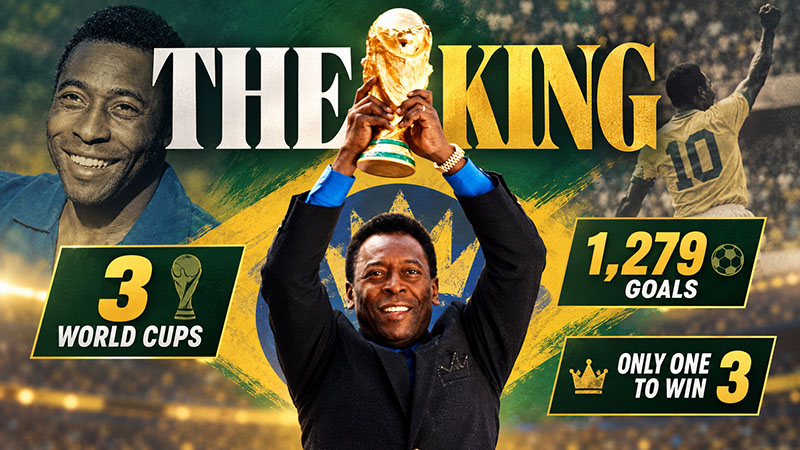
With that win, Pele became the only player in history to win three World Cups: 1958, 1962, and 1970. More than half a century later, nobody has matched it.
Meeting the King on a Small Screen
My father watched that era unfold in his own time. I met it on YouTube. The footage is grainy. The colors bleed. The camera often loses the ball. Some clips are so old the players look like they’re moving in fast forward. None of that matters once Pele gets the ball.
You see the balance first. Defenders lunge, and he’s already somewhere else. Then the vision: the pass nobody else saw, the shot from an angle that shouldn’t work. And the near misses, which somehow became as famous as the goals. In 1970, he tried to score from his own half against Czechoslovakia. Against Uruguay, he sold the goalkeeper a dummy without touching the ball, then hit the shot just wide. Most players are remembered for what they scored. Pele is remembered even for what he didn’t.
Watching those clips, I finally understood something about my father’s stories. He hadn’t been exaggerating. If anything, he’d been holding back.
More Than Goals
The numbers around Pele are staggering. Guinness World Records credits him with 1,279 goals in 1,363 games. On November 19, 1969, he scored his 1,000th goal from the penalty spot at the Maracanã, the same stadium where his father’s heart broke in 1950. He dedicated it to the children of Brazil.
He spent almost two decades at Santos, then joined the New York Cosmos and helped put soccer on the map in a country that barely cared about it. Later, he served as Brazil’s Minister of Sport. In 2000, FIFA named him one of its Players of the Century.
But numbers aren’t why grown men in my family lowered their voices when they said his name.
Pele made football feel like joy. He played as if the game were a celebration rather than a battle, and he carried that spirit to every corner of the world. Brazilians called it jogo bonito, the beautiful game, and for millions of fans who never set foot in Brazil, Pele was its face. People who couldn’t find Rio on a map knew his name. People who didn’t speak a word of Portuguese learned to shout it.
That’s how a Brazil fan gets made thousands of miles from Brazil. Not by geography. By a feeling, passed along.
The Day the King Left
When Pele died on December 29, 2022, at 82, it felt strangely personal for a man I never met. Brazil declared three days of national mourning. Tens of thousands lined up at Santos’s Vila Belmiro stadium to say goodbye. Messi, Ronaldo, Mbappe, and almost every player who ever dreamed of wearing the number 10 paid tribute.
A few months later, Brazil’s best-known Portuguese dictionary, Michaelis, added “Pele” as an adjective meaning someone exceptional, incomparable, and beyond the ordinary. Think about that. His name didn’t just enter the history books. It entered the language.
For me, his passing hit differently because of what it connected to. The man who first told me about Pele is gone too. When I think of one now, I think of the other. My father’s stories and Pele’s legend have become the same thread. I can’t pull on one without feeling the other.
86th Birth Anniversary of Pele: What We Really Inherit
Here’s what I’ve come to believe. Most of the legends we love, we never see for ourselves. Someone shows them to us. A father points at a television. An uncle tells a story at a wedding. An old man at a tea stall swears he saw something that changed the game forever.
Fandom, at its best, isn’t about being there. It’s about being told.
Pele understood that better than anyone. His whole career grew out of a moment with his father beside a radio. Mine grew out of countless moments with my father beside a television, or across a dinner table, telling me about a man in a yellow shirt who could do things no one else could.
My father couldn’t give me a seat at the Maracanã. He couldn’t take me back to 1970. What he gave me was better: his memory of it, told with so much love that I came to carry it as my own. Every grainy clip I watched later only confirmed what he’d already handed me.
So I still wear the yellow shirt. I still feel my heart jump when Brazil walks out of the tunnel. And somewhere in that feeling are two men I miss: the king I never saw and the father who made sure I didn’t need to.
Final Words
On Pele’s 86th birth anniversary, I won’t pretend to know him the way my father did. I can’t. I came too late.
But I know this much. A legend doesn’t really die as long as someone is still telling the story. Pele kept his promise to his father. My father kept Pelé alive for me. My uncles told the story again and again. Now I’m telling it to you.
Happy birthday, Pele. Thank you for the joy you gave my father.
And through him, to me.