

The caffeine cutoff formula can estimate how long a modeled dose needs to fall below a selected amount before bedtime. It cannot identify the exact moment caffeine stops affecting a particular person’s sleep.
That distinction matters. A calculator may return a precise time such as 2:17 PM, but the result still depends on an estimated drink dose, an assumed half-life, a fixed bedtime, and a chosen bedtime target. Change one of those inputs and the cutoff can move by several hours.
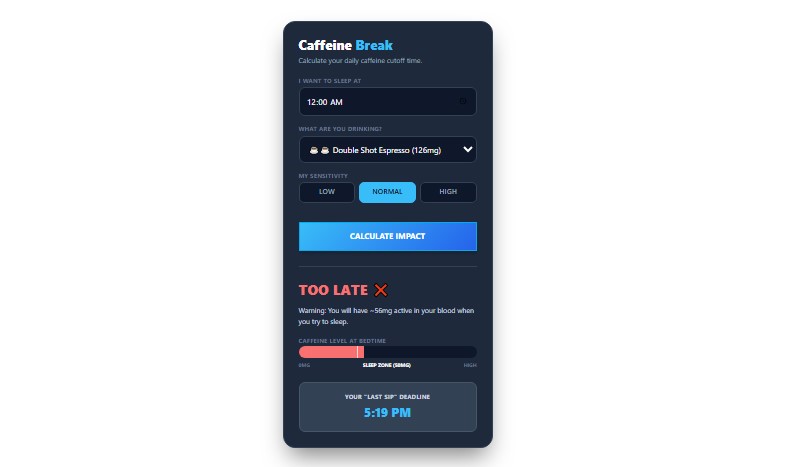
Our Editorialge operates the Caffeine Break Calculator examined in this article. This is therefore an analysis of our own tool, not an independent product review. The calculation successes and the failed test cases both belong in the record.
In this article, I explained an estimation model. It is general information, not personal medical advice.
What Does a Caffeine Cutoff Calculator Actually Estimate?
The calculator uses three main inputs: a caffeine dose, the time available before bed, and an assumed caffeine half-life. It then estimates how much of the original dose may remain at bedtime.
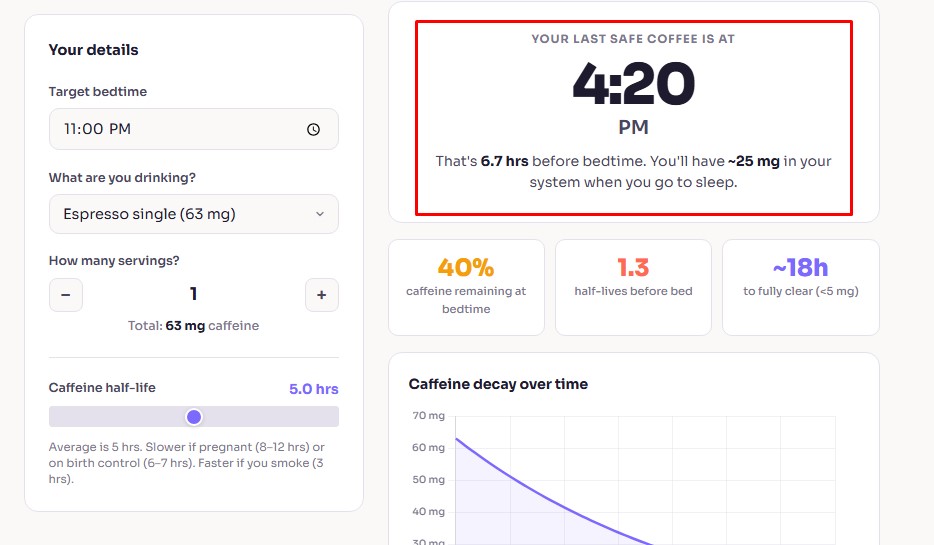
It can also work backward. Starting with a selected bedtime target, the calculator estimates the latest time a drink could be consumed before the modeled amount falls below that target.
The result is an estimate of parent caffeine remaining. It is not:
- a blood test;
- a measured blood concentration;
- a reading of adenosine-receptor activity;
- proof of a person’s metabolic type; or
- a prediction of sleep quality.
A result of 48 mg therefore means “about 48 mg under this mathematical model.” It does not mean a laboratory found 48 mg in the person’s bloodstream, or that sleep will be unaffected.
How Does the Caffeine Cutoff Formula Work?
For one dose, the usual simplified model is:
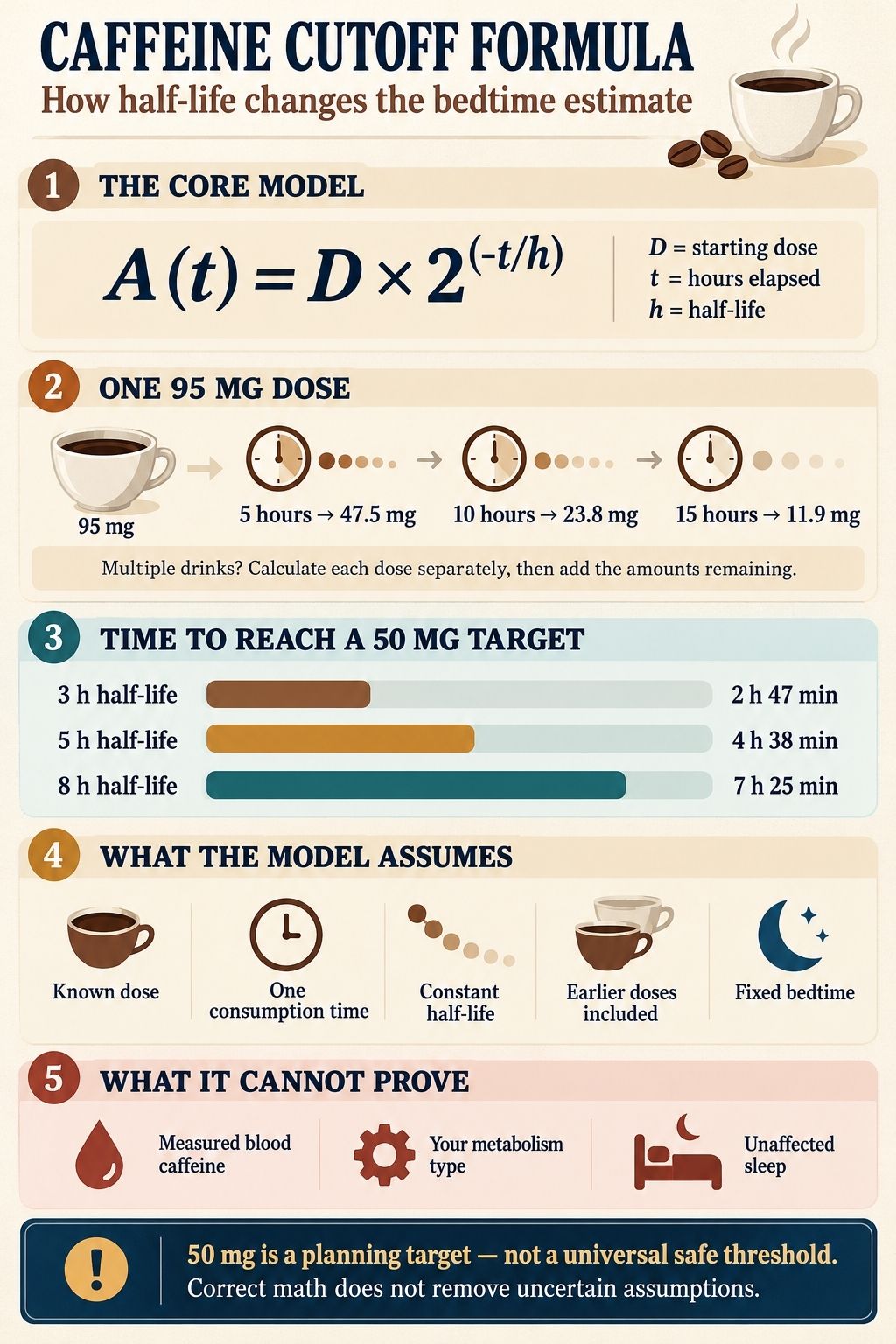
A(t)=D2-t/h
In this equation:
- D is the starting caffeine dose in milligrams;
- t is the elapsed time in hours;
- h is the assumed half-life in hours; and
- A(t) is the estimated amount remaining.
Half-life does not mean the time required for all caffeine to disappear. After one half-life, 50% of the original amount remains. After two half-lives, 25% remains. After three, 12.5% remains.
Suppose a regular coffee is entered as 95 mg and the selected half-life is five hours.
Five hours later, the model gives: 952-5/5=47.5mg
The displayed result may be rounded to 48 mg. That rounding should happen only at the display stage. Rounding intermediate values can gradually distort more complicated calculations.
To calculate a cutoff, the equation is reversed: t=h2(D/R)
Here, R is the selected amount allowed at bedtime. With a 95 mg dose, a five-hour half-life, and a 50 mg target, the required interval is approximately four hours and 38 minutes.
The clock-time cutoff is then: Cutofftime=Bedtime-t
The caffeine cutoff formula is internally consistent in this example. What it establishes is when the modeled amount crosses 50 mg. It does not establish that 50 mg is harmless to sleep.
The Model Is Simpler Than the Human Body
This calculation is best described as a one-compartment, first-order elimination approximation. In plain language, it treats the caffeine dose as if it were evenly distributed and assumes the body removes the same fraction during each equal period.
That is a useful educational model. It is not a complete account of absorption, distribution, metabolism, and biological response.
The clock normally starts at the entered consumption time, even though caffeine is not absorbed instantly. CDC material reports that circulating caffeine commonly peaks at around 30 minutes and gastrointestinal absorption is typically complete within approximately 45 minutes.
A drink consumed over 60 minutes also does not behave exactly like one immediate dose. The first portion has already begun to be absorbed before the last sip. A simple calculator usually collapses that drinking period into one timestamp.
At ordinary dietary doses, the simplified decay curve can provide a reasonable comparison between scenarios. Its certainty should not be extended to unusually high exposure, liver disease, medication interactions, or other situations in which caffeine handling may differ substantially.
Several Drinks Require More Than One Calculation
Running only the latest coffee can underestimate the caffeine remaining from the rest of the day. Every dose needs its own decay calculation.
For several drinks, the simplified total at bedtime B becomes:
A(B)=iDi2-(B-ti)/h
Each Di is a separate dose, and each ti is its consumption time. Consider two 100 mg drinks, one at 8:00 AM and another at 1:00 PM. Bedtime is 11:00 PM, and the assumed half-life is five hours.
- The first dose has 15 hours to decay, or three half-lives. About 12.5 mg remains.
- The second dose has 10 hours to decay, or two half-lives. About 25 mg remains.
- The modeled bedtime total is 37.5 mg.
Entering only the second drink would show 25 mg and miss the 12.5 mg carried over from the morning dose. Tea, cola, energy drinks, pre-workout products, chocolate, supplements, and some medicines can add further caffeine.
Why Half-Life Can Move the Cutoff by Hours
Caffeine half-life varies between people and can vary within the same person under different conditions. EFSA describes an average of approximately four hours in healthy adults, with a broad range of roughly two to eight hours.
This uncertainty changes the answer substantially. For a 95 mg dose and a 50 mg bedtime target:
| Assumed half-life | Time needed to fall below 50 mg |
| 3 hours | About 2 hours 47 minutes |
| 5 hours | About 4 hours 38 minutes |
| 8 hours | About 7 hours 25 minutes |
The three-, five-, and eight-hour settings should be presented as faster-, middle-, and slower-clearance scenarios. They are not medical diagnoses.
Genetics, smoking, pregnancy, hormonal factors, liver function, and some medicines can affect caffeine clearance. A person’s response can also involve more than clearance alone.
Someone may feel relatively calm after coffee yet eliminate caffeine slowly. Another person may feel anxious after a modest dose without having an unusually long half-life. Perceived sensitivity, tolerance, clearance, and sleep response are related concepts, but they are not interchangeable.
A short questionnaire cannot confirm CYP1A2 activity or determine an individual half-life. Genetic data would not, by itself, capture every factor affecting that person on that day.
Is 50 mg at Bedtime a Safe Caffeine Level?
No authoritative evidence reviewed for this article established 50 mg remaining at bedtime as a universal safe-versus-disruptive boundary. In this caffeine break calculator, 50 mg is a product-selected planning target.
EFSA has reported that a consumed dose of approximately 100 mg may affect sleep duration and patterns in some adults, particularly when taken close to bedtime. That is not the same as proving that 49 mg remaining is safe or that 51 mg is harmful.
A 2023 meta-analysis of 24 controlled studies found that caffeine reduced total sleep time by about 45 minutes on average. It also reported lower sleep efficiency, longer sleep-onset latency, more wakefulness after sleep began, and less deep sleep.
Its dose-and-timing model estimated that a coffee containing approximately 107 mg might need to be consumed about 8.8 hours before bed to avoid a measurable reduction in total sleep time. For a pre-workout dose of approximately 217.5 mg, the estimate extended to around 13.2 hours.
Those figures are study-derived estimates, not universal curfews. They combine data from different participants, doses, protocols, and sleep measurements.
A 2025 randomized crossover trial produced a more qualified result. In its sample of 23 young men, 100 mg did not produce a statistically significant sleep effect at the tested four-, eight-, and twelve-hour intervals. A 400 mg dose affected sleep when taken within twelve hours of bedtime, with greater disruption closer to bed.
The studies are not necessarily contradictory. Dose, sample size, participant characteristics, and study design can all change the detected effect. Together, they show why a calculator should offer a planning estimate rather than a “safe” or “unsafe” verdict.
The FDA’s widely cited 400 mg daily amount for most healthy adults answers a different question. General daily intake guidance is not a guarantee that an afternoon or evening dose will leave sleep unaffected.
What Assumptions Does the Caffeine Cutoff Formula Make?
The apparent precision of the answer depends on assumptions the calculator cannot verify.
| Assumption | Why it matters |
| The caffeine dose is correct | Coffee preparation, product formulation, and serving size can change the actual amount substantially. |
| The whole dose is consumed at one time | Slow sipping creates a series of smaller doses rather than one instant dose. |
| Absorption can be simplified | The model does not reproduce the early absorption and peak-concentration phases. |
| One constant half-life applies | Personal clearance may differ from the selected three-, five- or eight-hour scenario. |
| A one-compartment model is sufficient | Real distribution and metabolism are more complex than one evenly mixed pool. |
| Previous doses are included | Omitting earlier caffeine understates the bedtime total. |
| The bedtime and calendar date are correct | Midnight rollover, time zones, and daylight-saving changes can alter the interval. |
| The selected target is meaningful | Fifty milligrams is a planning preference, not a validated medical threshold. |
| Remaining milligrams predict sleep | The model does not calculate receptor activity, tolerance, circadian timing, or sleep architecture. |
Active caffeine metabolites are also outside the simple result. The body converts caffeine into compounds including paraxanthine, theophylline, and theobromine. A parent-caffeine estimate does not describe every potentially active compound or its effect.
Other influences on sleep remain outside the formula: stress, alcohol, nicotine, illness, light exposure, exercise timing, sleep debt, medicines, and the person’s usual sleep schedule.
What the October 2026 Calculator Check Found
A browser-based editorial check was conducted on October 21, 2026, in Chrome configured to Asia/Dhaka time, or UTC+6. The purpose was to test the software’s implementation, not anyone’s caffeine level or sleep.
The check used a repeatable sequence:
- Record the calculator version, date, browser, and timezone.
- List its visible inputs, default values, units, and result labels.
- Calculate reference answers independently.
- Test normal cases, boundary times, reload behavior, and low-dose inputs.
- Compare the displayed labels with the values apparently used by the calculation.
- Record failures and repeat them before drawing a conclusion.
The central decay calculation passed the normal reference case. Several interface and boundary checks did not.
| Test | Observed result | Assessment |
| 95 mg, five-hour half-life and five hours before bed | Approximately 48 mg remaining | Formula passed |
| Bedtime set to the currently displayed minute | Treated as the following day | Boundary logic failed |
| Soda selected | Visible label showed 150 mg while the calculation used 40 mg | Data-consistency failure |
| First click after a clean reload | No calculation appeared during the recorded attempt | Reproduced in the test environment |
| A drink starting below the 50 mg target | “Any time” was displayed | Mathematically explainable but misleading |
| High-sensitivity setting and supporting copy | Interface used eight hours while the copy described eight to ten hours | Assumption disclosure was inconsistent |
“Any time” is particularly easy to misread. If the starting dose is already below the selected target, the inverse formula produces zero or a negative waiting period. The accurate message is “already below the selected target under this model.” It is not permission to consume the drink at any time without a sleep effect.
The same-minute rollover can create a much larger error by treating an immediate bedtime as tomorrow’s bedtime. Cutoffs that fall on the previous day also need a date, not only a clock time.
The first-click failure may involve loading or initialization behavior. It should not be described as universal until it is repeated on clean desktop and mobile sessions. Daylight-saving transitions and additional time zones also require separate testing.
Why Calculator Verification Must Go Beyond Correct Arithmetic
The same quality-control sequence can be used for other calculators: freeze the version, map inputs and assumptions, calculate reference cases, test boundaries, document failed attempts, and rerun them in a clean environment.
The domain-specific decisions still change:
| Calculator type | What must be verified | Main limitation to disclose |
| Health | Formula source, units, population, and current guidance | A wellness estimate is not a diagnosis |
| Caffeine | Dose, serving size, absorption, half-life, accumulation and target | Remaining caffeine does not predict individual sleep |
| Medical | Validated clinical rule, inclusion criteria, exclusions and warning thresholds | Clinical decisions require qualified interpretation |
| Crypto | Price source, timestamp, trading pair, fees, slippage and decimal precision | Markets change after the result is generated |
| FIRE | Inflation, real or nominal returns, taxes, withdrawal rate and sequence risk | Long-term projections are scenario-dependent |
| Carbon | Emission factor, publication year, geography, units and system boundary | Different scopes can produce incomparable totals |
| Entertainment | Edition, runtime source, credits, adverts and playback assumptions | Runtime changes with version and viewing behavior |
| Game | Platform, patch, mode, scoring rules, rounding and random events | Updates can invalidate older outputs |
A calculator passes implementation testing when it reproduces its stated formula. It passes a different test when its assumptions are current, appropriately sourced, and clearly labeled. Passing the first does not guarantee the second.
How to Use a Caffeine Cutoff Result Sensibly
Start with the product label when one is available. Match the declared caffeine amount to the serving actually consumed. A bottle containing two servings should not be entered as one serving if the entire bottle was finished.
Treat coffee and tea presets as reference estimates. Bean type, brewing method, extraction time, portion size, and brand can all change caffeine content. A custom milligram field is more useful when the product publishes a reliable amount.
Include every meaningful caffeine source from the day. Calculating only the final drink can produce a reassuring but incomplete answer.
Run more than one half-life scenario. If three, five, and eight hours produce very different cutoffs, that difference is information. The earlier cutoff is the more cautious planning option when personal clearance is unknown.
A sleep diary can help compare ordinary caffeine timing with sleep onset, nighttime waking, and next-morning alertness. Keep bedtime and other routines as consistent as reasonably possible. An observed pattern can guide personal caution, but it cannot prove that caffeine caused every good or bad night.
This is a bedtime timing tool. It is not a withdrawal calculator, caffeine-detox plan, or tolerance-reset program.
People who are pregnant, take medicines that may interact with caffeine, have liver disease, or have significant heart or sleep concerns need more individualized guidance. Children and adolescents should not be treated as smaller versions of the default adult model.
A Precise Formula Can Still Produce an Uncertain Cutoff
The caffeine cutoff formula is useful because it turns dose, time, and half-life into a consistent comparison. Its precision comes from the equation. Its uncertainty comes from the inputs and assumptions.
The strongest use of the calculator is therefore not to declare an exact “safe” last sip. It is to compare scenarios, expose how much half-life changes the answer, and support a more cautious caffeine schedule.
A responsible result should say what was entered, which half-life was assumed, which target was selected, and what the tool does not know. That makes the calculator less dramatic, but considerably more trustworthy.
Frequently Asked Questions about Caffeine Cutoff Formula
How accurate is the caffeine cutoff formula?
The arithmetic can be accurate while the personal result remains uncertain. Accuracy depends mainly on the entered dose, selected half-life, previous caffeine, elapsed time, and bedtime target.
Is caffeine’s half-life always five hours?
No. Five hours is a useful middle scenario, not a universal value. Healthy-adult estimates vary widely, and pregnancy, smoking, liver function, hormones, and some medicines can alter clearance.
Is 50 mg of caffeine at bedtime safe?
There is no validated universal 50 mg bedtime safety boundary. In this calculator, it is a planning target used to generate a cutoff.
Can one calculation account for several coffees?
Only if the tool calculates every dose from its own consumption time and then adds the remaining amounts. Processing just the latest drink misses accumulation.
Does “milligrams remaining” mean a blood caffeine level?
No. It is a modeled amount of parent caffeine remaining from the entered dose. It is not a measured concentration or a direct prediction of alertness, receptor activity, or sleep quality.