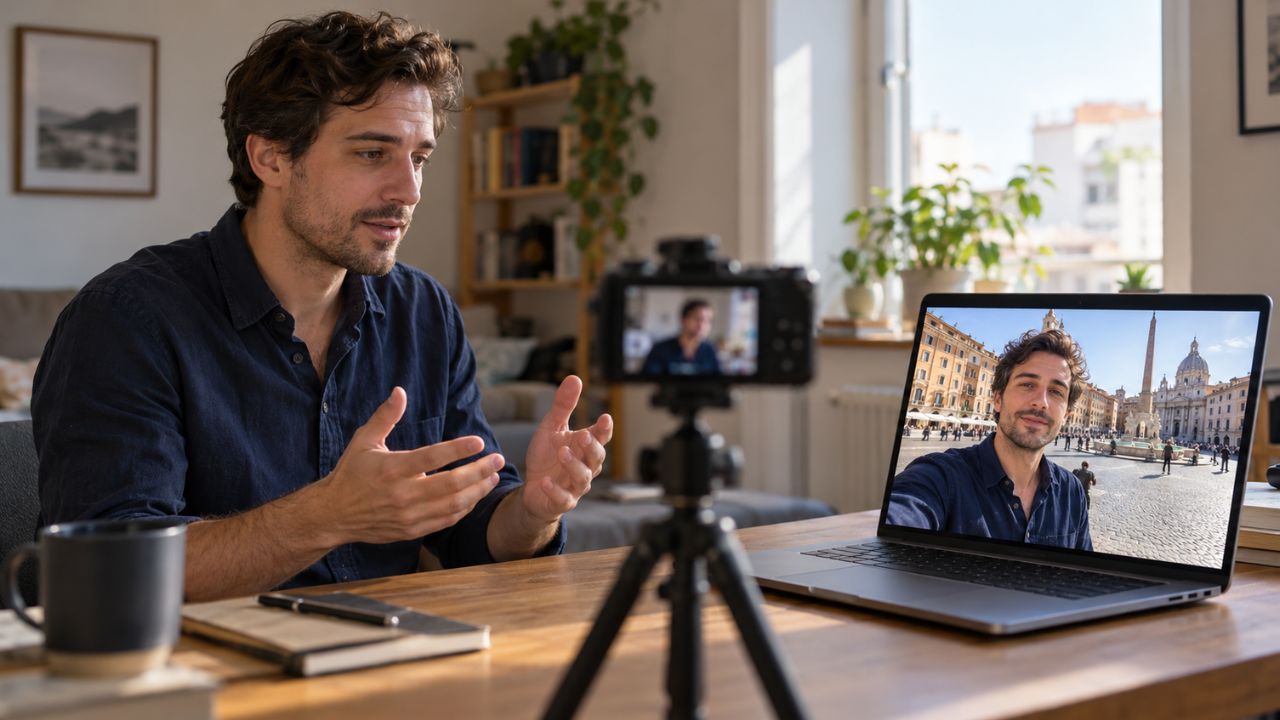
Recently, a video appeared on my feed where a man showed himself in several situations that looked entirely believable. Then he explained that he had recorded himself at home. The other settings, he said, were created with AI.
That explanation changed how I understood the video. It showed me what he had made, while also making clear what had not happened. Had I encountered a short excerpt without his explanation, I might have assumed he had been in those places.
I keep thinking about how easily that context could disappear on social media. Someone can repost the most convincing few seconds, add a caption, and leave the original explanation behind. The video will still look the same. Its meaning will have changed.
AI-generated videos make this a more urgent problem. A person can appear somewhere they never went. A familiar face can seem to deliver words its owner never said. How do we build trust when an image can make such a strong claim on its own?
The difference an honest explanation makes
The man’s demonstration was creative. He told viewers how it worked, which allowed me to enjoy it and understand it. People have always used cameras and visual effects to tell stories. AI has made some of those possibilities easier to use.
What matters is the claim made about the finished video. A fabricated setting becomes deceptive when it is presented as proof that someone was there. An altered voice becomes dangerous when listeners are led to believe the person actually spoke.
Even a recording made by a creative AI platform without AI can mislead. Footage from an earlier event may be shared as something that happened this morning. A short clip may remove the exchange that gives someone’s words their meaning. The question is bigger than whether a file contains synthetic images. We also need to know whether the story attached to it is true.
That is why the explanation in the video I watched mattered so much. It gave me the information the images could not provide.
When someone else’s face carries the claim
In November 2025, Bangladeshi fact-checkers examined a video presented as a political announcement by Sheikh Rehana. They traced part of it to an earlier Bangladesh Television recording and found that AI-generated audio had been used. The statement attributed to her was absent from the original footage.
In July 2026, the FBI warned about AI-generated videos depicting a senior FBI leader. The clips directed people to a website made to resemble the FBI’s online crime complaint centre. In that case, the familiar face lent authority to a false instruction.
The details differ, but the method is easy to recognise. We see someone we know, or someone whose position we recognise, and the message arrives with borrowed credibility. The video does some of the persuading before we have considered who posted it.
A private person may be just as vulnerable. A message apparently from a friend, family member, or colleague can reach us at the exact point where familiarity makes us less likely to pause. If it asks for money or sensitive information, one mistaken decision may be enough.
Doubt can also be used against the truth
There is another consequence I find harder to ignore. As fabricated videos become familiar, genuine footage can be dismissed with a few words: That looks like AI.
That suspicion can be reasonable. It can also become an easy way to avoid an uncomfortable piece of evidence. A witness who records misconduct may find the discussion turning to whether the clip looks artificial before anyone checks where it came from or what else confirms the event.
Research offers a useful warning about this atmosphere of doubt. In a 2020 experiment involving 2,005 British respondents, a deceptive political video did not clearly persuade participants of its false claim. It did increase uncertainty, and that uncertainty was linked to lower trust in news on social media.
One experiment cannot tell us how everyone will respond to every new video. It does show why the problem extends beyond people falling for a fake. Confusion can leave viewers less sure of what deserves belief at all.
I do not want that uncertainty to become a shortcut for the powerful. If a damaging recording is genuine, calling it fake should be treated as another claim requiring evidence. People who document real events deserve a fair hearing, even when the first version of their footage reaches us through a messy social media feed.
Why a detector cannot settle the matter
It is tempting to search a video for a distorted hand, an unnatural shadow, or a strange movement. Those details can prompt a closer look. They cannot carry the full judgment. A fabricated scene may look polished, while a genuine recording may be blurred, compressed, or poorly lit.
Technical tools have a place here. Content Credentials can provide verifiable information about a file’s recorded origin and edits. That history may be valuable when it is available. It does not establish whether the event depicted is true. The absence of such information does not establish that a video is false.
A detector’s assessment is another clue, not an account of everything that happened. It cannot tell us whether an authentic clip has been given the wrong date, whether a scene was staged, or why a particular person wants us to see it now.
Those are questions about context and responsibility. Software can help us investigate them. Someone still has to do the work.
What I would check before sharing a consequential video
I will not investigate every entertaining clip that appears on my screen. I will slow down when a recording asks me to believe an accusation, make a decision, or pass it on as fact.
Start with the source and the claim
Who first posted the video? Is there a longer version? Can its date and location be checked? Do independent witnesses or reliable reports support the event described in the caption?
Finding the earliest available version is often more useful than replaying a short clip in search of visual mistakes. It may reveal an explanation that was lost in reposting, just as easily as it may reveal a false claim.
When those questions remain unanswered, I can leave the video unshared. A pause gives someone time to establish what happened.
Verify urgent requests elsewhere
If a familiar face or voice asks for money, private information, or immediate action, I would contact that person through a number or account I already know. I would use an organisation’s established website or contact details rather than the ones supplied in the message.
That extra step may feel unnecessary when the person on screen seems unmistakable. It becomes reasonable once we accept that appearing to be someone and being that person are different things.
Trust must be earned beyond the feed
Viewers cannot carry this work alone. We see fragments after they have been copied, cropped, and passed between accounts. The people and institutions that create, distribute, and publish those fragments have more opportunity to preserve their context.
Creators should clearly disclose realistic synthetic scenes, voices, or likenesses when an audience might mistake them for real events. Platforms should make those disclosures visible, retain useful origin information where possible, and respond seriously when people are impersonated.
Newsrooms have a particular responsibility. I believe readers should be told where consequential footage came from, what has been verified about it, and what remains uncertain. An original file, a reliable account of its location, and independent reporting can all matter. So can a prompt, visible correction when an outlet gets the story wrong.
Verification must also leave room for people who cannot safely identify themselves in public. A missing credential or an anonymous post is a reason to investigate carefully, not a verdict against the person who recorded it.
I return to the man who said he had filmed from home. His explanation did not make the video less impressive. It made it possible for me to understand what I was seeing. That is the standard I want when a clip asks for something more serious than admiration: enough context to check the claim, and someone willing to answer for it.