
An agent takes a goal, not a click. Standard software splits a job into steps that someone must run one by one. The agent handles the same job as one supervised process from start to finish. In a legal setting, it receives the goal, works out the steps, and carries them out on its own.
Contract management shows this shift most directly. The agent drives the work forward instead of waiting for someone to click through it. Compliance runs along the same route, and so does the operational effort that sits around both.
Gartner expects task-specific AI agents in 40% of enterprise applications by 2026, up from less than 5% in 2025. Legal sits inside that shift, whether firms are ready or not.
The practical question now is how agentic AI could reshape legal workflows beyond traditional legal software, the systems firms already run. Getting to an answer means moving past general predictions and into the details.
What follows draws on analyst forecasts, Thomson Reuters Labs commentary, and published implementation lessons. It covers readiness, an ordered adoption sequence, the failure modes already on record, and the verification signals that catch them. Two things remain unresolved: whether a given firm is actually ready for a supervised pilot, and which workflow should go first.
What Agentic AI Changes That Traditional Legal Software Doesn’t
A contract reviewer can hand off an entire task now, not just click through it one step at a time. You write the instruction once. The agent breaks the work into pieces and runs each piece. Traditional software stops after every action and waits for you. Thomson Reuters Labs calls this a new approach to complex tasks and decisions. The real shift is who does the work, not just who answers the question.
How agentic AI could reshape legal workflows in one sentence: goals in, work out
One legal AI vendor shows the contrast with a single contract example. The old way: ask the tool to explain clause 8.3. The new way: “review this contract for liability risks, flag critical passages, and suggest alternative wording”. The software runs the whole review instead of stopping after one answer. Thomson Reuters Labs frames it the same way. Agents are built for outcomes, not single commands.
How fast adoption is moving, according to analysts
Gartner’s 2025 forecast puts task-specific AI agents in 40% of enterprise applications by 2026, up from less than 5% in 2025. That is a short timeline for enterprise software. The same analysis points to contract management, compliance and operational efficiency as early adoption areas. Legal teams work in all three every day. Agents are shipping now, and legal work sits near the front of the line.
Where agents already appear in legal work
A 2026 industry roundup lists six agentic AI use cases that corporate legal teams can use right away. Dr. Andrew Fletcher of Thomson Reuters Labs published the key to autonomous legal workflows in June 2025, naming agentic AI as the driver. Neither piece is a concept demo.
The pattern is consistent. Agents land first where documents pile up and tasks repeat, and intake and review both fit. These examples are published and easy to find. Pull them up and compare them to the intake and review work sitting on your own desk.
The Readiness Checklist Before an Agent Touches a Live Matter
Two gates open Jeremy Coleman’s February 2026 piece on agentic AI in legal operations: process and governance. Each gate hides a smaller question. Is this workflow actually ready for an agent?
Thomson Reuters Labs adds a third check. Its commentary treats structure as the key to autonomy. In practice, that means a named human stays accountable for output. Run an agent on a live matter without all three and you create risk, not value. So each gate needs concrete checks.
Process readiness: a workflow documented end to end
An agent can’t follow a process nobody has written down. The implementation lessons make useful pre-reading here.
What does “written down” look like in practice? Steps listed in order, with inputs named. One clear definition of done. An owner for every exception.
Teams sometimes assume a weekly workflow is ready by default. It isn’t. One missing piece can stop the whole thing. There’s a quieter benefit too. You can’t measure improvement without a stable baseline to measure against.
Governance readiness: privilege, oversight, and sign-off
When an agent gets a matter wrong, a person still answers for it. The structure-first point applies here as well. It boils down to three rules in writing.
First, a permission fence decides which documents an agent may touch. Privileged material stays out of reach. Second, a named reviewer checks agent output before it reaches a client or a court. Third, a sign-off rule keeps a licensed lawyer accountable for final work.
None of this invents new duties. Supervision already exists in legal ethics. Agents simply sit inside it.
Step 1: Inventory and Score the Firm’s Workflows
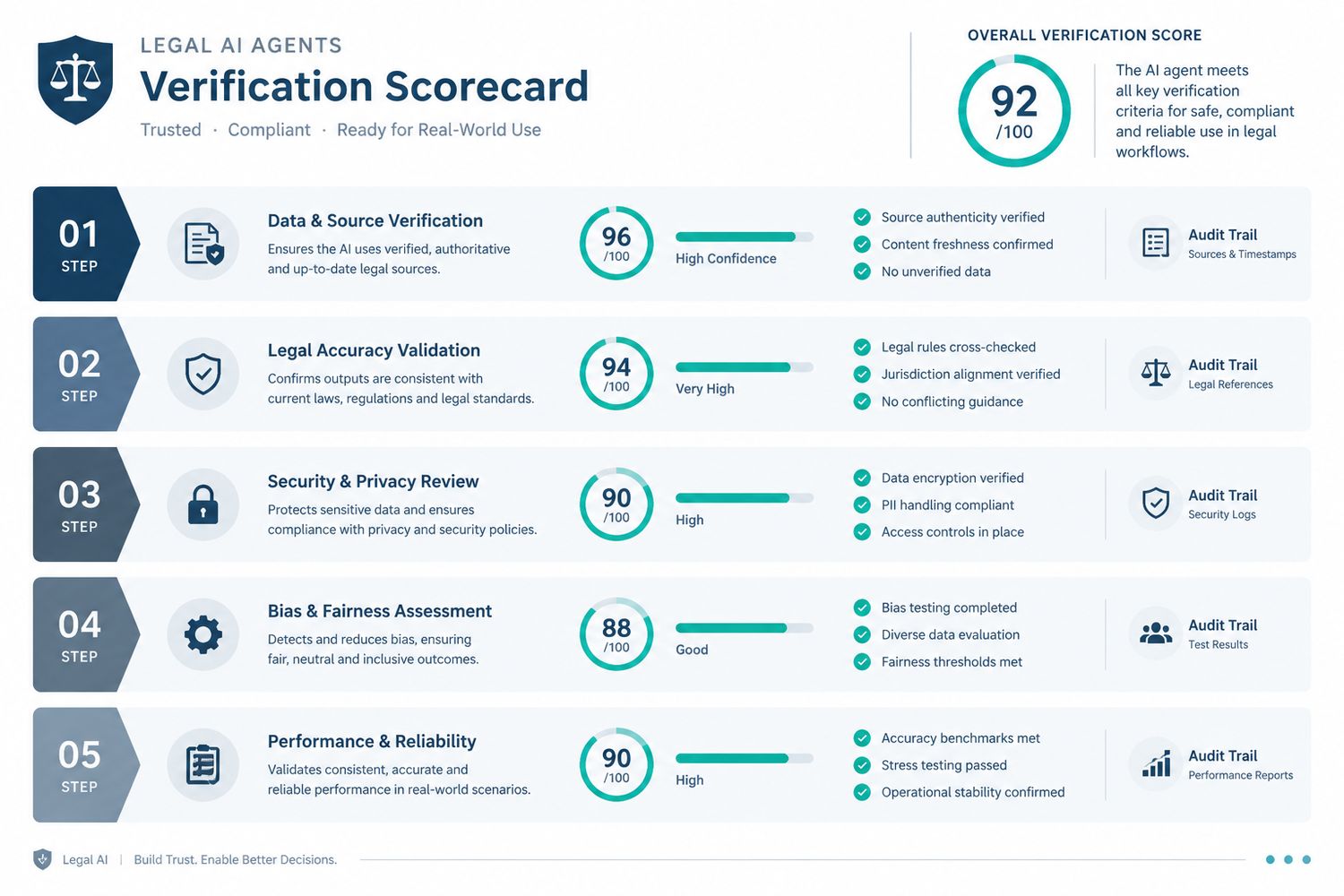
Partners often misjudge where complexity lives in their own workflows. That blind spot is exactly why guessing fails here. An operations lead needs to list every task that repeats in the firm, then run each one through a fixed scoring system. The six deployable use cases in the 2026 roundup offer a reference point.
The criteria that separate good candidates from bad ones
Five criteria drive the score. Volume measures whether the work repeats on a steady cycle. Digital inputs means documents arrive in a format software can read. Clear output requires one agreed definition of done. Catchable errors covers workflows where mistakes show up in review rather than after release. Low privilege exposure asks how much confidential material the work touches.
Bad candidates break down on the same dimensions. The matter may repeat only once a year. Inputs arrive too vague for software to parse. No one can verify the output. The deployable examples in the roundup anchor the scoring in real legal work. Score each workflow on all five points, then add up the columns.
The expected result: a ranked shortlist, not a hunch
Total the points, and two or three workflows rise to the top as a ranked shortlist. Each entry needs a one-page brief that names the process owner, states the volume, lists the tools involved, and quantifies the risk. A managing partner can approve the brief in a single meeting. The firm gets a defensible score instead of a guess, plus a clear first choice. When no winner pulls ahead, the firm usually needs to document its processes before any agent can run.
Step 2: Deploy One Agent Under Supervision and Baseline Everything
The winning agent from your shortlist needs a real test environment, and that means choosing the pilot matter carefully. Before the agent touches anything, measure how long the workflow takes right now and track how often errors get through. Write those two numbers down. Every claim you make later about speed or accuracy gets checked against this baseline.
The daily routine shifts for the lawyers involved. The agent drafts, and a lawyer reviews every line before it goes anywhere. Thomson Reuters Labs argues that agentic AI gives firms a real edge because the industry is adopting new technology so fast. A supervised pilot is how a firm captures that edge without staking a client matter on untested output.
What supervision looks like in practice
No agent output leaves the firm until a named reviewer sees it first. That person verifies the citations exist and match what the agent claims, then checks the work against the definition of done from the readiness checklist. Thomson Reuters Labs describes a structure where the agent acts and the human decides. That separation is what makes the autonomy safe.
Low-risk internal outputs can be reviewed on a sample basis. Anything headed to a client gets a full read. Track the review hours as well, because if review consumes the time the agent saves, the pilot has failed honestly and you should know it.
The expected result: a measured comparison, not a demo
After the pilot has run for a solid stretch, hold a comparison. Put the baseline next to the pilot numbers for time per task and error rate, and add review hours plus cost per matter to the same view. One demo only proves an agent can work once. A comparison tells you whether real matters got faster or more accurate, which turns the advantage Thomson Reuters Labs describes into something you can see.
If neither number moved, adjust the workflow or move on to the next candidate on the shortlist.
The Failure Modes on Record — and the Verification That Catches Them
Firms that skipped those steps left a useful record behind. A February 2026 lessons piece follows six deployable use cases through their gates and into supervised pilots, showing what goes wrong when the sequence gets compressed. Read together, the published accounts form a catalog of skipped steps. Nearly every early failure traces back to readiness work that never got finished.
The fix that keeps appearing: build verification into the workflow from the start instead of bolting it on afterward.
What published implementation lessons warn about
Three patterns cover most of the early failures. The most common is agents pointed at processes nobody documented. Permissions lag behind enthusiasm, so the agent ends up with access it should never have had in the first place.
Drift is the second problem. Output quality shifts when models update, and nobody notices because nobody re-checks the work. The third is a pilot that launched without a baseline, leaving “it feels faster” as the only evidence the firm can offer.
Every one of these has a known fix, and none of the fixes need new technology.
The verification signals that matter
Verification turns that warning list into a short checklist the firm reviews on a fixed schedule. Five signals cover most of the risk:
- Citation accuracy. A reviewer confirms every legal citation in agent output before release.
- Sampled quality. A reviewer scores a random sample of outputs against the definition of done.
- Permission audits. Access logs show the agent touched only approved document sets.
- Drift checks. After any model update, the team runs the pilot baseline test again.
- Escalation counts. The team tracks how often reviewers override the agent.
Each workflow comes out of this with a one-page scorecard. A signal moving the wrong way pauses the agent, and the team finds the cause before the next matter starts.
What comes next on the adoption curve
The analyst forecast from the top of this guide keeps surfacing elsewhere too. A September 2025 write-up points to the same Gartner number: task-specific AI agents in 40% of enterprise applications by 2026. Two sources citing one projection does not make it certain. It does show where industry expectations sit right now.
Read it narrowly. If the projection holds, most agents will arrive inside software a firm already pays for, not as separate purchases. Firms that ran supervised pilots early will have baselines and governance rules ready when that happens.
The ones that waited will still be writing checklists while their tools change under them.
Questions About Agentic AI in Legal Work, Answered Directly
Ask about agentic AI in a partnership meeting and two worries come up first: who signs off on the work, and what happens to privilege when software touches client files. The answers are simpler than the anxiety suggests. A named lawyer signs off on anything that leaves the firm, agent or no agent. The controls that already cover vendors and junior staff cover the agent too.
Is agentic AI just generative AI with a new name?
No, and the difference is mechanical. Generative AI answers a prompt and stops. Agentic AI takes a goal, works through the steps, and calls on tools along the way until the job is done. The Thomson Reuters Labs commentary points to that goal-driven behavior as the real break from earlier tools, not the label.
How is client privilege protected when an agent handles documents?
Use the same controls you’d apply to a vendor or a junior hire. The agent works behind a permission fence. Its access is logged. Nothing leaves the firm without a named lawyer signing off. Each of these points already sits in the governance gate of the readiness checklist.
Does agentic AI only make sense for large firms?
Size isn’t the filter. Any team with high-volume, document-heavy work scores well on the Step 1 criteria. A small firm with steady intake can be a stronger first candidate than a large firm running mostly bespoke matters. Workflow repetition counts more than scale.
What does agentic AI adoption look like in 2026?
Expect task-specific agents to show up as features inside mainstream business software. Gartner’s forecast puts 40% of enterprise applications featuring such agents by 2026, up from under 5% in 2025. The practical move: track what vendors actually ship, not what their press releases promise.
Final Thoughts
Agentic AI hands legal work to software that plans and acts under human oversight. The firms that succeed write down their processes first and name the people responsible for review. So pick one workflow this quarter. Run the Step 1 scoring exercise on it. Record its baseline performance before any vendor walks through your door.
Frequently Asked Questions (FAQs)
What makes agentic AI different from traditional legal software?
Traditional tools wait for you to click before they move. An agent receives a goal, plans the steps needed to reach it, and executes the work without prompts at each stage. The control model flips. You stop driving every action yourself and instead set the destination, then supervise the route.
How fast is agentic AI adoption moving in enterprise applications?
Gartner projects that 40% of enterprise applications will include task-specific AI agents by 2026, compared to under 5% in 2025. Contract management and compliance workflows are drawing early adopters, and organizations are chasing operational efficiency gains.
What should a firm check before deploying an agent on live matters?
Map the workflow from start to finish before you automate anything. Then write down the rules: who holds privilege, who gives approvals, and who has sign-off authority. Assign one person to own oversight. A named human must stay accountable for everything the agent produces.
Is agentic AI only for large law firms?
Volume drives readiness more than headcount does. A small firm with a steady document flow can outscore a large firm on the readiness criteria if that larger firm mostly handles one-off, custom matters. Size counts for little here. What counts is whether your work is repetitive and well-defined.