History is not just a collection of dates on a calendar; it is a continuously unfolding narrative of human triumph, tragedy, and transformation. If you peel back the layers of September 26, you will find a day that has fundamentally shaped our modern world. From a quiet Russian bunker where one man prevented a nuclear holocaust to the floor of the United Nations where the Bengali language echoed for the first time, this date is etched in gold—and in sorrow—in the annals of time.
Whether you are a student of history, a cultural anthropologist, or just someone curious about the world, exploring what happened on September 26 offers a sweeping view of human progress and endurance. We have meticulously chronicled the events of this day, highlighting the political turning points, the birth of visionaries, the passing of legends, and the fascinating trivia that connects us to our past.
Let us journey through time and uncover the depth of September 26.
The Bangalee Sphere: Renaissance, Resistance, and Rebirth
The Indian subcontinent, particularly the cultural epicenter of Bengal, has experienced profound historical shifts on September 26. The region’s history on this day spans the heights of linguistic pride, the sorrow of constitutional crisis, and the birth of some of its greatest minds.
Political Milestones
1974: The Bengali Language at the UN General Assembly
On this day in 1974, Bangabandhu Sheikh Mujibur Rahman, the founding father of Bangladesh, stepped up to the podium at the United Nations General Assembly and delivered a speech entirely in Bengali. This was a monumental victory for a nation forged out of the 1952 Language Movement. By addressing the global community in his mother tongue, he secured international recognition for Bengali, a language spoken by hundreds of millions, declaring to the world that a nation’s identity is inextricably tied to its cultural and linguistic heritage.
1975: The Dark Shadow of the Indemnity Ordinance
Conversely, a year later in Bangladesh, September 26 marked a deeply tragic legal precedent. Following the brutal assassination of Bangabandhu Sheikh Mujibur Rahman and his family in August, Khandaker Mushtaque Ahmed issued the Indemnity Ordinance. This draconian act legally protected the assassins from prosecution, suspending the rule of law and plunging the nation into a decades-long pursuit of justice that would only find resolution much later.
Famous Births
Ishwar Chandra Vidyasagar (Born 1820)
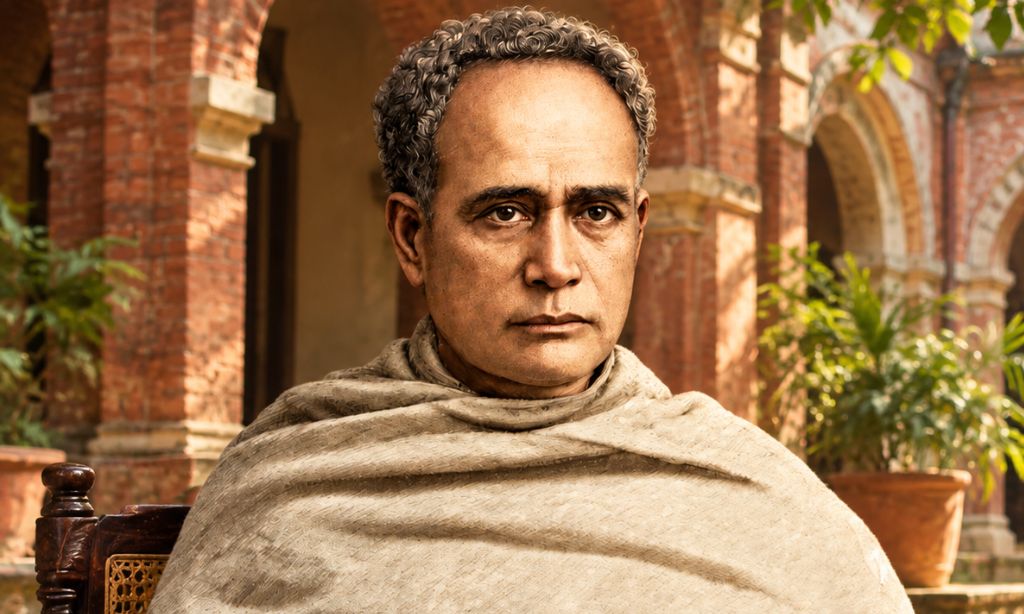
Perhaps no figure looms larger over the Bengal Renaissance than Ishwar Chandra Vidyasagar. Born on this day in the Midnapore district, he was a polymath, educator, and fierce social reformer. He simplified and modernized the Bengali alphabet through his seminal work, Barnaparichay, which remains a foundational text today. Even more significantly, Vidyasagar championed the rights of women, facing immense societal backlash to successfully campaign for the Hindu Widows’ Remarriage Act of 1856, fundamentally altering the social fabric of colonial India.
Dev Anand (Born 1923)
Born Dharam Devdutt Pishorimal Anand in Gurdaspur, British India, Dev Anand became the “Evergreen Star” of Indian cinema. A pioneer of Bombay Noir, his rapid-fire dialogue delivery, nodding style, and sheer charisma defined an era. Through his production house Navketan Films, he directed, produced, and starred in classics like Guide and Hare Rama Hare Krishna, leaving an indelible mark on Bollywood.
Dr. Manmohan Singh (Born 1932)
Born in Gah, Punjab (now in Pakistan), Dr. Manmohan Singh emerged as one of the most consequential figures in modern Indian history. A brilliant Oxford-educated economist, he served as the architect of India’s 1991 economic liberalization, pulling the nation back from the brink of financial collapse. He later served as the 13th Prime Minister of India from 2004 to 2014, becoming the first Sikh to hold the office.
Famous Deaths
Hemanta Mukherjee (Died 1989)
Also known across India as Hemant Kumar, this legendary music director and playback singer possessed a voice that captured the soul of Bengal and the heart of Bollywood. A maestro of Rabindra Sangeet and romantic melodies, his passing left a void in the subcontinent’s musical landscape, though his timeless classics continue to be celebrated today.
International Observances & Holidays
Globally, September 26 is dedicated to a variety of causes ranging from health awareness to global peace initiatives.
| Observance / Holiday | Focus / Significance |
| UN Day for Total Elimination of Nuclear Weapons | Established to educate the public about the existential threat of nuclear weapons and to mobilize international efforts toward global disarmament. |
| World Contraception Day | A campaign launched in 2007 to improve awareness of contraception choices, ensuring that every pregnancy is wanted and promoting sexual health. |
| World Environmental Health Day | Initiated in 2011 to highlight the intrinsic link between the health of our planet’s ecosystems and human well-being. |
| European Day of Languages | Celebrated across the Council of Europe to encourage language learning and protect the linguistic diversity of the continent. |
| Revolution Day (Yemen) | A national holiday commemorating the 1962 revolution that overthrew the Mutawakkilite Kingdom and established the Yemen Arab Republic. |
Global History
To truly understand the weight of September 26, we must look across the continents. On this day, empires have clashed, modern media has transformed politics, and humanity narrowly avoided self-destruction.
United States: The Dawn of the Televised Politician
1960: The landscape of American politics was forever altered when John F. Kennedy and Richard M. Nixon faced off in the first-ever televised presidential debate. Seventy million Americans tuned in. Nixon, recovering from a recent illness, refused stage makeup and appeared pale and sweaty, while Kennedy appeared tanned, relaxed, and charismatic. Interestingly, those who listened on the radio believed Nixon won on substance, but the television audience overwhelmingly declared Kennedy the victor, proving that optics in politics had become just as important as policy.
1786: Shays’ Rebellion began in Massachusetts when armed farmers, facing severe debt and economic ruin, protested by shutting down the local courts. Though eventually crushed, the rebellion alarmed politicians and became a primary catalyst for the Constitutional Convention, leading to the creation of a stronger federal government.
Russia / Soviet Union: The Man Who Saved the World
1983: As Cold War tensions peaked following the Soviet shootdown of a Korean airliner, alarm sirens began blaring inside a secret bunker near Moscow. The Soviet early-warning system, Oko, reported that five American Minuteman intercontinental ballistic missiles had been launched. Duty officer Stanislav Petrov had minutes to decide whether to report the launch to his superiors, which would almost certainly trigger a retaliatory nuclear strike. Trusting his intuition and reasoning that a genuine first strike would involve hundreds of missiles, not five, Petrov declared it a false alarm. He was right—it was a glitch caused by sunlight reflecting off high-altitude clouds. His calm judgment literally saved the world from nuclear annihilation.
1580: English privateer Sir Francis Drake sailed his galleon, the Golden Hind, into Plymouth harbor, successfully completing the second circumnavigation of the world (and the first under a single commander). Laden with plundered Spanish treasure and rare spices, Drake’s voyage was a massive financial success for Queen Elizabeth I and cemented England’s rise as a premier naval power, setting the stage for future colonial expansion.
Canada: The Battle of Thiepval Ridge
1916: During the brutal, muddy slaughters of the First World War, the Canadian Corps proved their mettle on the Western Front. On September 26, Canadian and British troops launched a major offensive to capture Thiepval Ridge during the larger Battle of the Somme. Facing devastating German machine-gun fire and treacherous “no man’s land” terrain, the Canadians valiantly captured the first two trench lines. It marked a defining moment of military coming-of-age for Canada on the global stage.
Australia: Ending the Longest Winning Streak in Sports
1983: In the waters off Newport, Rhode Island, the yacht Australia II accomplished the impossible. Equipped with a revolutionary, highly secret winged keel designed by Ben Lexcen, the Australian vessel defeated the American defender Liberty 4 races to 3. The New York Yacht Club had held the America’s Cup for an astonishing 132 years—the longest winning streak in modern sports history. Back home, an ecstatic Australian Prime Minister Bob Hawke famously declared that any boss who fired a worker for taking the day off to celebrate was a “bum”.
China: The Future of Hong Kong
1984: Representatives of the United Kingdom and the People’s Republic of China initialed the Sino-British Joint Declaration in Beijing. This historic treaty laid the groundwork for the 1997 handover of Hong Kong, outlining the “one country, two systems” principle that guaranteed Hong Kong would retain its capitalist economy and democratic rights for 50 years after the transfer—a promise that remains highly relevant and fiercely debated in global geopolitics today.
Europe: The Tragedy of the Parthenon
1687: The Parthenon in Athens, which had stood largely intact for over two millennia, suffered its most devastating blow. During the Morean War, Venetian forces led by Francesco Morosini laid siege to the Acropolis. The defending Ottoman Turks had stored gunpowder inside the ancient temple. A Venetian mortar round struck the building, igniting the magazine and blowing the roof and sides of the magnificent structure to pieces.
Rest of World: Typhoon Vera
1959: Japan was struck by Typhoon Vera (also known as the Isewan Typhoon). Packing winds of a Category 5 hurricane, it was the strongest and deadliest typhoon in recorded Japanese history. The massive storm surge destroyed sea walls and inundated coastal regions, resulting in the deaths of over 5,000 people and fundamentally changing Japan’s disaster management and coastal defense systems.
Notable Births & Deaths (Global)
September 26 has seen the arrival and departure of some of the most influential figures in arts, sports, science, and politics.
Notable Birthdays on September 26
| Name | Year of Birth | Nationality | Key Contribution & Legacy |
| Ivan Pavlov | 1849 | Russian | Physiologist who pioneered the concept of classical conditioning (the “Pavlovian response”). Winner of the 1904 Nobel Prize. |
| T.S. Eliot | 1888 | American-English | One of the most major poets of the 20th century. Author of The Waste Land; awarded the Nobel Prize in Literature in 1948. |
| George Gershwin | 1898 | American | Legendary composer and pianist who bridged the gap between jazz and classical music with works like Rhapsody in Blue. |
| Serena Williams | 1981 | American | Generational athletic talent; widely considered one of the greatest tennis players of all time with 23 Grand Slam women’s singles titles. |
| Martin Heidegger | 1889 | German | Influential and controversial philosopher whose work on existential phenomenology (Being and Time) deeply influenced 20th-century thought. |
| Olivia Newton-John | 1948 | Australian | Beloved singer and actress who achieved global superstardom through her role in the musical film Grease. |
Notable Deaths on September 26
| Name | Year of Death | Nationality | Cause / Legacy |
| Daniel Boone | 1820 | American | Frontiersman and explorer who became a folk hero for his role in the blazing of the Wilderness Road and settling Kentucky. |
| Bessie Smith | 1937 | American | The “Empress of the Blues,” she was the most popular female blues singer of the 1920s. Died from injuries sustained in a car accident. |
| Béla Bartók | 1945 | Hungarian | Visionary composer and one of the founders of ethnomusicology, blending folk music with classical structures. Died of leukemia. |
| Paul Newman | 2008 | American | Academy Award-winning actor (Cool Hand Luke, The Hustler), race car driver, and philanthropist who founded Newman’s Own. Died of lung cancer. |
| Jacques Chirac | 2019 | French | Served as President of France (1995–2007). Known for his opposition to the 2003 Iraq War and leading the country’s transition to the Euro. Died peacefully at age 86. |
“Did You Know?” Trivia
-
The Origin of the “G-Men”: During the Prohibition era, the FBI was actively hunting down notorious gangsters. On September 26, 1933, agents finally cornered George “Machine Gun” Kelly in Memphis, Tennessee. According to legend, a terrified Kelly surrendered by dropping his weapon and screaming, “Don’t shoot, G-Men! Don’t shoot!” The nickname (short for Government Men) immediately caught on with the press and became the permanent cultural moniker for FBI agents.
-
The Longest Speech in UN History: If you think political speeches drag on today, consider the United Nations General Assembly of 1960. On September 26, Cuban leader Fidel Castro took the podium and spoke for a staggering 4 hours and 29 minutes—the longest timed speech in the history of the UN.
-
Unearthing the Indus Valley: On this day in 1924, Sir John Marshall, the Director-General of the Archaeological Survey of India, officially announced to the world the discovery of Mohenjo-Daro and Harappa. This revelation pushed the history of the Indian subcontinent back by thousands of years, proving the existence of a sophisticated ancient civilization that rivaled Egypt and Mesopotamia.
Quote of the Day
“Only those who will risk going too far can possibly find out how far one can go.”
— T.S. Eliot (Born September 26, 1888)
The brilliant modernist poet captures the essence of this day perfectly. Whether it was Francis Drake venturing into the unknown oceans, or the Australia II crew daring to defeat a 132-year undefeated giant, history is made by those willing to push beyond the accepted boundaries of their time.
Final Thoughts
The events of September 26 offer a profound reflection on the trajectory of human history. From the cultural awakening of the Bengal Renaissance to the geopolitical brinkmanship of the Cold War, this single day demonstrates how rapidly the world can shift. We see the power of language at the United Nations, the unstoppable force of nature in Japan, and the beauty of human creativity through the births of musical and literary geniuses.
History is not a static subject confined to dusty textbooks; it is a living, breathing continuity that shapes our present reality. By looking back at the tragedies, the victories, and the quiet moments of heroism that occurred on September 26, we gain a deeper understanding of who we are today—and where we might be heading tomorrow.