History is never just a collection of dates; it is a tapestry woven from the triumphs, tragedies, and turning points of human civilization. September 20 stands as a remarkable testament to this fact. From the treacherous waves conquered by early global explorers to the hard-fought battles for civil rights in the modern era, this day has witnessed events that reshaped borders, redefined human rights, and revolutionized popular culture.
As an expert historian and cultural archivist, I invite you to travel back in time. In this comprehensive “On This Day” report, we will uncover the monumental historical events, celebrate the iconic figures born on this date, remember the legacies of those we lost, and explore fascinating global trivia associated with September 20.
The Bangalee Sphere
The Indian subcontinent, encompassing modern-day India, Bangladesh, and Pakistan, is a region of immense historical density. September 20 marks several pivotal moments in this sphere, particularly concerning colonial resistance and the geopolitical shifts of the 20th century.
Historical Events
-
1857 — The Fall of Delhi and the Waning of the Sepoy Mutiny: The Indian Rebellion of 1857, which initially sparked in the Bengal Presidency (specifically Barrackpore with the defiance of Mangal Pandey), reached a tragic culmination on September 20. British forces, after a grueling siege, successfully recaptured Delhi from the mutineers. This day effectively ended the reign of the last Mughal Emperor, Bahadur Shah Zafar II, leading to his exile in Rangoon. More importantly, the fall of Delhi marked the transition of power from the British East India Company directly to the British Crown, changing the administrative destiny of Bengal and the rest of the subcontinent for the next 90 years.
-
1965 — UN Demands Ceasefire in the Indo-Pakistani War: The United Nations Security Council unanimously passed Resolution 211 on September 20, 1965, demanding an immediate ceasefire between India and Pakistan. While the primary theater of this war was in the west over Kashmir, the geopolitical fallout deeply impacted East Pakistan (now Bangladesh). The war exposed the physical and military vulnerability of the eastern wing, heightening political discontent and economic disparity. This realization directly fueled the Bangalee nationalist movement, setting the stage for the 1971 Bangladesh Liberation War.
Famous Births
-
Mahesh Bhatt (1948): A prominent Indian film director, producer, and screenwriter known for his critically acclaimed Hindi cinema works. Bhatt’s films, such as Arth and Saaransh, are celebrated for exploring complex psychological themes and breaking away from traditional Bollywood formulas.
-
Akkineni Nageswara Rao (1923): A legendary Indian film actor and producer. Often referred to as ANR, he was instrumental in moving the Telugu cinema industry from Madras to Hyderabad, forever altering the cultural landscape of South Indian cinema.
-
Shriram Sharma Acharya (1911): An influential Indian social reformer, philosopher, and the visionary founder of the All World Gayatri Pariwar. He dedicated his life to integrating modern science with traditional Indian spirituality.
Famous Deaths
-
Annie Besant (1933): Though British by birth, Annie Besant was a fierce champion of Indian self-rule and a prominent figure in the Indian National Congress. She died on September 20 in Adyar, Madras. Her legacy in fighting for Indian independence alongside Bangalee and Indian nationalist leaders remains profoundly impactful.
-
Narayana Guru (1928): A revered philosopher, spiritual leader, and social reformer in India. He led a reform movement against the injustice in the caste-ridden society of Kerala in order to promote spiritual enlightenment and social equality.
-
Zeenat Barkatullah (2023): A highly respected Bangladeshi dancer and television actress. For her immense contributions to the performing arts in Bangladesh, she was awarded the prestigious Ekushey Padak in 2022.
Cultural/Festivals
-
Sree Narayana Guru Samadhi: Observed primarily in Kerala but recognized across the subcontinent, this day marks the death anniversary of Narayana Guru. It is a day of spiritual observance and a reminder of his core philosophy: “One Caste, One Religion, One God for All.”
International Observances & Holidays
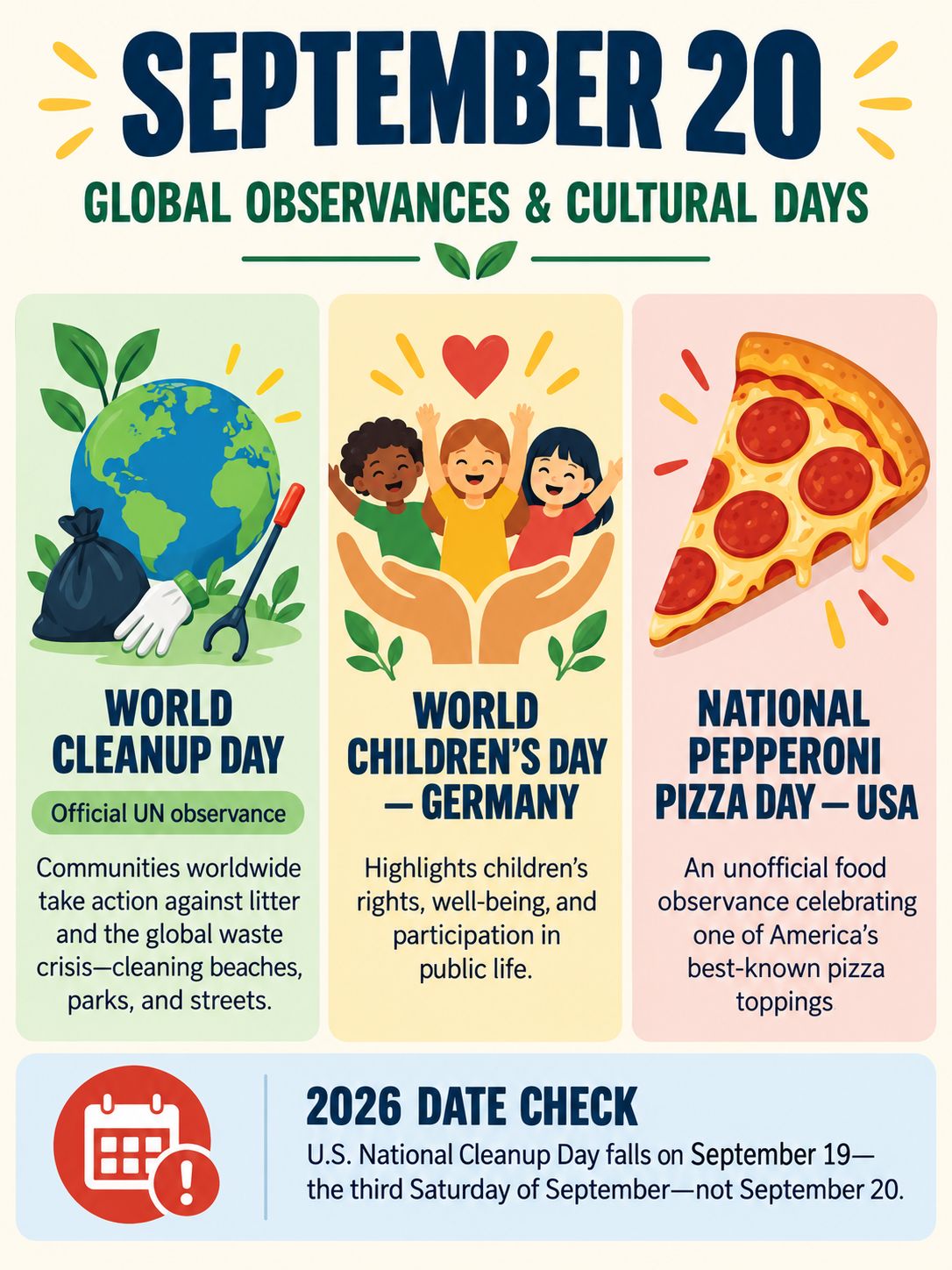
September 20 hosts several global observances dedicated to environmental sustainability and unique cultural celebrations.
Major International Days
-
National Cleanup Day (USA) & Global Variations: Often falling on or around September 20, National Cleanup Day encourages citizens to take immediate action against local waste. It frequently aligns with World Cleanup Day, uniting millions of volunteers across 190 countries to tackle the global mismanaged waste crisis, cleaning up beaches, parks, and urban streets.
-
German World Children’s Day: Observed in Germany on September 20, this day emphasizes the importance of children’s rights, child welfare, and the need to prioritize youth in political and social decision-making.
National & Cultural Days
-
National Pepperoni Pizza Day (USA): While less serious than UN observances, this is a widely celebrated culinary holiday in North America, honoring the continent’s most popular pizza topping. It represents the cultural assimilation of Italian cuisine into mainstream global fast food.
Global History
Beyond the Indian subcontinent, September 20 has been a stage for the expansion of empires, the breaking of barriers, and the defining of modern geopolitics.
United States
-
1881 — A New President Assumes Office: Chester A. Arthur was sworn in as the 21st U.S. President following the tragic assassination of James A. Garfield, testing the resilience of the American democratic succession process.
-
1973 — The “Battle of the Sexes”: In a cultural milestone for women’s sports and the feminist movement, 29-year-old tennis champion Billie Jean King defeated 55-year-old Bobby Riggs in straight sets. Played at the Houston Astrodome and watched by 90 million people worldwide, King’s victory struck a massive blow against gender discrimination in athletics.
-
2001 — The Declaration of the “War on Terror”: Just nine days after the devastating 9/11 attacks, President George W. Bush delivered a historic address to a joint session of Congress. By formally declaring a global “War on Terror” and announcing the creation of the Office of Homeland Security, this speech fundamentally shifted 21st-century global geopolitics and military strategy.
-
2011 — “Don’t Ask, Don’t Tell” Repealed: The U.S. military’s controversial policy, instituted in 1994, officially ended on this day. For the first time in American history, openly gay, lesbian, and bisexual service members were legally permitted to serve in the Armed Forces without fear of discharge based on their sexual orientation.
Europe
-
1519 — Magellan Sets Sail (Spain): Portuguese explorer Ferdinand Magellan departed from Sanlúcar de Barrameda, Spain, with a fleet of five ships. Sponsored by the Spanish Crown, this expedition sought a western route to the Spice Islands. Though Magellan himself would die in the Philippines, one of his ships, the Victoria, would return three years later, completing the first successful circumnavigation of the globe.
-
1870 — The Unification of Italy: Italian Bersaglieri troops breached the walls of Rome through the Porta Pia. This monumental military action successfully captured the city, ended the temporal power of the Papal States, and completed the long-sought unification of Italy (the Risorgimento).
-
1946 — The First Cannes Film Festival (France): Originally planned for 1939 but delayed due to the outbreak of World War II, the inaugural Cannes Film Festival finally opened on the French Riviera, establishing what would become the most prestigious cinematic event in the world.
United Kingdom
-
2000 — MI6 Headquarters Attacked: The Secret Intelligence Service (MI6) headquarters in London was shocked by a brazen domestic security breach when unidentified individuals fired a Russian-built RPG-22 anti-tank missile at the iconic building.
Russia
-
1854 — The Battle of the Alma: During the Crimean War, an allied force of British, French, and Ottoman troops defeated Russian forces at the Alma River. This battle highlighted the severe modernization gap between the western European powers and the Russian Empire, forcing subsequent Russian military reforms.
Rest of World (Asia & South America)
-
1977 — Vietnam Joins the UN: Two years after the fall of Saigon and the end of the devastating Vietnam War, the newly unified nation of Vietnam was officially admitted as a member state into the United Nations, signaling a crucial step toward international normalization and post-war recovery.
-
2017 — Hurricane Maria Devastates Puerto Rico: Making landfall as a catastrophic Category 4 hurricane, Maria caused widespread destruction across Puerto Rico. It triggered a devastating humanitarian crisis, destroyed the island’s power grid, and resulted in nearly 3,000 fatalities, sparking intense debate over the U.S. federal response to the territory.
Notable Births & Deaths (Global)
September 20 marks the arrival and departure of some of history’s most brilliant artistic minds, athletes, and social reformers.
Famous Births
-
Upton Sinclair (1878 – 1968): American author and muckraker journalist. His landmark novel The Jungle (1906) exposed the abhorrent labor and sanitary conditions in the U.S. meatpacking industry, directly leading to the passage of the 1906 Pure Food and Drug Act and the Meat Inspection Act.
-
Sophia Loren (Born 1934): The legendary Italian actress and global cinema icon. Rising from the ashes of post-war Italy, she became a Hollywood sensation and made history as the first actor to win an Academy Award for a foreign-language performance for her role in Two Women (1960).
-
George R. R. Martin (Born 1948): The celebrated American author and screenwriter. He is best known for his sprawling, politically complex epic fantasy series A Song of Ice and Fire, which was adapted into the global television phenomenon Game of Thrones.
-
Khabib Nurmagomedov (Born 1988): Russian mixed martial artist from Dagestan. He retired as the undefeated UFC Lightweight Champion with a pristine 29-0 record, widely regarded as one of the greatest grapplers in the history of combat sports.
Famous Deaths
-
Jean Sibelius (1865 – 1957): The most globally recognized Finnish composer. His powerful, sweeping symphonic works played a vital role in the formation of the Finnish national identity during their struggle for independence from Russia.
-
Jim Croce (1943 – 1973): Beloved American folk singer-songwriter, famous for timeless hits like “Time in a Bottle” and “Bad, Bad Leroy Brown.” He tragically died in a commercial plane crash in Louisiana at the absolute height of his musical career.
-
Simon Wiesenthal (1908 – 2005): An Austrian Holocaust survivor who dedicated his post-war life to tracking down fugitive Nazi war criminals. His relentless pursuit ensured that those responsible for atrocities were brought to justice, leaving behind a legacy of accountability and human rights advocacy.
“Did You Know?” Trivia
Looking for engaging conversation starters? Here are three fascinating, lesser-known facts related to September 20:
-
The First American Gas Car: Long before Henry Ford’s Model T, on September 20, 1893, Charles Duryea and his brother J. Frank Duryea took to the streets of Springfield, Massachusetts, to road-test the very first successful American-made, gasoline-powered automobile.
-
The Iron Man’s Rest: On September 20, 1998, Baltimore Orioles shortstop Cal Ripken Jr. walked into the manager’s office and voluntarily asked to sit out a baseball game. This quiet decision ended his unprecedented streak of playing 2,632 consecutive games over 16 years—a record that many sports historians believe will never be broken.
-
The Cosby Show Premiere: On this day in 1984, The Cosby Show aired its very first episode on NBC. It revolutionized television by presenting a highly educated, affluent African-American family, dominating the Nielsen ratings for five consecutive seasons and fundamentally altering the landscape of American sitcoms.
Quote of the Day
“In real life, the hardest aspect of the battle between good and evil is determining which is which.”
— George R. R. Martin, acclaimed fantasy author, born on this day in 1948.
Final Thoughts
September 20 is a powerful reminder of how human ambition, struggle, and creativity echo through time. From the political upheaval following the Fall of Delhi to the joyous celebration of victory in the Battle of the Sexes, the events of this day highlight our continuous pursuit of progress, equality, and exploration.
As we reflect on the brilliant minds born on this date and honor the legacies of those who have passed, we gain a deeper appreciation for the complex, shared history that binds our global community together. History is not just a study of the past; it is the blueprint for our future.