Every day on the calendar carries the weight of centuries of human experience, and September 7 is no exception. Whether it is the birth of an iconic monarch, a revolutionary declaration of independence, or a battle that shifted the course of global conflicts, this date is etched with fascinating narratives.
If you are a history buff looking for a deep dive into the archives, or simply curious about what the world looked like on your birthday, you are in the right place. Let’s explore the defining moments, legendary individuals, and fascinating trivia that make September 7 a monumental day in human history.
September 7 at a Glance
For those who want a quick snapshot before diving into the details, here is a breakdown of the most significant events, births, and observances associated with September 7.
| Category | Highlights |
| Global Events | The beginning of the London Blitz (1940); Brazil declares independence (1822); The first submarine attack in history (1776). |
| Famous Births | Queen Elizabeth I (1533); Buddy Holly (1936); Gloria Gaynor (1943); Sunil Gangopadhyay (1934). |
| Notable Deaths | Keith Moon (1978); Tupac Shakur (fatally wounded, 1996); Mobutu Sese Seko (1997). |
| Holidays/Observances | International Day of Clean Air for Blue Skies; Brazil’s Independence Day. |
The Bangalee Sphere & South Asian History
The Indian subcontinent is home to ancient civilizations, complex colonial struggles, and rich cultural renaissances. September 7 holds unique significance in this region, marking political turning points and the lives of literary giants.
Historical Milestones
-
1965 – The Indo-Pakistani War Aerial Combat: During the height of the 1965 war, Squadron Leader M. M. Alam (born in Calcutta) of the Pakistan Air Force achieved a controversial but legendary feat, reportedly shooting down five Indian Air Force Hawker Hunter aircraft in less than a minute over Sargodha.
-
1947 – Post-Partition Political Shifts: In the immediate aftermath of the traumatic 1947 partition of India and Bengal, early September saw the rapid formation of new political alliances and resistance groups in East Bengal (now Bangladesh) advocating for democratic rights and cultural preservation, laying the earliest groundwork for the Bengali Language Movement.
Births & Deaths
-
Sunil Gangopadhyay (Born 1934): One of the most prolific and beloved Bengali authors and poets of the modern era. He was the founder of the Krittibas poetry magazine, which became a platform for a new generation of writers. His historical fiction masterpiece, Sei Somoy (Those Days), won the Sahitya Akademi Award and remains a staple in Bengali households.
-
Jatindranath Mukherjee (Bagha Jatin) (Final Stand, 1915): While the legendary anti-British revolutionary passed away on September 10, the first week of September marks his intense, final days. He and his associates were preparing for the famed Battle of Buribalam, a daring armed confrontation against the colonial police that occurred shortly after.
Global History: The Turning Points
From European conflicts to South American liberation, September 7 has seen empires clash and nations rise.
The Americas: Independence and Infrastructure
-
1822 – Brazil Breaks Free: On the banks of the Ipiranga Brook, Prince Dom Pedro uttered the famous “Cry of Ipiranga,” effectively declaring Brazil’s independence from Portugal after over 300 years of colonial rule. The nation celebrates this day annually as Sete de Setembro.
-
1813 – The Birth of “Uncle Sam”: The United States government was affectionately (and mockingly) referred to as “Uncle Sam” for the very first time in a Troy, New York newspaper editorial. The name derived from Samuel Wilson, a meatpacker who supplied rations to American soldiers during the War of 1812.
-
1977 – The Panama Canal Treaties: U.S. President Jimmy Carter and Panamanian leader General Omar Torrijos signed the historic Torrijos-Carter Treaties. This pivotal agreement promised to hand over full control of the Panama Canal to Panama by the end of 1999, peacefully ending decades of American jurisdiction over the vital waterway.
Europe: War, Technology, and Governance
-
1940 – The London Blitz Begins: In a drastic escalation of World War II, the German Luftwaffe launched a massive air attack on London. This marked the beginning of “The Blitz”—57 consecutive nights of relentless bombing that devastated the city but ultimately failed to crush the British spirit.
-
1999 – Rebirth of the Reichstag: The German parliament (the Bundestag) held its first session in the newly restored Reichstag building in Berlin. This symbolic moment marked the government’s official return to its historical capital after decades of division and Cold War politics.
Africa & The Rest of the World
-
1986 – Tutu Takes the Lead: Desmond Tutu became the Archbishop of Cape Town, making history as the first Black man to lead the Anglican Church in South Africa. His leadership was a crucial moral pillar in the international fight to dismantle the oppressive apartheid regime.
International Observances & Holidays
Beyond specific historical moments, this date holds ongoing cultural and global significance.
-
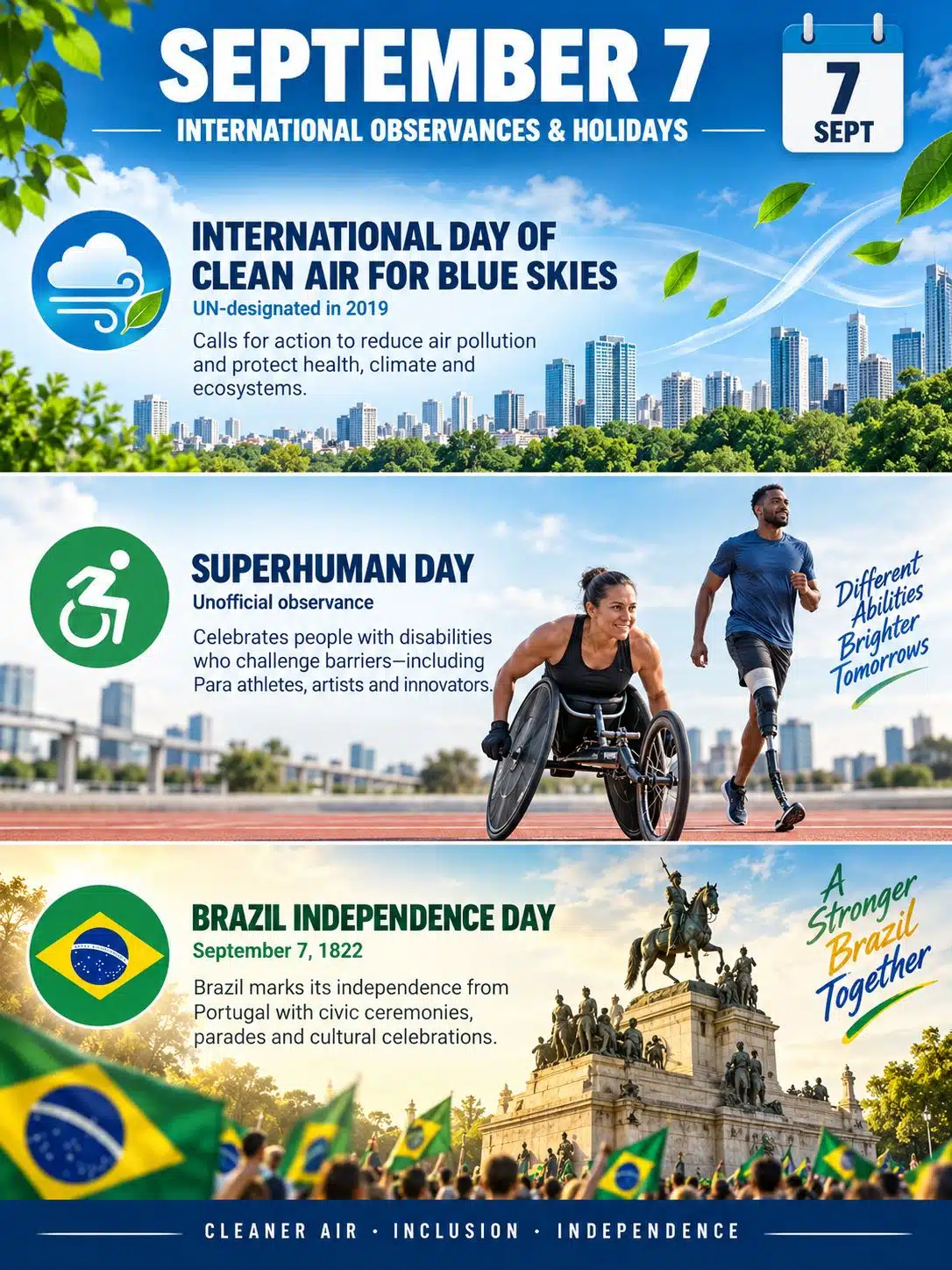
International Day of Clean Air for Blue Skies: Established by the UN in 2019, this day urges governments, corporations, and individuals to take actionable steps toward reducing air pollution. It highlights the direct link between air quality, public health, and climate change.
-
Superhuman Day: An unofficial but inspiring modern observance aimed at celebrating individuals with disabilities who overcome significant barriers, particularly highlighting Paralympic athletes and those pushing the boundaries of physical and mental endurance.
-
Brazil Independence Day: A nationwide public holiday featuring military parades, concerts, and fireworks as Brazilians celebrate their 1822 break from Portuguese rule.
Notable Global Births
History is shaped by individuals. Here are some of the most influential figures who entered the world on this day.
| Year | Name | Nationality | Claim to Fame |
| 1533 | Queen Elizabeth I | English | Reigning over the English Golden Age, her leadership saw the defeat of the Spanish Armada and the flourishing of Shakespearean theater. |
| 1860 | Grandma Moses | American | A renowned folk artist who famously began her prolific painting career in her late 70s, proving that creativity has no age limit. |
| 1914 | James Van Allen | American | A trailblazing space scientist who discovered the radiation belts surrounding Earth that now bear his name. |
| 1936 | Buddy Holly | American | A rock and roll pioneer whose short but brilliant career influenced the Beatles, the Rolling Stones, and Bob Dylan. |
| 1943 | Gloria Gaynor | American | The disco queen whose empowering anthem “I Will Survive” became a global phenomenon and a symbol of resilience. |
| 1999 | Gracie Abrams | American | A prominent contemporary singer-songwriter known for her emotive indie-pop music. |
Notable Global Deaths
September 7 also marks the passing of several influential figures whose legacies continue to impact modern culture, politics, and music.
| Year | Name | Nationality | Legacy |
| 1978 | Keith Moon | British | The famously chaotic and wildly talented drummer for The Who. He died of an accidental drug overdose at 32. |
| 1996 | Tupac Shakur (Incident) | American | The legendary hip-hop artist was fatally shot in a drive-by shooting in Las Vegas on this date (he succumbed to his injuries on September 13). |
| 1997 | Mobutu Sese Seko | Congolese | The long-ruling military dictator of Zaire (now the Democratic Republic of the Congo). He died in exile in Morocco after a deeply corrupt, decades-long reign. |
| 2003 | Warren Zevon | American | A critically acclaimed rock singer-songwriter known for his dark wit and hits like “Werewolves of London.” |
“Did You Know?” Fascinating Trivia
To round out your historical knowledge, here are three lesser-known facts about September 7 that make excellent conversation starters.
-
The First Submarine Attack: Long before nuclear subs prowled the oceans, the very first submarine attack happened on September 7, 1776. During the American Revolution, an egg-shaped submersible called the Turtle tried to attach a time bomb to a British ship. The mission failed, but it changed naval warfare forever.
-
The Poet and the Stolen Painting: In 1911, the famous French poet Guillaume Apollinaire was arrested on September 7 because police suspected he stole the Mona Lisa from the Louvre. He was eventually cleared, but not before his good friend Pablo Picasso was also brought in for intense questioning.
-
The Birth of Women’s Liberation Protests: On September 7, 1968, feminist organizers protested the Miss America pageant in Atlantic City. They dramatically tossed girdles, high heels, and bras into a “Freedom Trash Can.” While nothing was actually set on fire, this specific protest birthed the popular media myth of the “bra-burning feminist.”
Final Thoughts
From the explosive beginning of the London Blitz to the peaceful signing of the Panama Canal Treaties, September 7 is a microcosm of human history. It is a day marked by the birth of legendary monarchs and modern musicians, as well as the tragic loss of cultural icons.
Whether you are observing Brazil’s independence, reflecting on the literary contributions of South Asian writers, or advocating for cleaner air, this date serves as a powerful reminder of how our past continues to shape our present. History is not just a collection of dates; it is the ongoing story of human resilience, innovation, and change.