A child counts six toy cars correctly. When the cars are spread farther apart, the child counts them again and announces that there are now more. Another child sees four crackers and knows there are four without touching them. A third explains that eight can be made from five and three or from four and four.
All three children are working with numbers, but they are showing different parts of mathematical understanding.
Number sense goes beyond reciting the counting sequence or recognizing written numerals. It includes understanding quantities, comparing numbers, noticing relationships, breaking numbers apart, putting them together, and deciding whether an answer is reasonable.
These abilities develop gradually through purposeful instruction, play, routines, conversation, and repeated encounters with real quantities. A child with growing number sense does not simply know that 7 comes after 6. The child begins to understand that 7 represents a quantity, is one more than 6, is two less than 9, and can be separated into 5 and 2.
Those relationships eventually support addition, subtraction, place value, multiplication, division, measurement, and fractions.
What Number Sense Looks Like in Early Childhood
Researchers and curriculum frameworks do not use one identical definition. Broadly, what is number sense refers to a connected understanding of numbers, quantities, and the relationships between them.
In early childhood, this may include the ability to:
- Recognize some small quantities without counting
- Count objects accurately
- Understand that the last number counted represents the total
- Connect number words and written numerals with quantities
- Compare groups as more, fewer, or equal
- Understand the order and relative size of numbers
- Combine and separate quantities
- Find different ways to make the same number
- Estimate rather than make an unreasoned guess
- Use numbers to solve simple, meaningful problems
These skills do not appear together or develop at a uniform rate. A child may recite numbers to 30 but be unable to hand someone exactly eight blocks. Another may occasionally lose track while counting yet understand immediately that adding an object makes a group larger.
That unevenness is common. Number sense is not a single ability that a child either has or lacks. It is a collection of ideas that becomes more connected with experience and instruction.
Reciting Numbers Is Only a Starting Point
Saying “one, two, three, four” from memory is useful. It shows that a child is learning the conventional order of number words. It does not necessarily show that the child understands what those words represent.
Meaningful counting requires several ideas to work together.
First, each object must receive one count word. Young children may touch one object twice, skip another, or continue saying numbers after all the objects have been counted. Sliding each counted object into a new row can make the process easier to manage.
Number words also need to remain in a stable order. A child who says “one, two, four, seven” has begun learning the sequence but cannot yet use it reliably for counting.
The next step is understanding that the final number spoken represents the total. This principle is called cardinality. If a child counts five buttons and then starts again when asked, “How many are there?”, the counting routine may be ahead of the child’s understanding of total quantity.
Children must also learn that moving objects does not change how many there are. Five counters remain five whether they form a straight row, a tight cluster, or a circle. A widely spaced row may look like “more” to a young child because it takes up more room.
Recognizing a Small Group at a Glance
Adults usually know there are three dots on a die without counting them individually. This ability to recognize a small quantity quickly is called subitizing.
Children’s reliable range varies, so begin with very small groups. Briefly show a card with two or three dots, hide it, and ask how many the child saw. Once that feels easy, try different arrangements or slightly larger groups.
The follow-up question is especially useful: “How did you see them?”
A child might describe five dots as “two and three” or “four and one.” That answer shows emerging part-whole understanding, not just visual recognition.
Avoid turning the activity into a speed test. If the child is guessing, reduce the quantity or leave the card visible. The purpose is to notice and discuss a group, not reward the fastest response.
Dice, dominoes, playing cards, fingers, and dot plates provide familiar arrangements without requiring special materials.
Comparing Quantities: Appearance Can Be Misleading
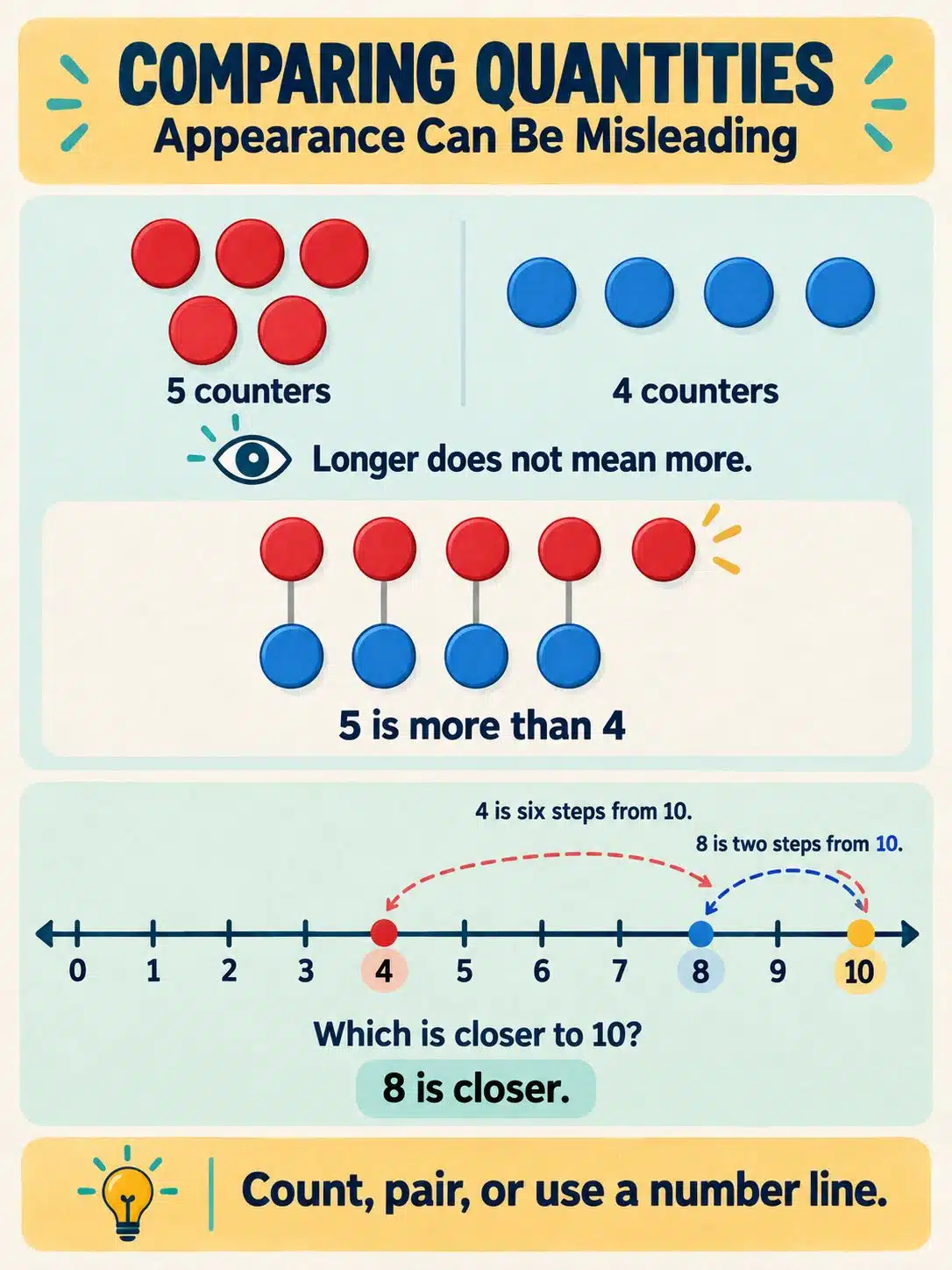
Children need opportunities to decide which group has more, which has fewer, and whether two groups are equal. Visual appearance can complicate the task.
Place five counters in a compact cluster and four in a long row. Ask which group has more and how the child could prove it. Counting is one approach. Pairing each counter in one group with a counter from the other is another.
When a child can compare clearly different groups, make the choices closer:
- Is 8 more or less than 6?
- How many more counters does this group have?
- What would make the two groups equal?
- Which number is closer to 10: 8 or 4?
The final question is more difficult because it asks about numerical distance, not simply order. If the child is unsure, place the numbers on a line rather than repeating the question louder or supplying the answer.
Numbers Can Be Taken Apart and Rebuilt
Five is not only the number that comes after four. It can be made from 4 and 1, 3 and 2, or five individual ones. Seven can be 5 and 2, 6 and 1, or 4 and 3.
This ability to compose and decompose numbers supports flexible calculation.
Consider 8 + 5. A child might separate 5 into 2 and 3, add 2 to 8 to make 10, and then add the remaining 3. Another might use the known double 5 + 5 and add 3 more. These strategies depend on recognizing number relationships.
Linking cubes, two-colour counters, fingers, dominoes, and ten-frames make those relationships visible. The materials alone are not enough, though. An adult needs to connect the arrangement to the idea:
“You made seven with five red counters and two yellow ones. Can you make seven another way?”
For most young learners, exploring numbers within 5 or 10 is more productive than rushing into large quantities. Small numbers leave enough mental space to compare, rearrange, explain, and check.
Connecting Quantities, Number Words, and Numerals
The written numeral 6, the spoken word “six,” and a collection of six buttons represent the same number in different forms. Children need repeated opportunities to make that connection.
Tracing the numeral 6 mainly practises writing a symbol. It does little by itself to establish quantity. A more useful task combines representations: trace or write 6, place six counters beside it, clap six times, and find six objects in the room.
Numeral reversals should be considered separately. A child may understand exactly what 3 or 5 represents while still writing the symbol backward. That is usually a numeral-formation issue, not evidence by itself of poor quantity understanding.
When a child can name a numeral but cannot produce the matching number of objects, return to small collections. Covering the page with more numeral-writing practice is unlikely to address that particular gap.
Number Order Is Also About Distance
Knowing that 9 comes after 8 is useful. Understanding that 9 is close to 10 and much farther from 2 reflects a stronger grasp of magnitude.
Number lines, measuring tapes, floor paths, and board games can make numerical distance visible. Draw a line with 0 at one end and 10 at the other. Ask where 5 might go, followed by 2, 7, or 9.
Young children’s placements will not always be exact. The explanation is more revealing:
- “Why did you put 9 near that end?”
- “Which number should be closer to 10?”
- “Where would 6 go compared with 5?”
- “If we move two spaces from 6, where will we land?”
An empty number line is generally harder than one with every number marked. Use the fully marked version first when a child is still learning the sequence.
A Flexible Developmental Picture From Ages 3 to 8
Age ranges can help adults choose suitable activities, but they should not be treated as pass-or-fail deadlines. Children develop at different rates, and school expectations vary across countries and curricula.
Around ages 3–4
Children may be learning part of the counting sequence, counting small collections, recognizing very small groups, and noticing obvious differences between quantities.
Useful experiences include counting snacks, matching one cup to each plate, sorting objects, singing number songs, and playing with groups of two or three items.
At this stage, adults should not be concerned with large totals. A child who can thoughtfully compare two and three is doing more valuable mathematical work than one who can recite to 50 without connecting the words to quantities.
Around ages 4–5
One-to-one counting usually becomes more reliable. Children begin to understand that the final count word gives the total, recognize some written numerals, and compare nearby quantities.
Simple board games, five-frames, dice, setting the table, and sharing objects work well here. Ask children to create a group rather than only count one: “Can you give me five blocks?”
Producing a requested quantity is often harder than counting a collection already provided.
Around ages 5–6
Children commonly work on making and breaking numbers within 10, finding one more or one less, and representing simple addition or subtraction situations.
Story problems should describe situations the child can picture:
“There were five birds on a fence. Two flew away. How many stayed?”
Let the child act it out with counters, draw it, or use fingers. Moving too quickly to written equations can hide whether the story itself makes sense to the child.
Around ages 6–8
Number sense expands into place value, more flexible addition and subtraction, estimation, skip-counting, equal groups, measurement, and early multiplication ideas.
Base-ten blocks can show that 34 contains three tens and four ones. Arrays can show that four rows of three and three rows of four contain the same total. Open number lines can record jumps used in mental calculation.
Older children may still need physical or visual materials when learning something new. Removing those supports purely because of age can make a concept less accessible without improving the mathematics.
Everyday Activities With Real Mathematical Value
Number sense does not require a shelf of educational products. Dice, cards, bottle caps, blocks, food, buttons, and household routines provide enough material for substantial learning.
Ask a child to distribute two strawberries to each person or divide eight counters between two bowls.
This creates useful problems:
- Does everyone have the same amount?
- How many are left?
- What happens if another person joins?
- Can eight be divided into two equal groups?
- Is there another way to share the objects?
Keep the quantities manageable. If the child spends all their effort keeping track of 20 loose objects, reduce the group.
Play dice and path games
A path game connects the quantity shown on a die with movement. Children recognize dot patterns, count spaces, compare positions, and judge how far they are from the finish.
With two dice, a child may first count every dot. Later, the child might recognize the larger quantity and count on from it. Familiar combinations may eventually be recalled without counting.
If the playing piece is moved incorrectly, ask the child to check the move. Quietly fixing it misses the chance to connect the die, the count, and the distance travelled.
Try a mystery-cup problem
Place six counters on a table. Ask the child to close their eyes while some are hidden under a cup. If two remain visible, how many are hidden?
Allow fingers, spare counters, drawings, or a number sentence. The representation is part of the thinking.
Once the basic version is familiar, make the problem less predictable: “There are fewer than ten counters altogether. Four are outside the cup. How many might be hidden?” Now the problem can have several correct answers.
Estimate before counting
Show a small jar of buttons and ask whether it contains more or fewer than ten. Older children can give an approximate total before counting.
Discuss how they made the estimate. Did they notice groups? Was the jar similar to one they had counted before? Did the objects seem tightly packed?
Estimation is not an accuracy contest. A reasonable estimate supported by an explanation is more useful than a lucky guess.
Notice what numbers do
Numbers on clocks, buses, houses, calendars, sports scores, recipes, measuring tools, and price labels serve different purposes.
A house number identifies a location. A number on a measuring cup represents an amount. A score records a result. Helping children notice these differences makes a number hunt more meaningful than simply naming every numeral they see.
Ask Questions That Reveal the Strategy
“What is the answer?” usually produces little information about how the child thought.
Try asking:
- “How did you work that out?”
- “Can you show it with objects?”
- “Is there another way to make eight?”
- “How do you know these groups are equal?”
- “What changes if we add one?”
- “Does that answer seem reasonable?”
- “Can you solve it another way?”
Then wait. Rephrasing the question immediately can interrupt a child who is still organizing an idea.
Wrong answers also need interpretation. A child who says 5 + 3 = 7 may have lost track while counting. A child who writes 53 may be joining the digits instead of combining the quantities. Another child may know the total but misunderstand the plus sign. Those errors do not call for the same explanation.
Common Approaches That Deserve More Caution
Moving to large numbers too soon
Counting to 100 sounds impressive, but it is not the strongest measure of early mathematical understanding. Exploring numbers within 5 or 10 often produces richer reasoning.
Treating speed as the main result
Efficient recall becomes useful as children progress because it frees attention for harder problems. It should develop alongside conceptual understanding, accurate procedures, and flexible strategies—not replace them.
Timed tasks reveal speed. They do not reveal everything a child understands.
Assuming manipulatives teach by themselves
Counters and cubes can become toys or counting props if nobody connects them to the problem. Ask what each group represents and how moving an object changes the quantity.
Relying mainly on worksheets
Written practice can reinforce an idea and record a child’s work. It is less useful when the child follows a visual pattern without understanding the numbers.
Young learners also need to build, move, compare, draw, estimate, measure, and talk.
Requiring one approved method
A child might solve 6 + 7 as 6 + 6 + 1. Another might take 4 from the 7 to make 10 + 3. Both strategies show useful relationships.
Children need accurate and efficient methods, but discussing more than one sensible route helps them understand why the calculation works.
When Difficulty Deserves a Closer Look
An occasional mistake is not evidence of a learning disability. Children lose track, misunderstand directions, become tired, or find one representation harder than another.
Pay closer attention when difficulty persists across different activities and settings, particularly after the child has received clear instruction and repeated practice. Examples may include:
- Regularly losing track while counting small groups
- Struggling to match one count word to each object
- Finding it difficult to compare groups with an obvious difference
- Failing to connect familiar numerals with quantities
- Recounting from one for nearly every simple problem long after other strategies have been taught
- Showing little retention of previously understood number ideas
- Becoming consistently distressed during ordinary mathematical activities
Record specific examples. “She counted six counters but skipped the third one each time” is more useful than “She is bad at math.”
Share those observations with the child’s teacher. The teacher can review the instruction already provided, compare performance across tasks, and decide whether targeted teaching, screening, or formal assessment is appropriate.
Final Thoughts
Understanding what is number sense changes what adults look for. Counting farther and answering faster are not the only signs of progress. A child who finds two ways to make eight, checks an unlikely answer, or proves that one group has more is developing useful mathematical reasoning.
Start with a small quantity and one ordinary activity: roll a die, share eight objects, estimate a collection, or ask the child to make seven in two ways. Pay attention to the explanation rather than rushing toward the correct answer.
If understanding grows, gradually make the problem more challenging. If the same difficulty continues across tasks, write down what happens and speak with the teacher. The most useful support begins with seeing exactly how the child is thinking.