History is rarely a straight line; it is a complex web of triumphs, tragedies, quiet innovations, and loud revolutions. September 6 is a date that perfectly encapsulates this chaotic beauty. On this exact day, the first ship to ever circle the globe limped back into a Spanish harbor, a United States President fell to an assassin’s bullet, and the Supreme Court of India handed down a monumental human rights ruling.
Whether you are a cultural anthropologist tracking the evolution of societies, an archivist hunting for forgotten milestones, or simply a curious mind looking for dinner-table trivia, the historical footprint of September 6 offers a wealth of stories. Let us dive deep into the events, the visionaries, and the cultural milestones that shaped the world on this day.
The Bangalee Sphere & Indian Subcontinent
The historical tapestry of the Indian subcontinent is rich with colonial resistance, political evolution, and profound artistic contributions. September 6 marks several pivotal moments for Bangladesh and India.
Major Historical Events
-
1956: The Dawn of a Democratic Coalition in East Bengal
Decades before Bangladesh achieved its hard-fought independence, the political landscape of East Pakistan (modern-day Bangladesh) was a volatile battleground for cultural and linguistic rights. On September 6, 1956, a coalition government was formed under the leadership of the Awami League. This was a watershed moment, ushering in a brief but vital era of democratic environment in East Bengal. It empowered the Bangalee political voice, laying the foundational groundwork that would eventually culminate in the Liberation War of 1971.
-
1965: The Escalation of the Indo-Pakistani War
September 6 is a day etched deeply into the military history of the subcontinent. Following Pakistan’s “Operation Grand Slam,” Indian forces crossed the international border in Punjab on this day in 1965 in retaliation, officially launching the Battle of Lahore. This escalation turned a regional skirmish over Kashmir into a full-scale conventional war. The conflict featured some of the largest tank battles since World War II. Ultimately, the war ended in a UN-mandated ceasefire and the signing of the Tashkent Declaration, but the geopolitical scars remain visible today.
-
2018: The Decriminalization of Homosexuality in India
In one of the most progressive legal milestones in modern Indian history, the Supreme Court of India read down Section 377 of the Indian Penal Code on September 6, 2018. This colonial-era law had criminalized consensual homosexual sex for over 150 years. The unanimous ruling by a five-judge bench was celebrated globally as a massive victory for human rights, personal liberty, and the LGBTQ+ community across South Asia.
Famous Births & Deaths in the Subcontinent
| Figure | Lifespan | Legacy & Contribution |
| Mita Haque | 1962 – 2021 | A legendary Bangladeshi Rabindra Sangeet singer. Haque was a purist who dedicated her life to the authentic rendition and preservation of Rabindranath Tagore’s musical legacy. She was awarded the Ekushey Padak, Bangladesh’s second-highest civilian honor. |
| Aditya V. Sengupta | 1983 – Present | An acclaimed Bengali film director. His groundbreaking debut, Asha Jaoar Majhe (Labour of Love), beautifully captured the silent, grueling rhythms of middle-class life in Kolkata, winning international acclaim and proving that regional Bengali cinema remains a powerhouse of global art. |
| Salman Shah | 1971 – 1996 | Born Chowdhury Mohammad Shahriar Emon, Salman Shah revolutionized the Bangladeshi film industry (Dhallywood) in the 1990s. Bringing a fresh, modern aesthetic and undeniable charisma, his tragic and highly controversial death on September 6 at age 24 left a permanent scar on the cultural psyche of Bangladesh. |
International Observances & Holidays
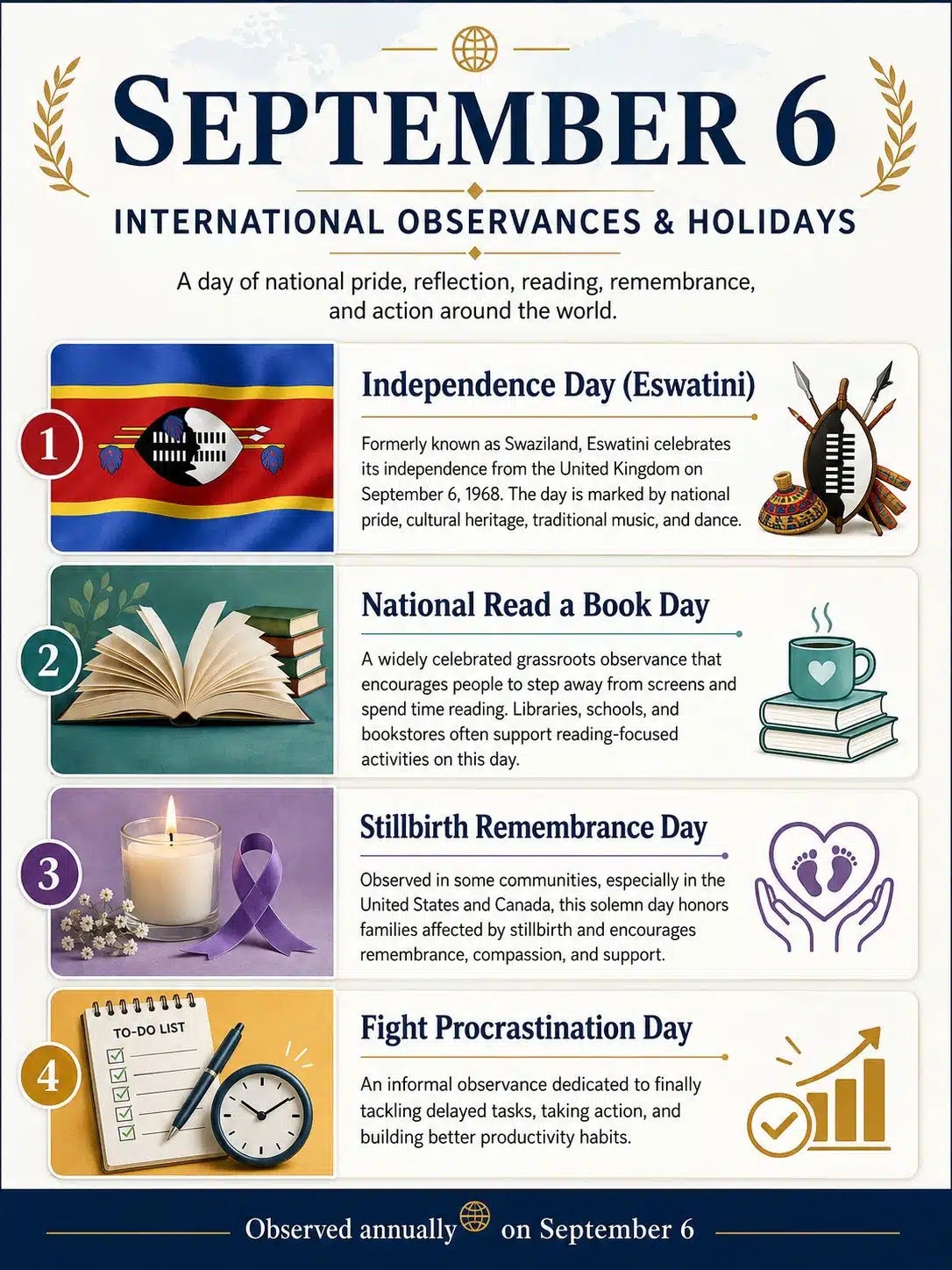
Beyond geopolitics, September 6 holds space for national pride, quiet reflection, and community-driven observances around the globe.
-
Independence Day (Eswatini): Formerly known as Swaziland, this landlocked nation in Southern Africa celebrates its formal independence from the United Kingdom, which was achieved on this day in 1968. The day is marked by traditional Swazi music, spectacular dance performances (including the famous Reed Dance during this season), and national unity.
-
National Read a Book Day: A globally celebrated grassroots holiday that encourages people to step away from digital screens, endless scrolling, and modern anxieties to immerse themselves in literature. Libraries, schools, and independent bookstores often host read-a-thons on this day.
-
Stillbirth Remembrance Day: Observed primarily in the United States and Canada, this solemn day honors families who have suffered the tragedy of infant loss or stillbirth. It is a day focused on breaking the social stigma surrounding miscarriage and offering communal grief support.
-
Fight Procrastination Day: A lighter, yet highly practical observance dedicated to finally tackling the lingering tasks on your to-do list.
Global History
To understand the global impact of September 6, we must look at how the geopolitical tectonic plates shifted across different continents on this day.
United States: Suffrage, Assassination, and Supermarkets
-
1870: A Milestone for Women’s Suffrage
Long before the 19th Amendment guaranteed women the right to vote nationwide, the western territory of Wyoming passed an equal suffrage law. On September 6, 1870, an older woman named Louisa Ann Swain put on a clean apron, walked into a polling place in Laramie, Wyoming, and became the first woman in the United States to cast a legal ballot in a general election since 1807.
-
1901: The Assassination of President William McKinley
While attending the Pan-American Exposition in Buffalo, New York, President William McKinley was shot twice in the abdomen by Leon Czolgosz, a self-proclaimed anarchist. The shooting shocked the nation. Though McKinley survived the initial attack, he succumbed to gangrene days later. His death vaulted Vice President Theodore Roosevelt into the presidency and fundamentally changed American security protocols, leading Congress to officially task the Secret Service with protecting the Commander-in-Chief.
-
1916: The Birth of the Modern Supermarket
Before September 6, 1916, grocery shopping required handing a list to a clerk, who would fetch items for you. Clarence Saunders changed global consumerism forever when he opened the first “Piggly Wiggly” store in Memphis, Tennessee. It was the very first true self-service grocery store, introducing shopping baskets, open shelves, and checkout stands.
-
1995: The Iron Man of Baseball
In one of the most emotional moments in sports history, Cal Ripken Jr. of the Baltimore Orioles played in his 2,131st consecutive Major League Baseball game, officially breaking the “unbreakable” streak set by Yankees legend Lou Gehrig. The game was paused for a 22-minute standing ovation, symbolizing a moment of pure resilience and dedication.
-
1522: The Victoria Completes the Ultimate Journey
Three years after Ferdinand Magellan set sail with a fleet of five ships and 270 men to find a western route to the Spice Islands, a single, battered vessel crept into the Spanish harbor of Sanlúcar de Barrameda. Captained by Juan Sebastián Elcano (Magellan had been killed in the Philippines), the Victoria carried just 18 starving survivors. On September 6, 1522, they officially completed the first recorded circumnavigation of the Earth, proving definitively the true, staggering size of our planet.
-
1972: The Tragic End to the Munich Massacre
The 1972 Summer Olympics in Munich were intended to showcase a new, peaceful Germany. Instead, they became the site of unprecedented terror. The crisis reached its bloody conclusion on September 6 at the Fürstenfeldbruck airbase, where a botched rescue attempt by West German police resulted in the deaths of all nine remaining Israeli hostages, a German police officer, and five Palestinian “Black September” terrorists. The event permanently altered global counter-terrorism strategies.
-
1991: The Rebirth of Saint Petersburg
As the Soviet Union began its rapid collapse, the citizens of Russia’s second-largest city voted to shed its Soviet identity. On this day, the city of Leningrad officially reverted to its original, imperial name: Saint Petersburg. On this same day, the Soviet Union formally recognized the independence of the Baltic states (Estonia, Latvia, and Lithuania), signaling the definitive end of the Iron Curtain.
-
1997: A Global Farewell to Princess Diana
Over two billion people worldwide tuned in to watch the funeral of Diana, Princess of Wales, held at Westminster Abbey in London. Her sudden death in a Paris car crash triggered an unprecedented outpouring of public grief, fundamentally modernizing the British Monarchy’s relationship with the public.
Africa & The Middle East: Assassinations and Covert Strikes
-
1966: The Architect of Apartheid Falls
South African Prime Minister Hendrik Verwoerd, the man widely considered the chief architect of the brutal, racially segregating Apartheid system, was stabbed to death. He was assassinated by Dimitri Tsafendas, a parliamentary messenger, directly on the floor of the House of Assembly in Cape Town. While his death shocked the ruling establishment, it did not immediately end the Apartheid regime, which survived for another three decades.
-
2007: Operation Orchard
In a highly classified military maneuver, Israeli Air Force jets crossed into Syrian airspace just after midnight and bombed a facility in the Deir ez-Zor region. Years later, it was confirmed that the target was a suspected nuclear reactor being built with North Korean assistance. The strike fundamentally altered the nuclear balance in the Middle East.
Notable Births & Deaths (Global)
Great movements are driven by individuals. September 6 is marked by the births of revolutionaries and scientists, and the deaths of cultural giants.
Famous Births
| Name | Year | Nationality | Legacy |
| Marquis de Lafayette | 1757 | French | The “Hero of Two Worlds.” A French aristocrat and military officer who fought valiantly in the American Revolutionary War alongside George Washington and later became a key figure in the French Revolution. |
| John Dalton | 1766 | British | The pioneering chemist and physicist who introduced modern atomic theory into chemistry and conducted the first formal research into color blindness (sometimes called Daltonism). |
| Jane Addams | 1860 | American | A trailblazing social worker, sociologist, and reformer. She co-founded Chicago’s Hull House to aid the poor and immigrants, eventually becoming the first American woman to win a Nobel Peace Prize. |
| Roger Waters | 1943 | British | The creative visionary, lyricist, and bassist for the legendary progressive rock band Pink Floyd, responsible for conceptual masterpieces like The Dark Side of the Moon and The Wall. |
| Idris Elba | 1972 | British | A highly acclaimed and versatile actor known for defining roles in HBO’s The Wire, BBC’s Luther, and his portrayal of Nelson Mandela in Mandela: Long Walk to Freedom. |
Famous Deaths
| Name | Year | Nationality | Legacy |
| Suleiman the Magnificent | 1566 | Ottoman | The longest-reigning Sultan of the Ottoman Empire. Under his rule, the empire reached the apex of its military, political, and economic power, dominating the Mediterranean and Eastern Europe. |
| Sully Prudhomme | 1907 | French | A French poet and essayist who holds a unique place in literary history: in 1901, he became the very first person to be awarded the Nobel Prize in Literature. |
| Akira Kurosawa | 1998 | Japanese | Arguably one of the most important and influential filmmakers in the history of cinema. Directors worldwide cite his masterpieces, such as Seven Samurai and Rashomon, as the pinnacle of visual storytelling. |
| Luciano Pavarotti | 2007 | Italian | One of the most commercially successful operatic tenors of all time. His brilliant tone and charismatic stage presence helped classical opera cross over into mainstream pop culture. |
| Burt Reynolds | 2018 | American | A charismatic Hollywood icon and sex symbol of the 1970s and 80s, famous for blockbusters like Deliverance and Smokey and the Bandit. |
“Did You Know?” Trivia
Looking for conversation starters? Here are three fascinating, lesser-known facts about September 6 that might surprise you:
-
A Royal Game of Hide and Seek: Following his devastating defeat at the Battle of Worcester in 1651, King Charles II of England spent a terrifying September 6 hiding in the branches of a large oak tree (later known as the Royal Oak) at Boscobel House to escape capture by Oliver Cromwell’s Parliamentarian forces.
-
Bob Dylan’s Humble Beginnings: On September 6, 1961, a young, virtually unknown folk singer named Bob Dylan made his New York City stage debut at the Gaslight Cafe in Greenwich Village. Within a few short years, he would become the voice of a generation.
-
Sunken Treasure Found: On this day in 1622, the Spanish treasure galleon Nuestra Señora de Atocha sank in a hurricane off the Florida Keys, taking tons of copper, silver, gold, and emeralds to the ocean floor. The wreck was famously discovered over 350 years later by treasure hunter Mel Fisher, yielding half a billion dollars in recovered artifacts.
Quote of the Day
“When the government violates the people’s rights, insurrection is, for the people and for each portion of the people, the most sacred of the rights and the most indispensable of duties.”
— Gilbert du Motier, Marquis de Lafayette (Born September 6, 1757)
Final Thoughts
The events of September 6 offer a profound reminder of the fragility and resilience of human progress. From the grueling, scurvy-ridden decks of the Victoria returning to Spain in 1522, to the quiet dignity of Louisa Ann Swain casting her ballot in 1870, this day is a testament to those who pushed the boundaries of what was considered impossible.
We see the dark consequences of political fanaticism in the assassinations of President McKinley and Prime Minister Verwoerd, and the tragic violence at the Munich Olympics. Yet, we also see the restorative arc of justice in the Supreme Court of India’s 2018 decision to strike down archaic colonial laws, proving that societies can, and do, evolve.
Whether we are remembering the birth of atomic theory through John Dalton, marveling at Cal Ripken Jr.’s physical endurance, or mourning the untimely loss of cinematic icons like Salman Shah and Akira Kurosawa, September 6 connects our modern world to a deeply layered past. Understanding what happened “On This Day” isn’t just about memorizing dates; it is about recognizing the continuing echoes of these historical milestones in our everyday lives.