History does not move in a straight, gentle line; it surges in unpredictable waves, quiet epiphanies, and sudden fractures. Few days on the calendar capture this dynamic quite like September 4. Looking back across the centuries, this date has witnessed the official sunset of the classical Western world, the quiet birth of an algorithmic engine that transformed human knowledge, crucial battles for civil rights, and seismic political shifts that rippled across continents.
Beyond the headlines of world capitals, September 4 holds profound resonance for the Indian subcontinent and the Bangalee cultural sphere. It marks the birth of visionary economists who challenged the British Empire from within, literary masters who pioneered indigenous science fiction, and the loss of cultural voices who gave musical soul to liberation movements.
Whether examining an ancient emperor surrendering his crown or an engineer filing a trademark that democratized photography, September 4 serves as a mirror to humanity’s endless cycle of collapse, reinvention, and creative triumph.
Landmark Historical Turning Points
476 CE: The Extinction of the Western Roman Empire
On September 4, 476, the Germanic chieftain Odoacer deposed the sixteen-year-old Roman emperor Romulus Augustulus at Ravenna. While the Eastern Roman (Byzantine) Empire endured for another millennium from Constantinople, the deposition of this teenage sovereign is widely recognized by historians as the definitive boundary stone marking the end of antiquity and the dawn of the European Middle Ages.
Romulus was spared execution due to his youth, granted a pension, and sent to live in Campania. Yet with his abdication, the institutional machinery that had governed Western Europe for over half a millennium ceased to function. Power decentralized into localized feudal kingdoms, fundamentally altering linguistic, legal, and urban patterns across the European continent.
1781: The Humble Genesis of Los Angeles
On this day, forty-four settlers—known historically as Los Pobladores—established a small agrarian village in Alta California under the authority of the Spanish Empire. They christened it El Pueblo de Nuestra Señora la Reina de los Ángeles sobre el Río Porciúncula (The Town of Our Lady the Queen of the Angels on the Porciúncula River).
Far from a European aristocracy, these forty-four pioneers represented a deeply diverse demographic mosaic: Indigenous American, Afro-Latino, European, and mestizo families seeking arable land in the arid frontier. Over the span of two centuries, this vulnerable, remote Spanish outpost evolved into Los Angeles: a four-million-person megacity, the global epicenter of entertainment, and one of the most culturally diverse urban economies on Earth.
1870: The Proclamation of the French Third Republic
Following the disastrous defeat of the French army and the capture of Emperor Napoleon III by Prussian forces at the Battle of Sedan, Parisian crowds erupted in protest. On September 4, 1870, republican statesman Léon Gambetta stood at the Hôtel de Ville in Paris and proclaimed the abolition of the Second French Empire and the birth of the French Third Republic.
Though born amid the humiliation of military collapse and tested immediately by the bloody trauma of the Paris Commune of 1871, the Third Republic proved exceptionally resilient. It lasted until 1940, establishing secular public education, cementing democratic parliamentary traditions, and anchoring France through the crucible of World War I.
1882 & 1888: The Double Spark of the Modern Age
September 4 holds rare distinction in the annals of industrial innovation:
-
September 4, 1882: Thomas Edison initiated operations at the Pearl Street Station in lower Manhattan. Powering roughly 400 lamps across a modest, one-square-mile district, this coal-fired generating facility was the world’s first commercial central power plant. It proved that electrical energy could be mass-generated, measured, and distributed into homes and businesses, setting off the electrification of global industry.
-
September 4, 1888: George Eastman received a patent for his portable box camera and officially registered the trademark name “Kodak.” Up until this moment, photography was a hazardous, chemically punishing craft reserved for professionals with heavy tripods and darkrooms. Eastman’s simple slogan—”You press the button, we do the rest”—transformed personal memory, journalism, and artistic expression, establishing photography as a universally accessible human pursuit.
1957: The Little Rock Nine and Constitutional Crisis
On the morning of September 4, 1957, nine African American teenagers walked toward Central High School in Little Rock, Arkansas, seeking to attend their first day of integrated classes following the landmark 1954 Supreme Court ruling Brown v. Board of Education. Instead of open doors, they were confronted by screaming white mobs and armed soldiers of the Arkansas National Guard, deployed directly by Governor Orval Faubus to block their entry.
A photograph taken that morning of fifteen-year-old Elizabeth Eckford, walking stoically amid a jeering, hostile crowd, became an indelible moral indictment of racial segregation. The standoff created a direct constitutional crisis between state resistance and federal authority, forcing President Dwight D. Eisenhower weeks later to send the 101st Airborne Division to escort the students, demonstrating that the federal government would use military power to enforce civil rights rulings.
1998: The Incorporation of Google
In a modest garage in Menlo Park, California, owned by Susan Wojcicki, Stanford doctoral students Larry Page and Sergey Brin officially incorporated Google as a private enterprise on September 4, 1998. Armed with an innovative algorithm named PageRank—which evaluated websites not merely by keyword frequency, but by the structural authority of incoming links—they transformed search from a chaotic directory into an intuitive, predictive utility.
Within two decades, Google expanded from an academic experiment into Alphabet Inc., a multitrillion-dollar technology enterprise that fundamentally reorganized human commerce, information retrieval, artificial intelligence, and everyday communications.
The Bangalee Sphere & South Asian Subcontinent
The cultural and political history of South Asia on September 4 illustrates a rich narrative of intellectual resistance, artistic brilliance, and shared ecological vulnerability.
Dadabhai Naoroji (Born September 4, 1825)
Known reverently as the “Grand Old Man of India,” Dadabhai Naoroji was born on this day in Navsari, Gujarat. While prominent across western India, Naoroji’s intellectual contributions left a lasting mark on the political consciousness of Bengal and the greater subcontinent.
Naoroji was an educator, mathematician, and the first Indian elected to the British House of Commons (representing Central Finsbury in 1892). His masterwork, Poverty and Un-British Rule in India, formulated the devastating “Drain Theory.” Through meticulous statistical analysis, Naoroji demonstrated that the British Raj was not a benevolent civilizing mission, but an economic siphon siphoning an estimated £200 to £300 million of untaxed wealth out of India to London. His scholarship dismantled the moral justification of colonial rule, providing the theoretical ammunition later wielded by Gopal Krishna Gokhale, Surendranath Banerjee, and Rabindranath Tagore.
Premendra Mitra (Born September 4, 1904)
Bengali literature owes an immense debt to Premendra Mitra, born on September 4, 1904, in Varanasi. A leading luminary of the Kallol era, Mitra shattered the sentimental conventions of early 20th-century Bengali fiction by shining a clear, compassionate light on urban poverty, alienation, and working-class struggles.
Mitra was also an architect of Bengali speculative fiction. He gifted subcontinental popular culture the immortal character Ghanada (Ghanashyam Das), an unassuming bachelor living in an old Kolkata mess-house whose tall tales mingled geography, cutting-edge science, and witty hyperbole. Mitra received both the Sahitya Akademi Award and the Padma Shri, standing alongside Satyajit Ray as a pioneering advocate for science-based storytelling in South Asian languages.
Gazi Mazharul Anwar (Died September 4, 2022)
In modern Bangladesh, September 4 is observed with deep reverence as the passing anniversary of Gazi Mazharul Anwar, one of the most prolific and beloved lyricists, filmmakers, and producers in the nation’s history.
During the dark, existential months of the 1971 Liberation War, Anwar’s pen served as an inspiring cultural weapon. Broadcasting through the clandestine Swadhin Bangla Betar Kendra, his songs—including “Joy Bangla Banglar Joy” (Victory to Bengal, Victory to Bangla) and “Ekbar Jete De Na Amar Chotto Sonar Gaye”—became battle hymns for freedom fighters (Mukti Bahini). Over a career spanning six decades, he composed more than 20,000 songs, earned a record six Bangladesh National Film Awards for Best Lyricist, and was honored with both the Ekushey Padak and the Swadhinata Puraskar (Independence Award).
The Great Bengal Inundation of 1978
On September 4, 1978, torrential monsoon rainfall, combined with upstream water discharges, crested across the river basins of the Bhagirathi, Damodar, and Mayurakshi. What followed was one of the most catastrophic natural disasters in modern South Asian history. Over the first week of September, catastrophic floodwaters inundated twelve districts of West Bengal and adjacent low-lying river belts in Bangladesh.
Entire agricultural ecosystems were submerged under 10 to 18 feet of water, washing away millions of tons of standing paddy crops, drowning tens of thousands of livestock, and displacing over 15 million people. The tragedy exposed the severe vulnerabilities of cross-border water management and spurred reforms in modern disaster warning systems.
Canonization of Saint Teresa of Calcutta (September 4, 2016)
On this day in 2016, tens of thousands gathered in St. Peter’s Square at the Vatican as Pope Francis officially canonized Mother Teresa as Saint Teresa of Calcutta. Arriving in Bengal in 1929, she spent over four decades in the slums of Kolkata running the Missionaries of Charity, tending to patients dying of leprosy, tuberculosis, and poverty. Her formal elevation to sainthood on September 4 linked the spiritual heritage of Kolkata directly with modern global history.
Global History Across Continents
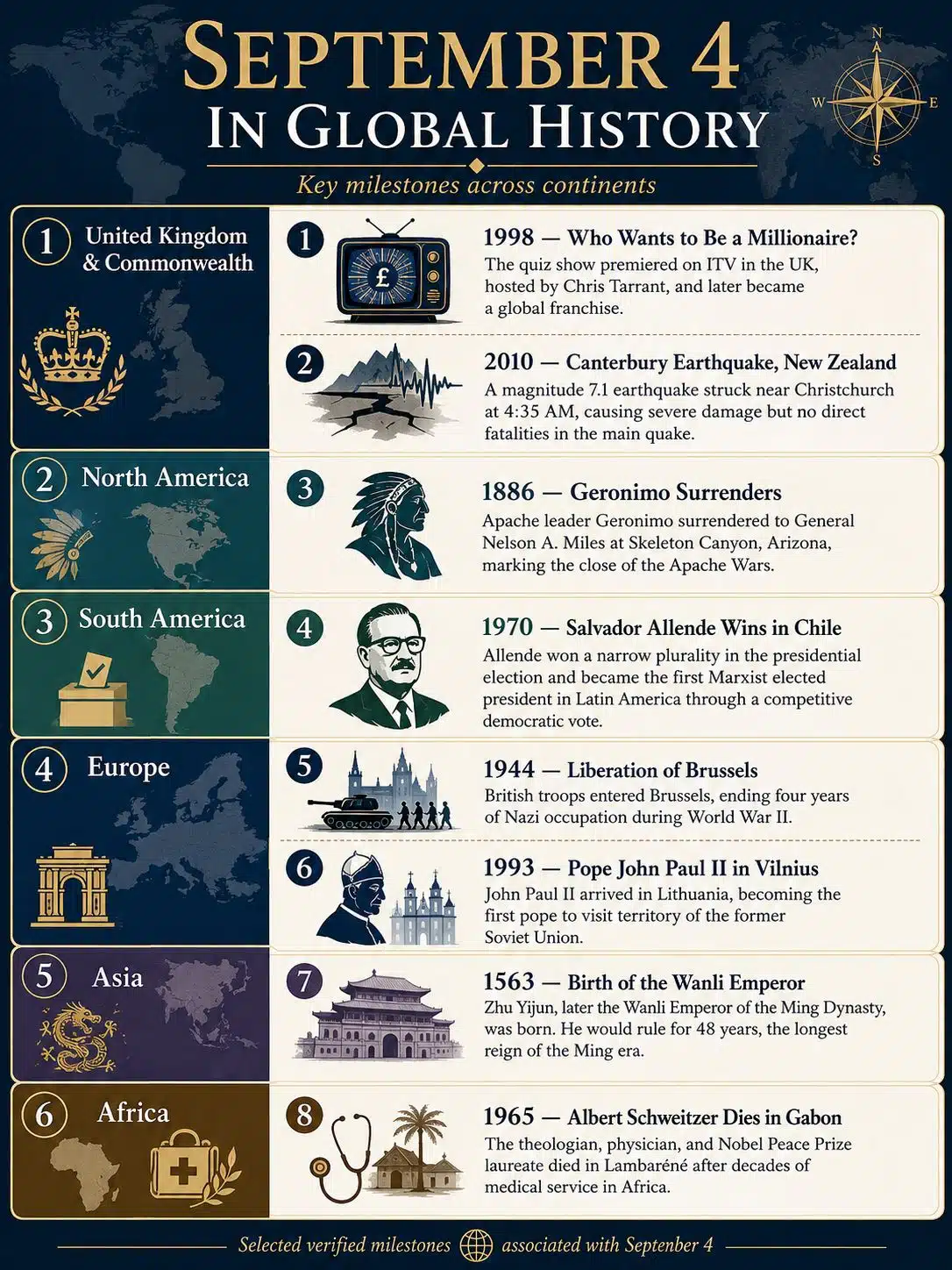
Beyond Europe and South Asia, September 4 has been marked by pivotal moments in statecraft, sovereignty, and human rights across every inhabited continent.
United Kingdom & The British Commonwealth
-
1884 (End of Transportation to New South Wales): Following decades of agitation by Australian colonial settlers who demanded civil autonomy rather than the stigma of a penal colony, imperial orders strictly ended convict transportation to New South Wales, clearing the path toward Australian democratic federation.
-
1998 (Television Revolution): The television game show Who Wants to Be a Millionaire?, hosted by Chris Tarrant, premiered on ITV in the United Kingdom. Its dramatic lighting, suspenseful pauses, and high-stakes quiz format created a global franchise licensed in over 160 nations.
-
2010 (The Canterbury Earthquake, New Zealand): A magnitude 7.1 earthquake struck the South Island of New Zealand near Christchurch at 4:35 AM. While it caused widespread infrastructure destruction, stringent building codes meant remarkably few direct fatalities, serving as an engineering case study in seismic safety.
The Americas (North & South)
-
1886 (Surrender of Geronimo, Arizona): Apache leader Geronimo (Goyahkla) surrendered to Brigadier General Nelson A. Miles at Skeleton Canyon, Arizona, following decades of fierce guerrilla resistance against Mexican and United States expansion. Geronimo’s surrender represented the closing military chapter of the American Indian Wars.
-
1970 (Salvador Allende’s Historic Victory in Chile): Salvador Allende Gossens, running as head of the Unidad Popular (Popular Unity) leftist coalition, won a narrow plurality in the Chilean presidential election. Allende became the first Marxist politician in Latin America to be elected head of state in a constitutional democracy, an outcome that sent shockwaves through Washington and set the stage for the tragic CIA-backed military coup of 1973.
Europe & Russia
-
1944 (Liberation of Brussels, World War II): British troops, spearheading the Allied advance across Western Europe, entered and liberated Brussels from four years of brutal Nazi occupation, greeted by ecstatic crowds filling the Grand-Place.
-
1993 (Papal Visit to the Former USSR): Pope John Paul II arrived in Vilnius, Lithuania. It was the first time in history that the Bishop of Rome set foot on territories that had comprised the Soviet Union, symbolizing the spiritual reclamation of Eastern Europe following the dissolution of the USSR in 1991.
Asia, Middle East & Africa
-
1063 (Passing of Sultan Togrul Beg): Togrul Beg, the visionary Turkic chieftain who established the Great Seljuk Empire, died on this day. His reign united fractured Islamic lands from Persia to Baghdad, laying administrative and military foundations that later enabled the emergence of the Ottoman Empire.
-
1563 (Ascension of the Wanli Emperor, China): Zhu Yijun, who became the Wanli Emperor of the Ming Dynasty, was born on September 4. Ruling for 48 years—the longest single reign in the Ming Dynasty—his governance saw economic and cultural achievements alongside bureaucratic paralysis that weakened the dynasty against the Manchu.
-
1965 (Albert Schweitzer Dies in Gabon): Dr. Albert Schweitzer, the French-German theologian, philosopher, and Nobel Peace Prize laureate, died at age 90 in Lambaréné, Gabon. Schweitzer devoted his life to operating a jungle hospital, promoting his ethical philosophy of “Reverence for Life” across post-colonial Africa.
Famous Birthdays on September 4
Literary, Scientific & Political Figures
-
Anton Bruckner (1824–1896): Austrian composer whose monumental, deeply spiritual symphonies bridged early Romanticism and the modern symphonic era.
-
Max Delbrück (1906–1981): German-American biophysicist who was awarded the 1969 Nobel Prize in Physiology or Medicine. His experiments on bacterial virus genetics laid the structural groundwork for modern molecular biology.
-
Richard Wright (1908–1960): American novelist whose groundbreaking works Native Son (1940) and Black Boy (1945) confronted the systemic brutality of racial oppression, influencing post-war American literature and the Civil Rights movement.
-
John McCarthy (1927–2011): Renowned American computer scientist who coined the phrase “Artificial Intelligence” in 1955. He created the Lisp programming language family and invented computer time-sharing systems, laying the groundwork for modern cloud computing.
-
Shinya Yamanaka (Born 1962): Japanese stem-cell biologist who discovered that mature adult cells can be reprogrammed into induced pluripotent stem cells (iPSCs). He received the 2012 Nobel Prize in Physiology or Medicine for this breakthrough, transforming regenerative medicine.
Cinema & Global Pop Culture
-
Rishi Kapoor (1952–2020): Born into Bollywood’s premier acting dynasty, Kapoor transformed Hindi romantic cinema starting with Bobby (1973). Over five decades, his infectious charm and musicality made him a beloved cultural figure not just in India, but across Pakistan, Bangladesh, the Middle East, and Central Asia.
-
Beyoncé Knowles-Carter (Born 1981): American singer, songwriter, and cultural icon born in Houston, Texas. Rising to fame with Destiny’s Child before launching an acclaimed solo career, she stands as the most-awarded artist in Grammy history (32 wins), celebrated for works like Lemonade and Renaissance.
Notable Deaths on September 4
The calendar of September 4 also marks the departure of celebrated explorers, artists, and humanitarians whose deaths prompted global reflection.
Steve Irwin (1962–2006)
Australian naturalist, zookeeper, and television host Steve Irwin died tragically on September 4, 2006, at the age of 44, after his chest was pierced by a stingray barb while filming a documentary on the Great Barrier Reef. Irwin had gained worldwide fame through The Crocodile Hunter, captivating millions with his passionate conservation advocacy and hands-on wildlife education. His sudden passing prompted an outpouring of grief from millions of fans, conservationists, and world leaders.
Edvard Grieg (1843–1907)
Norway’s preeminent composer passed away on September 4, 1907, in his hometown of Bergen. Grieg helped establish Norway’s musical identity on the global stage, weaving folk melodies and themes into classical masterworks such as the Peer Gynt Suites (featuring “In the Hall of the Mountain King”) and his Piano Concerto in A minor.
Joan Rivers (1933–2014)
One of the most fearless and pioneering comedians in American entertainment history, Joan Rivers died on this day at age 81 following complications during a medical procedure. She broke barriers for women in stand-up comedy, became the first woman to host a late-night network talk show, and redefined red-carpet fashion critique with her sharp, self-deprecating wit.
Gustavo Cerati (1959–2014)
The Spanish-speaking rock world lost one of its most influential figures on September 4, 2014, when Argentine singer, songwriter, and guitarist Gustavo Cerati died after four years in a coma following a stroke. As frontman of Soda Stereo, Cerati was a central figure in the Rock en Español movement during the 1980s and 1990s, packing stadiums from Buenos Aires to Mexico City.
International Observances & Cultural Holidays
September 4 carries both formal institutional observances and spontaneous cultural celebrations that bring communities together worldwide:
-
International Taekwondo Day: Officially recognized by World Taekwondo, this day commemorates September 4, 1994, when the International Olympic Committee convened in Paris and voted to include Taekwondo as an official medal sport for the 2000 Sydney Olympic Games. Martial arts schools, dojangs, and athletes globally celebrate the day with demonstrations and community classes.
-
National Wildlife Day (United States): Founded in 2005 by animal advocate Colleen Paige, this day focuses public attention on endangered species, habitat preservation, and the work of accredited zoos and wildlife rehabilitators. Following Steve Irwin’s death on this date in 2006, the observance gained added emotional resonance, with many international conservation societies honoring his memory on September 4.
-
Krishna Janmashtami (Lunar Calendar Alignment): While based on the Hindu Luni-Solar calendar (falling on the Ashtami Tithi of the month of Bhadrapada), the midnight birth celebration of Lord Krishna frequently aligns with early September. When it falls on or around September 4, millions of devotees across Bangladesh, India, and diaspora temples observe midnight fasts, chant devotional Kirtan, and break clay yogurt pots during the festive Dahi Handi ceremonies.
Fascinating Trivia: Did You Know?
-
The Origin of the Name “Kodak”: When George Eastman registered his trademark on September 4, 1888, he chose the word “Kodak” purely out of linguistic imagination. Eastman wanted an invented name that was short, impossible to mispronounce in any language, and began and ended with the letter “K,” which he considered strong and memorable.
-
The 2.5-Mile Electrical Island: When Thomas Edison threw the switch at his Pearl Street generating station on September 4, 1882, the power grid did not span a city, but a modest pocket of lower Manhattan. Among the very first private offices to be illuminated by this historic direct-current (DC) system were the banking headquarters of J.P. Morgan and the offices of The New York Times.
-
Mark Spitz’s Unbroken Olympic Feat: On September 4, 1972, at the Munich Olympic Games, American swimmer Mark Spitz won the 4×100-meter medley relay. It was his seventh gold medal of the games, and he set a new world record in every single event he entered. This feat went unequaled for 36 years, until fellow American swimmer Michael Phelps claimed eight golds at Beijing in 2008.
Quote of the Day
“Be united, persevere, and achieve self-Government, so that the millions now perishing by poverty, famine, and plague may be saved, and India may once more occupy her proud position of yore among the greatest and civilized nations of the world.”
— Dadabhai Naoroji, born on September 4, 1825; speaking as President of the Indian National Congress.
Final Thoughts
The record of September 4 reminds us of the dual nature of historical progress. Empires collapse not with cosmic fanfare, but often in quiet administrative chambers—as when Romulus Augustulus gave up his imperial insignia to a barbarian general in 476. Yet alongside the decline of the old, human ingenuity continually plants seeds for the future: Edison lighting the evening streets of lower Manhattan, George Eastman placing cameras into everyday hands, and two graduate students in a California garage indexing the boundless landscape of human knowledge.
For South Asia and the Bangalee diaspora, the day serves as a poignant reminder of moral courage and cultural endurance. Dadabhai Naoroji showed that data and scholarship could challenge an empire, Premendra Mitra demonstrated the boundless range of Bengali imagination, and Gazi Mazharul Anwar’s lyrics inspired a nation’s fight for freedom. September 4 is not merely a passing square on the calendar, but a rich chapter in the ongoing story of human perseverance, discovery, and artistic expression.