
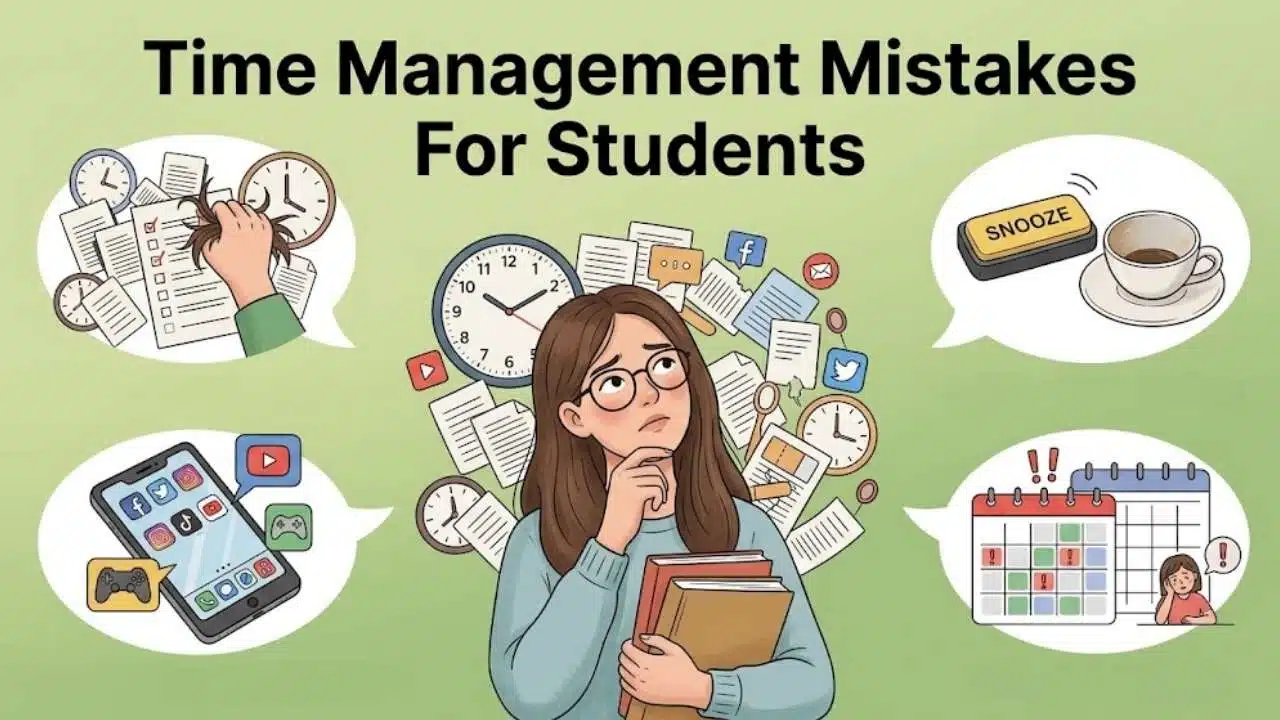
Many students work tirelessly all day only to feel like nothing got done. This disconnect stems from hidden time management mistakes for students—like relying on memory, misjudging task length, or confusing passive review with active study. When demanding work gets treated like a quick task, deadlines suddenly collide and force reactive cramming.
Research shows a strong link between structured time habits and higher academic performance. However, success comes down to clear visibility: estimating workloads honestly, scheduling buffers, and tackling deep work long before urgency takes over.
Before Blaming Your Planner
Not every overwhelmed student needs a better productivity system. A high school student may be balancing classes, sports, homework, and family responsibilities. A university student may also be commuting, working shifts, attending labs, or managing several courses with overlapping assessment periods.
No planner can turn an impossible workload into a reasonable one. If the weekly schedule only works by cutting sleep, skipping meals, or filling every evening, the problem may be the amount of work rather than poor discipline. That is when talking to a teacher, instructor, tutor, counselor, or academic advisor can be more useful than downloading another planning app. Good time management should make overload visible.
12 Time Management Mistakes for Students Worth Fixing

1. Keeping Deadlines in Different Places
One assignment is listed in the syllabus. Another appears in the learning-management system. A teacher changes a test date during class. The group presentation deadline is somewhere in a chat thread. Each detail seems manageable until several of them collide.
Students need one dependable place for major academic commitments. That might be a paper planner, Google Calendar, Apple Calendar, Outlook, or a school calendar. The tool itself is not the important part. Consolidation is.
A semester-level view is particularly useful because it exposes the weeks containing multiple exams, submissions, presentations, or personal commitments before those weeks arrive.
2. Making a To-Do List Without Making Time
A task list answers what needs doing. It does not answer when it will happen. “Finish lab report,” “study economics,” and “read Chapter 6” may all be legitimate tasks, but placing them on a list does not create the hours required to complete them.
Important work needs somewhere to live in the week. A student might reserve Tuesday afternoon for the lab report and Thursday evening for economics rather than carrying both tasks forward day after day. The plan can change, but assigning time forces a useful question: does all of this work actually fit? That question is often more valuable than the to-do list itself.
3. Underestimating How Long Schoolwork Takes

This is one of the more damaging time management mistakes for students because a bad estimate can throw off everything scheduled after it.
“Write essay” sounds like one task. In reality, it may involve finding sources, reading them, building an argument, drafting, referencing, revising, formatting, and uploading the final file. The same problem appears with reading. Thirty pages of a novel and thirty pages of technical material are not equivalent workloads.
Research involving college students has found systematic bias in estimates of academic task duration. The practical response is to use previous work as evidence. If recent problem sets regularly took two hours, giving the next one 45 minutes is not an efficient plan. It is an unrealistic one.
4. Prioritizing Everything by Deadline Alone
The nearest deadline is not always the task that deserves the most time. Suppose a short worksheet is due tomorrow, but an important exam follows two days later. Spending the entire evening perfecting the worksheet may feel responsible while leaving the harder academic problem untouched.
Students should also consider:
- How much work remains?
- How difficult is the task?
- How much does it affect the course?
- Does it require several stages?
- Is someone else waiting on their part of a group project?
Deadlines matter. So do consequences.
5. Waiting Until You Feel Ready to Start
Large assignments encourage delay because they are often described too broadly. “Work on presentation” gives a student no clear starting point. “Find two sources and draft the first slide” does. Breaking work down is not about turning every assignment into a 20-step productivity ritual. It is about removing enough ambiguity to start.
For a research paper, the first useful action might simply be reviewing the marking criteria or finding three credible sources. Once the work has begun, continuing is often easier than beginning from a vague instruction.
6. Switching Constantly Between Studying and Distractions
A student writes a paragraph, replies to a message, checks a notification, opens social media, returns to the document, and then spends another minute remembering what the paragraph was supposed to say. Technically, the study session lasted an hour. In practice, much of that hour was fragmented.
Research on task switching shows that repeatedly moving attention between tasks carries cognitive costs, particularly when the work is demanding or unfamiliar.
This does not require an elaborate “digital detox.” For difficult work, the simpler fixes are often enough: silence nonessential notifications, close unrelated tabs, or put the phone somewhere that requires a deliberate choice to reach it.
7. Treating Cramming as a Normal Study Strategy
Almost every student will occasionally face a compressed study session. The problem begins when that becomes the system. Spacing learning across time has stronger evidence behind it than concentrating all review into one final session.
Instead of leaving “study biology” for Sunday night, a student might review the material several times during the week and use some of those sessions for practice questions, retrieval, or problem-solving.
This matters for time management as much as learning. Starting earlier reduces the amount of material that has to compete for the final evening. Cramming creates urgency. It does not create extra capacity.
8. Leaving a Large Assignment as One Giant Task
A six-week project should not still appear as “write history paper” during week five. Large assignments need internal deadlines. Research paper might move through topic selection, source gathering, reading, outlining, drafting, revision, reference checking, and final submission. A group presentation may need even earlier milestones because one delayed section can hold up everyone else.
The exact stages will differ by assignment. The useful habit is working backward from the final deadline and deciding when the first meaningful piece needs to be finished.
9. Creating More Study Time by Cutting Sleep
Staying up late once in a while is different from making sleep the first thing sacrificed whenever the workload grows. Current CDC guidance recommends 8 to 10 hours of sleep for teenagers aged 13 to 17 and at least 7 hours for adults aged 18 to 60. Research on sleep loss also supports its negative effects on memory formation.
If work repeatedly continues deep into the night, the more useful question is what happened earlier. Did the assignment start too late? Was its difficulty underestimated? Is too much packed into the week? Sleep should not become the permanent buffer for a badly designed schedule.
10. Filling Every Available Hour
A schedule can look impressively efficient until something ordinary goes wrong. A class runs late. The bus is delayed. A group meeting overruns. A reading takes twice as long as expected. Suddenly Monday’s unfinished work moves into Tuesday, and Tuesday is already full.
Princeton’s academic-learning guidance specifically recommends leaving open time that can be used for catching up and rescheduling. That space is easy to dismiss as wasted time when building a timetable. In reality, it is what keeps a small disruption from wrecking the rest of the week.
11. Scheduling Difficult Work at the Wrong Time
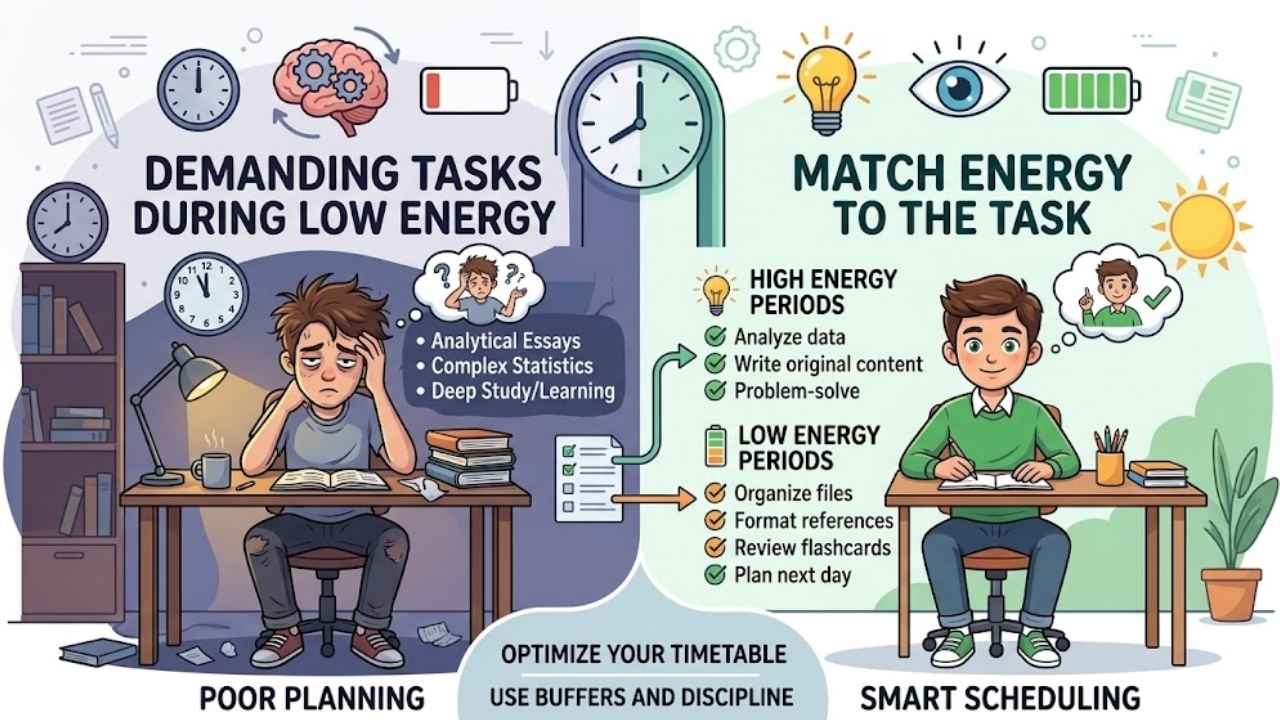
Not all free time is equally useful. Ninety minutes after classes, work, and a long commute may technically be available, but it may not be the best time to learn difficult statistics or write an analytical essay from scratch.
Where possible, demanding work should go into periods when concentration is stronger. Lower-energy gaps can handle simpler jobs such as organizing files, reviewing vocabulary, checking deadlines, formatting references, or preparing materials for the next day. Students cannot always control their timetable. When they can, matching the task to the available energy makes the schedule more realistic.
12. Never Reviewing What Actually Happened
A schedule is an estimate, not a contract. If a student never reviews it, the same bad assumptions can survive for an entire semester.
A short weekly check can reveal useful patterns:
- Which task kept getting postponed?
- What took much longer than expected?
- Which course needs more preparation time?
- Where are next week’s deadlines clustered?
Planning, monitoring, and reviewing are important parts of self-regulated learning. The review is what turns a timetable from a static plan into something that improves with use.
The Practical Takeaway
Fixing time management mistakes for students does not require scheduling every minute or building a complicated productivity system. Start with the parts that create the most leverage: put major deadlines in one place, estimate work using past experience, protect time for demanding assignments, and leave some room for delays.
Then review the week before planning the next one. If an assignment repeatedly takes longer than expected, adjust the estimate. If one study period consistently fails, move the work. If the timetable only functions by sacrificing sleep, reconsider the workload. A useful schedule is not the one that looks busiest. It is the one that still makes sense when an ordinary week becomes slightly messy.
FAQs
Are productivity apps necessary for good student time management?
No. A calendar and a simple task list are enough for many students. More complicated tools are useful when they solve a specific problem, such as coordinating a group project or managing several long-term deadlines. If maintaining the system becomes another daily chore, simplify it.
What should a student do after falling badly behind?
Start with triage rather than trying to complete everything in the order it was assigned. Check what is due soon, what still carries meaningful marks, and what can realistically be completed. If the workload has become unmanageable, contacting the instructor, teacher, tutor, or academic advisor early is usually more productive than staying silent until another deadline passes.
How far ahead should students plan?
Use more than one time horizon. A semester calendar helps reveal exam periods and major deadlines. A weekly plan decides when current work will happen. Daily planning should then be fairly light because the bigger decisions have already been made.