
Every calendar date serves as a vault of human triumphs, conflicts, discoveries, and moral milestones. August 26 stands out as a day that repeatedly witnessed tectonic shifts in politics, civil liberties, science, and the arts.
From the revolutionary halls of 18th-century France and the daring exploits of anti-colonial fighters in colonial Bengal to the certification of American women’s suffrage and the early days of space-age rocketry, August 26 has witnessed moments that redefined the social and scientific architecture of our world.
This comprehensive archive explores the historical milestones, influential births, notable passings, and unique cultural observances that make August 26 an unforgettable chapter in human history.
The Bangalee & South Asian Sphere: Resistance, Sacrifice, and Heritage
The history of the Indian subcontinent—and the Bengal region in particular—is rich with stories of anti-colonial valor, grassroots activism, and cultural evolution. August 26 highlights several critical moments of courage and political consciousness.
The Rodda & Company Arms Heist (Calcutta, 1914)
On August 26, 1914, a daring operation unfolded in the heart of British-administered Calcutta (now Kolkata). Bengali revolutionaries associated with the Mukti Sangha and Anushilan Samiti—including figures like Bipin Behari Ganguly, Habu Mukherjee, and Srish Chandra Mitra (known as Habu)—intercepted a major shipment belonging to Rodda & Company, a premier British firearms agency.
Disguised as customs cart pullers, the young freedom fighters successfully diverted a consignment of:
-
50 Mauser C96 semi-automatic pistols
-
46,000 rounds of specialized 7.63×25mm ammunition
British authorities described the theft as the “greatest daylight robbery” in colonial policing history. These precision handguns found their way into the hands of multiple revolutionary factions across Bengal and northern India, playing a pivotal role in insurgencies such as the Ghadar Conspiracy and the armed resistance led by Bagha Jatin.
The Phulbari Uprising and Phulbari Day (Bangladesh, 2006)
In modern Bangladeshi history, August 26 is commemorated annually as Phulbari Day (Phulbari Dibash). In 2006, more than 50,000 farmers, indigenous people, students, and local residents marched through the streets of Phulbari Upazila in Dinajpur district to protest a proposed open-pit coal mining project by Asia Energy (a British-backed multinational corporation).
The planned project threatened to displace over 100,000 people and decimate thousands of hectares of fertile, multi-crop agricultural land. During the peaceful march, paramilitary forces (the Bangladesh Rifles) opened fire on the demonstrators.
Three young activists—Tariqul Islam, Mohammad Salek, and Al Amin—lost their lives, while more than 200 people were injured. The resulting widespread civil disobedience forced the government to sign the historic 6-Point Phulbari Agreement, halting the open-pit project. Today, August 26 remains an enduring international symbol of environmental justice, community solidarity, and indigenous resource defense.
Medieval Chronicle: The Siege of Chittorgarh (1303)
On August 26, 1303, Sultan Alauddin Khilji of the Delhi Sultanate completed his eight-month siege of the formidable Chittorgarh Fort, the stronghold of the Guhila King Ratnasimha (Ratan Singh) in modern-day Rajasthan.
The siege remains one of the most documented and dramatized military campaigns of medieval India, later immortalized in Malik Muhammad Jayasi’s epic 1540 poem Padmavat. The event altered the balance of power across northern India and cemented the Delhi Sultanate’s imperial authority over the Rajput kingdoms.
International Observances & Global Days
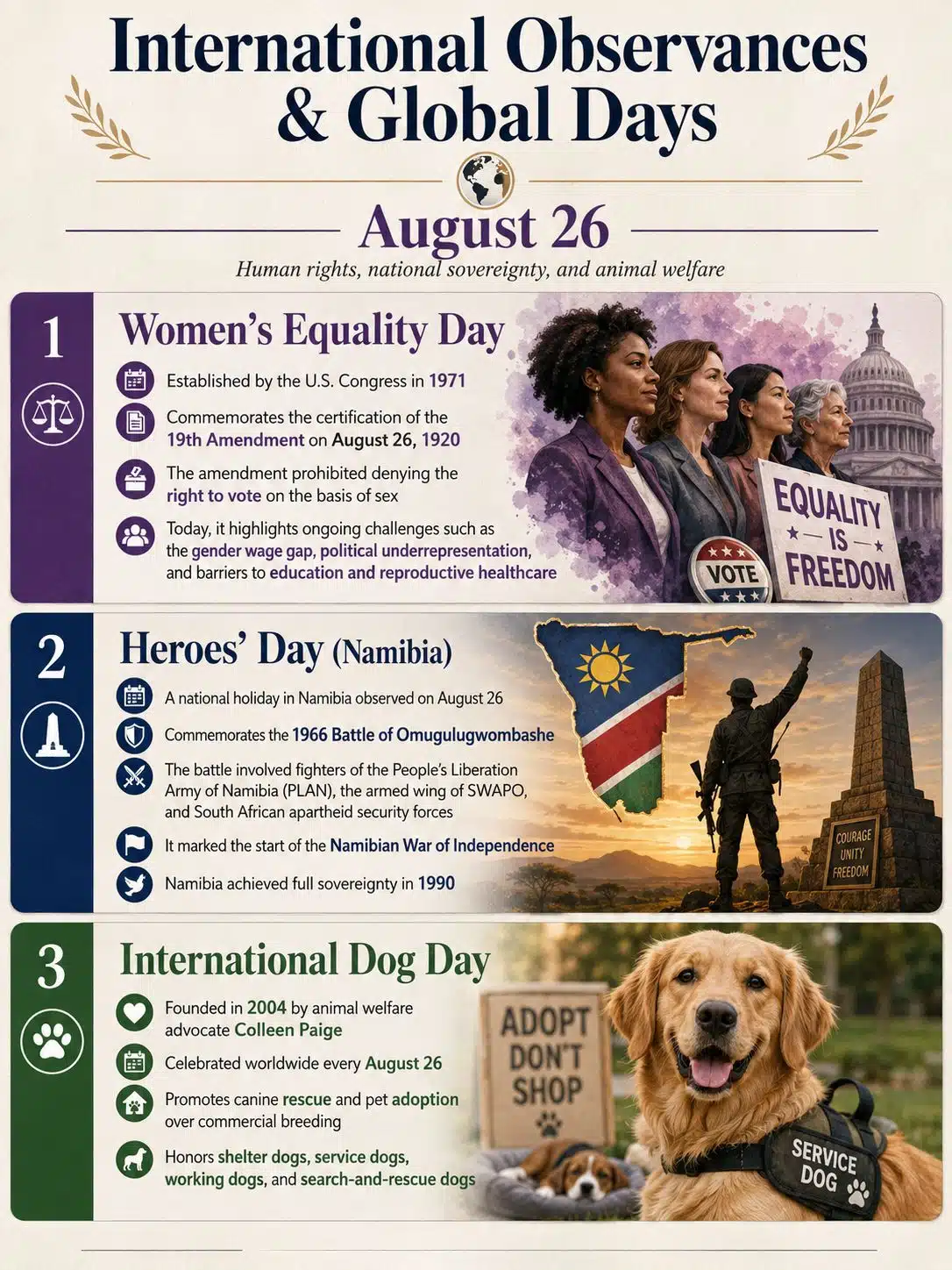
August 26 hosts significant international and national observances that promote human rights, national sovereignty, and animal welfare.
Women’s Equality Day
Established by the United States Congress in 1971 at the urging of Representative Bella Abzug, Women’s Equality Day commemorates the official certification of the 19th Amendment to the U.S. Constitution on August 26, 1920.
The amendment prohibited federal and state governments from denying the right to vote on the basis of sex. Today, the date is observed globally by human rights groups to evaluate ongoing challenges facing women, including the gender wage gap, political underrepresentation, and barriers to education and reproductive healthcare.
Heroes’ Day (Namibia)
August 26 is a solemn national holiday in the southern African nation of Namibia. It commemorates the 1966 Battle of Omugulugwombashe, where fighters of the People’s Liberation Army of Namibia (PLAN)—the armed wing of SWAPO—first clashed with South African apartheid security forces. This battle marked the official start of the 24-year Namibian War of Independence, which concluded with full sovereignty in 1990.
International Dog Day
Founded in 2004 by animal welfare advocate and author Colleen Paige, International Dog Day is celebrated worldwide every August 26. The observance focuses on canine rescue, highlighting the millions of dogs living in shelters, encouraging pet adoption over commercial breeding, and honoring service and working dogs that aid law enforcement, search-and-rescue teams, and individuals with disabilities.
Chronological Turning Points in Global History
From the Middle Ages to the Cold War and the 21st century, August 26 has served as the stage for transformative military battles, philosophical declarations, and technological leaps.
1071: The Battle of Manzikert
In one of the most consequential military engagements of the medieval era, the Seljuk Turkish army led by Sultan Alp Arslan routed the Byzantine forces under Emperor Romanos IV Diogenes near Manzikert (modern-day Malazgirt, Turkey).
The Byzantine defeat caused extensive territorial and economic losses across Anatolia. It permanently weakened the eastern frontier of Christendom and served as an indirect catalyst for Pope Urban II’s call for the First Crusade in 1095.
1346: The Battle of Crécy
Fought in northern France during the Hundred Years’ War, the Battle of Crécy saw an outnumbered English and Welsh army under King Edward III and his 16-year-old son, Edward the Black Prince, decisively crush King Philip VI’s French cavalry and Genoese crossbowmen.
The battle marked a revolution in European military strategy: the devastating range, rate of fire, and armor-piercing capabilities of the English longbow made heavy armored cavalry largely obsolete, signaling the decline of traditional chivalric warfare.
1789: The Declaration of the Rights of Man and of the Citizen
During the opening months of the French Revolution, the National Constituent Assembly in Versailles formally approved the Declaration of the Rights of Man and of the Citizen (Déclaration des droits de l’homme et du citoyen).
Drafted by the Marquis de Lafayette with consultation from Thomas Jefferson, this 17-article charter declared that all men are born free and equal in rights. It introduced principles of:
-
Popular sovereignty (authority rests in the nation, not the monarch)
-
Freedom of speech and of the press
-
The presumption of innocence until proven guilty
-
Protection of private property
The document became a cornerstone for modern democratic governance, directly inspiring the United Nations Universal Declaration of Human Rights in 1948.
1895: Harnessing Niagara Falls with Alternating Current
On August 26, 1895, the Adams Power Plant at Niagara Falls began delivering commercial electrical energy. Designed around Nikola Tesla’s polyphase alternating current (AC) patents and engineered by George Westinghouse, this facility settled the historic “War of the Currents” against Thomas Edison’s direct current (DC) system.
It proved that high-voltage alternating current could efficiently transmit massive amounts of electricity across long distances, laying the groundwork for the modern global electrical grid.
1957: The Soviet Union Tests the World’s First ICBM
The Cold War reached a turning point when the Soviet news agency TASS announced the successful flight of the R-7 Semyorka, the world’s first intercontinental ballistic missile (ICBM).
Engineered by chief rocket designer Sergei Korolev, the multi-stage missile flew over 6,000 kilometers from the Baikonur Cosmodrome in Kazakhstan to the Kamchatka Peninsula. This breakthrough confirmed that targets across the globe were now vulnerable to nuclear strikes within minutes, and the underlying rocket architecture would launch Sputnik 1 into orbit just six weeks later.
2021: The Kabul Airport Attack
During the final days of the Western military withdrawal from Afghanistan, a suicide bomber affiliated with the Islamic State Khorasan Province (ISKP) detonated an explosive vest at Abbey Gate, outside Hamid Karzai International Airport in Kabul.
The blast claimed the lives of approximately 170 Afghan civilians attempting to flee the country and 13 U.S. service personnel. The attack stands as one of the deadliest days of the two-decade war in Afghanistan.
Notable Birthdays on August 26
August 26 has produced some of history’s most influential scientists, humanitarians, writers, and artists.
Deep Profiles of Visionaries Born on August 26
Antoine-Laurent de Lavoisier (1743–1794)
Widely recognized as the “Father of Modern Chemistry,” Lavoisier reshaped scientific inquiry by shifting chemistry from a qualitative to a rigorously quantitative discipline.
His achievements include:
-
Proving the Law of Conservation of Mass (“Matter is neither created nor destroyed”).
-
Disproving the phlogiston theory and correctly identifying and naming oxygen (1778) and hydrogen (1783).
-
Writing the first modern list of elements and helping construct the metric system.
Tragically, his role as a tax collector for the Ferme Générale made him a target during the French Revolution’s Reign of Terror, and he was executed by guillotine in 1794.
Mother Teresa (Saint Teresa of Calcutta) (1910–1997)
Born Anjezë Gonxhe Bojaxhiu in Skopje (modern North Macedonia), Mother Teresa moved to India in 1929. In 1950, she founded the Missionaries of Charity in Calcutta, dedicating her life to caring for those suffering from HIV/AIDS, leprosy, and severe poverty.
She received the Nobel Peace Prize in 1979 and the Bharat Ratna (India’s highest civilian honor) in 1980, and was canonized as a Catholic saint in 2016. Her work remains a globally recognized symbol of selflessness and humanitarian service.
Katherine Johnson (1918–2020)
A trailblazing African American mathematician at NASA, Katherine Johnson’s calculations of orbital mechanics were critical to the success of early American human spaceflights.
Working initially as a human “computer” in the segregated West Area Computing section of Langley Research Center, she went on to:
-
Calculate the trajectory for Alan Shepard’s 1961 flight (the first American in space).
-
Personally verify the digital computer calculations for John Glenn’s 1962 orbit around Earth.
-
Calculate launch windows and backup paths for Apollo 11’s mission to the Moon in 1969.
Her contributions were brought to wider public attention by Margot Lee Shetterly’s book and the subsequent film Hidden Figures, and she was awarded the Presidential Medal of Freedom in 2015.
Julio Cortázar (1914–1984)
One of the central figures of the Latin American Literary Boom (el Boom), Argentine author Julio Cortázar challenged traditional storytelling structures. His 1963 novel Rayuela (Hopscotch) offers an open-ended narrative that can be read sequentially or by skipping between chapters according to a reading plan. Cortázar’s blend of surrealism, existential philosophy, and urban observation continues to influence contemporary world literature.
Notable Deaths on August 26
On this day, the world has said farewell to pioneers in medicine, aviation, psychology, and the performing arts.
Deep Profiles of Legacies Concluded on August 26
Antonie van Leeuwenhoek (1632–1723)
A self-taught Dutch tradesman from Delft, Leeuwenhoek revolutionized biological science by designing high-powered single-lens microscopes capable of up to 300x magnification.
Through patient observation, he became the first person in human history to see and document:
-
Microscopic single-celled organisms, which he termed animalcules (now known as bacteria and protozoa).
-
The circulation of blood cells through capillaries.
-
The structure of muscle fibers and spermatozoa.
His meticulous letters to the Royal Society of London established the foundations of microbiology.
William James (1842–1910)
Brother of novelist Henry James, William James was a foundational thinker in both psychology and philosophy. He established the first experimental psychology laboratory in the United States at Harvard University.
His 1890 work, The Principles of Psychology, introduced enduring concepts such as the “stream of consciousness,” while his philosophical writings established Pragmatism—the view that the truth of an idea is measured by its practical consequences.
Charles Lindbergh (1902–1974)
Lindbergh captured worldwide attention in May 1927 when he flew his custom-built single-engine monoplane, the Spirit of St. Louis, non-stop from New York to Paris in 33.5 hours. He was the first solo pilot to complete a non-stop transatlantic flight. His achievement accelerated commercial aviation development, though his later public life was complicated by political isolationism prior to World War II.
A. K. Hangal (Avtar Kishan Hangal) (1914–2012)
Born in Sialkot (in modern-day Pakistan), A. K. Hangal was a committed anti-colonial activist jailed multiple times by the British before the 1947 Partition. Moving to Bombay, he joined the Indian People’s Theatre Association (IPTA) and entered mainstream Hindi cinema in his fifties.
Over a four-decade career spanning more than 200 films—including classics like Sholay, Bawarchi, and Namak Haraam—Hangal was admired for bringing warmth, dignity, and realism to working-class character roles.
“Did You Know?” Trivia for August 26
-
The 33-Day Pope: On August 26, 1978, Cardinal Albino Luciani was elected as head of the Catholic Church, taking the name Pope John Paul I. His papacy was one of the shortest in history—he passed away suddenly just 33 days later on September 28, 1978.
-
Baseball History on the Mound: On August 26, 1947, Dan Bankhead made history with the Brooklyn Dodgers by becoming the first African American pitcher in Major League Baseball. In his very first plate appearance, he hit a home run.
-
A Masterpiece Released: On August 26, 1968, The Beatles released their single “Hey Jude” (backed with “Revolution”) in the United States. Written by Paul McCartney to comfort young Julian Lennon during his parents’ divorce, the track ran for over seven minutes and became the first release from the band’s Apple Records label.
-
The Krakatoa Climax: On August 26, 1883, the Krakatoa volcanic island in the Sunda Strait began its catastrophic final eruptive phase. The resulting explosions the following morning were heard nearly 3,000 miles away and triggered tsunamis that altered global weather patterns for years.
Quotes for August 26
“Not all of us can do great things. But we can do small things with great love.”
— Mother Teresa, Nobel Peace Prize Laureate (Born August 26, 1910)
Final Thoughts
August 26 reflects the recurring human drive for progress, justice, and discovery. Across centuries, the events of this day show how individual courage and collective action can challenge established systems.
In 1789, French citizens defined universal human rights; in 1914 and 2006, South Asian activists resisted colonial rule and defended community resources; and in 1920, the certification of the 19th Amendment broadened democratic participation in the United States.
At the same time, the scientific and humanitarian milestones associated with this date—from Lavoisier’s chemistry breakthroughs and Leeuwenhoek’s microscopic discoveries to Katherine Johnson’s orbital calculations and Mother Teresa’s care for the marginalized—continue to shape how we understand our world and our responsibilities to one another. August 26 stands as an enduring reminder of how ideas, courage, and perseverance move history forward.