“AI tutor” has become a broad label. It can describe a chatbot that answers a student’s questions, a mathematics platform that tracks individual skills across hundreds of exercises, or a system that combines both approaches.
For a school choosing software—or a development team building it—that difference matters. A polished conversation tells you surprisingly little about how a product evaluates learning, chooses the next activity, or decides when a student needs help.
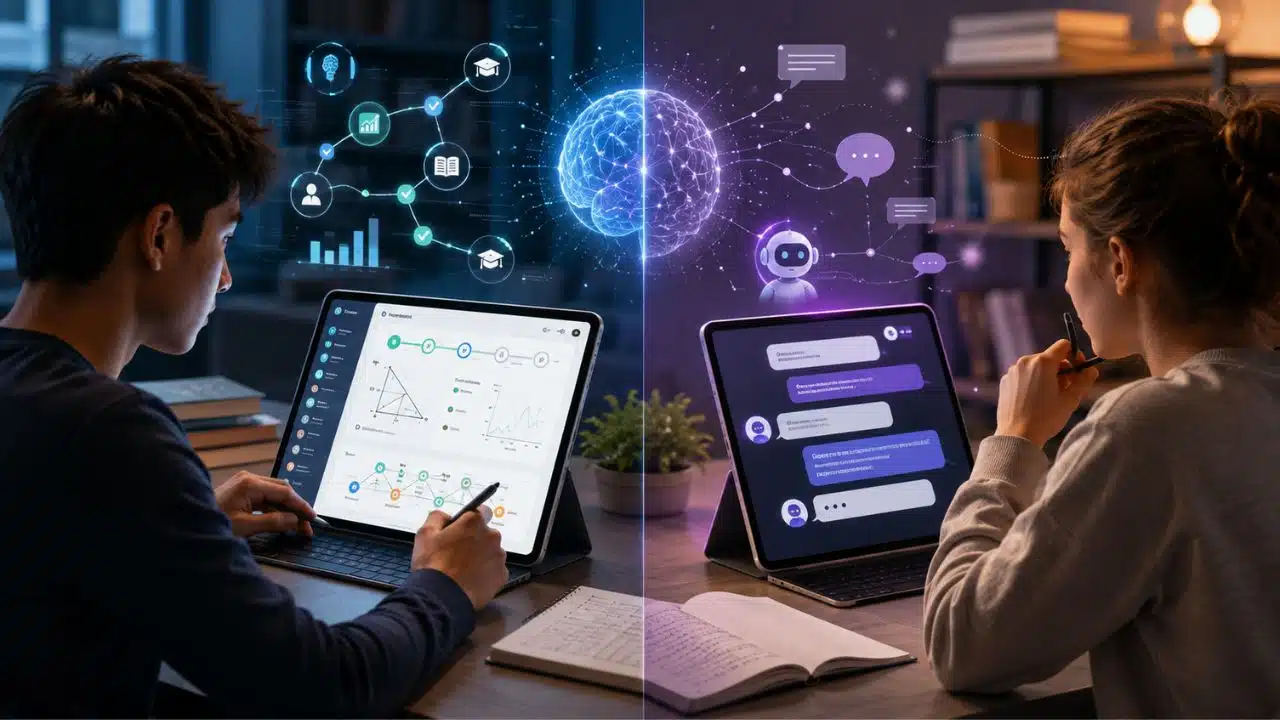
That is the central issue in Intelligent Tutoring Systems vs Chatbot Tutors. Traditional intelligent tutoring systems, or ITSs, usually organize instruction around explicit models of the subject and learner. Modern chatbot tutors often begin with a large language model that is exceptionally flexible with language but needs additional educational architecture around it.
Neither label guarantees good teaching. What matters is what happens beneath the interface.
The Difference in One Table
The categories increasingly overlap, but their typical strengths remain different.
| Point | Intelligent Tutoring System | LLM-Based Chatbot Tutor |
|---|---|---|
| Primary strength | Structured adaptation | Flexible conversation |
| Typical scope | Defined domain or curriculum | Potentially broad |
| Learner modeling | Often explicit and persistent | Varies considerably |
| Subject knowledge | Usually structured or curated | May be generated, retrieved, or grounded in course material |
| Feedback | Often linked to particular steps or skills | Generated dynamically from context |
| Choosing the next task | Common part of the system | Needs additional instructional logic |
| Unexpected questions | Can expose system limits | Usually handled well |
| Main concern | Rigidity | Fluent but poorly grounded or overly helpful responses |
These are tendencies, not technical rules. A chatbot can have a learner model. An ITS can use an LLM for dialogue. Some of the more interesting educational systems now do both.
An ITS Does More Than Produce a Helpful Response
Intelligent tutoring systems predate modern generative AI by decades. Their architecture varies, but ITS literature commonly separates four jobs: representing the subject, representing the learner, deciding how to teach, and handling interaction with the student.
Those distinctions may sound academic until a learner gets something wrong.
Imagine a mathematics system that sees a student repeatedly mishandle negative numbers. A useful tutoring system has several possible jobs to do. It must recognize what kind of error occurred, decide whether it represents a meaningful pattern, choose an appropriate response, and determine whether future practice should change.
A good explanation solves only one of those problems.
The domain model represents the subject
In a structured ITS, knowledge is often broken into concepts, skills, procedures, relationships, expected solution steps, or common misconceptions.
An algebra tutor might distinguish distributing multiplication from combining like terms, manipulating fractions, moving terms across an equation, and handling negative values.
That lets the software interpret work at a finer level than “correct” or “incorrect.”
The sophistication varies. Not every ITS has a detailed catalogue of misconceptions, and not every subject can be modeled neatly. But the basic idea is important: the system has an explicit representation of what is being learned.
The learner model is an estimate, not a diagnosis
The learner model records or infers aspects of the student’s current state. In practice, this may mean estimates of skill mastery, previous successes and errors, progression through a curriculum, or other evidence used for adaptation.
It should not be treated as an infallible portrait of what a person knows.
A wrong answer might come from misunderstanding, carelessness, confusing wording, or a simple typing error. Systems can only infer from the evidence they collect.
Even so, maintaining a structured estimate across activities gives the software something more useful than conversational memory alone. It can affect what the student sees later, not merely what the tutor says next.
Then someone—or something—has to choose what happens next
This is the less glamorous part of AI tutoring, but arguably the more important one.
Should the tutor give a hint or let the student struggle a little longer? Should it show an example? Ask the learner to explain a step? Repeat the same skill in a different form? Move ahead?
Those are instructional decisions.
A language model can generate all of those responses. That does not mean it automatically knows which one is pedagogically appropriate at a particular moment.
MATHia Shows What Skill-Level Adaptation Looks Like
Carnegie Learning’s MATHia provides a useful example of an ITS-style design because its adaptive mechanisms are relatively visible.
The platform is designed for mathematics and tracks progress at the level of individual skills. Its documentation describes skill estimates that can move as students work through problems and distinguishes states such as proficient, near proficient, remediation suggested, in progress, and not started.
For its skill reporting, MATHia currently classifies a learner as proficient when the system estimates at least a 95% probability that the learner understands and can correctly execute the skill.
That number should not be mistaken for an industry standard. It is a design choice within MATHia.
The more significant point is what the product is trying to measure. The system is not merely counting exercises completed. It is using student work to maintain estimates about particular mathematical skills and to support subsequent instruction and teacher reporting.
A chat transcript cannot substitute for that simply because it contains intelligent-sounding exchanges.
Chatbot Tutors Start With a Different Advantage
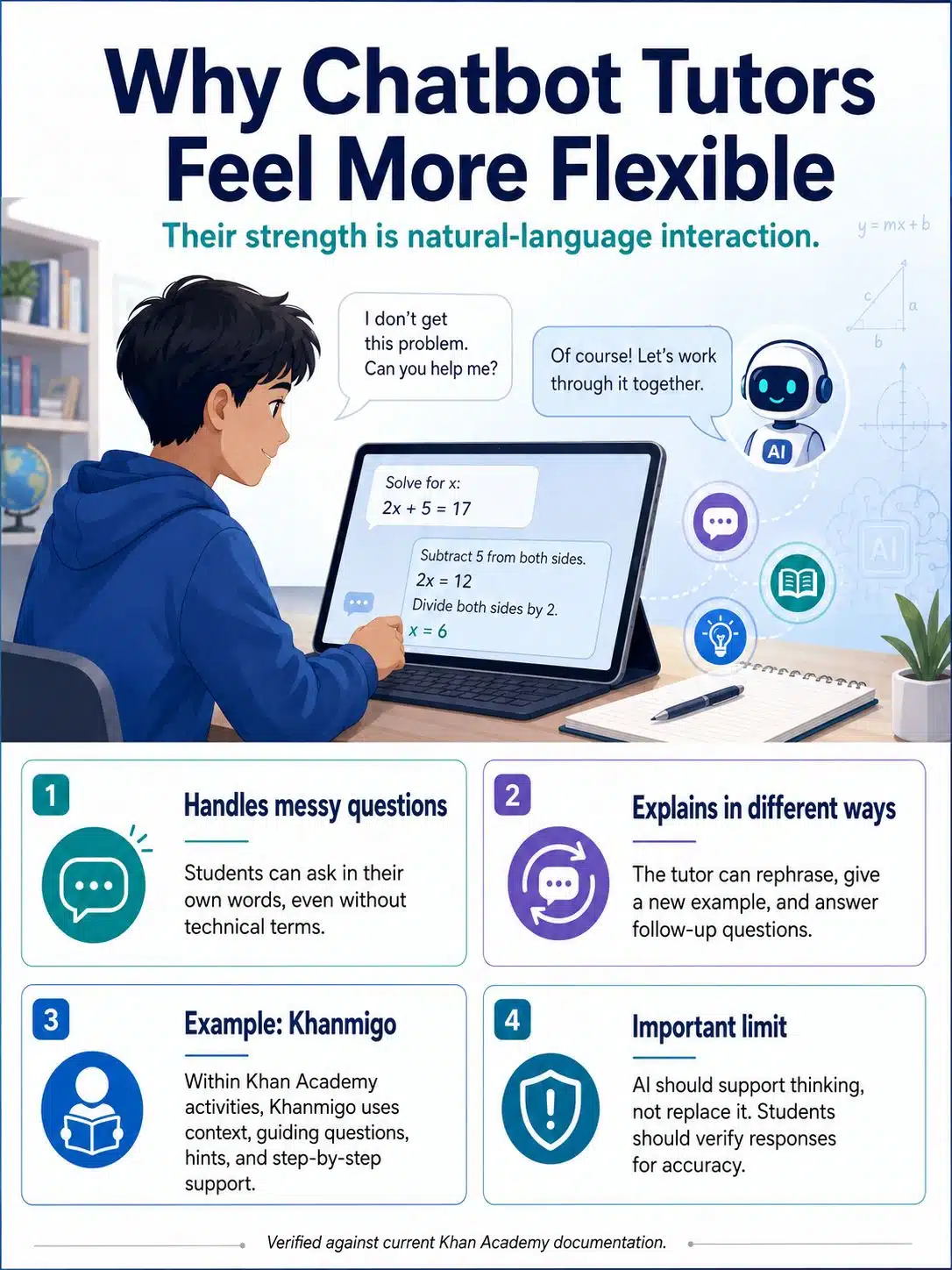
Large language models are unusually capable at dealing with messy human language.
A student can write, “I still don’t understand why the 3 goes inside the brackets,” instead of knowing the term distributive property. The tutor can infer the likely problem, explain it another way, generate a fresh example, and respond to the next question without forcing the learner through a predetermined menu.
That matters.
Traditional educational software has often struggled when a learner does something its designers did not anticipate. Conversational AI dramatically expands the range of inputs a tutoring interface can handle.
Khan Academy’s Khanmigo is a useful example of an educational chatbot designed around this strength. Within Khan Academy learning activities, Khanmigo can use the context of the material a student is viewing and respond with prompts, guiding questions, hints, and step-by-step support rather than treating every request as a demand for the final answer. Khan Academy also tells learners to verify factual information produced by the system rather than assuming AI output is always correct.
The important part is the surrounding design. An LLM provides the language capability. Educational rules, content context, restrictions, and instructional prompts shape how that capability is used.
One Algebra Error Makes the Difference Concrete
Suppose a student sees:
3(x + 4) = 21
and writes:
3x + 4 = 21
A structured algebra tutor may recognize that the student failed to distribute the 3 across both terms. It can attach the error to the relevant skill, offer a targeted hint, update its estimate of the student’s performance, and eventually present another problem that tests the same idea.
A capable chatbot can probably explain the mistake just as quickly and may do a better job with an unexpected follow-up:
Why does the 3 have to multiply the 4 too?
That conversational flexibility is genuinely useful.
But an educator evaluating the product should continue asking questions after admiring the response.
Will that mistake affect what the student practices tomorrow? If it occurs five more times, does the system recognize a pattern? Can it distinguish this skill from other algebra difficulties? Does the teacher see anything actionable?
A tutor does not need all of those functions to be useful. But without them, it is offering conversational assistance rather than the fuller adaptation associated with a mature ITS.
The Research Gives Neither Side an Easy Victory
Intelligent tutoring systems have a much longer research history than generative-AI tutors.
A major 2014 meta-analysis examined 107 effect sizes involving 14,321 participants. ITS-based learning produced better achievement outcomes than teacher-led large-group instruction, non-ITS computer instruction, and textbooks or workbooks in the studies analyzed. The researchers found no statistically significant difference between ITS learning and individualized human tutoring or small-group instruction.
A separate 2014 analysis focused on college students. It covered 35 reports containing 39 studies and 22 types of ITS. It found a moderate positive overall effect, although human tutoring performed better than ITSs in that particular comparison set.
Those findings are a useful warning against neat claims such as “AI tutors are as good as human tutors” or “human tutors always perform better.” Results depend on the population, system, comparison condition, subject, and study design.
The research on generative-AI tutoring is newer, and two 2025 experiments illustrate both its promise and its risk.
A Carefully Designed AI Tutor Performed Well in Physics
A randomized crossover study published in Scientific Reports examined 194 eligible students in a Harvard undergraduate physics course.
Students learned material either through an active-learning class or through a custom generative-AI tutor. The researchers did not simply point students toward a general chatbot. The tutor had been deliberately designed around instructional practices such as scaffolding, feedback, active engagement, and self-paced learning.
Students using the AI tutor achieved higher post-test performance in the experiment and generally spent less time on the lesson.
That is a meaningful result. It is not evidence that replacing physics instruction with an unrestricted chatbot will produce the same outcome.
The distinction matters because “uses generative AI” tells us almost nothing about the educational design of a system.
A Math Study Exposed the Risk of Making AI Too Helpful
A different 2025 randomized field experiment involved nearly 1,000 high-school mathematics students in Turkey.
Researchers tested two GPT-4-based approaches alongside a no-AI control.
One, called GPT Base, behaved more like a conventional chat interface. Another, GPT Tutor, was deliberately constrained. It received teacher-created solutions and information about common errors, and it was instructed to guide students with hints rather than simply solve problems for them.
While students had access to the AI, both groups performed better on practice work than the control group. The gains were substantial: 48% for GPT Base and 127% for GPT Tutor in practice grades.
Then the AI was taken away.
On the subsequent unassisted assessment, students from the GPT Base condition scored 17% lower than the control group. The more carefully constrained GPT Tutor largely mitigated that negative effect.
Those percentages belong to one particular experiment and should not be projected onto other schools or AI products.
The more durable lesson is methodological: a student doing better while an AI tool is available does not necessarily mean the student has learned more.
That distinction should shape how AI tutoring products are evaluated.
Where ITS-Style Design Earns Its Complexity
Structured adaptation is particularly useful when a learning domain can be divided into identifiable knowledge components, procedures, or performance states.
Mathematics is a natural fit. So are parts of introductory programming, formal logic, language mechanics, technical training, and other subjects where student actions can be compared with relatively clear expectations.
For a school, the value becomes apparent when teachers need answers to questions such as:
- Which prerequisite skill is blocking this student?
- Is this mistake isolated or recurring?
- What should the learner practice next?
- Has the learner demonstrated mastery independently?
- Which students need teacher intervention?
A general chatbot does not answer those questions merely because it can explain the material.
The cost is complexity. Domain modeling, content mapping, assessment design, misconception handling, sequencing rules, and validated feedback all require substantial development work. A tightly modeled system may also become awkward as soon as the learner asks something outside its anticipated domain.
Where Chatbot Tutors Are the Better Fit
Not all learning should be forced into a skill graph.
A literature student may want to test an interpretation of a novel. A language learner may want an improvised conversation. A university student reading a difficult paper may need to ask five increasingly specific questions before one concept makes sense.
Conversation is valuable in these settings precisely because the path is unpredictable.
Chatbots also reduce a longstanding interface problem: students do not need to know the exact vocabulary or menu option required to ask for help.
The danger is confusing responsiveness with understanding.
A system can sound attentive, adjust its wording, remember the current discussion, and still have little reliable evidence about the learner’s actual mastery. Worse, it can make difficult work so convenient that students complete tasks without practising the thinking those tasks were designed to develop.
For educational use, the smoothest chatbot is not automatically the strongest tutor.
The More Useful Future Is Probably Hybrid
The distinction between ITSs and chatbot tutors is already becoming less clean.
A serious educational system can use an LLM to understand questions and generate natural dialogue while relying on other components for curriculum structure, verified content, assessment, learner modeling, progress tracking, and decisions about what the learner should do next.
That division of labour makes sense.
Use the language model where linguistic flexibility is valuable. Do not ask it to carry instructional responsibilities that can be handled more reliably by structured data, validated assessments, or explicit pedagogical rules.
The result may look like a chatbot to the student while behaving much more like an intelligent tutoring system underneath.
What Schools Should Ask Before Buying an “AI Tutor”
Product demonstrations naturally emphasize the conversation. That is often the wrong place to begin an evaluation.
Ask the vendor what happens after a student interaction.
What information is retained about learning? Is progress tracked by course completion, topic, individual skill, or problem-solving step? What evidence changes the learner model? What happens when the system is uncertain?
Then examine assessment. Minutes spent chatting, questions asked, activities completed, and student satisfaction can all be useful operational data. None is convincing evidence of mastery on its own.
Content grounding deserves equally close attention. Buyers should understand whether answers are constrained to approved curriculum material, connected to verified solutions, generated more freely by a general model, or produced through some combination of these approaches.
Teacher reporting should lead to decisions rather than simply produce more data. “These six students repeatedly struggle with distributing multiplication” is much more actionable than “these six students used the AI tutor for 43 minutes.”
For products used by children, the evaluation also has to extend beyond pedagogy. Schools should examine data collection and retention, account controls, moderation, human oversight, age restrictions, vendor policies, and the privacy and education laws that apply in their jurisdiction. These conditions can change, so institutions should review current provider documentation and local requirements before deployment.
Final Thoughts
The practical difference in Intelligent Tutoring Systems vs Chatbot Tutors is not which technology sounds more advanced.
An ITS traditionally puts considerable effort into modeling the subject, estimating learner progress, and deciding how instruction should change. A chatbot tutor starts with a much stronger ability to understand and generate natural language. Each solves a problem the other has historically handled less well.
For open-ended explanation and unpredictable questions, conversational AI has an obvious advantage. For skill diagnosis, sequenced practice, persistent progress tracking, and evidence-driven adaptation, ITS principles remain difficult to replace.
Schools and developers should therefore resist judging tutoring software by the quality of a five-minute chat demonstration.
The better test is what the system does with evidence of learning. If it can recognize meaningful patterns, decide when help is appropriate, test whether students can eventually work without assistance, and give teachers information they can act on, the product is doing something much more valuable than simply putting an educational personality on a chatbot.