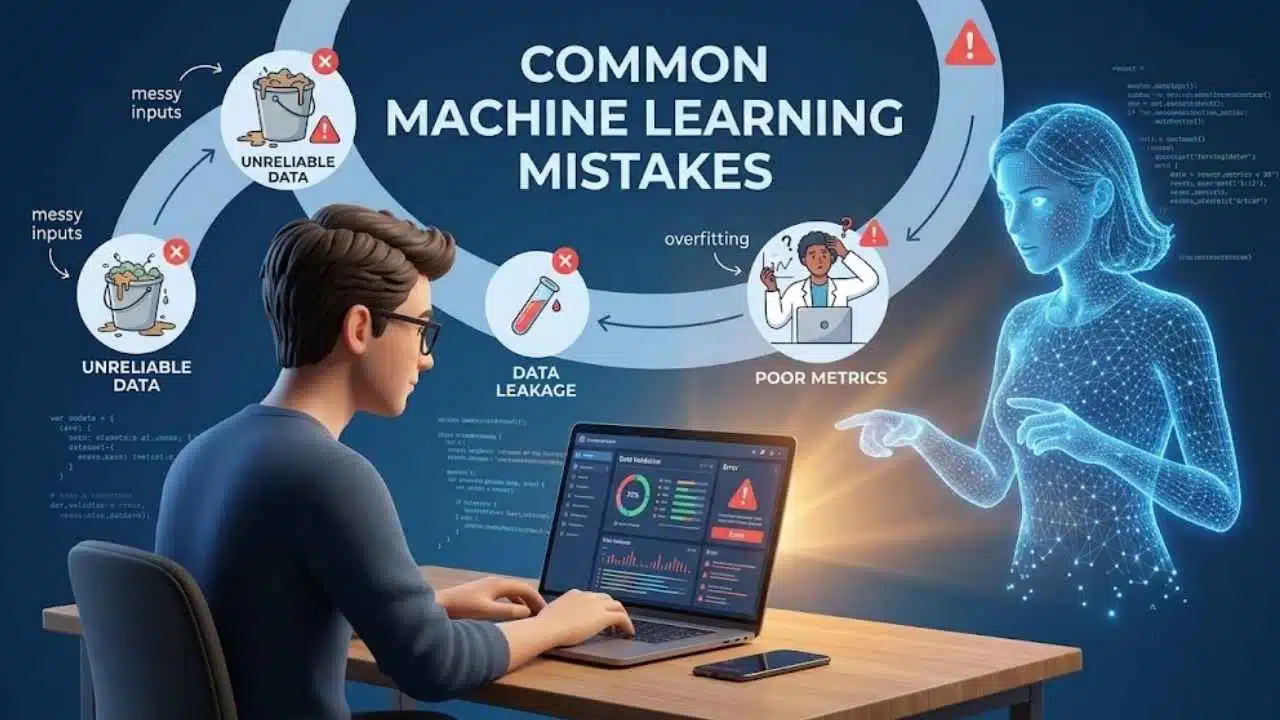
Common machine learning mistakes often stem from unreliable data, contaminated test sets, and misaligned evaluation metrics—not just picking the wrong algorithm. While a weak algorithm is easily replaced, fundamental errors in data preprocessing or target definition can render weeks of model development entirely useless.
Navigating the machine learning workflow requires avoiding critical traps at every phase, from initial dataset preparation to post-deployment monitoring. Understanding these common machine learning mistakes helps practitioners build models that perform reliably in production, rather than just delivering high accuracy on paper.
The following ten pitfalls track the typical lifecycle of an ML project, highlighting where workflows usually break down and how to prevent costly retraining cycles.
Why Common Machine Learning Mistakes Can Look Like Progress
Ordinary software bugs tend to break something visibly. A bad machine learning experiment may produce a polished notebook and an unusually high score.
Leakage looks like predictive power. Duplicate records look like generalization. Repeated use of the test set looks like steady improvement. When a result seems implausibly good, check for future information, train-test overlap, target-derived features, and preprocessing performed before the split.
1. Choosing an Algorithm Before Defining the Decision
“Predict customer behavior” is not a workable problem definition. Predict what behavior, for which customers, over what period, and for what action?
A clearer task would be: predict which active subscribers are likely to cancel within the next 30 days so the retention team can decide whom to contact. That identifies the population, outcome, prediction window, and intended decision. It also exposes whether the team can act on the result and whether “cancellation” has a consistent definition.
Write down what the model must predict, when the prediction is needed, which information will exist at that moment, and what happens after the prediction. Separate model quality from project success as well. Higher recall may look good in a report yet create an unmanageable queue of false alerts.
Some tasks do not need machine learning. A dependable rule, database query, or conventional software check may be cheaper, easier to explain, and less fragile.
2. Treating the Dataset as Ground Truth
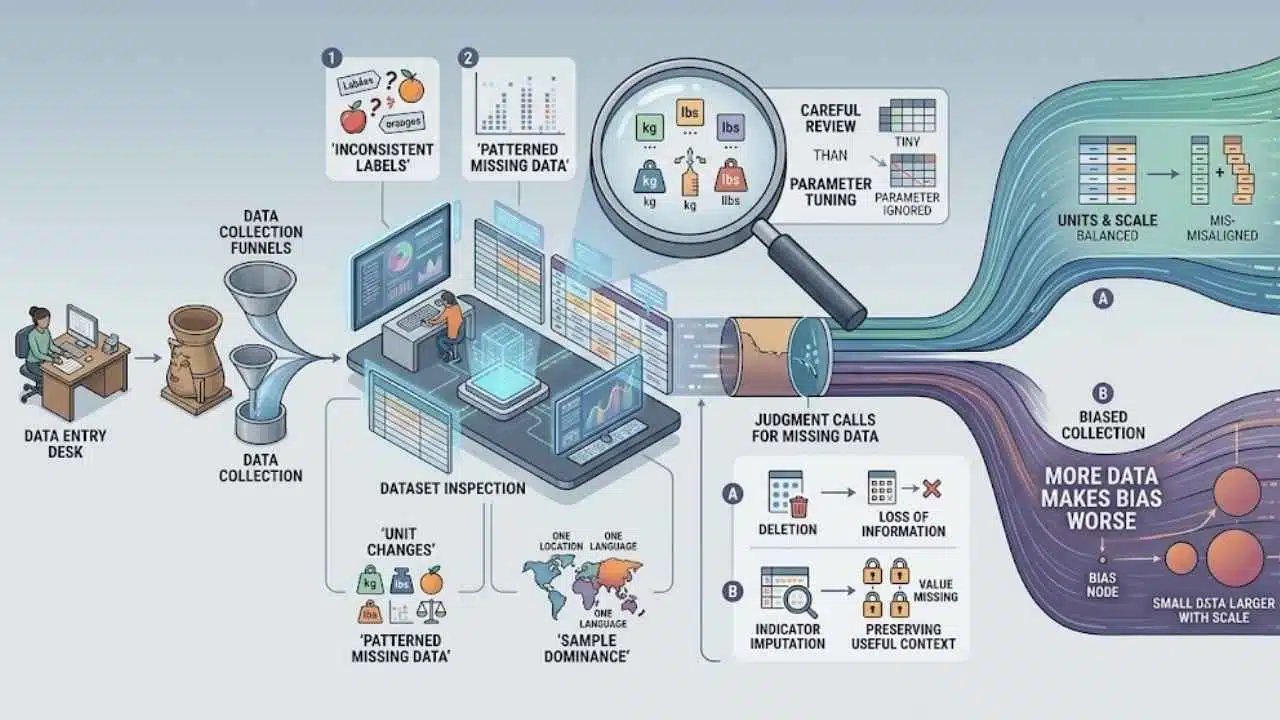
A dataset records how information was collected, filtered, labeled, and stored. It is not automatically an accurate picture of the problem. Labels may be inconsistent. Missing values can follow a pattern. Units may change between sources. Database joins can create duplicates. One location, language, device, or customer group may dominate the sample while appearing ordinary in an overall summary.
Before tuning, inspect examples from every class, rows with missing fields, extreme values, and records near the decision boundary. Compare suspicious values with the original source. A small, careful review can reveal problems that parameter tuning will not fix.
Missing data needs judgment. Deleting every incomplete row may remove one group disproportionately. Mean or median imputation can suit some tabular features, but an indicator showing that a value was imputed may preserve useful information about its absence. More data does not repair an unclear label or a biased collection process. It merely repeats the weakness at greater scale.
3. Preprocessing Before Creating the Data Split
This is one of the most damaging common machine learning mistakes because it can make an invalid experiment look excellent. Suppose a developer standardizes every numerical feature before splitting the data. The transformation has already learned the overall mean and variance, including the future test set. If supervised feature selection is performed on the full labeled dataset, test labels can also influence which features reach the model.
Create the partitions first, fit preprocessing on the training portion, and apply the learned transformations to validation, test, and production inputs. A scikit-learn Pipeline helps keep transformers and the estimator inside the same cross-validation process.
Oversampling belongs inside each training fold, not before cross-validation. Target encoding should use cross-fitting or another method that prevents a row’s label from determining its own encoded value.
Then inspect feature meaning. A column such as “days until account closed” may predict closure perfectly while being unavailable when a live prediction is requested. Clean code cannot rescue a feature from the future.
4. Using a Random Split for Grouped or Time-Dependent Data
A random split is convenient, but it assumes examples can be mixed without distorting evaluation. Many datasets do not meet that condition. If one patient contributes several records, putting some in training and others in testing lets the model exploit patient-specific patterns. The same problem appears with transactions from one customer, readings from one device, several images of the same object, or paragraphs taken from the same document.
Time creates a different failure. A demand model intended to predict next month should be evaluated on later observations, not a random mixture of past and future rows. Closely adjacent windows may even require a gap between training and evaluation.
Group-aware tools such as GroupKFold can keep related examples together. TimeSeriesSplit can preserve order when its assumptions fit the data. Neither tool decides what independence means in the real application. The split should imitate the conditions under which the model will actually make predictions.
5. Reusing the Test Set During Model Development
The test set should show how well the finished procedure performs on unseen data. If its score is checked after every feature change, algorithm switch, or hyperparameter adjustment, it begins influencing development. The model is not trained directly on those rows, but the developer keeps whichever choices improve the score. After enough iterations, the test set has quietly become another validation set.
Use training data to fit model parameters. Use validation data or cross-validation to compare features, algorithms, thresholds, and settings. Reserve the test set for the final estimate.
Nested cross-validation estimates an entire selection procedure by tuning in an inner loop and evaluating in an outer loop. It is useful when a reliable estimate is needed and a substantial untouched test set is unavailable, but many beginner projects do not need its extra cost.
6. Using Accuracy as the Only Measure of Quality
Imagine 100 examples: 95 negative and five positive. A classifier that predicts “negative” every time earns 95% accuracy while finding none of the positive cases.
Accuracy is not useless. It is simply a poor standalone measure when classes are imbalanced or different errors carry different costs. Precision matters when false alarms are expensive. Recall matters when missing a positive case is worse. F1 combines precision and recall, but it does not express the financial, safety, or operational cost of either mistake. Precision-recall curves or average precision can add useful context when positive cases are rare.
A confusion matrix shows which errors the model is making. Check important data slices too: respectable overall performance can hide weak results for one region, language, device, or customer segment.
Regression metrics also encode priorities. Mean absolute error stays in the target’s units and weights residuals linearly. Mean squared error and root mean squared error penalize large misses more heavily. Choose that emphasis deliberately.
Do not treat a classifier’s default threshold as a business decision. Validate it against the real cost of false positives and false negatives, using validation data rather than the final test set.
7. Skipping a Meaningful Baseline
A complicated model needs something useful to beat. For regression, a basic baseline might predict the training-set mean or median. For classification, it might predict the majority class. An existing business rule can be more informative because it represents the process the model would replace.
The comparison must use the right metric. A majority-class baseline can post high accuracy on imbalanced data while producing zero recall for the minority class.
After the naive baseline, try a simple model such as linear regression, logistic regression, or a small decision tree. If a larger system adds only a marginal benefit, its cost and maintenance burden may not be justified. If the baseline remains hard to beat, revisit the label, features, split, metric, and useful signal before expanding the search.
8. Responding to Every Weak Result With a Larger Model
“Try a bigger model” is not a diagnosis. Strong training performance paired with weak validation performance suggests overfitting or a mismatch between the datasets. Weak results on both may indicate underfitting, poor features, noisy labels, or a badly framed task.
Learning curves make the next decision less speculative. If validation performance keeps improving as the training set grows while training performance remains strong, more data may help. If both curves flatten at weak scores, collecting more of the same data is unlikely to solve the underlying problem.
Read the errors too. Check whether they cluster around one source, class, period, language, device, or missing-value pattern. Then change one part of the experiment at a time. A disciplined error review usually teaches more than another search job.
9. Keeping Experiments That Cannot Be Reproduced
Setting a random seed is useful, but it does not preserve an experiment by itself. Results can change because the source data changed, rows received different split assignments, preprocessing code moved, or dependency versions changed. Frameworks may promise repeatable random sequences only under particular combinations of code, seeds, and software versions.
Record the dataset version, split assignments, code revision, features, preprocessing, hyperparameters, seeds, library versions, metrics, and threshold. Keep failed experiments too, or a changed split may be mistaken for a real improvement.
Beginners do not need an elaborate experiment platform. A versioned configuration file and a clear results table are already a serious improvement over notebook history and memory.
10. Treating Deployment as the Finish Line
Offline evaluation describes performance on a fixed sample. Production data does not stay fixed. New categories appear. Missing-value rates change. An upstream system renames a field. Training and serving pipelines calculate the same feature differently. A service can remain online while the usefulness of its predictions declines.
Monitoring should cover more than uptime and latency. Track relevant signals such as invalid inputs, feature and prediction distributions, training-serving skew, model age, data slices, and real outcomes once labels become available.
Watch the reason the model exists too. A higher offline AUC means little if the downstream workflow does not improve or users learn to ignore the output.
Retraining on a calendar is not a maintenance plan. Define what change should trigger investigation, how a replacement will be compared with the current model, and how the system can return to an earlier version when an update performs poorly.
Final Thoughts
Avoiding common machine learning mistakes requires more care with the experiment than novelty in the algorithm. Before training, write down the label, prediction time, available features, split strategy, evaluation metric, and baseline. That short document will expose many problems while they are still cheap to fix.
Then preserve the first reproducible result, even if it is modest. An honest baseline on properly separated data is more valuable than an exceptional score produced by leakage, repeated test-set use, or a split that bears no resemblance to production. Reliable machine learning begins with an evaluation you can trust.