
Most study schedules fail because the plan stops matching the week, not because the student suddenly stops caring. A timetable may give every chapter an hour and treat each evening as fully available. It rarely leaves room for a difficult topic, a new assignment, or a practice paper that exposes a larger problem than expected.
Once that happens, unfinished work begins spilling into other subjects or pushing study late into the night. Learning how to build a study schedule means accounting for those disruptions from the beginning. The schedule should identify the next task, reserve time for demanding work, and provide somewhere for unfinished tasks to go.
A perfect timetable is neither necessary nor realistic. What matters is having a plan that remains useful when the week becomes difficult.
Start With the Exam Requirements
Before blocking out study time, confirm what each assessment involves.
For every subject, record:
- The exam date, start time, and location
- The format, such as multiple choice, essays, calculations, oral work, or practical tasks
- The chapters, lectures, readings, and topics included
- The weighting of the assessment
- Coursework still due
- Available practice papers or sample questions
- Materials allowed during the exam
- Any recent changes announced by the instructor
Check the course outline and learning platform rather than relying on memory. Students can waste hours revising excluded material or overlook a section carrying a large share of the marks. The format should shape the preparation. A multiple-choice science paper may require quick recall and careful comparison between similar answers. An essay exam demands evidence selection, argument, and writing under pressure. Mathematics preparation should include solving problems without following a worked example line by line.
Calendar entries should be equally specific. “Revise history” gives little direction. “Plan two essays on the causes of the conflict, then complete one timed source question” tells the student exactly what to do.
Map the Workload Before Dividing the Hours
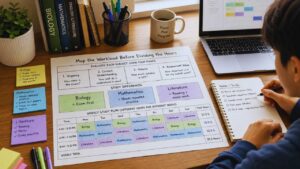
For each course consider four points:
- Urgency: How soon is the exam or deadline?
- Current understanding: Which topics can be explained or solved without help?
- Volume: How much content and practice remain?
- Assessment value: How heavily does the exam count toward the final result?
Use those details to decide how often a subject appears in the timetable.
Suppose biology comes first, mathematics is causing the most trouble, and literature still requires several readings and essays. Giving all three subjects two hours would ignore those differences. Biology needs attention first. Mathematics needs repeated problem-solving. Literature requires an earlier start because its reading and writing cannot be compressed into one evening.
Equal study time is overrated. Different subjects carry different workloads and different chances of losing marks.
Build Around the Hours That Really Exist
Block out fixed commitments before adding revisions. Include classes, work, travel, meals, appointments, family duties, exercise, religious commitments, and regular sleep. A student who returns home at 5:30 p.m. does not have a free evening beginning at 4:00 p.m., no matter what the timetable says.
The quality of an available hour matters too. A short gap between classes may be enough for flashcards or checking quiz mistakes. It is less suitable for learning a difficult mathematical method. A quiet morning may suit demanding work. After a long shift, familiar recall may be more realistic.
Plan fewer tasks each day and reserve the strongest periods for subjects carrying the greatest risk. A modest plan followed for two weeks is more useful than an ambitious one abandoned after two days.
Give Every Study Block a Clear Job
Each study period should have a specific result attached to it. Compare “study economics for two hours” with “complete 15 supply-and-demand questions, mark them, and review mistakes involving shifts in the curve.”
The second entry has a clear endpoint. It produces marked work and identified errors rather than two unmeasured hours of “studying.” Other useful entries include recalling 20 key terms, completing eight algebra problems without notes, planning one history essay, or reviewing mistakes from the previous chemistry test.
Avoid labels such as “revision,” “catch up,” or “work on notes.” They leave too many decisions until the session has already started. Choose the task while building the schedule.
Reading Is Only the Beginning
Students sometimes need to read an explanation or work through a model answer before practicing independently. Trouble starts when reading continues to replace practice. Rereading feels productive because the material becomes familiar. Recognizing a paragraph does not show that the student can reproduce the idea during an exam.
Retrieval-practice research has found benefits when learners attempt an answer before checking their notes. This could involve a flashcard, a short quiz, a diagram drawn from memory, or a problem solved without following the example.
Spacing matters too. Material is generally remembered better when it is revisited across several sessions rather than packed into one long sitting. The ideal gaps vary, but returning to a topic several times usually makes more sense than one marathon.
A balanced timetable should include four kinds of work:
- Repair weak understanding. Return to the explanation or a worked example, then attempt the next problem without looking back.
- Retrieve without looking. Recall facts, formulas, processes, diagrams, or evidence before checking the answer and correcting mistakes.
- Practice the form of the exam. Solve an unfamiliar problem, analyze a source, interpret data, or write part of an essay. Gaps hidden during rereading usually appear here.
- Work under time pressure. Timed questions reveal slow writing, poor pacing, and unfinished answers. One carefully reviewed paper is more useful than several rushed attempts.
Plan the Week Before Planning Each Evening
A weekly view protects time for exams that come later. A rough week might place mathematics and biology on Monday, literature and chemistry on Tuesday, timed work later in the week, and a longer practice paper on Saturday.
Turn those priorities into individual blocks. A weekday evening could include 45 minutes of algebra, a short break, 40 minutes of biology recall, and 45 minutes of literature planning.
Productive session length varies. Some students can concentrate for an hour; others begin making mistakes after 30 minutes. A timer can help, but no particular number is ideal for everyone. The block should be long enough to finish meaningful work without stretching beyond useful concentration.
Leave Space for Delays

Buffer time is often the first thing students remove when the week looks crowded. A full schedule has nowhere to absorb a chapter that runs long, a new deadline, or an evening lost to illness or exhaustion. Once one session is missed, later work gets pushed into another subject’s time or into sleep.
Leave one or two study periods open each week. Use them when a task runs long or a practice paper reveals a weakness that needs attention. If nothing spills over, keep the time free or use part of it for light review.
Travel, meals, and settling down also belong in the plan. Open time may look inefficient, but it prevents one delayed task from damaging the rest of the week.
Protect Sleep Before Adding More Hours
Cutting sleep creates more study time on paper. Those extra hours may be less productive because tired students often struggle to concentrate and remember what they have studied. Current public-health guidance recommends 8 to 10 hours of sleep for teenagers aged 13 to 17 and at least seven hours for most adults aged 18 to 60. Individual needs vary, and persistent sleep problems should be discussed with an appropriate health professional.
A late night may occasionally be unavoidable during exam season. It should not become the structure of the plan. Decide when the final session will end. Before stopping, note the exact point from which the next session should continue, such as “check questions 6 to 10” or “finish the second essay paragraph.”
When a timetable regularly pushes study past midnight, the timetable probably needs to change.
Review Results, Not Just Hours
Following every scheduled hour does not guarantee that the right work is being done.
Every few days ask:
- Which topics can now be recalled without help?
- Which errors keep appearing?
- Which tasks took longer than expected?
- Which subject has received too little attention?
- Has the exam coverage or format changed?
- Is the plan interfering with sleep or essential responsibilities?
Move time toward the topics still causing problems. If algebra errors continue, add another problem-solving block. If a biology topic can already be explained accurately, reduce its time. If an essay plan takes 40 minutes when only 10 will be available in the exam, practice under tighter limits.
One bad day does not require a new calendar. Move the most important unfinished task into the next buffer period and return to the existing plan.
Common Advice That Often Wastes Time
Study Every Subject Every Day
Daily contact can help with formulas or vocabulary. Other subjects do not need to appear every day, especially when switching repeatedly prevents deeper work.
Rewrite All Your Notes
Clear notes are useful. Rewriting an entire course takes time without testing recall. Once notes are usable, move toward retrieval and exam-style work.
Give Every Subject the Same Number of Hours
Equal hours ignore which exam comes first, where the student is weakest, and how much work remains. Give more time to subjects where errors are still common.
Complete as Many Practice Papers as Possible
The number completed matters less than the review that follows. Mark each paper, identify why important errors occurred, and schedule work on the weaknesses it revealed.
Find the Perfect Planning App
Google Calendar, Notion, a spreadsheet, a paper planner, or a basic task app can all hold a workable plan. The format will not fix a timetable containing more work than the student can complete. For most students, a simple calendar and short task list are enough.
When the Schedule Has Fallen Behind?
After several missed sessions, copying every overdue task into tomorrow only creates another impossible day.
Separate the remaining work into three levels:
- Essential: Weak, high-value material needed for the nearest assessments.
- Useful: Additional practice that could improve performance.
- Optional: Rewriting secure notes, repeating easy material, or completing low-value extras.
Put essential tasks into the schedule first. Later subjects may still need a short review, but some low-value work from the original plan will have to be dropped. Ask for help when the workload can no longer be managed safely or realistically. A teacher may clarify what is examinable. A tutor may identify the misunderstanding behind repeated errors. Support at home may protect a quiet study period.
A timetable is not enough when exam pressure is causing severe anxiety, ongoing sleep problems, or difficulty managing daily life. Appropriate school, counseling, or healthcare support may be needed.
The Final Day Before an Exam
Use the final day to settle uncertainty rather than begin a large new plan. Review core ideas that still need retrieval, common mistakes from earlier practice, and familiar exam-style questions. Confirm the exam time, location, login details, and permitted materials. Pack identification, stationery, a calculator, or anything else required.
When time is short, reviewing a few important weak points is usually better than reading an entire chapter once without practicing it. Stop at the time already set and leave enough room for sleep.
Final Thoughts
Start with the next seven days. Put every confirmed deadline and exam date in one place, then identify the subjects that are closest, weakest, or most heavily weighted. Break those subjects into tasks that can be completed in one sitting. Fit them around the commitments already in the week and leave at least one block open for work that runs long.
After a few days, adjust the plan based on completed questions and the mistakes that keep appearing. Learning how to build a study schedule is less about creating a flawless calendar than making the work easier to begin. A useful schedule shows the next realistic task without requiring the student to reorganize the whole week. During exam season, that clarity matters more than a perfect-looking timetable.
Frequently Asked Questions (FAQs) About How to Build a Study Schedule
How Many Hours Should a Student Study Each Day?
There is no universal number. Two focused hours completed consistently may produce more than six planned hours filled with interruptions. Start with an amount that fits the student’s real commitments, then adjust when the workload requires more.
How Far in Advance Should a Study Schedule Begin?
Begin as soon as the dates and likely coverage are known. A short test may need several days; a cumulative final may need weeks. Work backward from the material and practice required.
Should Every Study Session Include a Break?
Longer sessions usually benefit from breaks, but no single timing method suits every task. Stop before concentration drops far enough to increase mistakes.
Is It Better to Study One Subject for Hours or Switch Subjects?
Both can work. Essays and full practice papers often need longer uninterrupted blocks. Recall-heavy material may benefit from shorter visits across several days. Too much switching wastes time, but spending the whole day on one subject can leave later exams neglected.
What Should a Student Do After Repeatedly Missing the Schedule?
Reduce the number of planned tasks and keep the work most likely to affect the nearest exams. Move one important unfinished task into a buffer period instead of copying everything into the next day. When the same task keeps running long, change the estimate rather than blaming motivation.