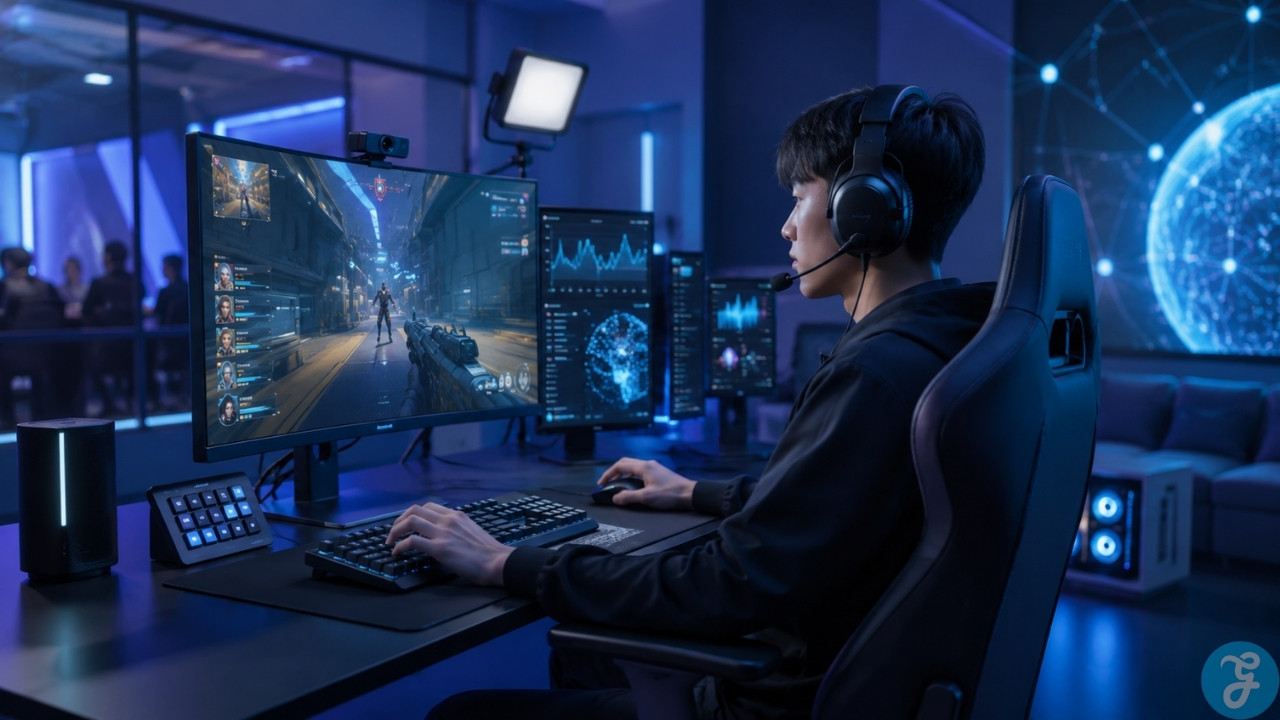
The landscape of esports is evolving rapidly. As the industry grows, the future of competitive gaming relies on far more than just faster processors and better graphics. Today, the ecosystem depends heavily on end-to-end latency reduction, reliable networking, advanced analytics, strict anti-cheat systems, player health monitoring, and scalable tournament infrastructure.
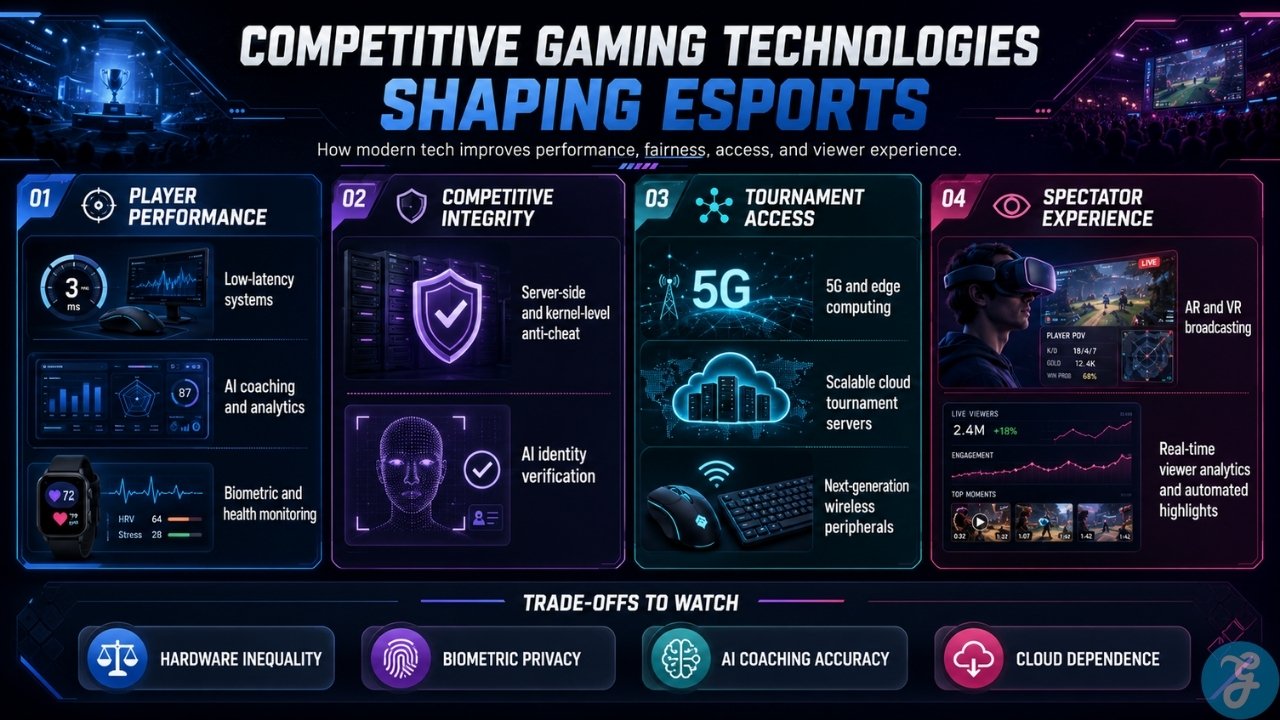
This guide breaks down the essential competitive gaming technologies defining the industry. To understand these esports technology trends, we have organized the most important gaming technology innovations according to how they affect four critical areas: player performance, competitive integrity, tournament accessibility, and the spectator experience.
Competitive Gaming Technologies Improving Player Performance
1. System Latency Optimization
Latency deserves particular attention in the realm of low-latency gaming technology. Technologies such as NVIDIA Reflex optimize the path between a player’s physical input and the displayed result on screen. By reducing system rendering queues, players experience a massive improvement in raw responsiveness. However, while these developments can improve responsiveness, consistent connections and standardized tournament environments remain essential to ensure a truly level playing field.
2. AI-Powered Coaching and Analytics
The integration of AI in esports has revolutionized how players train. Modern esports performance analytics platforms use machine learning algorithms to review match footage, identify rotational errors, and suggest optimal strategies. These tools break down massive amounts of gameplay data, turning raw statistics into actionable insights for both solo players and professional rosters.
3. Biometric and Health Monitoring
Staying focused during a high-stakes match requires immense mental and physical stamina. Organizations are now equipping players with wearable devices that track heart rates, stress levels, and eye movements. This data allows coaches to recognize when a player is tilting or suffering from fatigue, enabling them to adjust training schedules and optimize overall health.
Technologies Protecting Competitive Integrity
4. Server-Side and Kernel-Level Anti-Cheat
Maintaining a fair environment is mandatory for the survival of any competitive title. Traditional security measures have evolved into complex server-side and kernel-level anti-cheat programs. Modern systems utilize graph neural networks to analyze spatial and temporal player data in real time, instantly identifying impossible aim patterns or coordinated collusion without relying solely on client-side verification.
5. AI-Driven Identity Verification
To combat account sharing and identity spoofing in online qualifiers, developers are implementing AI-driven identity verification. These esports technologies 2026 use facial recognition trained on neural networks to ensure that the person playing is the registered participant. If the system detects an unauthorized user, it immediately alerts tournament administrators.
Technologies Expanding Tournament Access
6. 5G and Edge Computing Networks
The rollout of advanced 5G networks and edge computing aims to bring processing power geographically closer to the players. By routing data through local edge servers instead of distant centralized data centers, these networks drastically reduce round-trip ping. This allows players from remote regions to participate in global tournaments with highly stable connections.
7. Scalable Cloud Tournament Servers
Cloud computing allows tournament organizers to spin up virtualized, high-tick-rate servers on demand. Instead of relying on fragile local hardware networks, scalable cloud infrastructure ensures that sudden spikes in player traffic do not cause server crashes or degraded performance during massive open qualifier events.
8. Next-Generation Wireless Peripherals
The future esports hardware market is completely eliminating the need for wired setups. Devices like the ATTACK SHARK RS6 ULTRA feature native 8,000Hz polling rates and magnetic hot-swappable batteries. These innovations provide continuous, ultra-fast wireless performance that meets the strict demands of professional FPS players without the drag of a traditional cable.
Technologies Transforming the Spectator Experience
9. Augmented and Virtual Reality Broadcasting
Fans expect more than a standard video feed. Immersive esports technology is transforming broadcasts through AR and VR integration. Spectators can now use VR headsets to step onto the virtual battlefield, controlling their own camera angles and experiencing the match from the exact perspective of their favorite professional players.
10. Real-Time Viewer Analytics and Automated Highlights
Artificial intelligence is also reshaping how audiences consume content. AI systems track the most exciting moments of a match, instantly compiling highlight reels and generating advanced statistical overlays for the broadcast. This keeps viewers engaged during lulls in the action and helps casual fans understand complex in-game economies or team compositions.
Limitations and Trade-Offs to Consider
While these technologies push the industry forward, they come with significant trade-offs that organizations and players must navigate carefully.
Hardware Inequality and Competitive Standardization
As peripherals and networking tools become more advanced, the gap between well-funded professionals and amateur players widens. Hardware inequality means that players who cannot afford top-tier PCs will face an inherent disadvantage. Furthermore, achieving true competitive standardization is incredibly difficult when players practice on vastly different hardware setups and edge networks.
Anti-Cheat Permissions and Biometric Privacy
Kernel-level anti-cheat software requires deep, ring-zero access to a user’s operating system, raising severe security red flags. Similarly, the collection of physiological data sparks debates over biometric privacy. Players must carefully consider who has access to their heart rates and eye-tracking metrics, and how securely that information is stored.
AI Coaching Accuracy and Data Ownership
AI coaching tools are not infallible. Players must be wary of AI coaching accuracy, as machine learning models can misinterpret complex macro-strategies or hallucinate incorrect advice. Over-reliance on AI is dangerous. Additionally, the rise of extensive analytics creates legal questions regarding data ownership. It remains highly debated whether the telemetry generated during a match belongs to the player, the team organization, or the software publisher.
Cloud-Service Dependence
Relying entirely on cloud infrastructure introduces severe vulnerabilities. Cloud service dependence means that a single localized internet outage or regional server failure can completely halt a multi-million dollar tournament. Organizers must maintain robust fallback plans to prevent network failures from ruining the competitive experience.
What Competitive Gaming Technologies Mean for Esports
The rapid evolution of competitive gaming technologies is completely reshaping the esports landscape. From system latency optimization to AI-driven analytics providing deeper strategic insights, these tools are pushing player skill to unprecedented heights.
While challenges regarding biometric privacy, hardware inequality, and cloud dependence must be addressed, the continued advancement of scalable networks and anti-cheat systems ensures that the future of competitive gaming will be faster, fairer, and more immersive than ever before.
Frequently Asked Questions (FAQs) on Competitive Gaming Technologies
1. How Do Edge Computing and 5G Improve Esports?
Edge computing places game servers physically closer to the end user. Combined with the bandwidth of 5G, this reduces the physical distance data must travel, significantly lowering ping and minimizing packet loss for players competing from home.
2. Are Wireless Mice Good for Competitive Gaming?
Yes. Modern wireless mice feature advanced sensors and high polling rates that match or exceed the latency speeds of traditional wired mice. Professionals across titles like Valorant and Counter-Strike 2 now use wireless peripherals as their standard equipment.
3. Why Is Kernel-Level Anti-Cheat Controversial?
Kernel-level access gives the anti-cheat software the highest level of administrative permission on a computer. While this is highly effective for stopping cheats, it poses a security risk because any vulnerability in the anti-cheat software could potentially be exploited by malicious hackers to access the entire operating system.