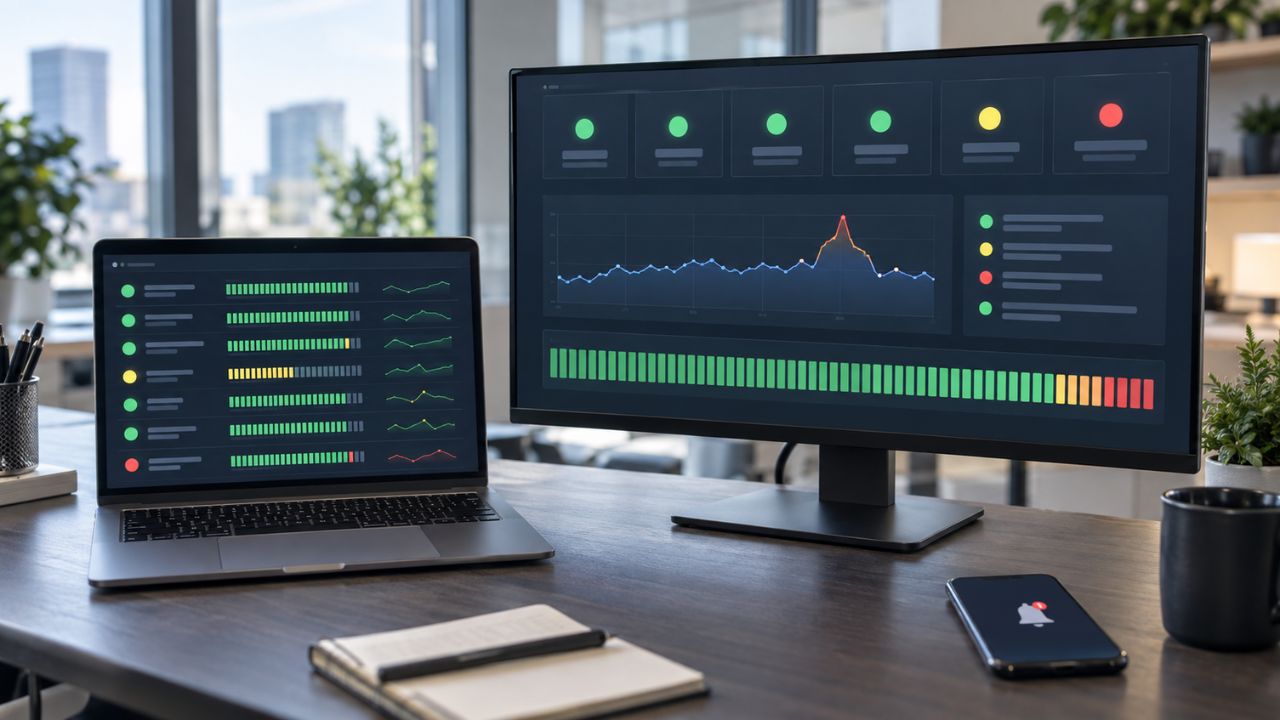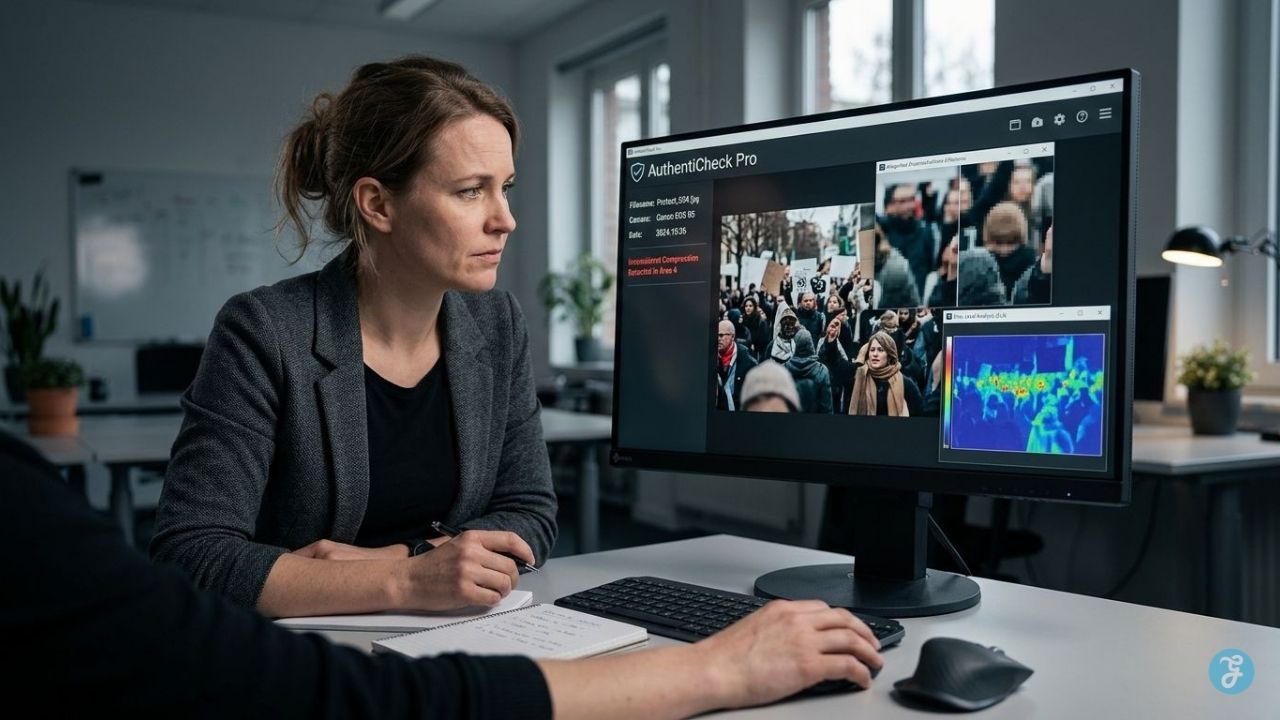
Nowadays, whatever we see online, we have to pause for a second, wondering if it is real or if AI made it. I have had that same moment, and it is exactly why digital provenance matters so much now. In the age of ai-generated content, a slick image detector can help, but it does not answer the bigger question: where did this file come from, who touched it, and can I verify that history?
I am going to walk you through digital provenance vs AI detection, C2PA Content Credentials, and cryptographic signatures. Then I will show you when each kind of evidence helps, where each one fails, and why the strongest verification workflow uses both.
The Growing Crisis of Digital Trust
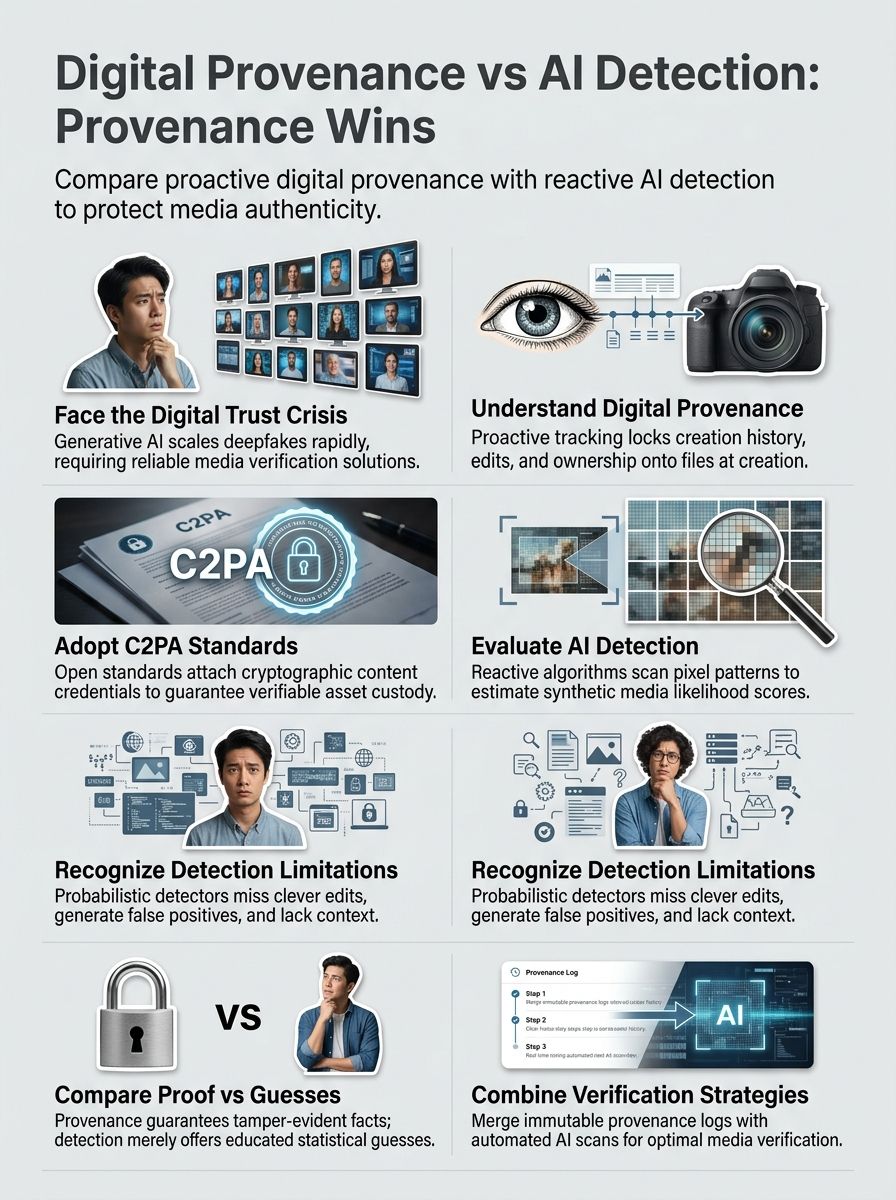
AI images, cloned voices, and edited video now spread faster than most people can check them. That changes how we judge news, product claims, social posts, and even evidence in business disputes.
Gartner has called digital provenance a top strategic technology trend, which tells me this is no longer a niche security topic. It is becoming core provenance infrastructure for any organization that publishes or buys digital content.
The hard part is no longer creating convincing media. The hard part is proving what is authentic. That is where the split begins. AI detection tries to infer whether something looks synthetic after the file already exists. Content provenance tries to carry proof from the moment the file is created.
Competitors in this space often explain detection well, but they skip the practical gap: a score is useful for triage, while a signed history is useful for trust, audits, and disputes. That difference is what readers usually need help with.
Digital Provenance: A Proactive Approach
This is the core difference for me: provenance starts at creation, while AI detection starts after suspicion appears. That proactive design changes the quality of evidence. Instead of asking whether a file seems fake, you ask whether its history is signed, intact, and understandable.
Verifiable chain of trust through provenance
A proper provenance system traces a file from capture or generation through later edits and publishing steps. Each stage adds information that can be validated instead of guessed.
The C2PA FAQ makes this especially clear: Content Credentials are open, tamper-evident, and user-verifiable, and they are built to interoperate with familiar metadata systems like EXIF, XMP, and IPTC. That is helpful because teams do not need to throw away existing metadata workflows to adopt provenance.
When I review a file with a clear record, I can answer business questions faster:
- Did this start in a trusted app or device?
- Were AI tools used, or only standard edits?
- Did the asset keep its history all the way to publication?
- Did anyone break or strip the chain?
That is stronger evidence than a detector saying the image is 73% likely to be synthetic.
The role of the C2PA standard
C2PA is the open standard that powers most of the modern conversation around content credential systems. It came out of work connected to Adobe, Microsoft, the BBC, and Project Origin, and it now sits at the center of the broader content authenticity ecosystem.
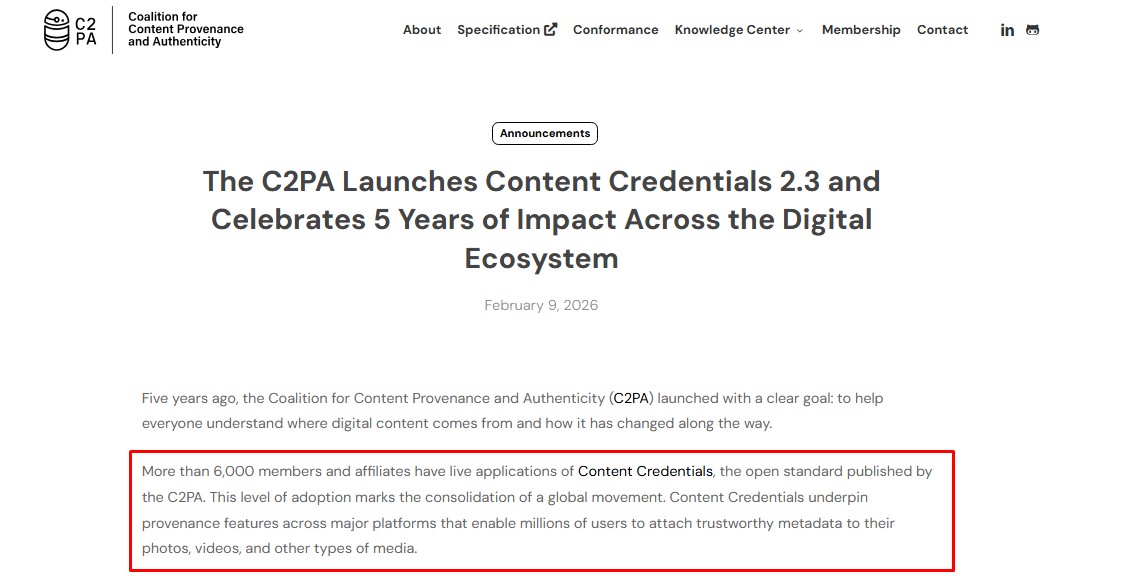
In the latest update from C2PA, Content Credentials 2.3 was published on January 5, 2026. The coalition also said in February 2026 that more than 6,000 members and affiliates had live applications of Content Credentials. For me, that is the clearest sign that provenance is moving from pilot status into real deployment.
C2PA helps because it standardizes the structure of claims about origin, edits, and signing. That gives tool builders a common language.
- Creators can attach provenance when they capture or publish media.
- Editors can append later changes without wiping the earlier record.
- Platforms can read and display the information in a consistent way.
- Audiences can inspect a history instead of relying on visual intuition alone.
There is an important catch, though. C2PA does not magically prove that every part of a story is true. It proves what the signing and edit history says, assuming that history stayed attached and the signer can be trusted.
Blockchain and cryptographic signatures in provenance
People often lump these together, but they do different jobs. Cryptographic signatures are the foundation. They prove that signed provenance data has not been changed without detection.
C2PA itself uses strong cryptographic building blocks like SHA-256 hashes, X.509 certificates, and digital signatures. In other words, if someone tampers with the asset or the credential, the validation should fail.
Blockchain can add another layer for timestamping or independent logging, but it is optional. I would not tell a reader that blockchain is required for digital authenticity. In most real workflows, the bigger priority is getting signed capture, secure key management, and readable credentials working first.
My rule is simple: if the signature is weak or the workflow is sloppy, adding blockchain will not rescue the evidence.
AI Detection: A Reactive Approach
Reactive does not mean bad. It means the tool steps in after content is already circulating. That makes AI detection useful for moderation queues, fraud screening, and first-pass review of older files that were created before provenance tools were available.
Identifying AI-generated and manipulated content
Detection still has a place, especially in fast-moving environments where teams cannot wait for manual review of every item.
- It can flag suspicious files that arrived with no provenance at all.
- It can help sort large backlogs so reviewers spend time on higher-risk items first.
- It can catch conflicts, such as a file that claims to be camera-captured but also shows signs of synthetic generation.
- It can support a combined workflow with watermark checks and provenance review.
Google has also started giving users more verification context inside products like Gemini and Search-related experiences, which shows how detection and provenance are starting to meet in consumer interfaces. That is useful because ordinary readers need fast context, not just forensic tooling.
Still, I keep coming back to the same principle: AI detection identifies risk, while provenance explains history.
Challenges of false positives and scalability
Scalability is where detection becomes expensive. A tool can look solid in a demo, then struggle when it has to process millions of posts across formats, languages, crops, and repost chains.
That is one reason current research keeps focusing on generalization and degradation. A detector may learn yesterday’s generators well, then miss tomorrow’s outputs or overreact to harmless edits made in common apps.
| Challenge | Why it matters in practice |
| False positives | Real content gets delayed, de-ranked, or wrongly challenged. |
| False negatives | Synthetic or manipulated content slips through review. |
| Model drift | New generators reduce performance of older detectors. |
| Scale costs | High-volume moderation needs fast, cheap triage, which can pressure accuracy. |
If I am handling a sensitive claim, I would rather scale trust from the source with provenance than scale suspicion after the fact with detection alone.
Digital Provenance vs AI Detection: A Comparison
If you only remember one thing from this page, make it this: provenance is evidence of history, while AI detection is evidence of likelihood. Both matter. They just answer different questions.
Guaranteeing authenticity vs detecting manipulation
I have seen people frame this as an either-or choice. It is not. The better question is which tool gives you stronger evidence for the decision in front of you.
| Aspect | Digital Provenance | AI Detection |
| Core purpose | Record creation, edits, and custody in a tamper-evident way. | Infer whether a file may be AI-generated or manipulated. |
| Timing | Proactive, starts at capture or generation. | Reactive, starts after review or suspicion. |
| Evidence type | Signed history and metadata. | Probability score, watermark hit, or forensic signal. |
| Best for | Authentication, audit trails, ownership, publishing trust. | Triage, moderation, risk scoring, legacy media review. |
| Main weakness | Can lose value if credentials are stripped or never attached. | Can fail under common edits, new models, and scale pressure. |
| Bottom line | Better for proving history. | Better for raising suspicion. |
Use cases for each approach
Here is how I would choose between them in real work.
| Use Case | Digital Provenance | AI Detection |
| Newsrooms | Best for proving source, edit history, and publish integrity. | Useful for screening incoming content that lacks credentials. |
| Photographers and creators | Best for showing authorship, edits, and licensing confidence. | Useful when contest judges or clients want a secondary review. |
| Insurance and claims | Best for chain of custody on submitted photos and documents. | Useful in older workflows that have no provenance records. |
| Marketplaces and content buyers | Best for purchase confidence and cleaner rights review. | Useful as a first-pass fraud filter. |
| Archives and museums | Best for long-term asset history and preservation records. | Useful for periodic scans of legacy collections. |
| Social platforms | Best for visible context when supported media arrives with credentials. | Useful for high-volume moderation of unsupported uploads. |
If the decision has legal, financial, or reputational weight, I would put provenance first and use detection as backup.
The Future of Content Verification
I expect the next phase of trust tools to look less like a single detector and more like a layered system. Capture devices, editing apps, cloud services, and platforms will all contribute pieces of the record.
That is already happening. Google Photos now displays a “How this was made” view for compatible images, and C2PA keeps expanding the common standard behind those experiences.
Why digital provenance is essential in the AI era
Provenance is essential because it changes the question from “Does this look fake?” to “What evidence travels with this file?” That is a much better question in the age of ai.
It also creates room for privacy-aware design. A 2026 USENIX presentation on provenance and privacy argued that transparency systems need data minimization, selective disclosure, and careful retention rules. I agree with that. Good provenance should improve trust without turning every file into a surveillance object.
- It can show that media was captured by a camera.
- It can distinguish AI edits from non-AI edits.
- It can preserve history across tools that support the same standard.
- It can fail visibly when the chain has been broken.
That last point matters more than people think. A visible gap is often more honest and more useful than a detector pretending to be certain.
Integrating provenance and detection for robust verification
The strongest workflow uses both approaches in sequence.
- Check for provenance first. Look for Content Credentials, signing details, and edit history.
- Validate the chain. Make sure the credential is intact and readable.
- Run detection second. Use detectors and watermark readers when provenance is absent, incomplete, or suspicious.
- Escalate conflicts. If provenance and detection point in different directions, send the file for human review.
I like this model because it uses provenance as the source record and AI detection as a pressure test. One tells you what the workflow claims happened. The other helps you spot cases where the file still deserves a closer look.
Wrapping Up
If I have to choose which evidence matters more, I choose digital provenance. It gives me a signed trail, a clearer chain of custody, and a stronger path to authenticity than AI detection can offer on its own.
AI detection still matters. It is valuable for triage, older media, and missing-metadata cases. But it is reactive, probabilistic, and easier to shake with ordinary edits.
So my practical advice is simple: use provenance by default, use detection as backup, and treat any high-stakes piece of digital media as something that should carry proof, not just pass a guess.
Frequently Asked Questions on Digital Provenance vs AI Detection
1. What is the difference between digital provenance and AI detection?
Digital provenance traces who created, edited, and moved a file, it gives a clear paper trail and adds Transparency (behavior). AI detection uses a detection tool to flag likely machine made content, it can spot output from Gemini (language model).
2. Which matters more for a Blog audience?
For a Blog audience, provenance often matters more, clear origins build Trust (social science). AI detection still helps, as a quick check.
3. Can provenance and AI detection work together?
Yes, they are two sides of the same coin. Provenance gives the chain of custody, detection flags likely AI parts. Together they raise Transparency (behavior), and boost Trust (social science).
4. Can we trust models like Gemini (language model) to decide?
Use Gemini (language model) as a tool, not a judge. Have humans review results, to keep Transparency (behavior) and Trust (social science).