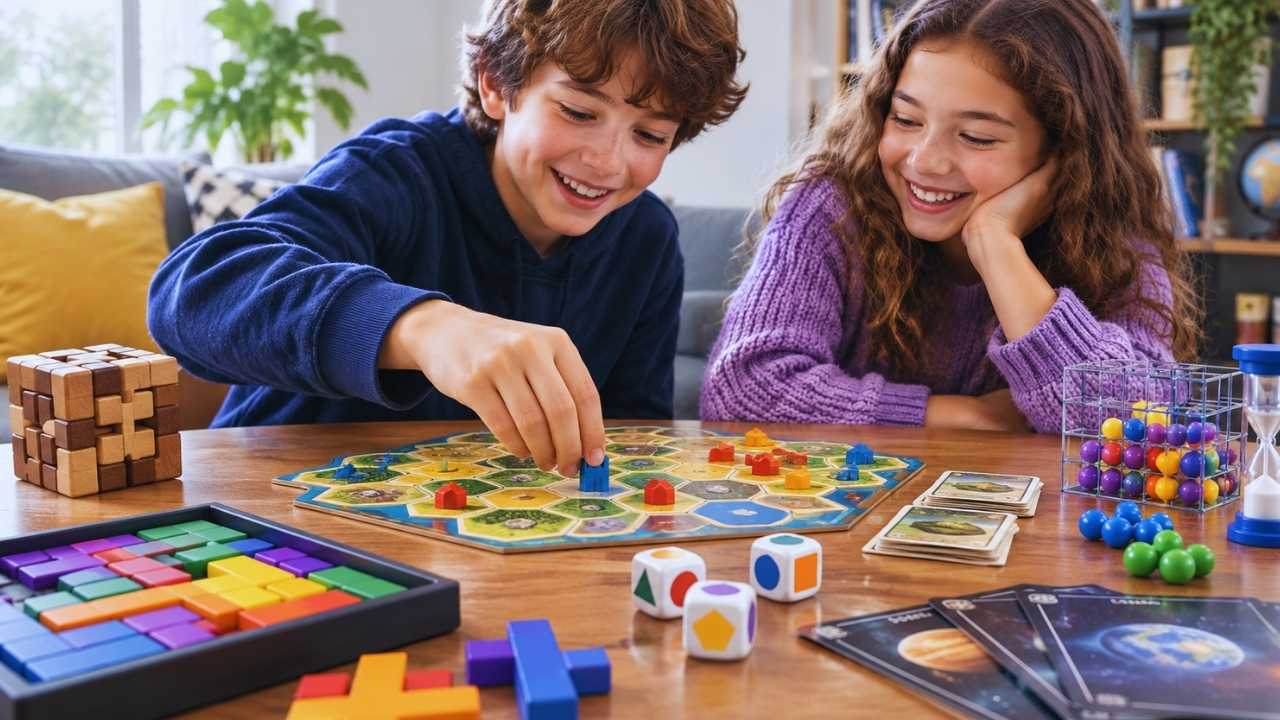
A child may refuse ten arithmetic questions and then calculate twice as much while trying to win a game. The difference is purpose. In a worksheet, the calculation is the whole task. In a game, numbers help the child reach a target, block another player, manage a budget, claim space, or solve a puzzle. That does not mean the math has been hidden. It has simply become part of a decision.
Making math games fun does not require expensive apps or shelves of educational products. Some of the strongest activities below use cards, dice, paper, or household objects. The commercial games earn their place because they offer enough strategy, replay value, or visual thinking to remain interesting after the rules are familiar.
Begins with games that feel least like schoolwork. Later choices make the mathematical content more obvious but still avoid the repetitive structure that puts many reluctant learners off. Together, they cover number sense, operations, fractions, factors, spatial reasoning, coordinates, probability, money, estimation, and logical thinking. For more practical projects connecting math with science, design, and engineering, explore best STEM activities kids.
What Makes a Math Game Feel Like Play?
A game stops feeling playful when every move becomes a public test. Fast recall can be useful, but speed should not control every activity. A child may understand fractions or multiplication perfectly well and still dislike being expected to shout an answer before everyone else.
The stronger games offer something beyond getting the calculation right:
- A choice between several possible moves
- More than one route to a target
- A strategy that develops over several turns
- Enough luck to keep a newer player involved
- Pieces or images that make an abstract idea visible
- Short rounds that invite another attempt
- Mistakes that can be corrected without embarrassment
Competition is not essential. SET can become a shared puzzle. “Target Number” can be a team challenge. A child can play gravity-style logic games alone or try to beat a previous score. The rules should make the child want another turn. If they mainly expose who calculates fastest, change them.
The Part Adults Often Get Wrong
A child can become skilled at one game without automatically transferring every idea to schoolwork. Someone may spot visual patterns quickly in SET but still need help with written multiplication. Another child may handle money confidently in a shop game and hesitate when decimals appear in a textbook.
Games build familiarity, strategy, number sense, and confidence. They do not replace clear teaching or varied practice. The adult’s role is not to interrupt every turn with an explanation. Let the game run. Later, ask one useful question:
- How did you choose that move?
- Was there another solution?
- What made that strategy fail?
- What would you try differently next time?
That short conversation often reveals more understanding than turning the activity into another lesson.
1. 123 Magic Number Fun: Math Kid
 123 Magic Number Fun stands out because it covers more ground than many single-skill preschool apps without turning early math into a worksheet. Designed for ages two to eight, it moves from number recognition and tracing to counting, sequencing, matching, missing-number problems, and basic operations. Its 12 mini-games use touch, audio, puzzles, dot-to-dot play, a submarine activity, and a math car race, giving children varied ways to practice.
It suits preschoolers and early elementary learners who respond well to short, visual tasks. Parents might use it for ten minutes three times a week: tracing on Monday, counting objects on Wednesday, then a simple puzzle on Friday. Adults should select activities rather than letting a two-year-old wander into multiplication or division.
The broad age range is its main weakness. The store listings do not describe adaptive difficulty, progress tracking, or specialist support for children with math difficulties. It also contains ads and in-app purchases, while its public review history remains limited. Even so, it deserves its ranking as a practical choice for families seeking varied, low-pressure number practice in one app.
2. SET
SET contains no sums, equations, or obvious school math. Each card varies across four features: color, shape, number, and shading. Players search for three cards where every feature is either the same across all three cards or different across all three. A group might contain three colors, three shapes, the same number of symbols, and the same shading. If one feature breaks the rule, it is not a set.
The standard game includes 81 cards and is recommended for ages six and above. It can also be played alone. SET develops classification, visual scanning, and the ability to compare several attributes at the same time. It is especially valuable for children who enjoy finding patterns but resist arithmetic games.
The usual race format is not ideal for everyone. A quick player can dominate while a thoughtful child barely gets started. Remove the speed element by taking turns or working together to clear the table. The puzzle remains strong. Only the pressure disappears.
3. Blokus
Blokus turns geometry into a fight for territory. Each player receives 21 pieces made from connected squares. Pieces of the same color may touch at the corners but not along their edges. Players continue until they can no longer make a legal move. At first, children place any shape that fits. A few games later, they begin rotating pieces mentally, protecting open corners, saving smaller shapes for narrow spaces, and blocking routes across the board.
The standard game supports two to four players and is generally recommended for ages seven and above. Blokus is one of the better choices for children who say they dislike numbers but enjoy puzzles, maps, building, or visual strategy. The mathematical thinking sits in rotation, area, shape, symmetry, and planning rather than written calculation.
Adults should resist playing at full strength against beginners. An experienced player can close off the board quickly. Play in teams, let the child move first, or allow one piece to be repositioned during the game. A close match teaches far more than an easy defeat.
4. Prime Climb
Prime Climb makes arithmetic part of a wider board-game strategy. Players roll dice and move two pawns by adding, subtracting, multiplying, or dividing. The aim is to land both pawns on 101. Players can also bump opponents and draw cards that change the course of the game.
The board uses color to represent prime factors. Numbers built from the same prime numbers share visual patterns, making relationships between factors and multiples easier to notice. The standard recommendation is age ten and above, though simplified rules and adult support can make it accessible to some younger children.
Prime Climb is not the right first choice for a child who is still anxious about basic operations. Too much effort will go into working out possible moves, leaving little attention for strategy. For confident upper-elementary and middle school learners, however, it has much more depth than flashcards. It rewards flexible thinking rather than one memorized method.
5. The 24 Game
Four numbers appear on a card. The challenge is to make 24. Players may add, subtract, multiply, and divide, using every number exactly once. Parentheses are allowed, and many cards have more than one solution. The official Single Digits deck includes 48 cards and is recommended for ages nine and above. Each card has at least one valid answer.
The normal competitive version rewards the first person to solve the card. That format works for confident mental calculators but can turn the game into another source of pressure. A better family or classroom version gives everyone a fixed amount of time. Players then compare methods. Finding an unusual solution can matter more than finishing first.
The deck is convenient but not essential. Roll four dice, write four numbers on a whiteboard, or let children create their own cards for adults to solve. This is one of the strongest games for children who know the four operations but still treat them as separate procedures. Making 24 forces them to switch between multiplication, division, addition, subtraction, and grouping.
6. Shut the Box
Shut the Box looks like an addition game. The real interest comes from deciding which numbers to remove. A player rolls two dice and closes one or more available tiles that add up to the total. After rolling an eight, the player could close 8, 5, and 3, or 1, 2, and 5. Each option changes what will be possible later.
Closing one large tile may preserve several useful smaller combinations. Removing three small numbers can reduce the final score but leave awkward totals on the board. Commercial versions use slightly different layouts and rules. A homemade game needs only two dice and numbered cards from 1 to 9.
Younger children can play with addition alone. Older players can discuss likely dice totals, compare strategies, and total the numbers left open. Rounds are short, which matters. A ten-minute game is easier to repeat than a long educational activity that everyone feels obliged to finish.
7. Math Dice Jr. and Math Dice
Math Dice creates a target and leaves the route open. In Math Dice Jr., players roll one 12-sided target die and five standard dice. They use addition or subtraction to reach the target, moving farther when they use more dice. It is recommended for ages six and above.
The standard Math Dice version is more demanding. Two 12-sided dice are multiplied to create the target, while three scoring dice can be combined using addition, subtraction, multiplication, division, and powers. It is recommended for ages eight and above. The junior version is particularly easy to adapt. A beginner may use only three dice. A stronger player can be required to use four or five. Mixed-age children can work toward the same target under different rules.
A boxed set is useful but not necessary. Ordinary dice and a written target provide the same core challenge. Its main strength is flexibility. There is often more than one correct route, so children must choose rather than repeat a fixed method.
8. Got It!
Got It! needs no equipment and takes less than a minute to explain. Choose a target, such as 23. Players take turns adding 1, 2, 3, or 4 to a running total. Whoever lands exactly on 23 wins. The early rounds feel like basic counting. Then players notice that certain totals place the opponent in a difficult position. The game shifts from taking turns to controlling the sequence.
Got It! is based on the strategy game family known as Nim and is used by NRICH to develop prediction and mathematical generalization. Do not reveal the winning pattern too early. Let children record several games, circle numbers that frequently appear before a win, and test their own theories.
Once the strategy becomes familiar, change the target or alter the numbers players may add. A tiny rule change creates a new problem. This is one of the best no-cost classroom activities because the rules are simple enough for everyone to join, while the underlying reasoning can become surprisingly deep.
9. Fraction War
Fraction War turns a standard deck of cards into a comparison game. Each player flips two cards. For beginners, place the smaller number over the larger one so every fraction stays below one. The player with the larger fraction wins the round. Some comparisons are immediate. Others demand real reasoning. Is 5/8 larger than 3/5? How does 7/9 compare with 4/5?
Children may use one-half as a benchmark, create common denominators, convert to decimals, or think about how close each fraction is to one. Remove jokers. Treat aces as 1, and decide before playing whether face cards will be removed or assigned values such as 11, 12, and 13.
Older learners can keep the first card as the numerator and include improper fractions. The useful part is explaining close rounds. If speed becomes more important than reasoning, the game turns into guessing with cards.
10. Target Number
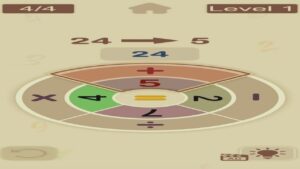 Target Number is a flexible dice game that can grow from simple addition to middle school math. Choose or roll a target. Then roll four numbers that players must combine to reach it.
Suppose the target is 17 and the available numbers are 2, 3, 4, and 6:
2 × 4 + 3 + 6 = 17
The difficulty can be adjusted without changing the basic game:
- Addition only for beginners
- Addition and subtraction for early elementary learners
- All four operations for older children
- Fractions, negative numbers, brackets, or powers for middle school students
This is particularly useful with mixed-age groups. Everyone can work toward the same target while following different operation rules. The game looks plain beside a boxed product or colorful app. That is also its strength. There is nothing to charge, update, lose, or subscribe to.
11. Coordinate Treasure Hunt
A coordinate grid becomes more interesting when it hides treasure. Draw and label the horizontal and vertical axes. Mark several secret locations. Players call out coordinates such as (3, 5), earning treasure, points, or clues for accurate guesses.
Begin in one positive quadrant. Older children can use all four quadrants, place shapes using several points, or translate a design left, right, up, and down. The game gives ordered pairs a visible job. Children who hesitate over coordinates in a textbook may understand them more easily when each pair identifies a location.
Use consistent language: Move across the horizontal axis first, then up or down the vertical axis. Casual changes in the order create unnecessary confusion. Once the child understands the system, let them create the map. Designing a fair challenge requires more thought than simply guessing coordinates.
12. The Shopkeeper Budget Game
The Shopkeeper Budget Game turns ordinary objects into a practical math activity. Create a small shop using food packages, stationery, toys, or handwritten product cards. Give each player a budget and a task. A younger child might receive $10, £10, or ₹500 to choose a snack. An older learner could compare package sizes, calculate change, apply a discount, or choose supplies for several people.
Avoid making the cheapest basket the only successful answer. Add a condition:
- Buy at least three types of items.
- Prepare food for four people.
- Keep enough money for transport.
- Choose between a discount and a larger package.
- Stay within budget while meeting a quality rule.
Use realistic prices and familiar local currency. An Indian version should reflect purchases a child might actually see in India, not a US example with rupee symbols added later. Let the child discover when the total is too high and revise the basket. Explaining every calculation first removes the problem-solving element.
13. Kahoot! Numbers by DragonBox
Kahoot! Numbers by DragonBox is designed for children aged four to eight. The app represents numbers as characters called Nooms. Children combine, split, compare, and arrange them through activities focused on quantity and part-whole relationships.
It is particularly useful for a child who can count in sequence but does not yet see numbers flexibly. Seven is not only “the number after six”; it can be five and two, four and three, or several other combinations. The current access model is the main drawback. Full use requires a Kahoot! subscription, so families should check whether they already pay for the service and whether the app supports the device they plan to use.
It also works better when the ideas leave the screen. After combining Nooms in the app, recreate the same relationship with coins, blocks, buttons, or drawings. Without that step, children may learn how the app behaves more readily than how numbers behave.
How to Keep Math Games Fun for Reluctant Learners?
Begin below the child’s frustration level. A game built around the exact skill causing anxiety may feel like a worksheet wearing a costume. Choose an activity where the child can make meaningful decisions using math they mostly understand.
Keep the first session short. Stop while they still want another round. Do not correct every mistake immediately. In many games, the rules will reveal the error naturally. A failed strategy can be more memorable than an adult stepping in with the correct method.
Winning can also mean more than defeating another player:
- Beat a previous score.
- Find three different solutions.
- Solve the puzzle together.
- Explain the cleverest move.
- Design a harder version for an adult.
- Predict what will happen before the next turn.
The most reliable way to keep math games fun is to protect the game itself. The math can remain visible without making every move feel assessed.
Final Thoughts
A good math game does not need to cover an entire curriculum. It needs to make a child think, choose, notice patterns, and stay involved long enough for strategy to develop. SET and Blokus are the strongest starting points for visual thinkers. Prime Climb and the 24 Game provide deeper arithmetic for children ready for it. Shut the Box and Math Dice make calculation part of a wider decision.
Some of the most useful choices cost almost nothing. Got It!, Fraction War, Target Number, Coordinate Treasure Hunt, and the Shopkeeper Budget Game can be adjusted for age, confidence, and local context more easily than most commercial products. The digital options need more scrutiny. Kahoot! Numbers by DragonBox now requires a subscription for full access, while Prodigy places free math practice inside a reward-heavy game system.
Making math games fun comes down to matching the challenge to the child. Choose one activity linked to something they already enjoy, remove unnecessary speed or pressure, and play it more than once. The first round teaches the rules. The later rounds are where the mathematical thinking usually begins.
Frequently Asked Questions (FAQs) About Math Games For Fun
How Long Should a Child Play a Math Game?
Ten to twenty minutes is enough for many younger children, particularly when the activity involves repeated mental calculation. Strategy games such as SET, Blokus, and Prime Climb may hold attention much longer. Stop when thinking turns into frustration rather than ending only because a fixed timer has expired.
Can Maths Games Replace Lessons or Written Practice?
No single game teaches everything a child needs. Games are particularly useful for number sense, flexible thinking, confidence, discussion, and applying skills in an unfamiliar setting. Children still need clear explanations and experience recording methods on paper.
What Should Parents Do if a Child Dislikes Competition?
Change the objective. Work together to clear a SET layout, find several ways to make 24, solve a coordinate map, or stay within a shared shopping budget. Solo puzzles and attempts to beat a previous score also remove the pressure of losing to another person.
Are Digital Maths Games Better Than Cards and Board Games?
Neither format is automatically better. Digital games can provide independent practice, quick feedback, and adaptive questions. Physical games make discussion, shared strategy, mental calculation, and hands-on reasoning easier to observe. The useful choice is the one that suits the skill and keeps the child thinking rather than clicking automatically.