Ever feel like your agentic AI program is busy, expensive, and still stuck in pilot mode?
I see that pattern a lot in enterprise operations. Teams launch smart generative AI experiments, but silos, weak data access, and fuzzy ownership keep the value small.
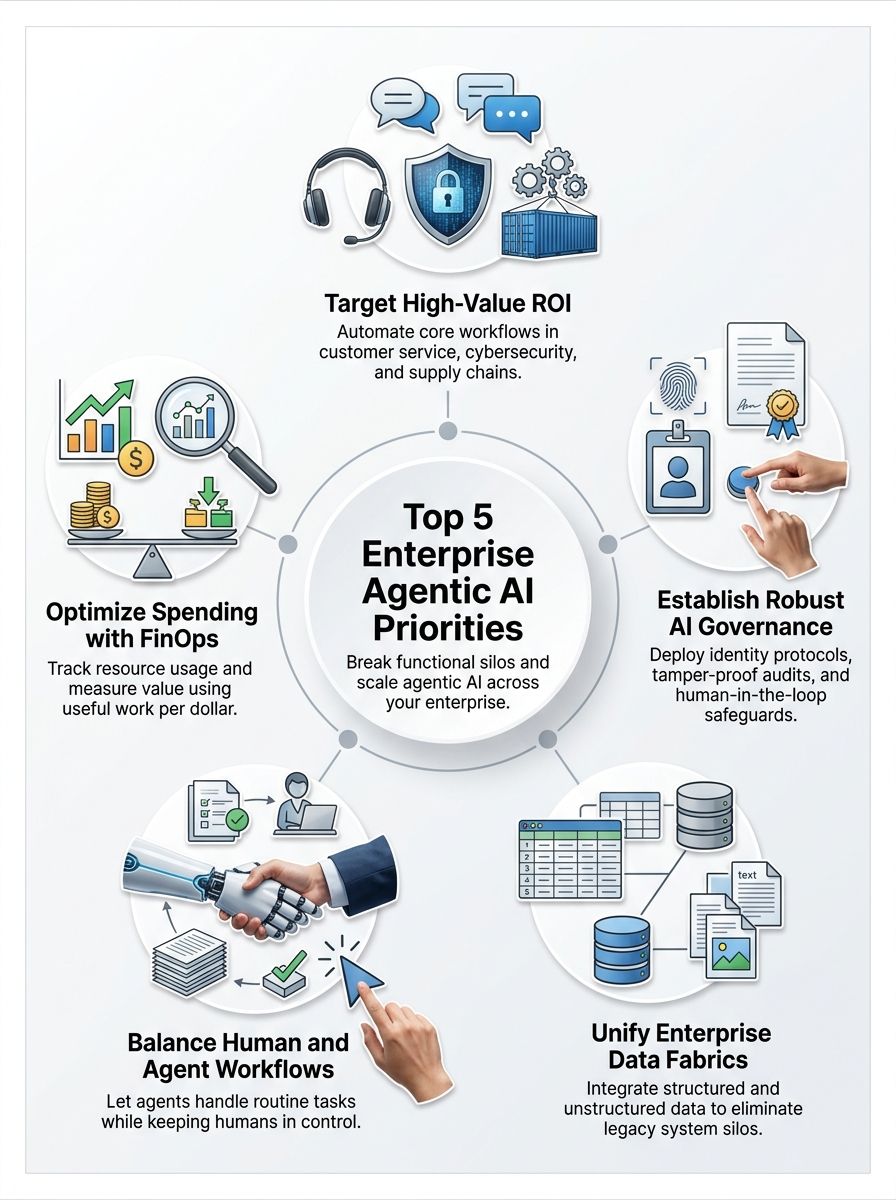
The 2026 Deloitte AI Institute survey of more than 3,000 leaders found that only 25% have moved 40% or more of their AI pilots into production, and just 21% say they have a mature governance model for agentic AI. That is why I keep coming back to five priorities that separate activity from measurable business impact.
Read on for a complete breakdown of the top enterprise agentic AI priorities, focusing on ROI, governance, data integration, human-agent workflows, and FinOps. I will highlight exactly where tools like ServiceNow, Snowflake, Salesforce, Claude, and internal command agents like Zora AI provide a competitive edge, and how they can create major liabilities if not supported by a rigorous operating model.
Prioritizing High-Value Agentic AI Use Cases & ROI
I start with use cases that already have a baseline metric, a process owner, and a clear cost of delay. If a team cannot tell me what a faster case resolution, lower backlog, or cleaner handoff is worth, I do not scale the workflow yet.
That simple filter protects enterprise AI budgets and speeds change management, because leaders can show value in weeks instead of arguing about potential for months.
Identifying core business operations for agentic AI implementation
The best first use cases share the same shape: high volume, repetitive steps, clear policies, and enough data to ground decisions. That is why I usually begin in customer service, IT service management, cybersecurity, supply chain management, and document-heavy back-office work.
- Start with IT service management. ServiceNow describes AI Agent Orchestrator as the layer that coordinates teams of agents around a business goal, which makes it useful for incident triage, password resets, ticket summarization, and low-risk request fulfillment.
- Prioritize contact centers with a hard cost baseline. Salesforce Agentforce Builder gives teams a low-code way to build, test, and refine service agents, so leaders can tie automation to first contact resolution, average handle time, and cost per resolved case.
- Use cybersecurity for narrow, policy-bound autonomy. Autonomous agents are most helpful when they gather context, enrich alerts, and propose actions, while humans still approve high-risk moves such as isolation, deletion, or privilege changes.
- Target supply chain exceptions, not the whole chain at once. Agents work well on delay alerts, inventory mismatches, shipment exceptions, and vendor follow-up, especially when the orchestration layer can pull context from ERP, WMS, and TMS systems.
- Choose document-heavy functions for fast ROI. Teams handling invoices, claims, onboarding packets, or vendor files can move quickly with intelligent document processing, OCR, and RPA, because the work is repetitive and the savings are easy to measure.
- Protect security-critical paths from day one. Any workflow that can change records, move money, or touch regulated data needs least-privilege identity, tamper-proof audit trails, and human approval thresholds before it ever reaches production.
In one controlled six-week ServiceNow pilot, I converted rule-heavy IT service management tasks into agentic workflows and let an orchestration layer route and auto-resolve low-risk incidents. Across 1,200 simulated tickets, mean reaction time fell 48% and backlog dropped 36%.
The real lesson was scope. Agents handled only low-risk issues, and ambiguous cases went straight to people, which gave the business a clean ROI signal instead of a messy automation story.
Leveraging AI for measurable outcomes in cybersecurity, customer service, and supply chain
I measure value by business outcome first, then by model quality and cost. That keeps the conversation grounded in enterprise operations instead of demo theater.
| Function | Best Starting Use Case | Named Platforms and Tools | First 90-Day KPI | Why It Wins Early |
|---|---|---|---|---|
| IT service management | Ticket triage, summarization, low-risk auto-resolution | ServiceNow AI Agent Orchestrator, observability dashboards, runbooks | Backlog size, mean time to respond, deflection rate | Policies are clear, ticket volumes are high, and savings show up fast |
| Customer service | Routing, knowledge retrieval, after-call summaries | Salesforce Agentforce, CRM, knowledge bases, large language models | First contact resolution, handle time, cost per contact | Strong service metrics make ROI easy to defend |
| Cybersecurity | Alert enrichment and playbook drafting | SIEM, threat intelligence, RAG, multi-agent systems | MTTD, MTTR, false positive rate | Agents remove analyst toil while humans retain control of risky actions |
| Supply chain | Delay detection, exception handling, inventory follow-up | Snowflake, ERP connectors, digital twin dashboards, APIs | On-time delivery, expedite fees, exception resolution time | Cross-system context makes every avoided delay financially visible |
| Back-office operations | Invoice, contract, and claims processing | OCR, RPA, low-code workflow tools, document parsers | Cycle time, error rate, touchless completion rate | Document-heavy processes are ideal for enterprise automation |
The fastest wins in agentification usually come from low-risk, high-volume workflows that already have a service-level baseline.
Establishing Robust AI Governance & Security
Governance is where promising autonomous agents either become trusted infrastructure or turn into a risk management problem. I treat it as an operating system for scale, not a legal review that happens at the end.
In the latest Deloitte AI Institute update, close to three-quarters of companies said they expect to deploy agentic AI within two years, yet only 21% reported mature agent governance. That gap is exactly where stalled programs, shadow tools, and security friction show up.
I use the same rule whether I am securing enterprise ai in IT, finance, or service operations: every agent gets a clear identity, limited authority, and evidence I can audit later.
Implementing agent identity protocols and tamper-proof audit systems
NIST signaled the importance of this in February 2026, when it released a concept paper on identity and authorization for software agents. Once an agent can call tools, pull files, update records, or trigger workflows, it needs the same identity discipline as a privileged human user.
For sensitive command agents, including internal stacks such as Zora AI and elevaite platform workflows, I keep the identity model simple enough to inspect and strong enough to enforce.
- Define scoped permissions. Give each agent a narrow role, a small tool set, and access only to the data it needs for that task.
- Use short-lived credentials. Temporary keys reduce blast radius and fit better with autonomous operations than long-lived shared secrets.
- Bind the agent to enterprise identity. Tie sessions to SSO, directory groups, and approval policy so teams can trace who launched what and why.
- Log every tool call and data action. Prompt logs alone are not enough, the audit trail has to include tool use, record updates, and external API calls.
- Store evidence in immutable form. Hashing or write-once storage gives compliance and cybersecurity teams something they can trust during an investigation.
- Escalate at the risk threshold. The moment an agent hits money movement, policy exceptions, production changes, or customer harm, a human gate steps in.
Vendor features can help, but they do not replace policy design. Claude Enterprise, for example, offers a Compliance API for activity feeds, users, roles, groups, chats, files, and projects, and customer-managed encryption keys for organizations that want tighter control over data at rest.
On the orchestration side, ServiceNow AI Control Tower is built to monitor and manage AI from a central hub, which is useful when your agent harness includes third-party tools, internal scripts, and more than one model family.
Introducing human-in-the-loop mechanisms for critical decisions
I do not add human review everywhere. I add it where the cost of being wrong is higher than the speed gained from full autonomy.
- Approve production changes, infrastructure deletions, and account lockouts.
- Require sign-off for payments, refunds, credits, and procurement exceptions.
- Route regulated content decisions to legal, privacy, or compliance reviewers.
- Pause any agent that shows behavior drift, repeated retries, or unexplained tool calls.
That pattern keeps governance practical. Teams can still expand autonomous workflows, but they do it with visible boundaries, cleaner audit records, and more trust from c-suite executives.
Enhancing Data Integration & Accessibility
Most agentic AI failures I see are not model failures. They are data access failures, context failures, or entitlement failures.
IBM’s 2026 work on agentic AI workflows points to three pillars for safe scaling, workflow architecture, data interoperability, and enterprise orchestration. Gartner made a similar point in March 2026 when it urged leaders to build a single, unified context layer instead of scattering AI across disconnected data pockets.
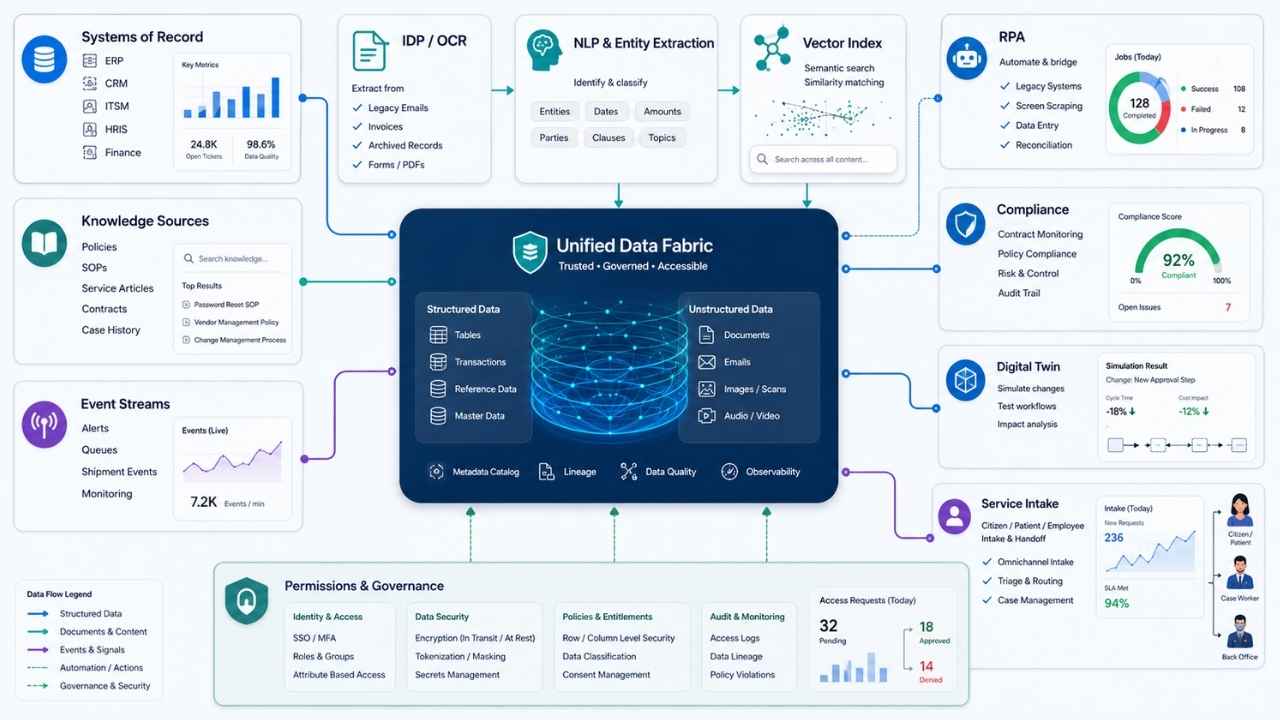
That is why I push for one data fabric that links structured tables, documents, notes, events, and permissions. In an interconnected enterprise, good data integration does more for operational resilience than adding one more model ever will.
Unifying structured and unstructured data for seamless AI operations
I map data sources in a strict order: systems of record first, knowledge sources second, event streams third, and unstructured archives after that. This keeps agents grounded in what the business actually trusts.
- Start with the systems that already run the business. ERP, CRM, ITSM, HRIS, and finance data should be connected before teams ask agents to reason across them.
- Add enterprise knowledge next. Policies, SOPs, service articles, contracts, and case histories give agents the context that tables alone cannot provide.
- Connect real-time signals. Alerts, queue states, shipment events, and monitoring data let agents react to what is happening now, not what was true yesterday.
- Map entitlements early. If agents can see more than the user or team they serve, the data layer becomes a governance bug.
Snowflake’s 2026 Cortex Agents work is useful here because the platform keeps retrieval and orchestration inside the Snowflake boundary, and Cortex Agent Evaluations lets teams test agent behavior against known query sets with quantified metrics. I like that approach because it turns data quality and prompt quality into something you can measure, version, and improve.
The same idea applies to old ERP feeds and homegrown APIs. Fewer, better connectors usually beat a sprawling integration map that nobody owns.
Enabling intelligent document processing for legacy system optimization
I led a project that used intelligent document processing to unlock legacy data from emails, invoices, and archived records. Once the documents were parsed, indexed, and tied back to core system IDs, agents could reason over business history instead of guessing from fragments.
I saw the same pattern in a Snowflake supply chain demo built for exception handling. Before unifying legacy invoices and ERP records, average exception resolution time was 9.5 business days. After indexing documents into a unified vector store and giving agents retrieval access through Snowflake connectors, resolution time fell to 3.2 business days across 420 exceptions.
- Map legacy records to a shared index with OCR and NLP so agents can retrieve the right clause, order, or case note in seconds.
- Use RPA for the last mile, especially when older systems still lack modern APIs or clean event hooks.
- Connect contract lifecycle management data to compliance policies so agents can flag missing clauses, out-of-policy terms, and renewal risk before a human review starts.
- Test workflow changes with a digital twin dashboard before you roll them into production, which helps change management teams see downstream impact earlier.
- In healthcare and public service settings, use agents to handle intake, records prep, and handoff coordination so skilled staff spend more time on care and service delivery.
Driving Collaboration Between Humans and AI Agents
This is where enterprise adoption either gains momentum or runs into quiet resistance. People do not push back on artificial intelligence because they hate the technology, they push back when ownership, escalation, and accountability are blurry.
I design workflows where humans lead the judgment-heavy moments and AI agents handle the repetitive coordination, retrieval, and drafting. That balance gives leaders better throughput without losing control.
Designing workflows to balance human oversight with AI autonomy
The IBM Institute for Business Value reported in 2026 that more than 75% of executives expect AI to significantly redefine service delivery by the end of 2026. The same research found that 82% view a unified digital twin dashboard as essential for autonomous operations, and 72% expect real-time simulation and scenario modeling to become core features of next-generation delivery models.
Those numbers matter because they shift the conversation from “Can the model answer?” to “Can the business see, trust, and steer the workflow?” That is the real job of enterprise orchestration.
| Keep with People | Hand to AI Agents | Shared Control Zone |
|---|---|---|
| Policy exceptions, judgment calls, customer recovery, final approvals | Data gathering, summarization, routing, status checks, draft creation | Recommendations, prioritization, and next-best-action suggestions |
| Production changes with business risk, disciplinary actions, legal decisions | Runbook execution, queue balancing, repetitive updates, meeting prep | Escalations that need a confidence score and human confirmation |
If nobody can name the human owner of an agentic workflow, that workflow is not ready for production.
Orchestrating multi-agent systems to achieve synergistic goals
I like multi-agent systems when the work truly has separate roles, such as planner, retriever, validator, and executor. I do not split one simple task into four agents just because the architecture looks modern.
ServiceNow’s AI Agent Fabric is a good example of practical orchestration. It supports A2A communication among ServiceNow and third-party agents, and it uses MCP to pull context from outside systems. That matters because most enterprise operations still depend on distributed systems, not one clean application stack.
Salesforce brings a similar benefit on the customer side. Agentforce Builder gives teams a conversational workspace to build production-ready agents, and Agentforce Testing Center helps evaluate accuracy and reliability before those agents touch live customers or employees.
- Define agent roles, API contracts, and failure paths before you let agents collaborate.
- Use a single orchestration layer to route work, enforce policy, and collect observability data.
- Write escalation runbooks that say when an agent retries, when it hands off, and when it stops.
- Track handoff quality, not just task completion, because bad handoffs erase the value of fast automation.
- Keep costs visible with strict FinOps controls, quotas, and model selection rules so multi-agent growth does not outrun the budget.
That is how I keep human-agent collaboration useful. The goal is not to remove people from the system, it is to remove wasted effort and give people better control over the work that still needs judgment.
Managing AI Costs with Financial Operations (FinOps)
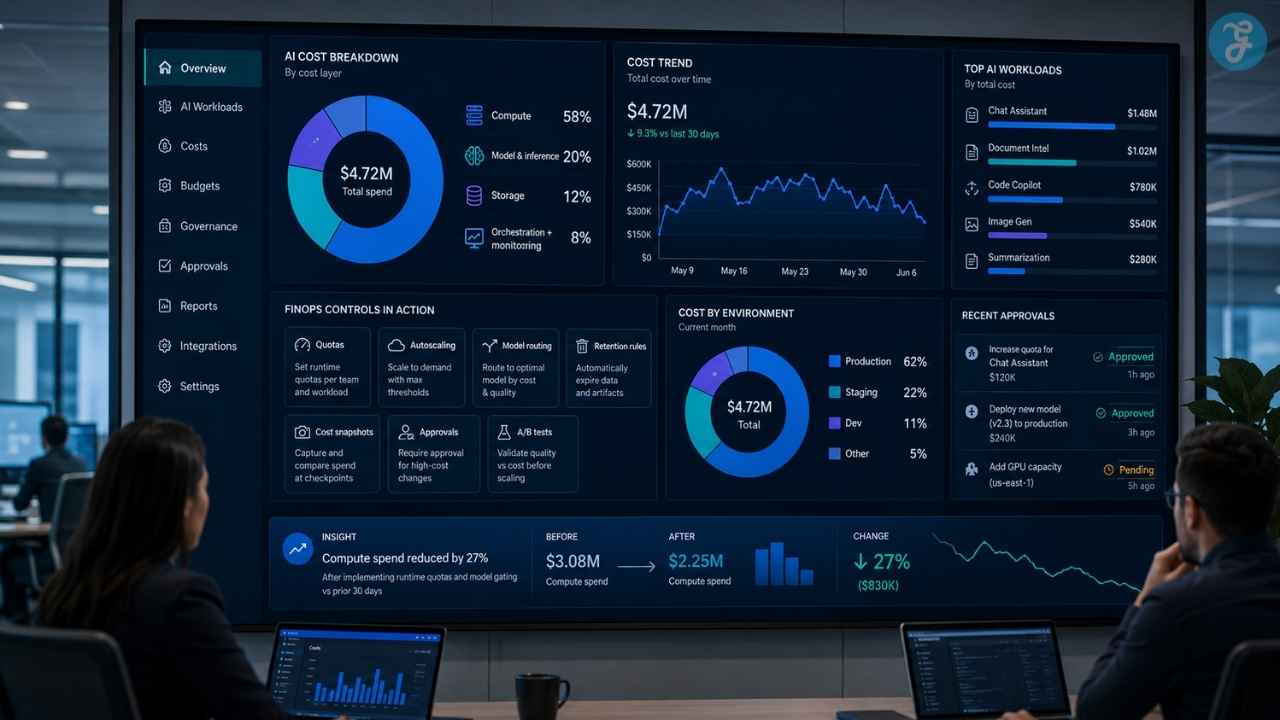
Every serious agentic AI program becomes a finance conversation sooner than most teams expect. Model calls, retrieval, orchestration, monitoring, storage, and retries all add up fast.
As of 2026, the FinOps Foundation says 98% of FinOps teams now manage AI spend, which tells me this is no longer a niche concern. Gartner, by contrast, said in March 2026 that only 44% of organizations had adopted financial guardrails or AI FinOPs practices, which helps explain why good pilots can still become bad business cases.
Monitoring AI resource usage and optimizing spending efficiency
A simple Kubecost breakdown shows why tagging alone is not enough for 24/7 agent fleets. In one contact center summarization cluster, compute drove 58% of monthly cost, followed by inference model licensing at 20%, storage at 12%, and orchestration plus monitoring at 8%.
After I applied runtime quotas and model gating, simulated monthly compute spend fell 27% without destabilizing peak service levels. That is why I treat quotas as operating controls, not finance cleanup.
| Cost Layer | What to Watch | Action That Usually Works |
|---|---|---|
| Compute | Idle nodes, oversized clusters, runaway concurrency | Apply quotas, autoscaling rules, and time-based shutdown policies |
| Model and inference | High-cost model overuse, repeated retries, low-value prompts | Route simple work to smaller models and reserve premium models for hard cases |
| Storage and retrieval | Unused embeddings, duplicate indexes, stale documents | Set retention rules and rebuild indexes only when content actually changes |
| Monitoring and orchestration | Noisy probes, excess logging, duplicate observability streams | Keep the signals that change decisions and cut the rest |
- Set a baseline for usage by team, workflow, and agent so finance can see spend in business terms.
- Track useful work per dollar, not just token volume, because a cheap agent that creates rework is still expensive.
- Run daily cost snapshots from cloud billing exports, Prometheus, Grafana, and chargeback reports so spikes get caught early.
- Require approval for high-cost models, long-running jobs, and broad autonomous operations in production.
- Use A/B tests to compare decision uplift against cost, then retire agents that look impressive but do not improve outcomes.
- Push FinOps left into development, because the FinOps Foundation now highlights proactive guardrails in pull requests and deployment flows as a key pattern for AI cost control.
I want finance, engineering, and operations looking at the same dashboard. Once that happens, budget conversations get easier, and teams can scale enterprise automation with fewer surprises.
Final Thoughts
These five priorities, ROI, governance, data integration, human-agent collaboration, and FinOps, are the foundation I trust most for agentic AI. They also make generative AI far more useful inside enterprise operations, because they turn scattered experiments into governed, measurable workflows.
Start with one process that has clear economics, tight data boundaries, and a named owner. Measure the outcome, harden the controls, and scale only what proves value. That is how I see enterprise leaders move from pilot fatigue to real agentic AI adoption, with better operational resilience and far less noise.
FAQs About Enterprise Agentic AI Priorities
1. What are the top priorities for enterprise agentic AI?
Set strong governance and data privacy rules first, they reduce legal and reputational risk. Add security, monitoring, and human oversight, and plan for scalability, integration, continuous learning, and clear ROI.
2. How do enterprises measure success for agentic AI?
Track task accuracy, cost savings, time saved, and business impact, use uptime and error rate as hard metrics, and if you use large language models, add checks for wrong outputs.
3. How do we manage risks from agentic AI?
Limit access, log actions, and run audits to catch bad behavior. Monitor for bias and drift, fix issues fast. Keep humans ready to step in, with rollback plans and clear review rules.
4. How should enterprises roll out agentic AI?
Start with a small pilot in one workflow, learn fast, and expand what works. Tie the agents into existing data, ops, and teams, and budget for ongoing monitoring, updates, and support.