
I did not first notice the AI slop problem through an absurd image or a spectacular chatbot hallucination. I noticed it while researching and editing online editorial content.
I would open several articles about the same subject and find different headlines, different introductions, and slightly different wording. Yet underneath, the pages were doing almost identical work. They repeated the same examples, reached the same safe conclusions, and often relied on claims that became difficult to trace once I started looking for the original source.
At first, I treated this as a writing problem. I assumed the drafts needed better prompts, stronger editing, or a more natural tone. Sometimes they did. But after working through enough of them, I began to see a deeper problem. The sentences were not always the weak part. The missing part was the work that should have happened before the sentences were written.
Nobody had tested the product, or spoken to a source, or checked whether the study really supported the statistic, or even asked whether the article contributed anything that was not already available elsewhere.
Editing could improve the language. It could not create original evidence that had never been gathered. That is how I now understand the AI slop problem. It is not simply bad machine writing. It is polished material produced without enough research, judgment, context, or responsibility behind it.
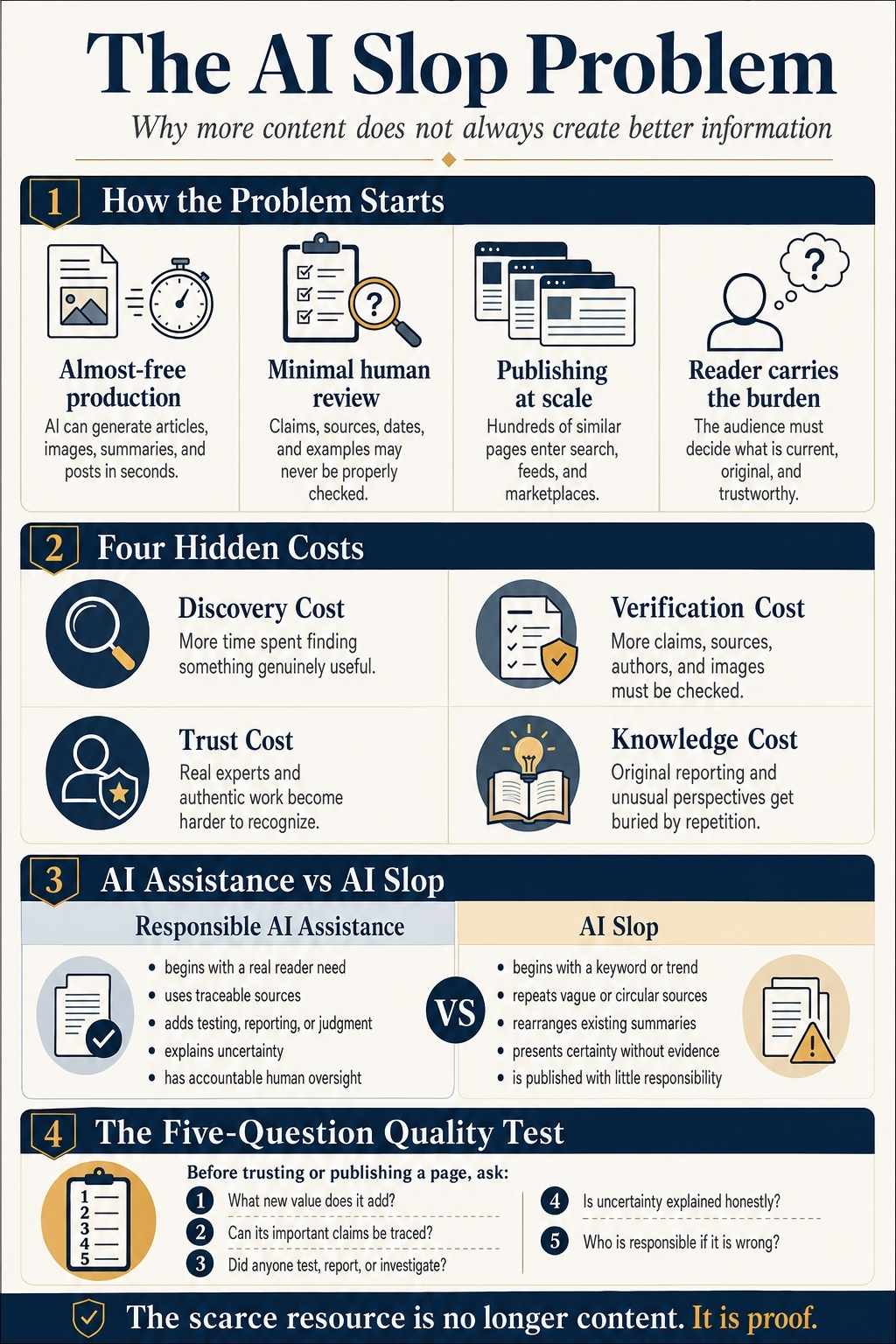
I Used to Think Faster Content Production Was Mostly a Benefit
The attraction of AI-assisted writing is obvious when you work with content regularly. A rough structure can appear in seconds. Research notes can be sorted quickly. A difficult paragraph can be reorganized. Several headline approaches can be compared without spending an hour staring at an empty document.
I still find those uses valuable. AI can reduce some of the mechanical work around writing. It can help identify gaps, summarize a document for closer review, translate material, suggest questions, or show where an explanation has become confusing.
The mistake is treating that initial output as the finished intellectual product. The faster the first draft arrived, the easier it became to assume the difficult part was over. In practice, the difficult part often started after generation.
I still had to check the dates. I still had to locate the original research. I still had to work out whether the example was real, current, and relevant. I still had to decide what the article was actually trying to say. AI had accelerated production. It had not removed editorial responsibility.
The First Warning Sign Was Repetition
The clearest sign was not factual error. It was sameness. I kept finding pages that appeared independent but felt as though they had been assembled from the same invisible template. They opened with a broad problem, listed familiar points, added a balanced warning, and ended with nearly identical advice.
Nothing on the page was necessarily outrageous. That made the problem harder to describe. The articles were readable. Some were technically accurate. But after opening several of them, I had learned almost nothing that the first page had not already told me.
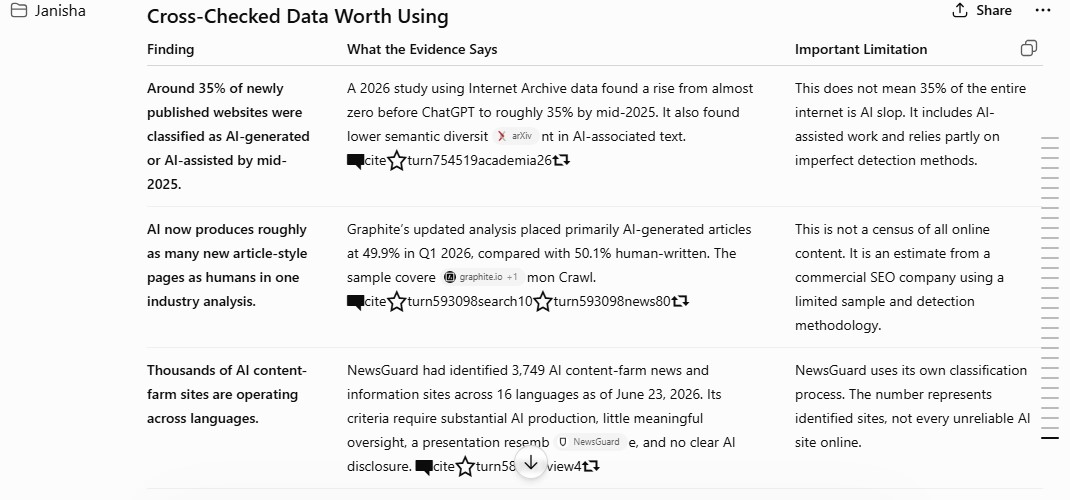
A 2026 preprint examining websites archived between 2022 and 2025 found a similar pattern at a much larger scale. The researchers estimated that roughly 35% of newly published websites by mid-2025 were classified as AI-generated or AI-assisted. They also found a relationship between greater AI involvement and lower semantic diversity, alongside more positive sentiment. However, they did not find statistically significant evidence that the sampled AI-associated content had reduced factual accuracy or stylistic diversity.
That distinction matched what I had been seeing. The immediate problem was not always a web full of obvious lies. It was a web becoming more repetitive, more predictable, and less useful despite containing more material. Many pages. Fewer genuinely different ideas.
What I Mean When I Call Something AI Slop
The word “slop” can sound dismissive, so it helps to be precise.
Merriam-Webster selected “slop” as its 2025 Word of the Year and defined the newer usage as low-quality digital content produced, usually in quantity, through artificial intelligence.
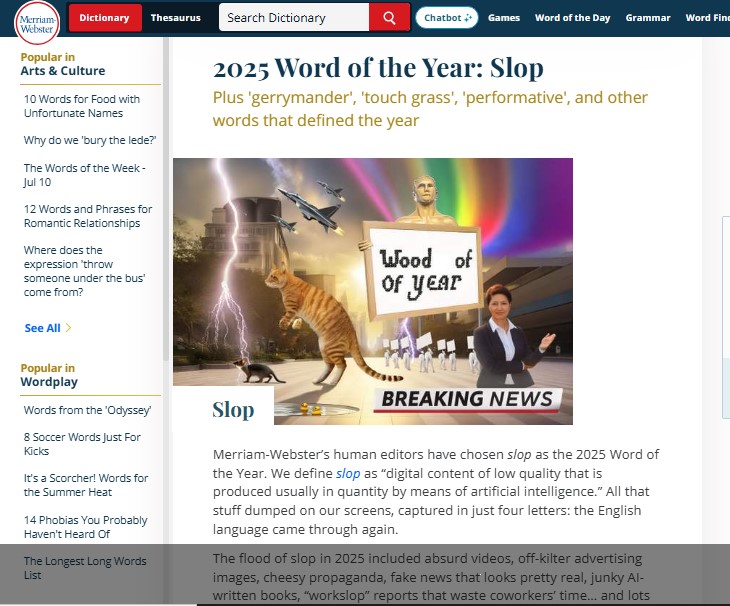
That describes the outcome, but in content work I find the process just as important.
I tend to recognize AI slop when several things happen together:
- The content looks finished before anyone has done meaningful research.
- The sources are vague, circular, or several steps removed from the original evidence.
- The examples sound plausible but contain no details that suggest real experience.
- The article answers a search query without adding reporting, testing, judgment, or a clearer explanation.
- Nobody appears willing to take responsibility for correcting it later.
- The page exists because it was inexpensive to produce, not because the reader genuinely needed it.
Not everything made with AI belongs in that category. A writer may use AI to organize notes and still produce an excellent article. A researcher may use it to compare structures while checking every source personally. A non-native English writer may use language tools to express an original argument more clearly.
The question is not whether AI touched the work. The question is what the human being contributed after, before, and around it.
One Statistic Taught Me How Easily Even an AI Slop Article Can Become Slop
While researching this subject, I found several dramatic figures about how much of the internet is now written by AI. The temptation was to choose the largest one and use it in the headline.
That would have made the article more dramatic. It also would have repeated the exact behavior the article was criticizing. The figures came from different samples, definitions, detectors, and periods. They could not be treated as interchangeable.
For example, the 2026 Internet Archive study estimated that about 35% of newly published websites by mid-2025 were AI-generated or AI-assisted. That is a model-based estimate derived partly from AI detection, not a direct count of every new website online.
Graphite reported that 49.9% of the English-language articles in its Common Crawl sample were classified as primarily AI-generated during the first quarter of 2026. Its study covered 55,400 URLs and averaged results from three detectors. The company also acknowledged limitations around mixed human-AI workflows and detection accuracy.
Those findings are useful, but they measure different things. One concerns newly published websites and includes AI assistance. The other concerns article-style pages classified as primarily AI-generated. Neither is a complete census of the internet.
This was a small but useful reminder: repeating a statistic is easy. Understanding what it measures takes longer. That gap between repetition and understanding sits at the center of the AI slop problem.
The Scale Is Real Even When the Exact Number Is Debatable
The imperfect nature of the measurements does not mean the trend can be ignored. Graphite’s analysis found that primarily AI-generated articles rose sharply after ChatGPT’s launch and then stabilized near half of its sampled article output.
NewsGuard’s tracker, updated June 23, 2026, had identified 3,749 AI content-farm news and information sites operating across 16 languages. Its criteria require substantial AI production, little meaningful human oversight, presentation that resembles a normal news site, and no clear disclosure of the automation. NewsGuard also notes that many such sites rely on programmatic advertising, which creates an economic incentive to continue producing them.
That number is not the total population of unreliable AI sites. It is the number NewsGuard had identified under its own criteria.
Still, the broader direction is hard to miss. Cheap synthetic publishing is no longer a small experiment. It has become a repeatable operating model.
A Polished Draft Can Leave the Editor With Most of the Work
One of the more frustrating lessons from editing AI-assisted material is that polish can be misleading.
A generated article may arrive with:
- An engaging introduction
- Logical headings
- Smooth transitions
- Examples
- A comparison section
- A conclusion
- Frequently asked questions
At first glance, it feels nearly complete. Then the checking begins.
The statistic in the introduction comes from another blog that cites no source. The product feature has changed. The “expert advice” is a generic summary rather than a named expert’s view. The example is hypothetical but written as though it happened. The conclusion sounds confident even though the available evidence is mixed.
The draft was quick. Repairing it is not. In some cases, starting with the sources would have been faster than trying to rescue a fully generated article whose structure concealed weak foundations.
That changed the order in which I review content. I no longer begin by asking whether the writing flows well. I begin with the claims that could cause the most damage if they are wrong: numbers, dates, quotations, legal rules, medical statements, product features, and claims about what research supposedly proves. Grammar can wait. False authority cannot.
Verification Has Become the Real Bottleneck
Generating text is no longer the slowest part of online publishing. Verification is.
Someone still has to read the study rather than copy its abstract from another website. Someone has to check when the policy changed. Someone has to open the software and confirm that the instructions match the current interface.
That work remains slow because it involves judgment. It is also where low-quality publishers save the most money.
When verification is skipped, the cost does not disappear. It moves to the reader. The reader must decide whether the author exists, whether the examples are genuine, whether the review reflects actual use, and whether the source supports the conclusion.
I have found that this is where the promised efficiency of automated content can become misleading. A publisher may save time producing a page, while every person who opens it spends extra time deciding whether it can be trusted. The productivity gain belongs to the producer. The verification burden belongs to everyone else.
More Pages Did Not Help Me Find Better Answers
One of the clearest problems appears when searching for practical information. Suppose a software interface changes. Several publishers create updated-looking articles about the task, but those articles are built from older pages rather than fresh testing. The dates are recent. The screenshots are absent. The menu path no longer exists.
The reader opens one result after another and encounters the same obsolete instruction. In that situation, publishing more pages has not created more knowledge. It has multiplied the obstruction between the reader and the answer.
The same pattern appears in product recommendations, travel guides, legal explainers, health content, and technical troubleshooting. A page counts as new content because it has a new URL. That does not mean it contains a new observation. This changed the question I ask before approving an article: What does this page contribute that the existing results do not?
A different introduction is not enough. A longer word count is not enough. Rearranging the same public information is not enough unless the rearrangement genuinely makes a complicated issue easier to understand.
The Business Model Rewards the Wrong Kind of Efficiency
It would be convenient to blame the language models and stop there. The surrounding incentives matter just as much.
Search publishing has long encouraged companies to create pages around keyword variations. Social platforms reward regular output, engagement, and watch time. Advertising systems can monetize a page without requiring the advertiser to inspect it directly.
Generative AI did not create those incentives. It made acting on them cheaper.
NewsGuard’s current tracking work notes that many unreliable AI content farms rely on programmatic advertising and that automated advertising can unintentionally provide an economic incentive for creating more of them.
This helps explain why the problem continues even when audiences complain about poor AI content. If a page is cheap enough to produce, it may not need many readers to be profitable. The operation can survive through scale.
Telling publishers to “care more about quality” will not completely solve a system that pays for volume.
Google’s Policy Confirmed an Important Distinction
I do not find “AI content is bad” to be a useful editorial rule.
Google’s search policy takes a more sensible approach. It defines scaled content abuse as producing many pages mainly to manipulate rankings rather than help users. The policy applies regardless of whether those pages were made by people, automation, or a mixture of both. It specifically lists mass generation without added value as an example.
Google’s separate guidance says generative AI may help with research and structure, but producing many pages without adding value can violate its spam rules.
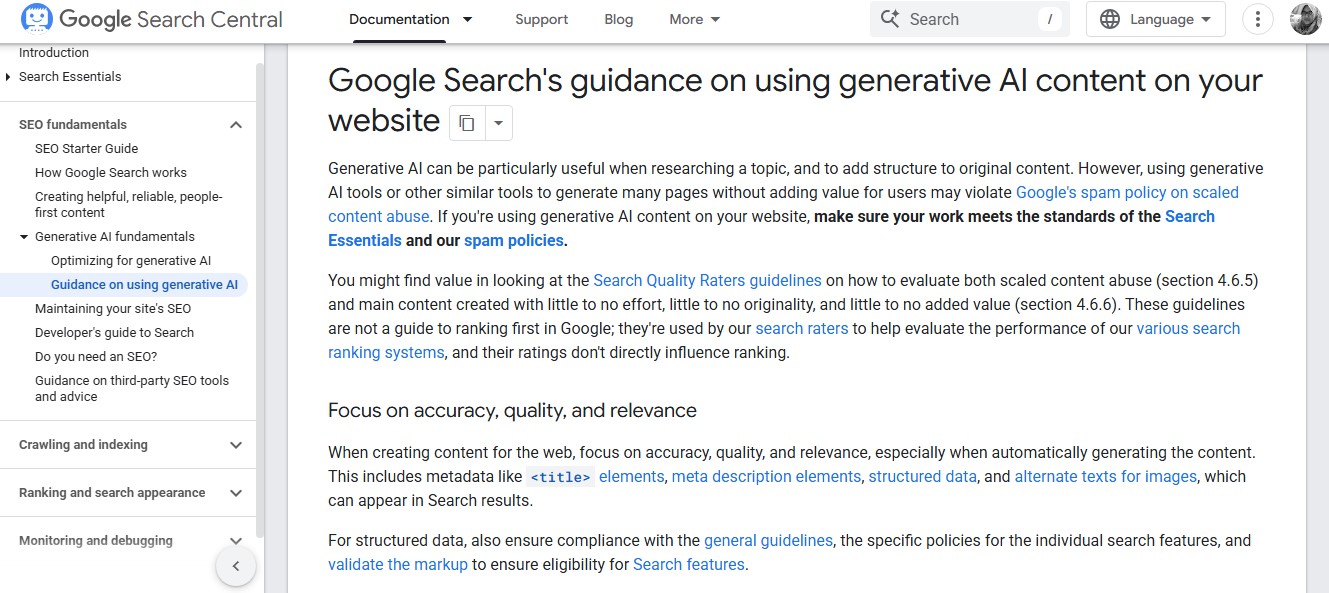
That reflects the distinction I now use in editorial work. I do not begin by asking whether AI was involved.
I ask:
- Did anyone add original value?
- Can the important claims be traced?
- Does the article reflect current reality?
- Is there a real author or editor behind it?
- Would the page still deserve to exist without the target keyword?
- Who will correct it when something changes?
A fully human-written article can fail every one of those tests. An AI-assisted article can pass them. Authorship method matters less than accountability.
The Trust Problem Reaches Beyond Bad AI Pages
The damage does not remain inside obvious content farms. The more synthetic reviews, images, quotes, and articles people encounter, the more suspicious they become of everything.
A genuine expert profile can look fabricated. A real photograph may be dismissed as generated. A firsthand article can be questioned because its structure resembles thousands of machine-produced posts.
This creates an uncomfortable situation for careful publishers. They must spend more time proving that ordinary editorial work actually happened.
Bylines, methodology notes, original photographs, revision histories, source trails, and correction policies become more important. That may be good for publishing standards. It is also a sign that trust has become harder to establish.
The 2026 Internet Archive study raised a related concern. Although it did not find a measurable decline in factual accuracy across its sample, its authors suggested that the growing difficulty of distinguishing human and AI writing may cause people to discount the credibility of online information more broadly.
The result may not be that readers believe every falsehood. They may simply become less willing to believe anything.
Repetition Can Reduce Information Quality Without Creating a Clear Fact-Check
One reason AI slop is difficult to regulate is that much of it does not contain one obvious false statement. The damage may come through narrowing.
The same familiar examples are selected because they are statistically common. The same moderate conclusions appear because they are unlikely to offend. Local knowledge, unusual perspectives, awkward contradictions, and minority experiences receive less attention.
The Internet Archive study found that AI-associated websites showed greater semantic similarity than non-AI sites in its sample. It described the broader pattern as semantic contraction rather than a proven explosion of misinformation. That description feels accurate to what I see in many generated drafts.
They are often competent in the middle of the distribution. They can summarize what is commonly said. They struggle to contribute the detail that comes from having tested, witnessed, investigated, or thought deeply about something.
The result is not necessarily wrong. It is often ordinary to the point of uselessness.
AI Detectors Do Not Answer the Question I Actually Care About
It is tempting to solve the problem with detection. In practice, a clean division between human and AI writing is difficult. One article may be fully generated. Another may begin with human reporting and use AI only for copyediting. A third may contain machine-written sections that an editor has substantially rebuilt.
Detection tools also make mistakes. Research has found that some detectors can misclassify writing by non-native English speakers, raising serious fairness concerns when detector scores are treated as proof.
But the larger issue is simpler. Even a perfect detector would tell me where the wording may have come from. It would not tell me whether the facts were checked, whether the author understood the subject, or whether the page helped anyone.
I care more about the evidence trail than the detector score. A shallow article does not become valuable because a human wrote it manually.
I Have Not Rejected AI Assistance
Working through this issue has not convinced me to stop using AI. That would ignore the genuine benefits.
A controlled experiment published in Science found that participants using AI writing assistance like ChatGPT, Gemini, or Claude for specific professional writing tasks completed them about 40% faster, while independent evaluators rated their output quality about 18% higher on average. The study covered a limited group of writing tasks, so it should not be generalized to every kind of research, journalism, or creative work. Still, it reflects why these tools are attractive.
AI can help with:
- Sorting notes
- Comparing structures
- Identifying missing questions
- Translating text for review
- Reducing repetitive formatting
- Testing alternative explanations
- Showing where a paragraph is unclear
I use those strengths as support. I become cautious when the tool is asked to supply authority it does not possess: firsthand experience, verified facts, expert judgment, original reporting, or accountability. The tool can suggest where to look. It cannot honestly claim that it went there.
The Difference I Now See Between Assistance and Slop
The distinction is not complicated. Useful AI-assisted content still contains visible human work. Someone selected the sources, checked the claims, made the judgment, removed unsupported material, and accepted responsibility for the result.
Slop tries to hide the absence of that work behind fluency. A practical comparison looks like this:
| Responsible AI-Assisted Content | AI Slop |
| Begins with a real reader problem | Begins because a keyword or trend exists |
| Uses traceable evidence | Uses vague or circular sourcing |
| Adds testing, reporting, experience, or analysis | Rearranges existing summaries |
| Explains uncertainty | Smooths uncertainty away |
| Has an accountable author or editor | Offers little visible responsibility |
| Is reviewed before publication | Is uploaded with minimal checking |
| Is updated when facts change | Is published and abandoned |
| Uses generated text as material | Treats generated text as finished work |
The useful side still requires time. That is the part advocates of fully automated publishing often leave out.
What I Changed in My Content Workflow
The most useful outcome of studying the AI slop problem was not a stronger opinion about AI. It was a stricter editorial process.
I begin with sources, not a generated draft
For research-heavy subjects, I collect the strongest original material before asking AI to organize anything. This prevents a polished draft from deciding the argument before I understand the evidence.
I verify precise claims first
Dates, percentages, legal rules, quotations, product capabilities, medical claims, and study findings receive priority. These details create authority quickly. They can also cause the most harm when they are wrong.
I check whether several pages are repeating one source
Ten websites do not equal ten confirmations when all ten copied the same unsupported claim. I try to follow important statements back to their earliest reliable source.
I ask what the article adds
The answer cannot simply be “more words” or “a cleaner structure.” A worthwhile page should offer clearer reasoning, updated evidence, firsthand experience, testing, stronger synthesis, or a useful decision framework.
I do not invent experience to improve E-E-A-T
This matters more now that firsthand knowledge has become a valuable search and trust signal.
If a product was not tested, the article should not imply that it was. If nobody visited the location, the writing should not sound like a travel diary. If no interview occurred, a generated quotation does not become acceptable because it sounds realistic. False experience is still false information.
I treat publication as the start of responsibility
Articles need updates, corrections, and ownership. A page that nobody plans to maintain should be written with that limitation in mind, especially when the subject changes quickly.
Synthetic Content May Also Matter to Future AI Systems
The slop problem may not end with today’s readers.
A 2024 study in Nature examined what can happen when generations of AI models are trained indiscriminately on material produced by earlier models. The researchers described “model collapse,” in which less common parts of the original data distribution disappear and later systems represent the underlying reality less accurately.
This should not be exaggerated. The study does not show that every AI-generated article damages the next model. Carefully designed synthetic data can be useful. Other research also suggests outcomes depend heavily on how real and synthetic data are mixed and managed.
The more careful conclusion is that original human data remains valuable. If the public web contains increasing amounts of unlabelled machine-generated material, future dataset builders will have to work harder to separate direct human knowledge from synthetic repetition.
Reporting, documentation, specialist writing, local history, minority language material, and firsthand accounts may become more valuable precisely because they cannot be recreated by repeatedly summarizing the same existing pages.
How I Now Judge Whether a Page Deserves Trust
I do not rely on one sign. Instead, I look for evidence that real editorial work happened.
I trust a page more when:
- Important claims link to original or authoritative sources
- The author is identifiable
- Examples include specific, relevant detail
- Uncertainty is admitted where the evidence is limited
- The publication explains how products or services were tested
- The article has a meaningful update date
- Errors can be corrected through a visible process
- The conclusion reflects the evidence rather than forcing certainty
I become cautious when an article contains many sections but no real evidence, mentions unnamed research, gives advice that could apply to almost anything, or appears nearly identical to several other results.
None of these clues proves AI involvement. They reveal whether the publisher has earned confidence.
More Content Stopped Looking Like Progress
Before generative AI became part of everyday content work, producing an article required enough effort that publication itself felt like an achievement. That is no longer a useful standard.
The ability to create a page has become ordinary. Deciding whether that page should exist is now more important.
Working with AI-assisted content has made me more interested in restraint. Sometimes the best editorial decision is to combine several thin ideas into one useful guide. Sometimes it is to delay publication until the evidence is strong enough. Sometimes it is to remove a claim that cannot be verified, even when that claim would make the headline more attractive.
The AI slop problem is not proof that machines should never help people write. It is proof that production was never the only work involved in creating reliable information.
Research still matters. Testing still matters. Context still matters. Judgment still matters. Someone still has to be responsible when the answer is wrong. AI can help me reach a draft faster. It cannot decide whether the draft has earned the reader’s time.
Frequently Asked Questions About the AI Slop Problem
1. What is the AI slop problem?
The AI slop problem is the rapid growth of low-value digital material produced with generative AI and published with little research, verification, originality, or oversight. The problem is not simply machine involvement; it is automation without enough human responsibility.
2. Is all AI-assisted writing AI slop?
No. AI can help with structure, editing, translation, research organization, and other supporting tasks. The work becomes slop when generated output replaces evidence, expertise, checking, and accountability.
3. How can AI slop be accurate but still harmful?
A page may avoid clear factual mistakes while repeating familiar information, removing nuance, wasting readers’ time, and crowding out original reporting or experience. Information quality involves usefulness and context, not only the absence of falsehoods.
4. Can AI detectors reliably identify slop?
AI detectors may help in limited investigations, but they do not measure quality, evidence, or usefulness. They can also misclassify human writing, including work by non-native English speakers.
5. How does Google treat mass-produced AI content?
Google targets scaled content created mainly to manipulate rankings and add little or no value. Its policy applies regardless of whether the pages were created by humans, AI, or a combination of both.
6. How can publishers avoid producing AI slop?
They should begin with a real reader need, use reliable sources, verify important claims, add original experience or analysis where available, keep human editorial responsibility visible, and avoid treating generated drafts as finished work.