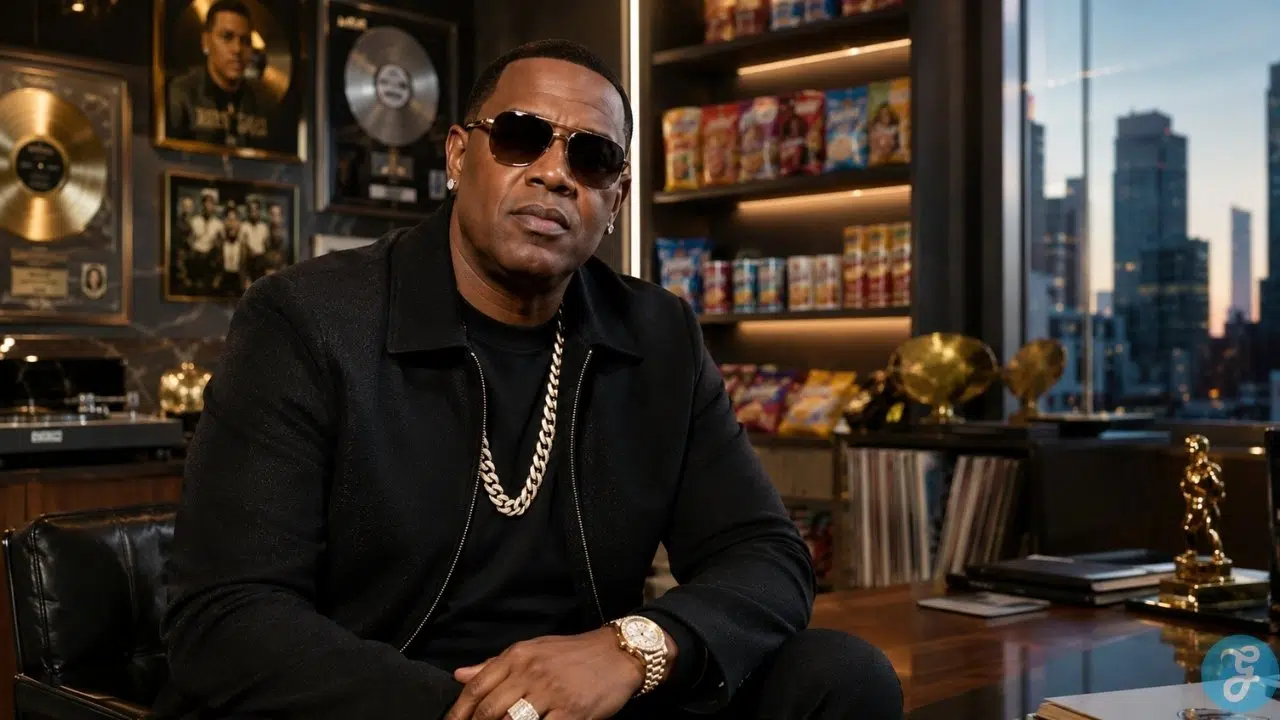
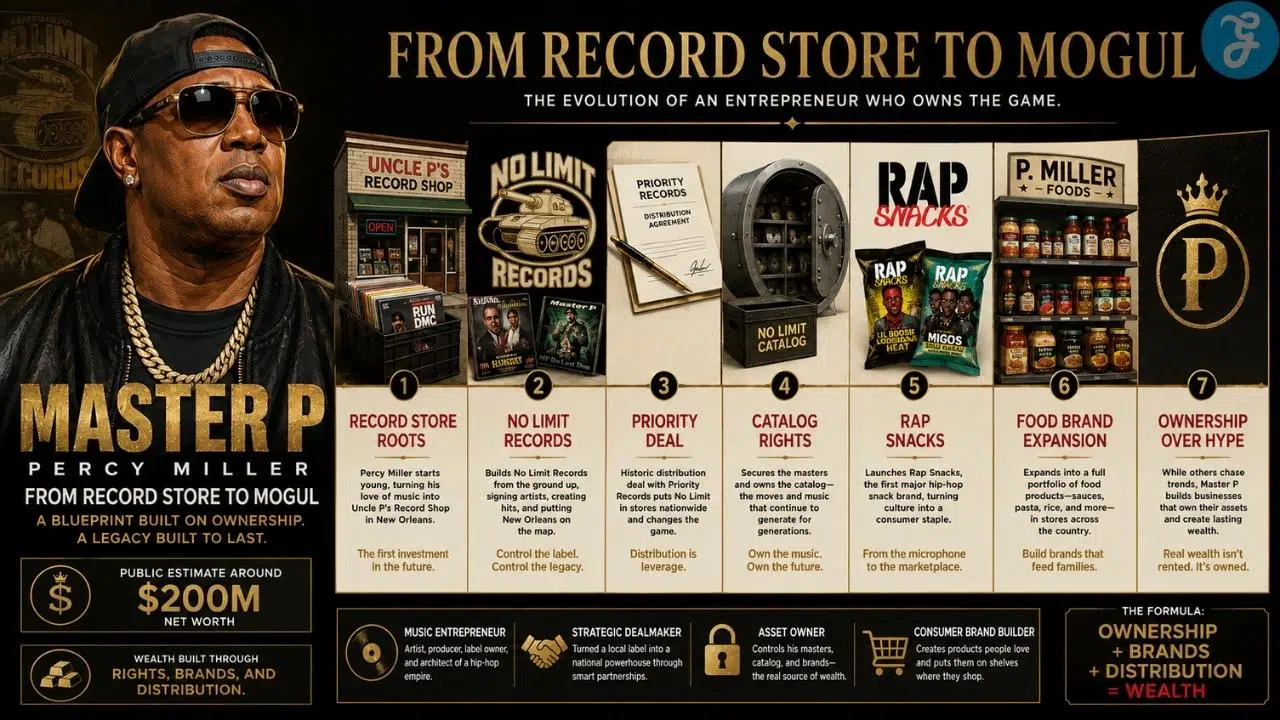
Search for Master P net worth and the internet gives you a clean answer almost too quickly: around $200 million. That number gives readers a useful starting point, but it does not explain why Percy “Master P” Miller still gets studied as one of hip-hop’s most important business minds decades after No Limit Records peaked.
A rapper can get rich from hits. Master P got rich from structure.
He started with a record store before he became a rap mogul. He learned what buyers picked up, what covers caught the eye, what regional artists moved units, and how demand worked before streaming dashboards made that kind of data fashionable. When the music industry finally came calling, he did not simply ask for a bigger check. He pushed for masters, distribution control, and backend leverage.
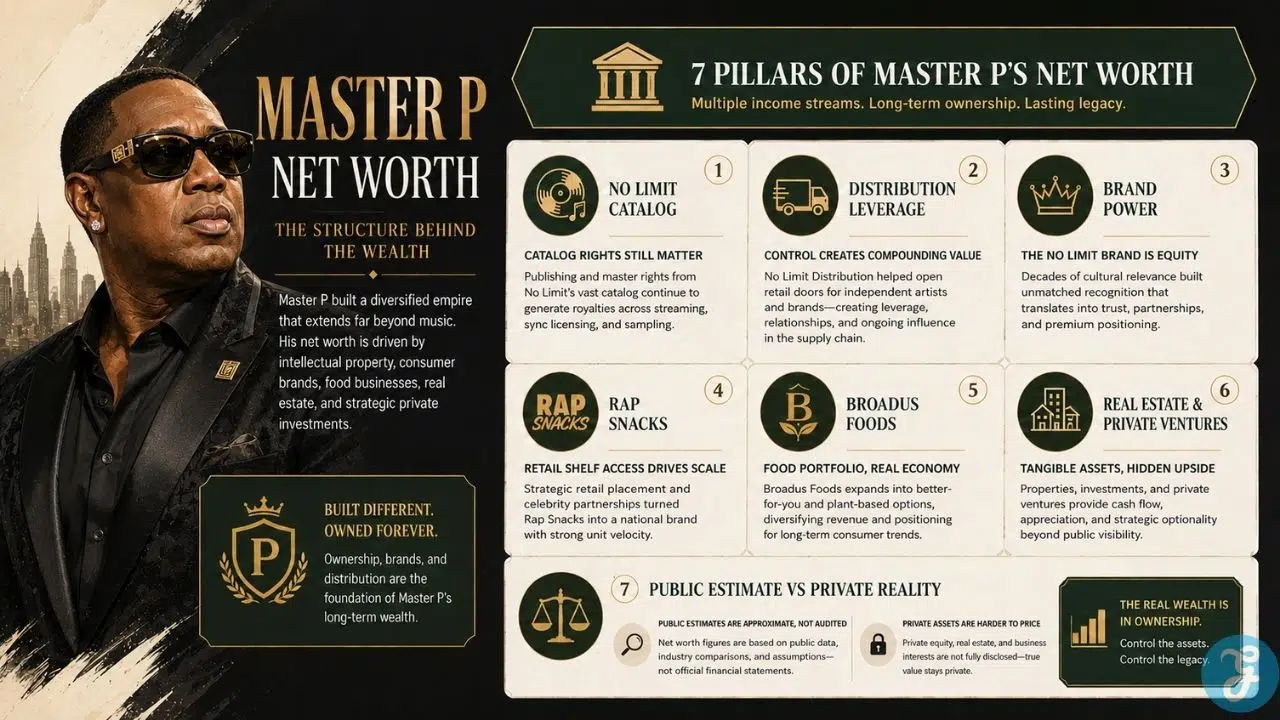
That is why the Master P net worth conversation needs more than a recycled celebrity estimate. His money story sits across several lanes: music ownership, record distribution, film, sports management, real estate, food products, brand partnerships, and private business ventures that outsiders cannot price perfectly.
The number matters. The machinery behind the number matters more.
Why Master P Net Worth Needs More Than a Simple Number
Most public estimates place Master P net worth near $200 million. That figure works as a broad marker, not an audited personal balance sheet.
Celebrity wealth estimates usually rely on visible signals: old earnings, public business activity, property claims, lawsuits, interviews, catalog assumptions, and reported deals. They rarely reveal tax exposure, debt, private-company equity splits, family ownership structures, or how much cash someone can access on short notice.
That caveat matters with Master P because his strongest assets are not all sitting in public view. A public company leaves a clean trail. A private snack brand does not. A sports contract can be read from announced numbers. A royalty stream from a legacy catalog is harder to judge without actual statements. A celebrity may say “ownership,” but the public still does not know whether that means majority control, licensing income, advisory equity, or a smaller promotional stake.
The $200 million estimate puts Master P in the mogul tier. It does not fully explain how he got there, why he stayed there, or why his model still gets compared with later hip-hop entrepreneurs.
So the better question is not only “how much is Master P worth?” The better question is, what did he own that most artists did not?
Quick Facts: Master P Net Worth at a Glance
| Question | Quick answer |
|---|---|
| Estimated net worth | Around $200 million |
| Main wealth source | No Limit Records, catalog rights, business ownership, consumer products, real estate, film, and private ventures |
| Biggest public earning year | Forbes listed Master P at $56.5 million in 1998 |
| Historic asset claim | Divorce filings in 2014 estimated community assets at about $178.7 million |
| Peak wealth claims | Older reports and filings have floated figures near $350 million, but those are not the same as current audited net worth |
| Most important business lesson | Master P made his real money by owning assets, not just performing |
| Best known business moves | No Limit Records, Priority distribution deal, No Limit Films, No Limit Sports, Rap Snacks, Broadus Foods |
The Record Store That Taught Him the Business Before the Business Knew Him
Master P’s origin story starts with a $10,000 settlement tied to his grandfather’s death. Many profiles mention that detail, then race straight to No Limit Records. That skips the most important part: he used the money to open a record store.
No Limit Records and Tapes in Richmond, California, gave him a different education from the one a young rapper gets in a studio.
A studio teaches an artist how to make songs, handle ego, find producers, build confidence, and chase a sound. A record store is colder and more useful if you are paying attention. You watch people spend money. You notice which covers they stop for, which regional artists they ask about, which tapes move without radio, and which heavily promoted releases die quietly on the shelf.
Master P was not just dreaming behind the counter. He was watching demand reveal itself.
That early retail experience shaped everything after it. When he started pressing and selling his own music, he already knew that street-level demand did not always match what major labels thought was marketable. He understood that the person closest to the buyer often owned the least, and he did not want to stay in that position.
That is the root of his business style: watch the buyer, own the product, control the route, repeat.
How the Priority Deal Changed the Math
The Priority Records deal remains the center of Master P’s financial legend because it gave No Limit a structure most artists did not have.
The widely reported version is that No Limit retained ownership of its masters while Priority handled manufacturing and distribution for a smaller cut. The famous shorthand is an 85/15 split, with No Limit keeping 85% and Priority taking 15%.
The exact contract language is private, but the broad point is well established: Master P did not come to Priority like an artist begging to be discovered. He had leverage. He had regional demand. He had product movement. He had a label identity. Priority gave him a bigger pipe, not a new personality.
That mattered because standard major-label deals often worked very differently. An artist might get a flashy advance, expensive videos, and national marketing, but then face recoupment, royalty deductions, and loss of master ownership. A rapper could look rich in a magazine while the real asset sat with the label.
Master P pushed toward the asset.
He was chasing ownership while many artists were still running after quick advance checks. Instead of begging major labels for shelf space forever, he focused on distribution loops, product control, and backend rights before much of the industry understood how powerful that could be.
The priority deal did not just make him money. It changed what he was selling. He was not only moving records anymore; he was keeping a bigger piece of the machine that moved them.
The 1998 Peak: The Year the Model Proved Itself
The cleanest historical financial anchor in the Master P net worth story is 1998.
Forbes listed Master P at $56.5 million in earnings that year, placing him among America’s top-paid entertainers. That number matters because it gives the ownership story hard weight. This was not just motivational talk about independence. It was a business model producing elite entertainment money.
No Limit’s peak came from several forces hitting at once:
- Master P had a favorable distribution structure.
- No Limit released music at a relentless pace.
- The label’s visual identity was instantly recognizable.
- CD sales were still powerful.
- Fans treated No Limit like a universe, not just a roster.
- The company used every release to promote the next one.
That last point is easy to underestimate. No Limit albums often worked like catalogs. A fan who bought one CD saw upcoming releases, cover art, dates, and roster links inside the booklet. The current product sold the next product. It was direct marketing before the internet made that language boring.
No Limit’s business did not look polished in the traditional corporate sense. It looked loud, crowded, fast, and almost ridiculous. But in physical retail, loud can work. The tank logo, Pen & Pixel covers, constant releases, and roster crossover created a shelf presence that felt impossible to ignore.
In 1998, that machine was not theory. It was Forbes-level money.
Why No Limit Was More Than a Record Label
A lot of articles reduce Master P’s late-90s empire to No Limit Records, but the more important story is how quickly he tried to stretch the brand beyond music.
By the late 1990s, No Limit was not only a rap label. It had become a broader business experiment with film, clothing, sports representation, property, travel, retail, and other ventures attached to the brand. Some of those ideas worked better than others. Some now look ahead of their time. Some look messy. All of them show the same instinct: use music as the launchpad, then move into products and services where the audience can follow.
This middle era matters because it proves the core thesis. Master P did not wait until the 2020s to think beyond rap. He was already trying to build an ecosystem when many artists were still celebrating a big advance as the finish line.
No Limit Films
No Limit Films was one of the clearest examples. Master P understood that his audience did not only want records. They wanted the world around those records. Films like I’m Bout It and I Got the Hook-Up extended the No Limit brand into visual storytelling, comedy, street narratives, and direct fan monetization.
The films were not trying to win over arthouse critics. They were built for the audience No Limit already had.
That was the point. Master P saw that a fan base could be moved from CD shelves to video shelves and theater seats. The production quality could be rough, but the business logic was sharp: keep creating owned or controlled products for the same audience before someone else sells to them first.
No Limit Clothing and Merchandise
Clothing was another obvious extension. A music brand with a strong logo, loyal fans, and a recognizable identity can become wearable. No Limit’s tank logo was not subtle, which made it useful. Fans could signal affiliation without explaining anything.
This matters because merchandise income often gives artists better margins than music royalties. Master P was not the first musician to understand that, but he acted on it early and aggressively.
Real Estate and Property Claims
Master P has long been linked with real estate and property management. Public reporting has mentioned PM Properties and extensive holdings, though the exact current values, debt positions, and ownership structures are not fully public.
Real estate fits the pattern because it is less dependent on public attention. Music money can spike and fade. Property, if bought well and managed properly, can produce rental income, appreciation, leverage, or security. That does not mean every reported property claim should be accepted blindly. It does mean real estate belongs in the financial architecture.
No Limit Sports and the Ricky Williams Lesson
No Limit Sports is the messy part of the middle era, and it should not be skipped.
Master P’s agency represented NFL running back Ricky Williams, whose rookie contract with the New Orleans Saints became infamous because of its incentive-heavy structure. On paper, the deal had huge upside. In practice, it gave Williams far less guaranteed money than expected for a top draft pick and later became a cautionary tale about celebrity-led sports representation.
That episode matters because it shows both sides of Master P’s ambition. He was early in seeing that hip-hop business figures could move into sports management, years before artist-led sports agencies became normal. But the execution exposed the limits of charisma, brand power, and outsider disruption when specialized contract expertise is required.
It was not a clean win. It was still part of the larger experiment.
Why the Divorce Filings Matter as a Financial Anchor
The 2014 divorce filings between Master P and Sonya Miller gave the public one of the rare glimpses into the scale of assets being claimed around his fortune.
TMZ reported that Sonya Miller’s legal filings estimated community assets at $178,743,300, including claims around properties, cars, companies, and business interests. Other older reports and celebrity-finance discussions have floated a $350 million peak wealth figure around that era.
These figures need careful handling. Divorce filings are not the same as audited net worth. One side may present values in a way that supports its legal position. Asset claims may include businesses, property, disputed ownership, estimated values, and illiquid holdings. The number can be useful without being final.
Still, the filings matter because they support one thing: Master P’s wealth was not only theoretical internet hype. At minimum, the divorce case placed large asset claims into the public record and reinforced the idea that his fortune extended beyond music checks.
For readers trying to understand Master P net worth, the divorce filings serve as a rough historical marker. They do not prove his current net worth. They show that by the 2010s, the public legal conversation around his assets was already far larger than a normal retired rapper’s balance sheet.
Catalog Ownership Still Matters, But Exact Valuations Get Slippery
Standard internet valuation models often try to guess what the No Limit catalog is worth by inventing streaming numbers and slapping a generic multiplier on top. That is dressed-up guessing.
Without royalty statements, publishing splits, master-rights details, licensing history, and current streaming performance, nobody outside the business can produce a clean number.
The safer point is also the more useful one: Master P’s ownership-first model gave him more long-term upside than many artists from his era kept.
A catalog’s value depends on more than nostalgia. Buyers look at master ownership, publishing participation, streaming consistency, sync potential, legal clarity, licensing history, sample issues, and whether the music still carries cultural weight. A 1990s rap catalog with meaningful ownership can hold value in the streaming age, but exact value depends on real income, not vibes.
This is where Master P’s business model still earns respect without inflated math. If his rights position remains strong, or if he controls meaningful parts of the No Limit catalog, he sits in a better place than an artist whose old label owns the asset outright.
The catalog does not need to be secretly worth some wild number to matter. It only needs to be part of a broader asset base that kept working after CD sales faded.
Why Food Made Sense After Music
Master P’s move toward food and consumer products can feel random only if you separate it from the record-store years. Once you put those years back into the picture, it starts looking like the same instinct in a different aisle.
The difference is that music forces you to constantly fight for a slice of someone’s attention, while the food industry is all about embedding your product into their weekly grocery routine. A fan might buy an album once. A household might buy snacks again and again if the price, flavor, availability, and packaging all line up.
That does not make food easy. Grocery is brutal in its own quiet way. Margins can be thin. Retailers control space. Distributors matter. Manufacturing delays can wreck momentum. A product can be loved online and still fail if it cannot stay visible in stores. A celebrity name may spark curiosity, but curiosity does not automatically become a repeat purchase.
Still, the logic behind Master P’s move is clear. He understood packaging. He understood shelf behavior. He understood that culture could sell physical products if the customer felt seen. In the CD era, that meant album covers and booklets. In the snack aisle, it meant flavor names, rapper faces, and packaging that spoke directly to an audience giant food companies often tried to reach through expensive agency campaigns.
Rap Snacks and the Power of Cultural Shelf Space
Rap Snacks is one of the clearest examples of why Master P’s post-music business story still matters. Founded by James Lindsay and built around hip-hop branding, the company created a lane that major snack brands had not fully occupied. Artist faces, culturally specific flavors, and street-level recognition turned the bag itself into the advertisement.
Master P and Romeo Miller have been publicly associated with the brand, and Rap Snacks has appeared in major retail conversations and stores. That retail presence matters because it shows the product moved beyond novelty.
A novelty chip bag can get a laugh once. A real snack brand has to deal with restocking, pricing, distribution, buyers, margins, placement, and whether customers come back after the first impulse purchase.
The concept sounds obvious now because celebrity product lines are everywhere. It was less obvious when hip-hop branding still got treated like something outside mainstream consumer goods. Rap Snacks made the cultural signal part of the packaging. The artist was not just in a commercial. The artist helped sell from the shelf.
This is where a lot of net worth articles overreach. Rap Snacks is privately held, and private company equity splits are rarely disclosed. Master P’s exact take-home profit, ownership percentage, licensing income, advisory role, or revenue participation cannot be measured from the outside.
The brand still belongs in the Master P net worth conversation because it proves his retail instincts did not end with music. He kept chasing products that could live in ordinary buying habits, not just entertainment cycles.
Broadus Foods and the Modern Grocery Fight
Broadus Foods, the company connected to Snoop Dogg and Master P, adds a more current and complicated chapter.
The company launched breakfast products including Snoop Cereal and Momma Snoop items, with public messaging around family ownership, community impact, and building a minority-owned food company. The brand worked with Post Consumer Brands for manufacturing and distribution, then the relationship turned into a legal fight involving Post and Walmart.
Broadus Foods alleged in a 2024 lawsuit that Snoop Cereal was mishandled in retail, including claims that boxes were kept off shelves, shown as unavailable, placed in poor locations, or priced in ways that hurt the brand’s stated affordability goals. Walmart and Post disputed the allegations, pointing to other explanations such as demand, sales performance, and business terms.
Those claims belong in the allegation lane unless a legal outcome proves them.
The lawsuit matters because it exposes how brutal grocery can be for independent brands. The fight is not only about having a celebrity name on the box. It is about shelf placement, inventory coding, pricing, restocking, buyer support, and whether the product actually reaches the shopper. If the box sits in the wrong place or never makes it out of the backroom, the marketing story collapses before the customer even gets to decide.
For Master P’s broader wealth story, Broadus Foods shows the next problem after ownership. Owning the brand matters, but access decides whether ownership can turn into sales.
Master P Compared With Jay-Z, Dr. Dre, and Diddy
Master P is not the richest rapper in the world, and the article should not pretend he is. Jay-Z became hip-hop’s first billionaire and built a fortune across music, Roc Nation, liquor, art, real estate, streaming, and investments. Dr. Dre crossed into billionaire status largely because of Beats and his long entertainment career. Diddy, once one of hip-hop’s leading wealth figures, built much of his fortune through Bad Boy, Sean John, Ciroc, DeLeón, Revolt, and other ventures, though his current financial picture has changed under legal and business pressure.
That comparison helps put Master P in perspective.
He is not in the same current wealth tier as Jay-Z or Dr. Dre. But he was thinking about ownership, distribution, brand extension, and product control before those ideas became the standard billionaire-rapper playbook. In the 1990s, Master P did not have streaming, social media, Shopify, direct-to-consumer infrastructure, or the modern celebrity-investment machine. He had CDs, retail stores, street teams, aggressive packaging, and a distribution deal that gave him unusual control.
That is why his model still gets respect. Jay-Z, Dr. Dre, and Diddy built larger or more publicly visible empires, but Master P belongs in the conversation because he helped normalize the idea that rappers should own more than their image.
He was not the final form of hip-hop entrepreneurship. He was one of the prototypes.
A More Useful Asset Map for Master P Net Worth
This is not a balance sheet. It is a map of where the public evidence points, with plenty of fog still sitting over the numbers.
| Asset area | What seems clear from public information | What remains unclear |
| No Limit catalog | His ownership-first model gave him long-term rights that many artists never kept | We do not have his royalty statements, so exact streaming or licensing value is still guesswork |
| No Limit brand and media | The label, films, nostalgia, and licensing still carry cultural weight | Cultural value and yearly cash flow are not the same thing |
| Rap Snacks portfolio | Hip-hop-branded consumer products fit his retail and ownership playbook | Private company equity splits are rarely disclosed, so his actual take-home profit is a black box |
| Broadus Foods | The cereal dispute shows he is still active in food-brand ownership fights | The lawsuit may affect leverage or losses, but it does not produce a clean dollar figure yet |
| Real estate and investments | Master P has long been associated with property and private business holdings | Entity records, debt, and ownership percentages would decide the real value |
| Film and merchandise | No Limit Films and brand merchandise prove he extended the label beyond albums | Some projects created cultural reach more clearly than lasting cash flow |
| Public persona | Speaking, partnerships, media appearances, and business credibility keep his brand useful | Fame opens doors, but it should not be counted as cash unless a deal shows what it pays |
This structure is more useful than pretending every asset can be priced. Some pieces are likely meaningful. Some may be smaller than fans assume. Some could be valuable but illiquid. Some depend on contracts that outsiders have never seen.
Net worth estimates flatten all of that into one number. Real wealth rarely sits that neatly.
Why Net Worth Trackers Struggle With Master P
Celebrity wealth trackers work best when money leaves a public trail. Tour grosses, sports contracts, SEC filings, property sales, public company shares, and major acquisitions give writers something to count. Master P’s career has always lived partly outside that kind of visibility.
The No Limit years left public evidence, but the finer details still depend on contracts and rights. Rap Snacks and Broadus Foods create public attention, yet private company economics stay private. Real estate can sit behind entities. Catalog income moves through royalty systems most readers never see. Media licensing can stay quiet until a sale, lawsuit, or distribution announcement drags it into the open.
This is why weak net worth articles repeat the same facts. They mention the $10,000 start. They mention No Limit. They mention the 85/15 deal. They throw in Rap Snacks, say “real estate,” and land on the same number as everyone else.
The topic deserves better, but better does not mean louder. It means knowing when the trail ends.
Master P’s wealth is visible enough to analyze. It is not visible enough to audit.
What Master P Changed in Hip-Hop Business
The deeper lesson in Master P’s career is not simply “rapper became rich.” Plenty of rappers got rich. Some got richer. Some made more popular music. Some built bigger public companies later.
Master P’s edge was positioning.
A standard artist deal pays you to perform inside someone else’s system. Miller spent much of his career trying to own pieces of the system around the performance. He understood that the real money often sits in the backend: masters, distribution, packaging, licensing, retail access, property, and equity.
It was not always polished. No Limit’s volume strategy could feel like a factory. The covers were proudly ridiculous. The music could be uneven. The business sprawl sometimes sounded bigger than it was. No Limit Sports became a warning as much as an innovation.
Still, the ownership lesson landed because it had visible proof behind it.
He made artists and fans think harder about questions that now feel obvious:
- Who owns the masters?
- Who controls distribution?
- Who keeps the margin?
- Who owns the brand after the hit fades?
- Who builds equity instead of only collecting an advance?
Those questions were not always standard in hip-hop. Master P pushed them into the room loudly.
Why the “Hidden Empire” Angle Needs Restraint
It is tempting to describe Master P’s fortune as a hidden empire because that sounds more exciting than saying private assets are difficult to value. A lot of internet commentary leans into that mystery. Anonymous LLCs, secret property stacks, catalog multipliers, private-equity language, and giant speculative valuations make the story feel bigger, but they also make it less trustworthy.
A careful article can still say public trackers may miss parts of his wealth. Private companies, catalog rights, food ventures, licensing, and property can all be undercounted if the paperwork stays private. It can also say his asset mix is broader than the average rapper’s.
What it cannot do is pretend to see through every locked door.
The more useful read is less flashy: Master P built wealth through ownership habits, but the exact split between catalog income, food equity, real estate, licensing, investments, and cash remains private.
That line gives readers something firmer than myth. It respects the business without inventing the accounting.
Why Master P Net Worth Still Matters in 2026
Master P’s music peak happened decades ago, yet Master P net worth remains a live search topic because the business model still feels relevant. Artists now talk about masters, equity, distribution, direct-to-consumer sales, catalog value, private brands, and ownership as if those ideas were always obvious. They were not.
Miller helped make them obvious in hip-hop.
He was not the only entrepreneur in rap, and not every move he made should become legend. But his career forced a generation to look past the advance check. He showed that the artist who owns the asset can outlast the artist who only owns the image.
That lesson still travels. It applies to musicians, athletes, influencers, creators, and anyone building a brand in an economy that loves to rent attention and keep the infrastructure.
Master P’s career is useful partly because it has rough edges. He was never a polished corporate case study. He was a street-level retailer who turned himself into a label boss, then kept dragging his ownership obsession into new markets.
The Real Read on Master P Net Worth
Master P net worth is best understood as a layered ownership story, not a clean celebrity paycheck.
The current public estimate near $200 million remains the simplest answer. The stronger explanation sits underneath it. No Limit Records gave him the first major engine. The Priority deal gave him leverage. The 1998 Forbes figure showed how much money that machine could produce at its peak. The 2014 divorce filings gave the public a rare glimpse into the scale of claimed assets. No Limit Films, merchandise, real estate, and No Limit Sports show that he was trying to stretch the brand long before modern rappers started calling themselves portfolio entrepreneurs. Rap Snacks and Broadus Foods show that he kept moving toward consumer products, where shelf access can matter as much as fame.
The exact number can still be debated because private wealth is hard to audit from the outside. That does not weaken the story. It actually makes the honest version clearer.
Percy Miller’s real achievement is not that he became rich from rap. It is that he saw rap as the first customer door, not the whole building. He understood that attention fades unless it gets converted into something owned: a catalog, a company, a product line, a property, a licensing right, or a distribution relationship.
People still search for the number because they want the size of the fortune. The better answer is the shape of it.
Master P built his wealth by studying the buyer, keeping more of the asset, and refusing to treat fame as the same thing as control.