Pitch deck best practices are easy to list and hard to use well. Every founder has seen the same advice: explain the problem, show the solution, add traction, prove the market, introduce the team, and ask for money. Fine. That gets you into the right neighborhood. It still doesn’t make the deck fundable.
The hard part is making a startup pitch deck feel obvious to an investor who opened it between two partner calls, three Slack threads, and a calendar full of companies claiming they’re “the future of” something.
A good fundraising deck doesn’t win because it has pretty icons or a dramatic tagline. It wins because an investor understands the company quickly, believes the problem is real, sees why the timing works, and trusts that the team knows what to do with the next check.
Many founders build a deck that explains the company from the inside out. It includes every feature, every future product idea, every possible market angle, and a few slides that only make sense after a 45-minute founder monologue. Investors don’t read decks that way. They skim, judge, pause, ask questions, and decide whether the next conversation deserves calendar space.
Your deck is the door opener. It needs to make the investor want the meeting, not force them to decode your business from slide twelve.
What are Pitch Deck Best Practices?
Pitch deck best practices are the habits that make investors understand your company faster, trust your numbers sooner, and ask better follow-up questions. For founders, that means the deck has to do more than look clean. It has to make the business feel investable before the first call even starts.
A strong fundraising deck doesn’t explain every detail of the company. It shows the customer pain, the product, the proof, the market path, the business model, and the fundraising ask in a way investors can repeat inside their own firm. If the investor can’t explain your startup pitch deck to a partner after reading it once, the deck is doing too much, too little, or both.
The real test is simple: does each slide reduce doubt, or does it create more work for the reader? Good pitch deck best practices remove friction. Bad decks make investors guess who buys, what changed, why now matters, and what the round is supposed to achieve.
Your Deck Has One Job Before the Meeting
Your fundraising deck needs to create enough investor curiosity to earn the next conversation.
It must make the company understandable fast, show why the market deserves venture attention, prove there’s a reason to believe now, and give the investor a clean reason to keep reading.
Don’t try to turn 12 slides into a data room. Your product demo, financial model, customer references, and diligence files come later. The deck’s job is simpler: get the investor from “What is this?” to “I want to hear more.”
Clarity beats cleverness. If an investor has to reread the first three slides to understand what your product does, you’ve already made fundraising harder.
Start With the Investor’s First Question
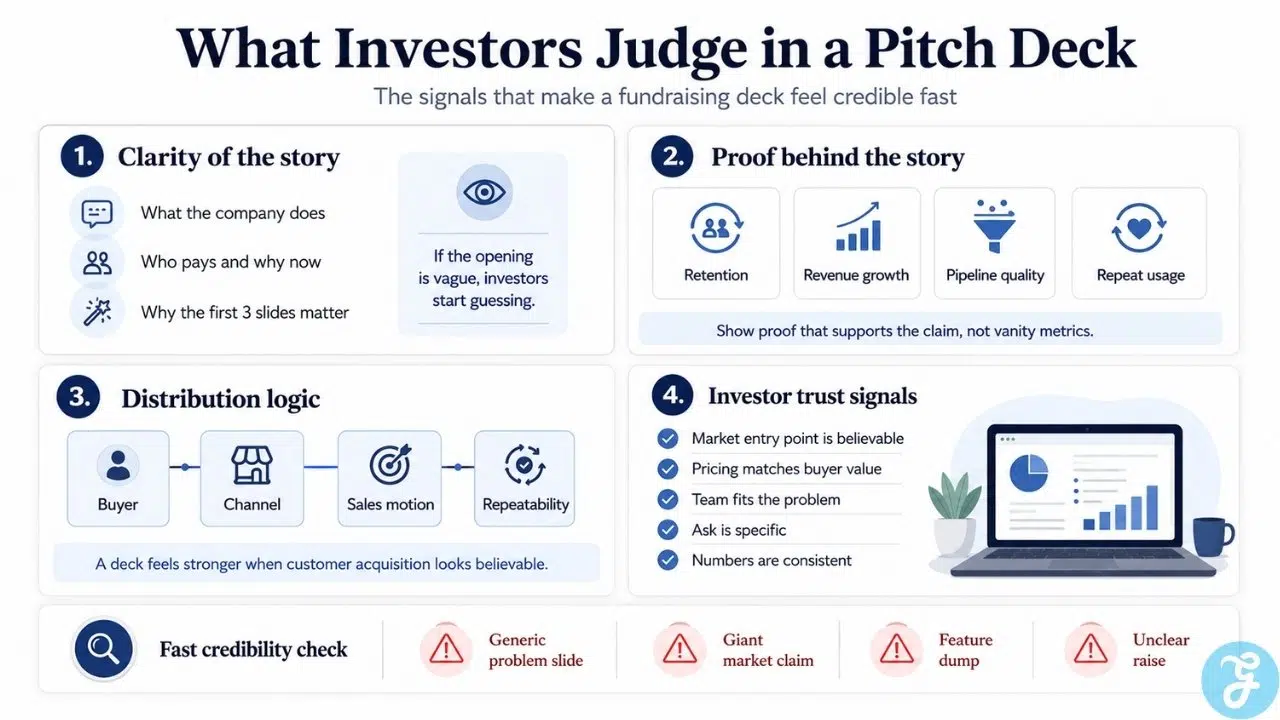
Most investors open a deck with one quiet question in mind: “What is this company, and why should I care now?”
Your first three slides must answer that without making them work for it.
Give them your one-liner. Show the specific customer pain. Prove why this market is opening right now. Anything else slows the read.
You may want to start with a sweeping market narrative, a personal origin story, or a big philosophical claim. Cut the delay. If you’re building SOC 2 automation for mid-market SaaS teams, say that. If you’re building workflow software for dental clinic billing teams, say that. If you help logistics teams cut empty truck miles, don’t hide it behind “reimagining supply chain intelligence.”
Don’t bury the customer. “SMBs” is too vague. “Independent HVAC contractors with 5 to 50 employees” is clearer. “Enterprise teams” is lazy unless you specify the team, budget, and workflow.
A vague opening creates doubt before the investor reaches the product slide.
Build the Startup Pitch Deck Around Investor Logic
Your startup pitch deck needs to answer the questions investors ask in their heads while reading.
What do you do?
Who hurts badly enough to pay?
What exists today?
Why is this market worth venture money?
What proof do you have?
How do you make money?
How do customers find you?
Who else is fighting for this budget?
Why is this team credible?
What does this round buy?
Those questions should drive the slide order.
If you have $2M in ARR, put traction near the front. Don’t bury it on slide eight because a template told you “Market Size” comes first. If you’re deep tech and the breakthrough is the company, explain the technical unlock early. If you’re building a marketplace, clarify supply, demand, and liquidity before showing a glossy product screenshot.
Templates help only until they make you hide the strongest proof. Build the order around the doubts an investor will have, then remove those doubts one by one.
Write the Problem Slide Like a Customer Would Say It
The problem slide is where many fundraising decks start sounding fake.
Bad problem slides use big market language without pain. “Existing workflows are inefficient,” “teams lack visibility,” and “legacy systems are fragmented” all sound reasonable until you realize they could describe almost any B2B startup on earth.
Get closer to the buyer’s actual week. A clinic manager is not walking around saying, “We face administrative inefficiencies.” She is chasing missing intake forms on Friday afternoon, calling patients for insurance details, and trying to prevent Monday’s appointments from turning into a paperwork fire drill.
That is the kind of pain investors understand because it gives them a real customer, a real workflow, and a real reason someone might pay.
Your problem slide needs a specific customer, a painful workflow, a broken workaround, and proof that the pain repeats. If the customer lives in Excel, Airtable, email threads, shared Google Drive folders, or manual admin hell, name it.
Avoid problems so broad they collapse under their own weight. “Hiring is broken” is a slogan. “Restaurants can’t fill shift gaps fast enough when workers cancel two hours before service” is a problem.
Make the Solution Slide Simple Enough to Repeat
Your solution slide has one job: make the investor able to repeat what you do without sounding confused.
If the clean version is, “It helps freight brokers automate quote follow-ups so they stop losing loads after hours,” use that. Don’t turn it into “AI-enabled workflow intelligence for logistics optimization.” That sentence may sound bigger, but it travels worse inside a partner meeting.
Show Product Without Making the Deck Feel Like a Manual
A product slide needs to make the company feel real without becoming a user guide.
Founders pack six screenshots onto one slide, each with tiny labels and arrows pointing to features. Investors won’t zoom in and study them like a product manager. They’ll skim, squint, and move on.
Use product visuals to show the workflow before and after.
Example:
- Before: sales reps manually update Salesforce notes after every call
- After: call summaries, next steps, and deal risks appear automatically
- Result: managers catch pipeline problems before the end of the quarter
That comparison gives the product slide a job. It shows the investor what changes for the customer.
If the product is early, say so. A simple prototype with real customer feedback beats a polished mockup pretending to be mature software. Investors know early products are messy. What matters is whether you understand the user, the workflow, and the path from rough product to valuable product.
Use Traction That Actually Proves Something
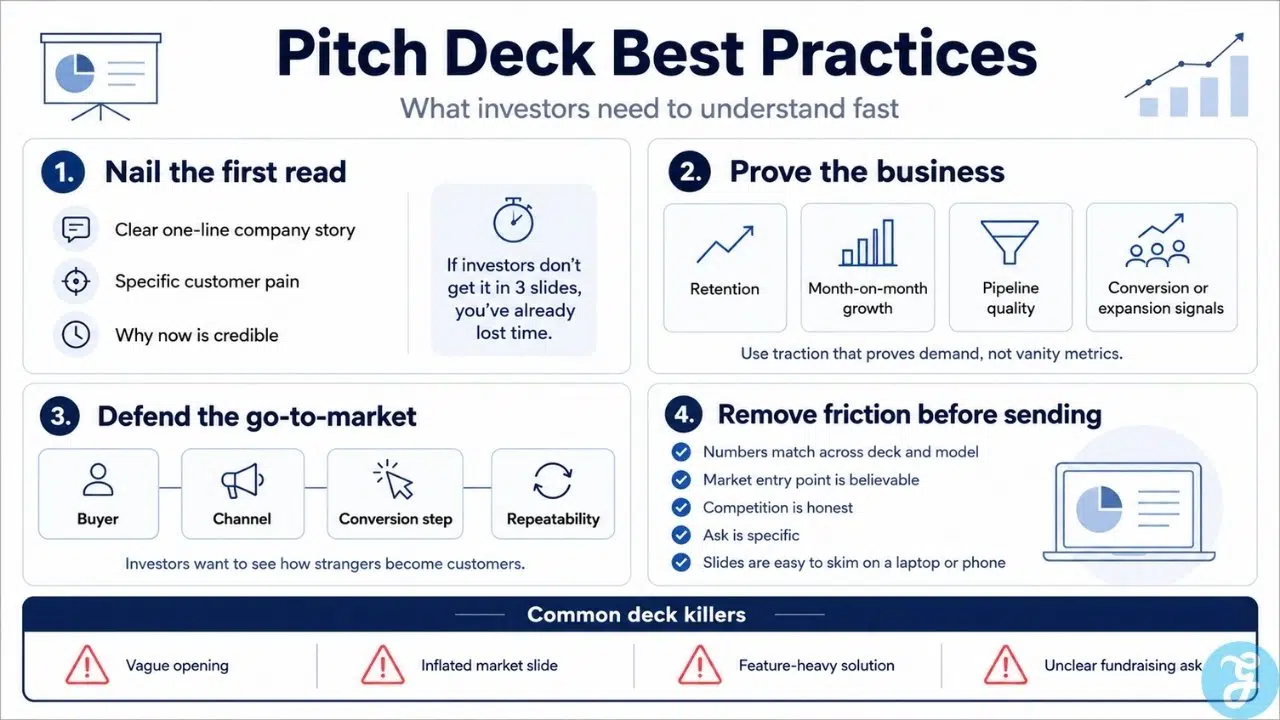
Traction matters only when it proves the right thing.
A big waitlist doesn’t prove customers will pay. Downloads don’t prove retention. Revenue matters, but weak retention makes that revenue fragile. Investor interest is not traction. Friendly pilot conversations are not demand.
This is where many fundraising deck slides get lazy. Founders throw in every upward-looking number because the chart looks good, then leave investors to figure out what the number actually proves. That is risky. Investors don’t just ask, “Is something growing?” They ask, “Is the thing that matters growing?”
For pre-seed, traction may be ugly but still useful. Ten serious customer interviews can matter if they show the same painful workflow repeating across buyers. Three paid pilots can matter if the customers are in the exact segment you plan to sell into. A prototype used weekly by five design partners can matter more than a 4,000-person waitlist full of people who clicked out of curiosity and never came back.
For seed, the bar changes. You need to show real movement: revenue, active usage, retention, paid pilots, pipeline quality, or early growth loops. If you say buyers love the product, show renewal intent, repeat usage, expansion conversations, or a pipeline that didn’t come from your personal network alone.
For Series A, investors will look harder at the machine behind the numbers. Sequential month-on-month growth matters. Net retention matters. LTV ratio matters if you have enough sales data to make the ratio meaningful. Sales efficiency, payback period, cohort behavior, and expansion revenue all start telling investors whether the company is becoming repeatable or just surviving on founder hustle.
Marketplaces need a different proof set. Supply growth without demand means nothing. Demand growth without liquidity means users leave. Transaction volume, repeat usage, match rate, time to match, and concentration risk all matter. A marketplace deck that only shows one side growing is basically asking the investor to trust the missing half.
Consumer companies have their own trap. Sign-ups are cheap. Retention is not. If users come back daily or weekly without constant paid acquisition, show it. If organic sharing exists, show the loop. If engagement drops after week two, don’t hide behind total downloads.
Pick the numbers that defend the story you’re telling. If net retention is strong, show it clearly. If revenue is small but growing 18% month over month, show the slope and explain what drove it. If enterprise pilots take longer than expected, show what you’ve learned and what must happen next. If a customer built a messy Airtable workaround before buying your product, say that. It proves pain better than another vanity metric.
After the traction slide, investors should know which number proves real demand, which number is still early, and which risk the next round is meant to attack.
Be Honest About the Market Without Inflating It
The market slide is where many founders lose investor trust.
Investors have seen the “$500 billion market” slide too many times. A giant number doesn’t make your startup venture-scale. If your first reachable market is tiny, fragmented, or expensive to sell into, a huge top-down market estimate won’t hide that.
Start with the customer you can win now. Then show how that wedge expands into a larger opportunity.
If you’re selling software to independent physical therapy clinics, don’t jump straight to “global healthcare market.” Never put a bullet that basically says, “This industry is huge.” Tell the investor how many independent clinics are currently spending on scheduling, billing, intake admin, or staff time to manage the workflow you replace.
A credible market slide might explain that you start with 18,000 independent clinics, win the intake and scheduling workflow first, then expand into multi-location clinic groups and adjacent outpatient specialties. That gives the investor a path. It shows where the business enters, how it earns trust, and how the opportunity gets bigger without pretending you can sell to the entire healthcare industry on day one.
Investors don’t need market theater. They need a believable entry point.
Make the Competition Slide Useful, Not Defensive
The competition slide shouldn’t pretend no one else exists.
When founders say “we have no competitors,” investors hear one of three things: the market doesn’t exist, the founder hasn’t looked hard enough, or customers are solving the problem with Excel, Airtable, agencies, and duct tape.
Competition includes direct competitors, internal tools, agencies, consultants, manual work, and doing nothing. If a customer solves the problem by hiring two coordinators and building a messy Airtable base, that’s your competition.
Explain what customers use today, where those options fail, and why your wedge matters. Don’t use the classic checkbox chart where your company has every green check and competitors look useless. Investors see through that instantly. It feels like a school project, not a strategy.
A sharper competition slide names the tradeoff.
Maybe incumbents are powerful but slow. Maybe point solutions are easy but narrow. Maybe agencies are flexible but expensive. Maybe the internal Excel process is free until it breaks at scale.
Show where you fit and why customers switch.
Connect the Business Model to Buyer Behavior
Your business model slide needs to explain how the company makes money and why customers accept that pricing.
“Subscription SaaS” is not enough. Investors need to know who pays, how much they pay, how pricing scales, and whether the pricing matches the value delivered.
Show the target buyer, sales motion, contract size, gross margin logic, and expansion path. If you’re pre-revenue, don’t pretend pricing is proven. Say what you’re testing, which budget you’re replacing, and what early buyer conversations suggest.
If you have paying customers, show what they pay and why the price grows.
A nervous founder prices too low and makes the opportunity look small. A careless founder prices high with no buyer evidence and makes the model feel invented. Tie the price to the buyer’s budget, the pain removed, and the outcome created.
Explain Go-to-Market Without Hand-Waving
The go-to-market slide is where investors find out whether you understand distribution or just understand product.
“Content, partnerships, and paid ads” is not a strategy. It is three words founders put on a slide when they haven’t figured out customer acquisition yet.
Start with the first buyer. Not the broad customer category. The actual buyer. Is it the VP of Sales, the clinic owner, the compliance lead, the operations manager, the CFO, the developer, the restaurant franchisee, or the school administrator? If you can’t name the buyer, you can’t explain the motion.
Then explain how you reach them. A founder selling SOC 2 automation to mid-market SaaS teams may start through security consultants, founder communities, compliance webinars, and outbound to companies hiring their first security lead. A company selling software to dental clinic billing teams may need industry associations, channel partners, local operators, or a very practical outbound motion. A developer tool may rely on GitHub, open-source adoption, community pull, documentation, and bottom-up usage before the buyer ever talks to sales.
The channel has to match the buyer’s behavior. Don’t say “SEO” if the buyer doesn’t search for the category yet. Don’t say “paid ads” if the contract value can’t support the acquisition cost. Don’t say “partnerships” unless you can name the partner type, explain why they care, and show how the deal reaches customers. Don’t say “PLG” if the product requires a six-week implementation and a procurement meeting.
A strong go-to-market slide needs to show the first repeatable path, even if it’s still early. Who did you reach? How did they respond? What did it cost in time or money? What conversion step broke? What improved after you changed the pitch, narrowed the ICP, or switched channels?
Investors don’t need the full 36-month growth plan on one slide. They need to see that you’ve wrestled with the messy part: getting strangers to care enough to buy.
For a B2B fundraising deck, be specific about sales motion. Is this founder-led sales moving toward repeatable outbound? Is it product-led sign-up with sales assist? Is it channel-led? Is it land-and-expand? Is the first contract $5K, $50K, or $250K? A $5K ACV product cannot carry the same sales motion as a $250K enterprise platform.
For consumer, show the loop. Where do users come from? Why do they invite others? What makes retention improve? What part of growth is paid, organic, referral, creator-led, community-led, or distribution-led through an existing platform?
For marketplaces, explain liquidity before you brag about growth. How do you seed supply? How do you bring demand? Where does the first local or vertical wedge become dense enough for the product to feel useful? “We’ll expand city by city” only works if the first city shows real supply-demand behavior.
The best go-to-market slides don’t pretend distribution is solved. They show that the founder knows which part is hardest and has a believable plan to test it.
Use Deck Examples Founders Can Actually Learn From
Deck examples founders study online help only when you study the judgment behind them.
Famous decks from Airbnb, Uber, Dropbox, and other breakout companies show clarity, focus, and momentum. They mislead founders who copy the structure without understanding the stage, market, and context behind it.
A marketplace deck from 2009 doesn’t automatically help a vertical AI startup today. A consumer deck with viral traction won’t help a B2B founder selling into insurance carriers. A famous deck may look simple because the underlying company had a sharp wedge, not because the slides were magical.
When reviewing deck examples founders need to ask sharper questions.
What stage was the company at? What proof did they already have? What risk did the deck reduce? What part of the story became easier to believe after the deck?
If a famous deck has ten words on a slide, that doesn’t mean your technical product gets the same treatment. If another deck leads with traction, don’t lead with traction when your traction is still thin. Learn the judgment. Don’t copy the slide style.
Make the Team Slide Earn Its Place
The team slide shouldn’t be a collection of headshots and logos.
Investors want to know why this team has a real shot at winning this market. That proof may come from technical depth, customer insight, prior startup experience, industry relationships, distribution knowledge, or unusual execution speed.
Connect the team to the company’s hardest problem.
If you’re building infrastructure software, show technical credibility. If you’re selling into pharmacies, show domain access or buyer understanding. If you’re building a consumer product, show taste, growth instincts, or community pull. If you’re entering a regulated market, show that someone knows the rules and buyer politics.
Don’t overstuff the slide with every school, employer, award, and advisor. Pick the proof that makes the investor believe this team can handle the specific business in front of them.
A deck full of famous advisors can backfire. It makes investors wonder whether the founding team is strong enough without borrowed credibility.
State the Fundraising Ask Clearly
A fundraising deck shouldn’t make investors guess how much you’re raising.
Say the amount. Explain what the money buys. Connect the raise to milestones that make the company more valuable.
A weak ask sounds like this:
“We’re raising $2 million to grow the team and accelerate growth.”
That’s vague enough to mean almost anything.
A stronger version:
“We’re raising $2 million to reach $80K MRR, hire two engineers and one account executive, and prove repeatable sales in three clinic networks over the next 18 months.”
Now the investor can argue with the plan instead of guessing what the plan is. That’s a good thing. Fundraising conversations get better when the assumptions are visible.
Your ask needs the round size, committed capital if relevant, use of funds, runway, milestones, and what the next round needs to prove.
Don’t turn this slide into a fantasy hiring plan. If half the round goes to engineering, say why. If sales hires unlock growth, show the pipeline or early conversion data behind that decision.
Investors don’t need perfection. They need a plan that connects capital to progress.
Keep the Design Clean Enough to Stay Invisible
Good deck design helps the story. Bad deck design makes investors work.
You don’t need a deck that looks like a luxury brand campaign. You need slides that are readable, consistent, and easy to skim when an investor opens the file on a laptop, tablet, or phone between meetings.
Use design strictly to lower cognitive load. Keep one macro-idea per slide, make the text large enough to read on an iPhone screen, and cut any chart label that needs an explanatory footnote. If the investor has to pinch, zoom, decode colors, or ask what the chart is trying to say, the design is getting in the way.
Product screenshots need context. A clean screenshot that shows the customer’s workflow is useful. A crowded screenshot wall with tiny labels and decorative arrows is just visual noise.
Avoid walls of text, unexplained logo grids, and diagrams that only work with live narration. If a slide collapses without you talking over it, tighten the slide before sending the deck.
Prepare Two Versions of the Fundraising Deck
Most founders need two versions of the fundraising deck: a send-ahead deck and a presentation deck.
The send-ahead deck has to stand on its own. It needs enough context for an investor to understand the story without you speaking. The presentation deck can be lighter because you’re there to explain, answer, and adapt.
Using the same deck for both creates unnecessary friction. It becomes too dense for a meeting and too thin for email.
The send-ahead deck needs clearer context on the company, market, traction, and ask. The presentation deck needs fewer words, cleaner visuals, and enough space for conversation.
Keep both versions aligned. If the numbers, market framing, or fundraising ask differ between decks, investors will notice. You don’t want to create doubt because two files tell slightly different stories.
Common Pitch Deck Mistakes That Make Investors Drop Off
Most bad decks don’t fail because of one terrible slide. They lose investors through compounding friction.
It starts when a vague opening makes the investor work too hard to understand the product. Then the problem slide sounds generic, so the pain feels fake. The solution slide buries the outcome under features. The market slide claims a giant opportunity without a believable entry point. By the time the traction slide appears, the numbers feel decorative instead of useful.
The damage gets worse when the go-to-market slide ignores distribution, the competition slide pretends no alternatives exist, or the fundraising ask never clearly explains what the round is meant to achieve. Inconsistent numbers across the deck, model, and data room can kill trust before diligence even starts.
The worst mistake is making investors guess. Guess what you do. Guess who buys. Guess why now. Guess how much you’re raising. Guess whether your numbers are real.
Investors will guess for about ten seconds. Then they’ll move on.
Best Practices Before You Send the Deck
Before sending your fundraising deck, do a brutal review.
Open the deck as if you’re an investor seeing it cold. No founder backstory. No product demo. No extra explanation. Just the slides.
Ask the hard questions.
Can someone understand the company in the first minute? Does the problem sound painful and specific? Does the solution explain the outcome, not just the feature set? Do the traction numbers support the story? Is the market wedge believable? Does the team slide explain why this team fits this company? Is the fundraising ask clear? Are the numbers consistent across the deck and model?
Then send it to a founder, operator, or investor-adjacent person who will be honest with you. Not the friend who says “looks great” after three minutes. You need someone willing to say, “I still don’t know who pays for this,” or “your traction slide sounds better than the actual numbers.”
That feedback may sting. Good. Better from a friendly reviewer than a partner meeting where everyone smiles politely and passes.
Before You Send It, Make the Deck Uncomfortably Clear
Pitch deck best practices are not about making slides look impressive. They’re about removing every easy reason for an investor to say no.
Founders lose the room before the traction slide when the opening never makes it clear who pays. The investor spends six slides trying to decode the customer, then checks out when the market slide claims a $200 billion opportunity with no believable entry point. By the time the fundraising ask appears, the investor isn’t evaluating the company anymore. They’re evaluating whether the founder understands the company.
Before you send the deck, clean the obvious mess. Tighten the opening. Cut the jargon. Fix the numbers. Make the ask clear. Show the risk you understand instead of hoping investors miss it.
A fundraising deck is not decoration around the company. It’s a pressure test for how clearly you understand the business.
If the deck feels confusing, the pitch probably is too.