Finding sustainable travel brands can feel tricky because travel itself is full of trade-offs.A tour company may support local guides but still involve long-haul flights. A hotel may use refillable toiletries but still overuse water in a dry region. A travel bag may be made from recycled fabric but still become waste if it breaks quickly. A booking platform may talk about community impact, but not clearly explain where the money goes.
That is why sustainable travel needs more than pretty nature photos and soft words. The better question is not, “Can travel be perfectly green?” It cannot. The better question is, “Which travel companies are helping people make better choices when they travel?”
A useful sustainable travel company should make it easier to support local communities, avoid overtourism where possible, choose slower routes, reduce unnecessary waste, respect wildlife, use better gear, travel in smaller groups, or book through platforms that give something back to destinations.
This list looks at seven eco travel brands and services that are worth knowing because they offer practical ways to travel with more care. Some help you book responsible tours. Some focus on flight-free travel. Some connect hotels with local charities. Some support adventure travel with stronger standards. One focuses on sustainable travel gear that is built to last.
No brand here makes travel impact-free. But each one gives travelers a better starting point than a random booking made only by price and convenience.
How I Chose These Sustainable Travel Brands
This list is not based on who has the prettiest mountain photo on Instagram. Each brand or service needed a clear reason for inclusion. That reason could be B Corp certification, responsible tourism policies, local community impact, flight-free travel planning, conservation support, responsible hotel booking, durable travel gear, or a practical model that helps travelers avoid some common low-value travel habits.
I also looked at usefulness. A sustainable travel brand should help real travelers make better decisions, not only sound good in a mission statement.
The review focused on:
- Local community benefit
- Responsible tourism standards
- Flight-free or lower-impact travel options
- Small-group travel quality
- Transparency around impact
- Wildlife and cultural respect
- Durable, sustainable travel gear
- Real limitations before booking or buying
That last point matters. Responsible travel is not a badge you buy. It still depends on destination, itinerary, flights, traveler behavior, money flow, seasonality, and respect for local communities.
Use this list as a smarter starting point, not as permission to travel carelessly.
1. Intrepid Travel
Intrepid Travel is one of the strongest sustainable travel brands for people who want guided trips without the worst mass-tourism feeling.
The company focuses on small-group travel, local leaders, local experiences, and responsible tourism standards. That matters because guided travel can go in two very different directions. It can become extractive and rushed, or it can help travelers connect more respectfully with communities, guides, and local businesses.
Intrepid’s biggest strength is its scale, combined with its responsible work. It operates in many destinations, but it has also built public policies around responsible travel, animal welfare, community impact, climate, diversity, and ethical marketing.
The brand is especially useful for travelers who want structure but do not want to sit on a giant coach being moved from one photo stop to another. Small groups, local guides, and locally grounded itineraries make a difference.
Still, Intrepid is not perfect. Many trips still involve flights before or after the tour. Adventure travel can still add pressure to fragile destinations. And like any tour company, the actual experience depends on the route, season, guide, group, and traveler behavior.
Intrepid is strongest when you choose an itinerary that supports local economies, avoids overcrowded places where possible, and gives you enough time to experience the destination properly.
Where Intrepid fits: small-group tours, local-led trips, solo travelers, cultural tours, adventure travel, first-time responsible travel.
Traveler note: Choose the itinerary carefully. A responsible operator helps, but your destination, flight choices, and travel behavior still matter.
2. G Adventures
G Adventures is another major responsible travel company, and its strongest idea is community tourism.
The company runs small-group trips around the world and works with Planeterra, its nonprofit partner, to support community tourism projects. One useful feature is the Ripple Score, which shows the percentage of trip money spent locally on services such as accommodation, transport, restaurants, and activities.
That kind of visibility matters. Many travelers want their spending to benefit the people who live in the destination, but it is hard to know where the money goes. A local-impact score gives shoppers something more useful than a vague “support local” promise.
G Adventures is a good fit for travelers who want group trips, cultural immersion, local connections, and a broad range of budgets and travel styles. It is also useful for younger travelers, solo travelers, and people who want some structure without planning everything themselves.
The caution is the same as with most tour companies. A community tourism model does not remove the impact of flights, waste, water use, or overtourism. Also, not every trip will have the same local-impact strength, so travelers should compare itineraries.
Where G Adventures fits: small-group tours, community tourism, active trips, solo travel, budget-to-midrange adventure travel.
Traveler note: Check the Ripple Score where available. It helps you compare how much money stays in the local economy.
3. Responsible Travel
Responsible Travel works as a marketplace and publisher for holidays that are screened through responsible tourism criteria.
This is useful because many travelers do not know where to start. They want a wildlife trip, walking holiday, family adventure, rail journey, cycling trip, or cultural holiday, but they do not want to spend hours sorting through green claims from every operator.
Responsible Travel helps by collecting trips from specialist operators and applying its own policy lens around local people, environment, wildlife, transport, and responsible tourism.
Its biggest value is comparison. You can browse many types of trips while staying inside a platform that is built around doing travel better.
The company is also known for taking a more critical view of travel industry issues, including overtourism, carbon offsets, volunteering, cruise impacts, wildlife tourism, and resort tourism. That editorial attitude makes it more useful than a platform that only sells pretty holidays.
The limitation is that it is still a marketplace. The exact quality and impact depend on the specific operator and trip. Travelers should read the trip notes, responsible tourism details, transport requirements, group size, and local-benefit claims carefully.
Where Responsible Travel fits: responsible holiday comparison, wildlife trips, walking holidays, family trips, rail holidays, specialist operators.
Traveler note: Use the platform as a filter, then still check the individual itinerary. Responsible travel depends on the details.
4. Byway Travel
Byway Travel is one of the clearest sustainable travel services because its entire model is built around flight-free trips.
The company plans holidays by train, ferry, bus, and bike, mainly across the UK and Europe. That makes it especially relevant for travelers who want the journey itself to become part of the trip rather than something to rush through.
Flight-free travel is not practical everywhere, but where it works, it can change the whole rhythm of a holiday. You see more places along the way. You avoid airport stress. You may spend more time in fewer destinations. You are less likely to treat travel as a checklist of disconnected stops.
Byway is a strong fit for slow travelers, rail lovers, families, couples, and people who want help planning multi-stop journeys without booking every train and hotel alone.
The biggest limitation is geography. Byway is most useful where rail, ferry, bus, and bike networks are strong. It will not solve long-haul travel, and it may cost more or take longer than flying. Some travelers may not have the extra time.
Still, for European travel, especially, Byway is one of the most practical services to know.
Where Byway fits: flight-free holidays, train travel, ferry trips, slow travel, UK and Europe itineraries.
Traveler note: Use Byway when time is part of the experience. Slow travel works best when you are not trying to squeeze five destinations into four days.
5. Much Better Adventures
Much Better Adventures is a strong option for travelers who want active trips with a more serious sustainability filter.
The company offers adventure trips such as hiking, kayaking, cycling, rafting, skiing, wildlife, and wilderness experiences. It is B Corp certified and describes its purpose as protecting the world’s wild places.
That mission matters because adventure travel can be both inspiring and harmful. Outdoor trips can support conservation and local livelihoods, but they can also increase pressure on fragile landscapes if poorly managed.
Much Better Adventures works best for travelers who want guided active trips but do not want to plan logistics alone. Its trips often include local hosts and small-group formats, which can make adventure travel feel more grounded.
The company also has a stronger editorial and environmental voice than many adventure platforms. It talks about responsible travel, nature protection, and community benefit as part of its core identity.
The caution is that adventure travel still has impacts. Flights, gear, trail erosion, wildlife disturbance, water use, and local pressure can all matter. A good operator helps reduce risk, but travelers still need to behave responsibly.
Where Much Better Adventures fits: hiking trips, kayaking, cycling, wilderness adventures, and small-group outdoor travel.
Traveler note: Pack carefully, respect local rules, and choose trips that match your ability. Sustainable adventure should not put guides, landscapes, or communities under extra strain.
6. Kind Traveler
Kind Traveler is a different kind of sustainable travel service because it focuses on hotel booking and local giving.
The platform connects travelers with hotels, destinations, and charities. Its model is built around the idea that travel bookings can support local communities and causes in the places people visit.
This is useful because accommodation is one of the biggest parts of travel spending. Many people spend hours choosing hotels by price, style, and location, but very little time thinking about whether their stay supports the destination in a meaningful way.
Kind Traveler gives travelers a way to connect stays with community impact, conservation, animal welfare, wellness, or local nonprofit work.
It is especially useful for travelers who still want hotel comfort but want more purpose behind the booking. It can work for couples, solo travelers, wellness travelers, city breaks, and boutique hotel stays.
The limitation is availability. Kind Traveler’s network is much smaller than the giant booking platforms. You may not find options in every destination or budget range. Also, a hotel’s partnership with a giving platform does not automatically make the whole stay low-impact.
Where Kind Traveler fits: responsible hotel booking, destination giving, boutique stays, charity-linked travel.
Traveler note: Look at both sides: the hotel’s own sustainability practices and the local cause your stay supports.
7. Cotopaxi
Cotopaxi belongs here as the sustainable travel gear brand on the list.
Travel gear matters because bags, backpacks, jackets, packing cubes, and daypacks are often bought in a rush and replaced too quickly. Cheap gear can fail mid-trip, and overbuilt gear can sit unused for years. A better travel gear brand should focus on durability, material choices, repair or warranty support, and long-term use.
Cotopaxi is a B Corp and is known for colorful outdoor and travel gear. Its Del Día products use repurposed leftover fabric, making each bag slightly different. Its Allpa travel packs are especially popular with carry-on travelers who want one bag that works like a backpack and suitcase.
The brand’s best role is helping travelers buy fewer bags that last longer. A well-built backpack used across many trips is a better choice than a cheap bag replaced every year.
That said, gear is still gear. Recycled or repurposed materials are not a reason to overbuy. Cotopaxi is most sustainable when you buy one item you truly need and use it heavily.
Where Cotopaxi fits: travel backpacks, daypacks, packing gear, outdoor layers, carry-on adventure travel.
Traveler note: Choose the bag for your actual travel style. A durable pack only helps if it is the one you keep reaching for.
Quick Comparison of the 7 Brands and Services
| Brand or Service | Main Category | Strongest Sustainability Signal | Best Fit |
| Intrepid Travel | Small-group tours | B Corp and responsible travel policies | Guided trips with local leaders |
| G Adventures | Small-group adventure travel | Community tourism and Ripple Score | Travelers who want the local economic impact |
| Responsible Travel | Responsible holiday marketplace | Screens trips for social and environmental criteria | Comparing responsible trip options |
| Byway Travel | Flight-free trip planning | B Corp and train, ferry, bus, bike travel | Slow travel in the UK and Europe |
| Much Better Adventures | Adventure travel | B Corp and wild-place protection mission | Active outdoor travelers |
| Kind Traveler | Hotel booking and giving platform | Hotel, destination, and charity network | Travelers who want stays tied to local causes |
| Cotopaxi | Travel and outdoor gear | B Corp and repurposed/recycled material focus | Backpacks and travel gear built for repeat use |
How to Choose Sustainable Travel Brands Without Falling for Greenwashing
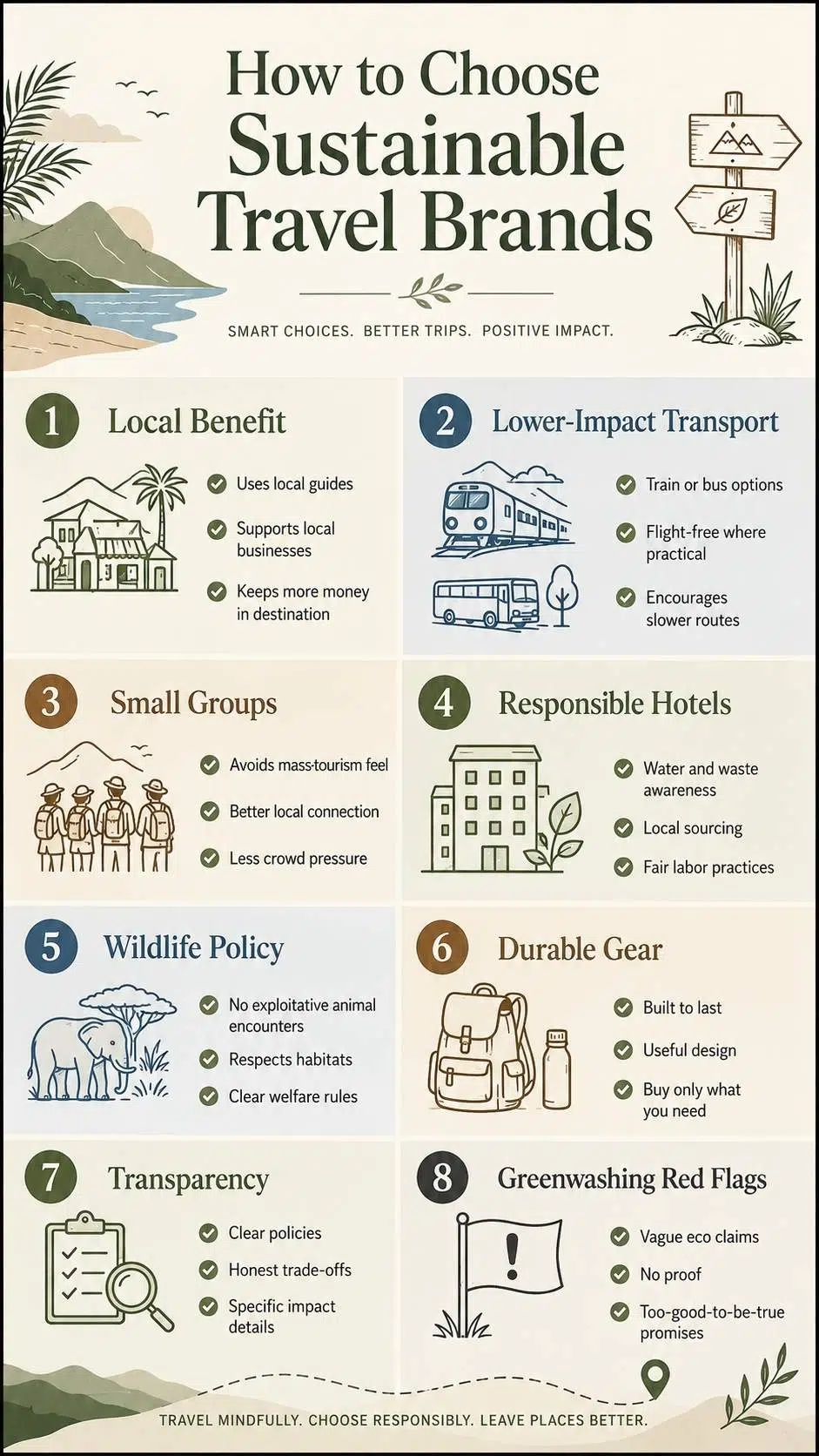
Travel greenwashing is everywhere. A company may show forests, oceans, smiling locals, recycled paper brochures, and words like eco, conscious, responsible, green, regenerative, low-impact, or carbon neutral. But those words do not mean much without proof.
A stronger travel company should answer basic questions:
- Who benefits from the trip?
- Are local guides and businesses used?
- How large are the groups?
- Does the company discuss animal welfare?
- Does it avoid harmful wildlife experiences?
- Does it offer lower-impact transport where practical?
- Does it publish responsible travel policies?
- Are hotels and operators vetted?
- Does it admit climate trade-offs?
- Does it encourage slower travel or only more travel?
For gear brands, ask different questions:
- Is the item durable?
- Can it be repaired?
- Are materials recycled, repurposed, organic, or responsibly sourced?
- Is there a warranty?
- Will you use it for years?
- Could you buy secondhand instead?
The biggest red flag is perfection language. Any company that makes travel sound impact-free should be questioned. Honest brands talk about trade-offs.
What Sustainable Travel Brands Can and Cannot Do
A responsible travel brand can help you make better choices.
It can choose local partners. It can avoid exploitative wildlife activities. It can reduce single-use plastic on trips. It can design slower itineraries. It can pay attention to cultural respect. It can support conservation or community projects. It can make durable gear. It can give travelers better information.
But it cannot erase every impact of travel.
It cannot make long-haul flights harmless. It cannot guarantee that every traveler behaves respectfully. It cannot remove pressure from a crowded destination if too many people go there. It cannot make a poorly planned itinerary sustainable with one donation or one offset.
That is why traveler behavior matters too.
Stay longer when you can. Choose fewer destinations. Spend with local businesses. Avoid wildlife exploitation. Carry reusable basics. Respect water use. Follow local rules. Travel outside peak pressure when possible. Do not treat communities as scenery. Buy gear only when you need it.
Sustainable travel is a shared responsibility between brands, destinations, and travelers.
A More Responsible Trip Starts Before You Book
The strongest lesson from these sustainable travel brands is that better travel begins before the trip starts. It begins when you choose a route, or decide whether a train can replace a short flight, or pick a tour company that uses local leaders, or when you choose a hotel that supports the destination, or when you buy one durable backpack instead of three cheap ones.
Intrepid Travel, G Adventures, Responsible Travel, Byway, Much Better Adventures, Kind Traveler, and Cotopaxi all offer useful ways to make travel more thoughtful. But none of them removes the need for judgment.
The most responsible trip is not always the most dramatic one. Sometimes it is the slower trip, the longer stay, the local guide, the train route, the smaller group, the less crowded destination, or the bag you keep using for ten years.
Travel better where you can. That is more honest than pretending travel can be perfectly green.
Frequently Asked Questions About Sustainable Travel Brands
1. What are sustainable travel brands?
Sustainable travel brands are companies that help travelers reduce harm and support better tourism. They may focus on local communities, small-group tours, flight-free travel, responsible hotels, conservation, ethical wildlife policies, durable travel gear, or lower-waste travel habits.
2. What are the best sustainable travel brands to start with?
Good starting points include Intrepid Travel and G Adventures for responsible small-group tours, Byway for flight-free European travel, Responsible Travel for comparing responsible holidays, Kind Traveler for hotel stays tied to local causes, and Cotopaxi for sustainable travel gear.
3. Are sustainable travel companies truly eco-friendly?
Some make stronger efforts than others, but no travel company is impact-free. Flights, transport, hotels, food, water, waste, and destination pressure all matter. The best companies are transparent about trade-offs and help travelers make better choices.
4. Is flight-free travel the most sustainable option?
Flight-free travel can be a lower-impact choice when train, bus, ferry, or bike routes are practical. It works especially well in regions with strong transport networks. But time, cost, safety, accessibility, and geography all affect whether it is realistic.
5. What should I look for in sustainable travel gear?
Look for durability, repair options, recycled or repurposed materials, strong warranties, useful design, and long-term fit for your travel style. The most sustainable gear is the gear you use for years.
6. How can I avoid travel greenwashing?
Look for proof. Check responsible travel policies, local guide use, group size, animal welfare rules, community benefit, transport choices, certifications such as B Corp or GSTC-related standards, and honest climate language. Be careful with vague claims like eco, green, carbon neutral, or planet-positive.