
Recovery day routines help you improve because progress does not happen only during workouts. Training creates stress. Recovery helps the body adapt to that stress. I used to think rest days meant doing nothing. Then I noticed something practical. When recovery days were careless, the next workout felt worse. When recovery days had light movement, better food, more water, and earlier sleep, training felt smoother.
That is the point of recovery. It is not weakness. It is part of the plan.
For busy professionals, recovery matters even more. Long desk hours, poor posture, late nights, stress, skipped meals, and irregular hydration can make the body feel heavy before exercise even begins. If your routine includes full body workouts busy schedules can handle, your recovery day should support those workouts, not erase their benefits. A good recovery day does not need to be complicated. It should reduce stiffness, restore energy, calm the nervous system, and prepare you to move again.
These rest day workouts and active recovery habits also fit into the best healthy habits for long-term energy, strength, focus, sleep, hydration, and stress control.
Why Recovery Days Matter More Than Beginners Think?
Recovery days matter because your body does not improve from training alone. It improves from the cycle of training, repair, and adaptation. If you only focus on effort and ignore recovery, progress can slow down. Many beginners think soreness means success. That is not always true. Mild soreness after a new or challenging workout can be normal, but extreme soreness that stops you from moving well is not the goal. A workout should help you train again, not make basic walking painful for days.
Recovery also protects consistency. If every session leaves you exhausted, you may start skipping workouts. A smart recovery day helps you return with better energy, cleaner movement, and more confidence. For desk workers, recovery has another layer. Sitting for long hours can tighten hips, weaken posture, reduce daily movement, and make soreness feel worse. That is why a recovery day should not always mean lying down all day. Light movement can help the body feel less stuck.
Recovery days also support mental performance. If your work demands focus, patience, writing, editing, managing, designing, teaching, or decision-making, poor recovery can affect how you think and react. The Corporate Athlete needs recovery because the workday also uses energy. A recovery routine does not need to be intense. In fact, it should not be intense. The best recovery day routines usually feel easy, controlled, and refreshing.
The goal is to finish the day feeling better than when you started.
| Recovery Day Benefit | Why It Matters | Practical Example |
| Less stiffness | Helps the body move comfortably | Light walking and mobility |
| Better workout consistency | Makes it easier to train again | Easy recovery between strength days |
| Improved movement quality | Keeps joints and muscles prepared | Gentle hips, spine, and shoulder work |
| Lower stress load | Helps the body calm down | Breathing or quiet walking |
| Better soreness management | Reduces the urge to stay completely still | Active recovery instead of total collapse |
| Better energy | Supports the next training day | Sleep, hydration, and food |
| Stronger routine identity | Keeps health habits alive | Recovery becomes part of training |
Recovery is not the opposite of training. It is what makes training sustainable.
Active Recovery vs. Complete Rest
Active recovery and complete rest are both useful, but they are not the same. Knowing when to use each one makes your training smarter. Active recovery means low-effort movement that helps you feel better without creating more fatigue. Examples include walking, easy cycling, gentle swimming, mobility work, yoga, stretching, or light movement drills. You should be able to breathe comfortably and talk easily.
Complete rest means you intentionally reduce physical activity and give the body more stillness. This can be useful after very hard training, poor sleep, illness, travel fatigue, heavy stress, or signs that your body needs a real break. The mistake is treating every rest day the same. Some days your body needs movement. Some days it needs quiet. A person who feels stiff from sitting may benefit from active recovery. A person who feels exhausted, sore, and mentally drained may need complete rest.
A useful question is: “Will light movement make me feel better today, or will it add more stress?” If movement feels refreshing, choose active recovery. If even light movement feels heavy, choose rest.
Active recovery should never turn into another hard workout. That is where people go wrong. They call it recovery training, then push until they are tired again. A recovery day should leave energy in the tank. For most busy people, the best approach is flexible. Use active recovery most of the time, and take complete rest when the body clearly asks for it.
| Recovery Type | What It Means | Best For |
| Active recovery | Easy movement that supports circulation and mobility | Stiffness, light soreness, desk fatigue |
| Complete rest | Very low activity and more physical downtime | Exhaustion, poor sleep, illness, heavy soreness |
| Mobility recovery | Gentle joint movement and stretching | Tight hips, back, shoulders, and neck |
| Breath-based recovery | Calm breathing and nervous system reset | Stress, anxiety, mental overload |
| Sleep-focused recovery | Prioritizing rest and bedtime habits | Poor recovery, low energy, hard training weeks |
| Nutrition-focused recovery | Protein, fluids, and balanced meals | Strength training and soreness management |
The best recovery choice depends on your body, not your ego.
7 Recovery Day Routines That Help You Improve
These recovery day routines are designed for real life. They are not extreme. They are not meant to burn maximum calories. They are meant to help your body feel ready for the next good session. Some routines are best after full-body workouts. Some are better after a stressful workweek. Some are useful after sitting too long. Some are better when you feel tired but still want to move.
Do not use all seven in one day. Choose the routine that matches your situation. If your legs feel heavy, walk and stretch. If your back feels stiff, use mobility. If your mind feels stressed, use breathwork and light movement. If your body feels drained, use sleep and nutrition support.
A recovery day should feel like support, not punishment.
| Routine | Time Needed | Best For |
| 1. Easy Walk and Mobility Routine | 25-40 minutes | General active recovery |
| 2. Desk Worker Recovery Routine | 15-25 minutes | Sitting stiffness |
| 3. Low-Impact Cardio Recovery Routine | 20-30 minutes | Light circulation and energy |
| 4. Stretch and Breathwork Routine | 15-20 minutes | Stress and tightness |
| 5. Foam Rolling and Mobility Routine | 20-30 minutes | Soreness and movement prep |
| 6. Nutrition and Hydration Recovery Routine | Full day | Muscle repair and energy |
| 7. Sleep and Nervous System Reset Routine | Evening | Deep recovery and fatigue |
1. Easy Walk and Mobility Routine
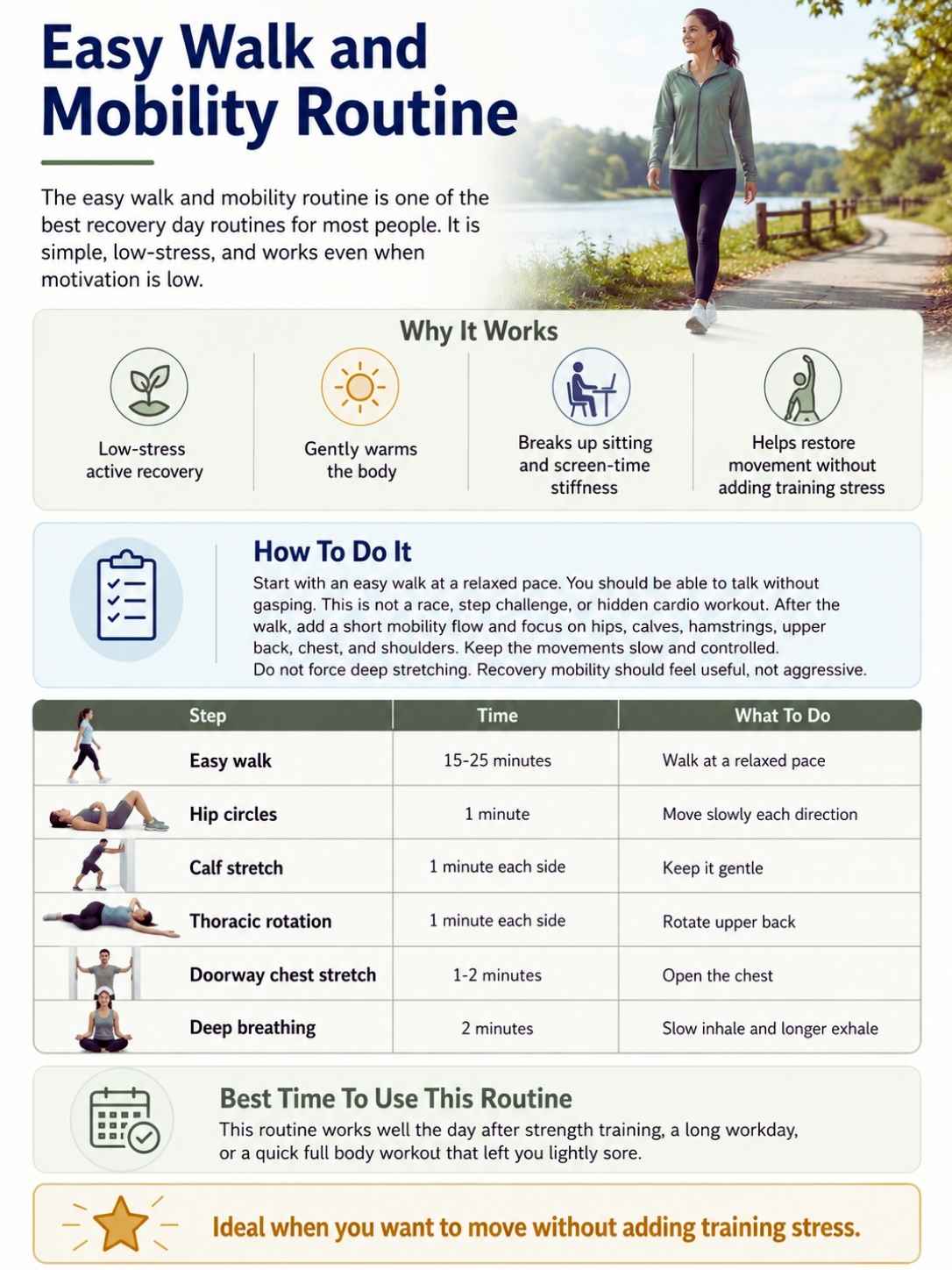
The easy walk and mobility routine is one of the best recovery day routines for most people. It is simple, low-stress, and works even when motivation is low. Start with an easy walk. The pace should feel comfortable. You should be able to talk without gasping. This is not a race, step challenge, or hidden cardio workout. It is active recovery.
Walking helps because it moves the joints, warms the body gently, and breaks up sitting. For desk workers, it also creates a mental reset. A short walk can clear the fog that builds after hours of screen time. After the walk, add a short mobility flow. Focus on the areas that usually get tight: hips, calves, hamstrings, upper back, chest, and shoulders. Keep the movements slow and controlled.
Do not force deep stretching. Recovery mobility should feel useful, not aggressive. If you are sore, move through a comfortable range. The goal is to restore movement, not prove flexibility. This routine works well the day after strength training, a long workday, or a quick full body workout that left you lightly sore.
| Step | Time | What To Do |
| Easy walk | 15-25 minutes | Walk at a relaxed pace |
| Hip circles | 1 minute | Move slowly each direction |
| Calf stretch | 1 minute each side | Keep it gentle |
| Thoracic rotation | 1 minute each side | Rotate upper back |
| Doorway chest stretch | 1-2 minutes | Open the chest |
| Deep breathing | 2 minutes | Slow inhale and longer exhale |
This routine is ideal when you want to move without adding training stress.
2. Desk Worker Recovery Routine
The desk worker recovery routine is for people whose bodies feel stiff from sitting, not necessarily sore from training. This is common for remote workers, writers, editors, designers, marketers, students, and anyone who spends long hours at a laptop. Desk stiffness usually shows up in predictable places. The hips feel tight. The neck feels heavy. The upper back feels rounded. The wrists may feel tired. The lower back may feel compressed.
This routine focuses on undoing some of that position. It opens the front of the body, wakes the glutes, moves the spine, and resets posture awareness. The mistake is waiting until pain appears. Recovery should not start only after the body complains loudly. A simple 15 to 25-minute desk recovery session can keep stiffness from becoming a daily pattern.
This is not a hard workout. It is recovery training for a sedentary body. It should feel refreshing and easy enough to repeat several times per week. If you are doing movement habits for sedentary lifestyles, this routine fits naturally into that system.
| Movement | Time or Reps | Why It Helps |
| Neck side stretch | 30 seconds each side | Reduces screen tension |
| Shoulder rolls | 1 minute | Releases upper-body stiffness |
| Doorway chest stretch | 1-2 minutes | Opens rounded posture |
| Cat-cow or standing spinal wave | 1 minute | Moves the spine |
| Hip flexor stretch | 1 minute each side | Opens the hips |
| Glute bridge | 12-15 reps | Wakes the glutes |
| Wall angels | 8-10 reps | Improves upper-back awareness |
| Wrist stretch | 30 seconds each direction | Helps keyboard fatigue |
This routine is especially useful on days when you do not need more intensity, but you do need better movement.
3. Low-Impact Cardio Recovery Routine
Low-impact cardio can be excellent for active recovery when it stays easy. The goal is circulation, not exhaustion. Good options include easy cycling, slow swimming, walking on a treadmill, using an elliptical lightly, or doing a gentle step routine. You should finish feeling better, not drained.
This routine is useful after strength training because it keeps the body moving without heavy loading. It can also help on mentally stressful days when you need to move but do not want a hard workout. The biggest mistake is turning low-impact cardio into a secret high-intensity session. If you finish gasping, sweating heavily, and needing a nap, it probably was not recovery.
Use a simple effort scale. On a recovery day, aim for an effort of 3 or 4 out of 10. You should feel like you are doing something, but you should still be comfortable. This kind of rest day workout works well for people who dislike doing nothing. It gives you movement without competing with your next training day.
| Cardio Option | Time | Recovery Intensity |
| Easy cycling | 20-30 minutes | Comfortable pace |
| Treadmill walk | 20-30 minutes | Light incline if desired |
| Swimming | 15-25 minutes | Easy laps |
| Elliptical | 20 minutes | Low resistance |
| Outdoor walk | 20-40 minutes | Relaxed breathing |
| Light step routine | 10-20 minutes | Low impact |
If the session makes you feel calmer, looser, and more awake, you used the right intensity.
4. Stretch and Breathwork Routine
The stretch and breathwork routine is best when the body feels tight and the mind feels overloaded. This is common after hard workdays, poor sleep, emotional stress, or high-pressure deadlines. Stretching helps the body slow down, but breathing is what makes this routine feel different. Slow breathing tells the nervous system that the day does not need to stay in high alert.
Use gentle stretches only. Hold each position at a comfortable level. Do not push into sharp pain. Do not bounce. Do not turn stretching into another performance goal. The breathing can be simple. Inhale for four seconds. Exhale for six seconds. Repeat for two to five minutes. The longer exhale helps the body shift toward calm.
This routine is especially useful in the evening. It connects well with evening habits that improve sleep and habits that reduce stress long term. If you struggle with racing thoughts, this recovery day routine can become a bridge between training stress, work stress, and better sleep.
| Stretch or Breath Step | Time | Purpose |
| Child’s pose | 1-2 minutes | Relaxes back and hips |
| Hip flexor stretch | 1 minute each side | Opens hips |
| Seated forward fold | 1 minute | Releases back side gently |
| Doorway chest stretch | 1 minute | Opens chest |
| Neck stretch | 30 seconds each side | Reduces tension |
| Legs up the wall | 3-5 minutes | Calming recovery position |
| Slow breathing | 2-5 minutes | Lowers stress response |
This routine is not about becoming flexible fast. It is about helping the body feel safe enough to recover.
5. Foam Rolling and Mobility Routine
Foam rolling can be useful when it is done with the right expectations. It may help some people feel less tight and more ready to move, but it is not magic and should not be painful. The mistake is attacking sore muscles aggressively. More pressure is not always better. If foam rolling makes you tense up, hold your breath, or feel bruised, use less pressure.
A good foam rolling routine should be slow and controlled. Spend time on large muscle areas like calves, quads, hamstrings, glutes, lats, and upper back. Avoid rolling directly on joints or the lower back aggressively. Foam rolling works best when paired with mobility. Rolling may help you feel looser, but mobility teaches the body to use that range. For example, roll the calves, then do ankle rocks. Roll the upper back, then do thoracic rotations.
This routine is useful before a light recovery session, after a hard week, or on days when your body feels sticky and restricted. Keep the whole routine short. You do not need 45 minutes of rolling. Ten minutes of rolling plus 10 minutes of mobility is usually more realistic.
| Area | Foam Rolling Time | Follow-Up Mobility |
| Calves | 1 minute each side | Ankle rocks |
| Quads | 1 minute each side | Half-kneeling hip flexor stretch |
| Hamstrings | 1 minute each side | Gentle hinge pattern |
| Glutes | 1 minute each side | Figure-four stretch |
| Upper back | 1-2 minutes | Thoracic rotation |
| Lats | 1 minute each side | Child’s pose reach |
This recovery training routine is best used as support, not as a replacement for sleep, hydration, nutrition, or smart programming.
6. Nutrition and Hydration Recovery Routine

Recovery is not only what you do on a mat. It is also what you eat and drink across the day. After training, your body needs enough energy, protein, fluids, and nutrients to repair and adapt. If you train hard but eat randomly, skip meals, and drink very little water, recovery becomes harder.
A recovery day should include balanced meals. Aim for protein at each main meal, fiber-rich carbohydrates, vegetables or fruit, and enough fluids. You do not need a perfect diet. You need reliable basics. Protein helps support muscle repair. Carbohydrates help restore energy, especially if you train regularly. Fluids support hydration, digestion, and normal body function. Minerals from food also matter, especially if you sweat a lot.
The mistake is treating rest days like they do not need nutrition. Some people under-eat because they are not training. Others overeat because the day has no structure. A better approach is to eat in a way that supports the next workout. This routine connects naturally with nutrition habits that work long term and hydration habits because recovery depends on what the body has available.
| Recovery Nutrition Habit | Why It Helps | Practical Example |
| Protein at meals | Supports muscle repair | Eggs, fish, beans, tofu, chicken, yogurt |
| Fiber-rich carbs | Restores energy and supports fullness | Rice, oats, potatoes, lentils, whole grains |
| Fruits and vegetables | Adds micronutrients | Greens, berries, carrots, bananas |
| Fluids through the day | Supports hydration | Water before coffee and with meals |
| Post-workout meal | Helps recovery after training | Protein plus carbs within a normal meal |
| Electrolyte awareness | Useful after heavy sweating | Salted food or electrolyte drink when needed |
| Avoid random grazing | Keeps energy steady | Planned snacks if hungry |
A strong recovery day routine includes food and water because muscles do not recover from intention alone.
7. Sleep and Nervous System Reset Routine
Sleep is the deepest recovery tool most people have, but it is often the first thing busy people sacrifice. A recovery day without enough sleep is only half a recovery day. The sleep and nervous system reset routine is for days when you feel drained, sore, mentally tired, or overstimulated. It focuses on reducing evening pressure and helping the body settle.
Start by cutting off heavy work earlier than usual. Do not check stressful messages late if they can wait. Dim the lights. Prepare tomorrow. Stretch lightly. Use a wind-down anchor such as reading, prayer, breathing, or a warm shower. This routine is not only for athletes. It is for the Corporate Athlete who needs the brain and body to recover from long work demands.
The nervous system matters because stress affects recovery. If your mind stays in high alert, your body may struggle to feel restored even after a rest day. This routine connects directly with evening habits that improve sleep, habits that reduce stress long term, and habits for better focus.
| Reset Step | Time | Why It Helps |
| Close work early | 5-10 minutes | Reduces mental carryover |
| Prepare tomorrow | 5 minutes | Clears open loops |
| Dim lights | Final hour | Signals wind-down |
| Gentle stretching | 5-10 minutes | Releases body tension |
| Slow breathing | 2-5 minutes | Calms stress response |
| Phone away from bed | Overnight | Reduces scrolling |
| Consistent sleep window | Full night | Supports recovery rhythm |
A recovery day should end in a way that makes tomorrow easier.
How to Know If You Need a Recovery Day?
Many people wait too long before taking recovery seriously. They only rest after pain, exhaustion, or burnout shows up. A better approach is to read the earlier signs. You may need a recovery day if your performance drops for several sessions, your soreness feels heavier than usual, your motivation disappears, your sleep worsens, or your body feels unusually stiff. You may also need recovery if your resting stress is high, work pressure is intense, or your mood feels more reactive than normal.
Not every sign means something is wrong. One tired day is normal. But patterns matter. If several signs show up together, recovery becomes a smart choice. For beginners, soreness can be confusing. Mild soreness is common after new exercises, but severe soreness is not a badge of honor. You should still be able to move normally. If pain is sharp, swelling is severe, or symptoms feel unusual, stop training and seek proper help.
A recovery day is not quitting. It is adjusting the plan before the body forces you to stop. The more experienced you become, the better you get at noticing the difference between normal effort and poor recovery.
| Sign You May Need Recovery | What It Might Mean | Better Choice |
| Heavy soreness | Muscles need more repair time | Active recovery or rest |
| Poor sleep | Recovery capacity is lower | Sleep-focused routine |
| Low motivation | Nervous system may be tired | Gentle movement |
| Performance drop | Body may not be adapting well | Reduce intensity |
| Irritability | Stress load may be high | Breathwork and lighter training |
| Joint discomfort | Movement quality may be poor | Modify workouts |
| Stiffness from sitting | Body needs circulation | Walk and mobility |
| Unusual pain | Possible injury concern | Stop and get guidance |
Taking recovery before breakdown is one of the smartest habits for long-term training.
Recovery Day Mistakes That Slow Progress
The biggest recovery mistake is doing nothing all day and calling it rest. Complete rest can be useful, but for many desk workers, lying around after sitting all week can make the body feel even stiffer. Another mistake is turning recovery into another hard workout. A rest day workout should not feel like a secret training session. If you push too hard, you are not recovering. You are adding more stress.
Many people also ignore food and water on recovery days. They train hard during the week, then eat randomly and drink very little water when they rest. Muscles still need support on rest days. Sleep is another common problem. A person may do mobility, take supplements, use a massage tool, and still sleep five hours. That is not a strong recovery strategy.
Beginners also chase soreness. They think if they are not sore, the workout did nothing. That belief leads to too much intensity and not enough consistency. Progress is better measured by strength, energy, movement quality, and repeatability. A final mistake is copying someone else’s recovery routine. An advanced lifter, runner, beginner, parent, shift worker, and desk worker may all need different recovery.
| Recovery Mistake | Why It Slows Progress | Better Habit |
| Doing nothing every rest day | Can increase stiffness | Use light active recovery |
| Training too hard | Adds more fatigue | Keep effort low |
| Skipping food structure | Reduces repair support | Eat balanced meals |
| Poor hydration | Can worsen fatigue | Drink regularly |
| Sleeping too little | Limits recovery | Protect bedtime habits |
| Chasing soreness | Encourages overtraining | Track performance instead |
| Ignoring pain | Increases risk | Modify or seek help |
| Copying others | Ignores your needs | Match recovery to your body |
A good recovery day should help you feel more prepared, not more behind.
Recovery Day Routine by Training Goal
Recovery should match your training goal. A person lifting weights needs a slightly different recovery focus than someone trying to improve endurance, reduce stress, or return after a long break. If your goal is strength, recovery should include protein, sleep, light movement, and mobility for the joints used in training. If your goal is fat loss, recovery should still include food structure, not extreme restriction. If your goal is better energy, recovery should prioritize sleep, hydration, and stress control.
Desk workers often need recovery that includes posture and mobility because work itself creates physical stress. Even if the workout was not hard, long sitting may make the body feel tight. Beginners should keep recovery simple. Walk, stretch lightly, drink water, eat enough protein, and sleep. That alone solves many problems.
Advanced exercisers may need more structured recovery, including planned deload weeks, mobility work, and careful training volume.
| Training Goal | Recovery Focus | Best Routine |
| Build strength | Protein, sleep, joint mobility | Nutrition and hydration recovery |
| Reduce soreness | Light movement and gentle mobility | Easy walk and mobility |
| Improve endurance | Easy low-impact cardio | Low-impact cardio recovery |
| Reduce stress | Breathing and gentle stretching | Stretch and breathwork |
| Desk-worker health | Hips, spine, shoulders, wrists | Desk worker recovery |
| Travel fitness | Walking and mobility | Easy walk or hotel-room recovery |
| Beginner consistency | Low-pressure movement | Active recovery walk |
| Better sleep | Evening wind-down | Sleep and nervous system reset |
Recovery is more useful when it supports the reason you train.
How Recovery Day Routines Support the Best Healthy Habits?
Recovery day routines connect with nearly every part of a healthy lifestyle. They are not just fitness habits. They support energy, sleep, movement, nutrition, hydration, focus, and stress control. Morning habits for better energy are easier when recovery is handled well. If you sleep better, hydrate, and reduce soreness, waking up feels less heavy. Evening habits that improve sleep also play a major role because sleep is where much of the body’s repair process happens.
Full body workouts busy people can follow become more effective when recovery is built into the week. Without recovery, workouts start feeling harder, motivation drops, and form can suffer. Movement habits for sedentary lifestyles matter because recovery does not only happen after exercise. Desk workers need daily movement to reduce stiffness and improve circulation.
Nutrition habits that work long term and hydration habits also support recovery. The body needs fluid, protein, carbohydrates, vitamins, and minerals to repair well. Recovery also supports habits for better focus. A tired, sore, under-recovered body can make the brain feel dull. Better recovery often creates better work energy.
| Recovery Habit | Related Healthy Habit Topic |
| Morning walk | Morning habits for better energy |
| Evening wind-down | Evening habits that improve sleep |
| Light mobility | Movement habits for sedentary lifestyles |
| Protein-rich meals | Nutrition habits that work long term |
| Water through the day | Hydration habits |
| Easy training day | Full body workouts busy |
| Breathing practice | Meditation aids and tools |
| Lower stress routine | Habits that reduce stress long term |
| Better recovery sleep | Best healthy habits |
| Social walk | Social wellness habits |
Recovery is where healthy habits start working together instead of competing for attention.
Final Thoughts
Recovery day routines are not wasted time. They are part of improvement. If you train hard but recover poorly, your body eventually pushes back. You may feel sore longer, sleep worse, lose motivation, move poorly, or struggle to stay consistent. A better approach is to treat recovery as a planned part of the week. Walk easily. Stretch gently. Move your joints. Eat enough protein. Drink water. Sleep well. Breathe slowly. Use complete rest when your body truly needs it.
Start with one routine. If you feel stiff, use the easy walk and mobility routine. If your job keeps you at a desk, use the desk worker recovery routine. If your body feels drained, use the sleep and nervous system reset. If soreness is mild, try active recovery.
The goal is not to do more every day. The goal is to recover well enough to keep going. That is how active recovery supports better training.
Frequently Asked Questions (FAQs) About Recovery Day Routines
What are recovery day routines?
Recovery day routines are planned habits that help your body restore after training or stress. They may include walking, mobility, stretching, hydration, protein-rich meals, sleep support, breathing, and low-intensity movement. The goal is to feel better and prepare for your next workout.
Is active recovery better than complete rest?
Active recovery is useful when light movement helps you feel looser and more energized. Complete rest is better when you are exhausted, sick, sleep-deprived, or dealing with unusual pain. Both are useful. The right choice depends on how your body feels.
What should I do on a recovery day?
A good recovery day can include an easy walk, gentle mobility, light stretching, balanced meals, enough water, and a calmer evening routine. Keep the effort low. You should finish feeling refreshed, not more tired.
Are rest day workouts a good idea?
Rest day workouts can be helpful if they are truly easy. Walking, gentle cycling, mobility, yoga, or light swimming can support recovery. A hard circuit, heavy lifting session, or intense cardio workout is not a true rest day workout.
How often should I take recovery days?
Most people benefit from at least one or two recovery days each week, depending on training intensity, sleep, stress, and fitness level. Beginners may need more recovery. Advanced exercisers may use lighter training days instead of full rest.
Can I stretch on a recovery day?
Yes, gentle stretching can be useful on a recovery day. Focus on comfort, breathing, and control. Do not force painful stretches. Stretching should help you feel better, not create more soreness.