SaaS customer success is not a polite follow-up email after someone buys your product. It is the system that decides whether customers actually reach value, keep using the product, renew, expand, and trust your company enough to stay.
That sounds obvious until you look at how many SaaS companies still treat customer success like a reactive support desk with a friendlier name. They wait until usage drops. They wait until the renewal is close. They wait until the customer complains. Then someone rushes in with a discount, a meeting link, or a “just checking in” message that arrives months too late. That is not customer success. That is damage control.
A real SaaS customer success program starts much earlier. It begins before the customer signs the contract or starts the trial. It continues through onboarding, adoption, health scoring, support, education, renewal, expansion, and feedback loops. It connects product data with human judgment. It turns customer outcomes into a working operating system.
For SaaS businesses, this matters because growth is not only about new signups. It is about keeping the right customers and helping them get more value over time. You’ll get a broader strategy behind acquisition, onboarding, retention, and expansion in my SaaS Growth Marketing Guide.
What Is SaaS Customer Success?
SaaS customer success is the process of helping customers achieve the outcomes they expected when they bought or signed up for your product.
It is not only support, or account management, or onboarding, or renewal management. It is the full customer journey after acquisition, built around one question:
Is this customer getting enough value to keep using, paying for, and growing with the product?
In a SaaS business, customer success usually includes:
- Onboarding new customers
- Defining customer goals
- Driving product adoption
- Monitoring usage and health signals
- Preventing churn
- Supporting renewals
- Finding expansion opportunities
- Educating users
- Gathering product feedback
- Helping customers prove ROI
- Coordinating with sales, support, product, and marketing
The best customer success SaaS programs do not just respond to problems. They look for risk before it becomes visible.
Why SaaS Customer Success Programs Matter
SaaS businesses are built on recurring revenue. That means the customer relationship does not end after the first payment. In many ways, it begins there.
- If customers do not activate, they churn.
- If they do not adopt the product, they churn.
- If their team does not use it, they churn.
- If they cannot prove value internally, they churn.
- If support feels slow or confusing, they churn.
- If the product becomes another unused subscription, they churn.
A strong SaaS customer success program helps prevent this by creating a clear path from purchase to value.
It improves:
- Customer retention
- Product adoption
- Renewal rates
- Expansion revenue
- Customer satisfaction
- Onboarding completion
- Support efficiency
- Customer feedback quality
- Revenue predictability
- Net revenue retention
Customer success is not just a “nice to have” team. In SaaS, it is one of the main reasons customers stay long enough for the business model to work.
Customer Success vs Customer Support vs Account Management
These roles often overlap, especially in smaller SaaS companies. But they are not the same.
| Function | Main Focus | Typical Question |
| Customer Support | Fixing issues and answering questions | “How can we solve this problem quickly?” |
| Customer Success | Helping customers reach outcomes and stay healthy | “Is this customer getting enough value to stay?” |
| Account Management | Managing commercial relationships | “How do we renew, expand, or protect this account?” |
Support is usually reactive. A customer has a problem, and support helps. Customer success should be proactive. The team watches for signals, guides customers through value, and acts before problems become cancellations.
Account management is often commercial. It handles renewals, upsells, contracts, and relationship growth. In an early-stage SaaS company, one person may do all three. That is fine. But the responsibilities still need to be clear.
A customer should not fall through the cracks because everyone assumed someone else owned the relationship.
The Core Goal of a SaaS Customer Success Program
The goal is not to “keep customers happy” in a vague way. The goal is to help the right customers get measurable, repeatable value from the product. Happiness is useful, but it is not enough. A customer can like your team and still cancel because the product is not essential. Another customer can complain often and still renew because the product solves a painful problem. A good SaaS customer success program focuses on value.
Ask:
- What outcome did the customer buy the product for?
- What must happen for them to feel successful?
- Which product actions show real adoption?
- Which users need to be active?
- What risks appear before churn?
- What does a healthy customer look like?
- What proof of value is needed before renewal?
- What support or training helps customers stay?
This is where customer success becomes more than relationship management. It becomes a retention engine.
Key Parts of a Strong SaaS Customer Success Program
A good program does not need to be complicated. But it does need structure. Here are the essential parts.
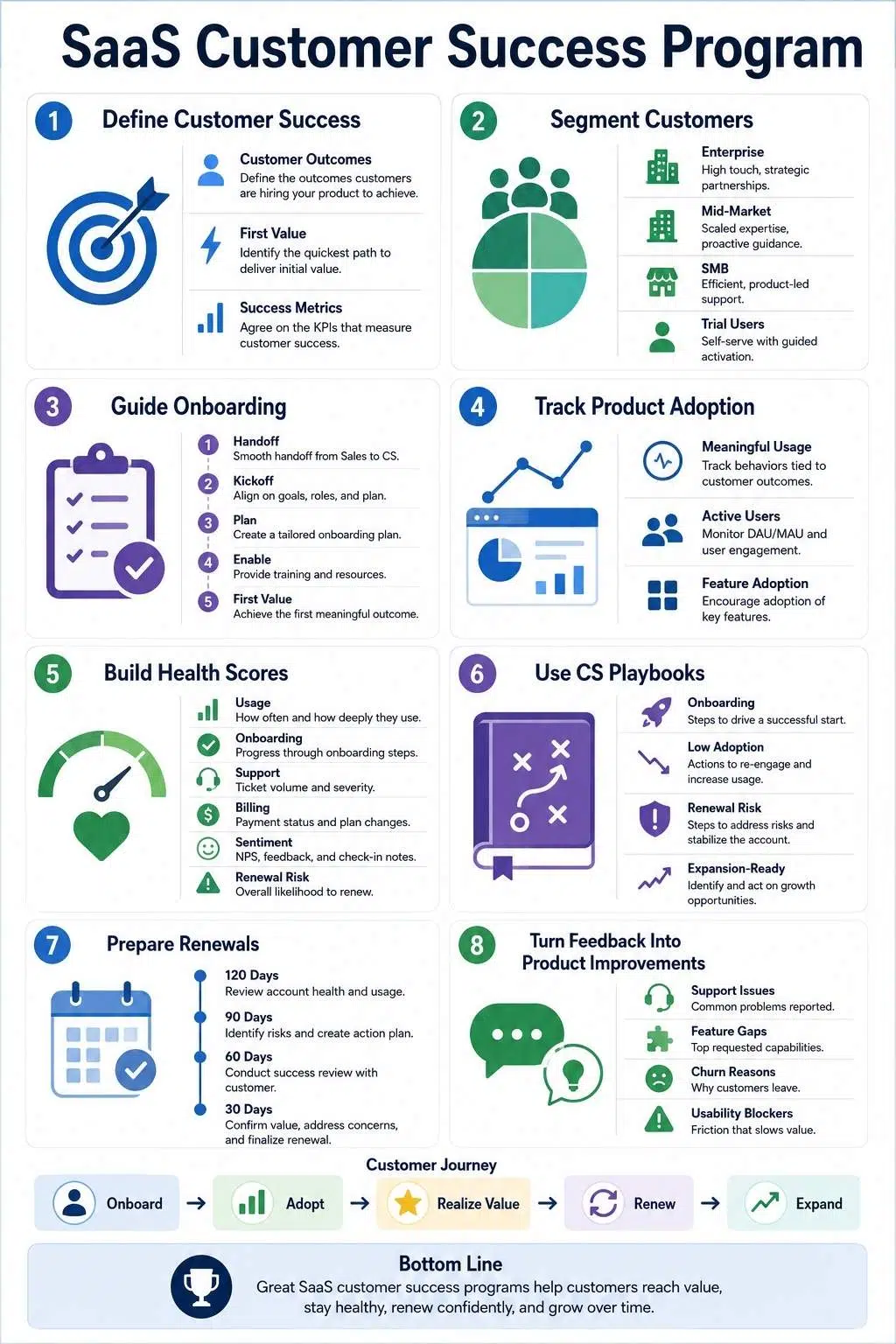
1. Define What Customer Success Means for Your Product
Before building playbooks, health scores, or dashboards, define success. Not in internal language. In customer language.
For example:
| SaaS Product Type | Customer Success Might Mean |
| Project management SaaS | Teams complete work faster with fewer missed tasks |
| CRM SaaS | Sales teams manage leads and deals more consistently |
| Email marketing SaaS | Users launch campaigns and improve engagement |
| Analytics SaaS | Teams make better decisions from clear reporting |
| HR SaaS | Hiring or employee workflows become easier to manage |
| Finance SaaS | Teams close books, track spending, or report faster |
| AI writing SaaS | Users produce usable content faster with less editing time |
Do not define success as “the customer logs in.” That is activity, not value. Define the outcome your product exists to create. Then build your customer success SaaS program around that outcome.
2. Segment Customers by Needs, Value, and Risk
Not every customer needs the same level of customer success. A startup paying monthly for one seat needs a different experience from an enterprise account with 200 users, custom onboarding, and a procurement team. Customer segmentation helps you decide where to use high-touch, low-touch, and digital-led success.
Useful segmentation factors include:
- Account size
- Revenue value
- Company size
- Use case
- Industry
- Plan type
- Product complexity
- Onboarding needs
- Expansion potential
- Churn risk
- Strategic importance
- Support volume
- Product usage
- Renewal timeline
A simple model may look like this:
| Segment | Success Motion |
| Enterprise accounts | High-touch customer success, onboarding calls, business reviews |
| Mid-market accounts | Guided onboarding, periodic check-ins, and health monitoring |
| Small business accounts | Digital success, automated education, office hours, support-led guidance |
| Free trial users | Product-led onboarding, behavior-based nudges, activation emails |
| At-risk accounts | Proactive outreach, success review, risk playbook |
| Expansion-ready accounts | Adoption review, use-case expansion, upgrade conversation |
Segmentation protects the CS team from trying to treat every account the same. Equal effort is not the same as smart effort.
3. Build Onboarding Around the First Value Moment
Onboarding is where many SaaS customer success programs either win trust or quietly create churn.
A weak onboarding process says:
“Here is everything the product can do. Good luck.”
A strong onboarding process says:
“Here is the fastest path to the outcome you came here for.”
Start by defining the first value moment.
Examples:
| SaaS Type | First Value Moment |
| CRM SaaS | User imports contacts and manages the first deal |
| Reporting SaaS | User connects data and views a useful report |
| Project management SaaS | User creates a project and assigns work |
| Customer support SaaS | Team receives and resolves the first ticket |
| Email marketing SaaS | User creates and sends or schedules a campaign |
| Automation SaaS | User activates the first working automation |
| Collaboration SaaS | Multiple team members complete one shared workflow |
Then remove friction around that moment.
Ask:
- Can users reach value without a call?
- Where do they get stuck?
- Are you asking for too much information too early?
- Do users understand what to do next?
- Are empty states helpful?
- Are templates or sample data available?
- Are onboarding emails connected to actual behavior?
- Does the CS team know who completed setup and who did not?
Good onboarding does not explain everything. It helps users do the first important thing.
4. Create a Customer Success Journey Map
A customer success journey map shows what should happen after signup or purchase. It helps your team stop improvising.
A simple SaaS customer success journey might include:
| Stage | Goal | CS Focus |
| Handoff | Transfer context from sales or signup data | Confirm goals, use case, plan, and expectations |
| Onboarding | Help the customer reach the first value | Set up, training, success milestones |
| Adoption | Build repeat usage | Feature adoption, team usage, workflow integration |
| Value Realization | Prove the product is working | Reports, outcomes, ROI, success stories |
| Renewal | Confirm continued value | Risk review, stakeholder alignment, renewal planning |
| Expansion | Grow usage or account value | New teams, upgrades, additional use cases |
| Advocacy | Turn happy customers into supporters | Reviews, referrals, case studies, community participation |
This map does not need to be fancy.
It needs to answer:
- What should happen at each stage?
- Who owns it?
- What data tells us the customer is moving forward?
- What risks should we watch?
- What message or action comes next?
Without a journey map, customer success becomes random check-ins.
5. Design Customer Health Scores That Trigger Action
Customer health SaaS tracking is one of the most useful parts of a customer success program, but only if the score leads to action. A customer health score is a signal that shows whether an account is healthy, at risk, or ready for expansion.
Common health score inputs include:
- Product usage
- Core feature adoption
- Active users
- Admin activity
- Onboarding completion
- Support tickets
- Payment status
- Customer sentiment
- Renewal date
- Survey responses
- Training completion
- Integration usage
- Account growth
- Executive sponsor engagement
The mistake is building a score that looks smart but does not change what anyone does.
A practical customer health SaaS model should be simple at first:
| Health Signal | Healthy | At Risk |
| Onboarding | Completed key setup | Setup incomplete after the expected period |
| Core usage | Uses the key feature regularly | No meaningful usage recently |
| Team adoption | Multiple active users | Only one user is active |
| Support | Issues resolved quickly | Repeated or unresolved tickets |
| Billing | Payments current | Failed payment or billing issue |
| Sentiment | Positive or neutral feedback | Negative feedback or silence |
| Renewal | Value reviewed early | Renewal is closed with weak adoption |
The score should trigger a playbook. If health drops, someone knows what to do. If adoption rises, someone knows how to expand value. If renewal risk appears, someone acts early. A score without ownership is just decoration.
6. Build Playbooks for Common Customer Moments
A CS team’s SaaS program needs repeatable playbooks. Playbooks help customer success managers respond consistently without sounding robotic.
Useful playbooks include:
- New customer onboarding
- Trial activation
- Low product usage
- Failed onboarding
- Admin inactive
- Team adoption lag
- Repeated support tickets
- Negative feedback
- Failed payment
- Renewal risk
- Expansion opportunity
- New feature adoption
- Champion leaves the company
- Customer requests cancellation
- Customer reaches a success milestone
A good playbook includes:
- Trigger
- Owner
- Customer segment
- Suggested message
- Data to review
- Action steps
- Escalation path
- Success metric
- Follow-up timing
Example:
| Playbook | Trigger | Action |
| Low Adoption | Core feature not used in 14 days | Send use-case guidance, offer setup help, review blockers |
| Renewal Risk | Renewal in 60 days and low usage | Schedule a success review, identify missing value, and create a recovery plan |
| Expansion Ready | Strong usage across the team | Share advanced use cases, discuss plan fit, and introduce the upgrade path |
| Failed Payment | Payment fails | Send a helpful billing update link, notify the admin, and apply the retry workflow |
Playbooks prevent customer success from depending only on memory, mood, or heroic effort.
7. Create Clear CS Team Roles and Ownership
A customer success program breaks down when ownership is unclear. Who owns onboarding? Who owns adoption? Who owns renewal risk? Who owns expansion? Who talks to the product when customers keep asking for the same thing? Who follows up when a customer stops using the product? The CS team’s SaaS structure depends on the company’s stage.
Early-Stage SaaS
One person may handle onboarding, support, customer success, and renewals. The founder may still be involved.
Focus on:
- Learning directly from customers
- Documenting repeat problems
- Building simple onboarding
- Identifying retention signals
- Creating basic health tracking
Growing SaaS
Roles become more defined.
You may have:
- Customer Success Managers
- Onboarding Specialists
- Implementation Managers
- Support Specialists
- CS Operations
- Renewal Managers
- Customer Education Owners
Focus on:
- Segmenting customers
- Standardizing playbooks
- Improving handoffs
- Tracking health scores
- Building scalable success motions
Mature SaaS
Customer success becomes more specialized.
You may have:
- Enterprise CSMs
- Digital Success Managers
- Renewal teams
- Expansion teams
- Customer education teams
- Community teams
- CS operations analysts
Focus on:
- Predictive health models
- Scalable digital success
- Revenue retention
- Expansion strategy
- Executive alignment
- Customer advocacy
No matter the stage, one rule matters:
Every important customer moment needs an owner.

8. Align Sales, Product, Support, and Customer Success
Customer success cannot succeed alone.
- If sales overpromises, CS inherits disappointment.
- If the product ignores adoption problems, CS keeps explaining broken workflows.
- If support does not share recurring issues, CS misses risk signals.
- If marketing attracts the wrong users, CS deals with poor-fit churn.
Strong SaaS customer success programs connect teams.
Sales to CS Handoff
The handoff should include:
- Customer goals
- Use case
- Buying reason
- Decision-makers
- Promised features
- Timeline
- Risks
- Current tools
- Success criteria
- Important objections
Support for CS Handoff
Support should flag:
- Repeated issues
- Angry or frustrated customers
- Product confusion
- Billing concerns
- Workarounds
- Feature gaps
- Unresolved tickets
Product to CS Handoff
Product should share:
- Upcoming releases
- Known limitations
- Feature changes
- Roadmap context
- Bugs affecting accounts
- Adoption goals
CS to Product Feedback
Customer success should share:
- Common onboarding blockers
- Feature requests from best-fit customers
- Usability problems
- Churn reasons
- Expansion blockers
- Customer language
- Product gaps affecting renewals
Customer success is often closest to the truth of how customers experience the product.
That knowledge should not stay trapped in meeting notes.
9. Use Product Adoption as the Heart of Customer Success
A customer who does not use the product will not stay forever. That is why product adoption belongs at the center of SaaS customer success. Track meaningful usage, not vanity activity.
Examples of meaningful adoption:
- Projects created
- Reports generated
- Automations activated
- Campaigns sent
- Tickets resolved
- Team members invited
- Dashboards viewed repeatedly
- Integrations connected
- Data imported
- Workflows completed
- Templates used
- Seats activated
- Key features used by the right roles
The right adoption signal depends on the product.
For a team collaboration tool, active seats matter. For a reporting tool, recurring reports matter. For a CRM, pipeline activity matters. For an automation tool, live workflows matter.
Once you know the behavior that predicts retention, customer success can guide more customers toward it. That is much stronger than sending generic check-in emails.
10. Build a Digital Customer Success Motion
Not every customer can receive high-touch support. That does not mean they should receive no successful experience. Digital customer success uses scalable systems to guide customers without requiring a dedicated CSM for every account.
It may include:
- Lifecycle emails
- In-app onboarding
- Product tours
- Help center articles
- Video tutorials
- Webinars
- Office hours
- Community forums
- Usage-based messages
- Automated health alerts
- Self-serve training
- Templates
- AI-assisted support
- Customer education paths
Digital success is especially useful for:
- Free trial users
- Low-ARPA customers
- Self-serve SaaS
- Large user bases
- Product-led growth motions
- Small teams with limited CS headcount
But digital success should still feel relevant. A user who has not completed setup should not receive an advanced feature tutorial. A customer who has used one feature deeply should not receive a generic “getting started” email. Use behavior to guide the message.
11. Turn Customer Education Into Retention
Customer education is not just a help center. It is a retention asset. Customers churn when they do not understand how to use the product well enough to get value. Education helps close that gap.
Useful education formats include:
- Getting started guides
- Short product videos
- Use-case playbooks
- Role-based training
- Live webinars
- Certification programs
- Template libraries
- Customer examples
- Feature walkthroughs
- Knowledge base articles
- Community demos
- In-app tips
The best customer education is tied to the customer journey.
Early users need setup help.
Active users need workflow improvement.
Admins need management and reporting guidance.
Power users need advanced use cases.
Decision-makers need value proof.
Do not throw every tutorial at everyone.
Teach the right thing at the right time.
12. Create Renewal Readiness Before Renewal Season
Renewals should not feel like a surprise meeting where everyone suddenly asks, “Did this work?” A strong SaaS customer success program prepares for renewal long before the contract ends.
Renewal readiness includes:
- Clear customer goals from onboarding
- Ongoing adoption tracking
- Success milestones
- Regular value reviews
- Risk monitoring
- Stakeholder engagement
- Support issue resolution
- Product feedback tracking
- Usage reports
- Executive alignment
- Renewal timeline
- Expansion fit assessment
For annual contracts, start early.
A practical renewal preparation timeline:
| Time Before Renewal | CS Action |
| 120 days | Review health, adoption, support history, and business goals |
| 90 days | Identify risks, missing value, and inactive users |
| 60 days | Schedule success review and align stakeholders |
| 30 days | Confirm value proof, renewal details, and next steps |
| Renewal week | Finalize terms and discuss future success plan |
Do not enter the renewal conversation with only a contract. Enter with evidence of value.
13. Use Business Reviews Carefully
Quarterly business reviews can be useful. They can also be a waste of time.
A good business review shows:
- What the customer wanted to achieve
- What has changed since onboarding
- Product usage trends
- Adoption by team or department
- Outcomes delivered
- Risks or blockers
- Recommendations
- Next goals
- Expansion opportunities, only when appropriate
A bad business review is just a slide deck of product usage screenshots.
The customer should leave thinking:
“This product is helping us move forward.”
Not:
“That was a meeting about the vendor’s dashboard.”
For smaller accounts, you may not need formal QBRs. A simple value recap email or automated usage report may be enough. Match the format to the customer segment.

14. Track the Right Customer Success Metrics
Customer success metrics should show whether customers are reaching value and staying healthy.
Track metrics such as:
| Metric | What It Shows |
| Onboarding completion rate | Whether customers finish setup |
| Time to first value | How quickly customers experience usefulness |
| Product adoption rate | Whether customers use key features |
| Active users per account | Whether the product spreads across the team |
| Customer health score | Overall risk or success signal |
| Renewal rate | How many customers renew |
| Gross revenue retention | Revenue kept before expansion |
| Net revenue retention | Revenue kept after expansion and contraction |
| Churn rate | Customers or revenue lost |
| Expansion revenue | Growth inside existing accounts |
| Support resolution time | Whether problems are solved quickly |
| Customer satisfaction | How customers feel about the experience |
| Feature adoption | Which features drive value |
| Advocacy signals | Reviews, referrals, case study interest |
Do not track metrics just because other SaaS teams track them. Choose the ones that connect to retention and customer outcomes.
15. Use Customer Feedback to Improve the Product
Customer success teams hear the same problems again and again. If that feedback does not reach the product, churn becomes predictable. Create a regular feedback loop.
Customer success should share:
- Repeated onboarding friction
- Feature gaps from best-fit customers
- Confusing workflows
- Reports of low value
- Expansion blockers
- Reasons customers downgrade
- Cancellation themes
- Competitive losses
- Support-heavy product areas
- Language customers use to describe pain points
Product teams should help CS understand:
- What is being fixed
- What is not planned
- What workarounds exist
- Which feedback matches the strategy
- Which requests come from poor-fit customers
- Which adoption behaviors matter most
Do not turn every customer request into a roadmap item. But do not ignore patterns from customers you want to retain.
16. Build Cancellation Learning Without Creating Friction
Even strong customer success programs lose customers. The goal is to learn without making cancellation painful.
Ask simple cancellation questions:
- What is the main reason you are canceling?
- Did the product help you reach your goal?
- What could have made it more useful?
- Are you switching to another tool?
- Would you be open to a short feedback call?
Then organize the answers.
Common cancellation patterns include:
| Reason | Possible Program Fix |
| Never used it | Improve onboarding and activation |
| Too expensive | Review value, communication, or pricing fit |
| Missing feature | Review the roadmap fit and the customer segment |
| Too hard to use | Improve UX, education, or setup |
| Poor support | Fix the support process and escalation |
| Project ended | Offer a pause or a lighter plan |
| Chose competitor | Improve positioning and differentiation |
| No measurable value | Improve success milestones and reporting |
Do not use cancellation feedback only as a report. Use it to improve onboarding, product, messaging, support, and customer fit.
17. Create Expansion Paths That Feel Earned
Expansion is part of customer success, but it must be handled carefully. If customers do not feel successful, upsell attempts feel tone-deaf. Expansion should come after value.
Good expansion signals include:
- Strong product usage
- More active users
- Multiple teams are adopting the product
- Repeated usage of plan-limited features
- Positive customer health
- Requests for advanced functionality
- Higher data volume
- New use cases
- Customer asks for integrations or admin controls
- Business goals expanding
Expansion paths may include:
- More seats
- Higher-tier plan
- Add-on features
- Additional workspace
- Advanced reporting
- Priority support
- Training package
- Professional services
- Enterprise security
- API access
The best expansion conversation sounds like:
“You are already using this successfully. Here is the next logical way to get more value.”
Not:
“Your renewal is coming. Want to pay more?”
18. Build a Customer Success Program by Company Stage
A SaaS customer success program should match the company’s maturity.
Stage 1: Founder-Led Customer Success
At the earliest stage, the founder or founding team should stay close to customers.
Focus on:
- Direct customer calls
- Manual onboarding
- Understanding use cases
- Identifying friction
- Learning why customers stay or leave
- Building the first success playbooks
Do not automate too early. You need to hear the messy truth first.
Stage 2: First Customer Success Hire
Once the customer base grows, hire or assign someone to own success.
Focus on:
- Standard onboarding
- Customer health tracking
- Basic renewal process
- Support-to-CS handoffs
- Customer feedback notes
- Retention reporting
This is where customer success starts becoming a real function.
Stage 3: Structured CS Team SaaS Model
As revenue grows, define roles.
Focus on:
- Customer segmentation
- CS playbooks
- Success metrics
- Renewal workflows
- Digital success
- Product feedback loops
- Customer education
Now the goal is consistency.
Stage 4: Scaled Customer Success
At scale, CS becomes more data-driven and specialized.
Focus on:
- Predictive health scoring
- CS operations
- Digital customer success
- Customer education programs
- Executive alignment
- Expansion strategy
- Advocacy programs
- Net revenue retention
The program should mature as the customer base matures.
Common Mistakes in SaaS Customer Success Programs
Mistake 01: Treating Customer Success Like Support
Support fixes issues. Customer success helps customers reach outcomes. Both matter, but they are not the same job.
Mistake 02: Waiting Until Renewal to Talk About Value
If value has not been built and documented before renewal, the conversation is already weak.
Mistake 03: Building Complicated Health Scores Too Early
A simple score that triggers action is better than a complex model nobody trusts.
Mistake 04: Sending Generic Check-In Emails
“Just checking in” is not a strategy. Use product data, customer goals, and specific next steps.
Mistake 05: Ignoring Product Adoption
Happy calls do not replace product usage. If customers are not using the product, churn risk is real.
Mistake 06: Giving Every Customer the Same CS Motion
High-value enterprise customers and small self-serve users need different success experiences.
Mistake 07: Over-Automating Too Soon
Automation helps scale success, but early teams still need direct customer conversations to understand what is really happening.
Mistake 08: Separating CS From Product
Customer success sees adoption blockers and churn risks. The product needs that feedback to improve the experience.
SaaS Customer Success Program Checklist
Use this checklist to audit your current program.
| Area | Question |
| Customer goals | Do we know what success means for each customer segment? |
| Handoff | Does sales or signup data pass useful context to CS? |
| Onboarding | Can customers reach the first value quickly? |
| Segmentation | Do different customer types get the right CS motion? |
| Health scoring | Can we identify risk before cancellation? |
| Playbooks | Do common customer moments trigger clear actions? |
| Product adoption | Do we track meaningful usage? |
| Education | Do customers know how to get more value? |
| Support alignment | Do support issues feed into success planning? |
| Renewal readiness | Do we prove value before renewal time? |
| Expansion | Do we expand only after the value is clear? |
| Feedback loop | Does CS feedback influence product priorities? |
If too many answers are “no,” your customer success program may be more reactive than proactive.
The Bottom Line on SaaS Customer Success
SaaS customer success is not about being nice to customers. It is about helping customers win with your product in a way that is visible, repeatable, and valuable enough to continue. The strongest SaaS customer success programs do the practical work well.
They define success clearly, onboard users to value, track customer health, act before churn, educate customers, align with product and support, prepare renewals early, and expand only when value is proven. That may not sound flashy, but it is how durable SaaS growth is built.
A company can keep buying traffic and closing deals, but if customers do not succeed after the sale, growth leaks. Customer success is the system that helps stop that leak. It turns customers from temporary revenue into long-term relationships. And in SaaS, that is where the real business is.
Frequently Asked Questions About SaaS Customer Success
1. What is SaaS customer success?
SaaS customer success is the process of helping customers achieve the outcomes they expected from a software subscription. It includes onboarding, product adoption, customer health tracking, retention, renewals, expansion, education, and proactive churn prevention.
2. Why is customer success important in SaaS?
Customer success is important because SaaS businesses depend on recurring revenue. If customers do not reach value, use the product, and see ongoing results, they are more likely to churn. Strong customer success improves retention, renewals, expansion, and customer satisfaction.
3. What does a CS team SaaS structure look like?
A CS team’s SaaS structure depends on the company’s stage. Early teams may have one person handling onboarding, support, and renewals. Growing teams often add customer success managers, onboarding specialists, CS operations, renewal managers, and customer education roles.
4. What is customer health SaaS tracking?
Customer health SaaS tracking uses signals like product usage, onboarding completion, active users, support history, payment status, satisfaction, and renewal timing to show whether a customer is healthy, at risk, or ready for expansion.
5. How do SaaS companies build a customer success program?
Start by defining customer outcomes, mapping the customer journey, segmenting accounts, building onboarding around first value, creating customer health scores, writing playbooks, assigning ownership, tracking adoption, and preparing renewal workflows.
6. What metrics should SaaS customer success teams track?
SaaS customer success teams should track onboarding completion, time to first value, product adoption, active users per account, customer health score, renewal rate, churn rate, gross revenue retention, net revenue retention, expansion revenue, support resolution time, and customer satisfaction.