

Every survival game starts with the exact same unglamorous ritual: you wake up naked on a beach, shivering in the dark, or stranded at the bottom of an alien ocean, holding nothing but a rock or a basic tool. From that moment, the clock is ticking. Your stomach is draining, the temperature is dropping, and something out in the fog is making a sound you don’t like.
The brilliance of the genre doesn’t lie in the constant threat of death, but in the fragile pursuit of stability. You are constantly balancing immediate risk against long-term preparation. I’ve spent more hours than I care to admit freezing to death in DayZ, losing my home to offline raiders in Rust, and building underwater bases in Subnautica. While these titles look entirely different on the surface, they all manipulate the exact same psychological lever: the addictive thrill of turning absolute vulnerability into total domination.
The Spectrum of Suffering: Four Ways to Survive in Survival Games
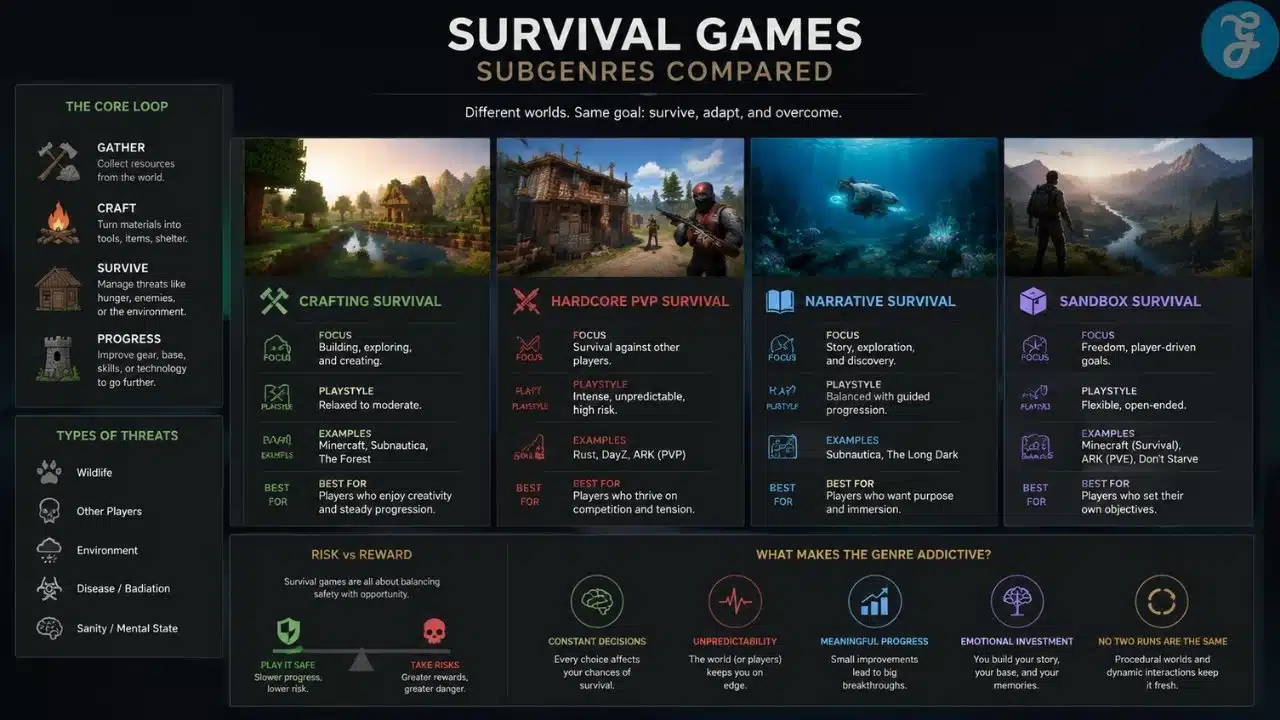
While the core loop—gather, craft, build, endure—remains constant, developers tweak the dials of malice to create entirely different subgenres.
1. Cozy Crafting & Safe Havens
Games like Minecraft or Valheim treat survival as a ladder you climb at your own pace. Yes, you need food and shelter, but the environment isn’t actively trying to erase your existence every five seconds. If you die, it’s a minor setback—you run back to your corpse, grab your gear, and keep building your mega-base. These games appeal to the architects and explorers who want the flavor of danger without the crippling anxiety.
2. Hardcore PvP: The Psychological Meatgrinder
On the dark end of the street sit Rust and DayZ. Here, the environment is just a minor inconvenience; the real monsters are the other players. Trust is a currency you can’t afford, and “gear fear” is a very real condition. You can spend two weeks building a fortress, logging off for a few hours of sleep, and waking up to find your walls blown open and your storage boxes completely cleaned out. It’s stressful, hostile, and utterly intoxicating because the stakes are genuinely absolute.
3. Narrative-Driven Isolation
Some games use the mechanics of scarcity to tell a specific story. In Subnautica or The Long Dark, hunger and thirst aren’t just tickers on a spreadsheet—they are narrative engines driving you deeper into the world. You brave the terrifying, pitch-black depths of a crater or a frozen wilderness not just to hoard resources, but to find out why you are there and how to escape.
4. Creative Sandboxes
The pure sandbox drops the pretense of a win condition altogether. The game gives you a massive set of interlocking systems: temperature management, infection mechanics, physics-based building, and says, “Good luck, make your own fun.” Success isn’t defined by beating a final boss; it’s defined by surviving one more night than you did last time.
The Rookie Trap Checklist
-
Rushing the Tech Tree: Trying to craft high-tier assault rifles or massive stone castles before securing a stable, reliable source of food and clean water.
-
Hoarding on Your Person: Walking around with hours’ worth of rare materials in your backpack instead of securing them safely in a base. If you get caught off guard, you lose everything.
-
Playing Blind and Loud: Ignoring stealth and situational awareness. In PvP survival, a single flashlight clicked on at the wrong time or a sprint through an open field, is a death sentence.
The Titans of the Genre: Survival in Practice
To really understand how these different philosophical approaches change your day-to-day gameplay, it helps to look at the games that define the genre. These four titles don’t just use different mechanics; they create entirely separate psychological experiences.
Minecraft and the Joy of Progression
Before it became a massive cultural creative platform, Mojang’s blocky survival mode laid the foundational groundwork for the entire modern genre. It serves as the ultimate casual entry point because it treats survival as a progressive ladder rather than a constant crisis. Your first night hiding in a dirt hole from skeletons might give you a brief spike of adrenaline, but the game quickly rewards you with a highly satisfying technological progression. Once you build automation, establish secure farms, and craft diamond armor, the survival elements blend into the background, giving you total freedom to shape the world.
Rust and the Pure Chaos of Human Nature
If Minecraft represents the gentle, rewarding side of crafting, Rust is a brutal psychological experiment disguised as a video game. Facepunch Studios drops you onto an island where the primary resource you are managing is human malice. The environment isn’t your biggest threat; it’s the other players roaming the fields. It introduces an intense form of high-stakes tension where losing a gunfight means your hours of grinding are completely gone, and going to sleep in real life means trusting that your base defenses can survive an offline raid. It is frustrating, hostile, and utterly intoxicating for players who thrive on maximum risk.
Subnautica and Oceanic Claustrophobia
Unknown Worlds took a different route by swapping out the endless, procedurally generated worlds for a hand-crafted, beautiful, and deeply terrifying alien ocean. Subnautica proves that survival mechanics don’t have to exist in a vacuum; they can serve as the engine for a brilliant sci-fi narrative. The loops of managing oxygen, gathering titanium, and hunting for food are all tied directly to your desire to explore deeper trenches and unravel the mystery of how to escape the planet. The fear doesn’t come from aggressive players, but from the vast, dark, and eerie depths of the ocean floor.
Project Zomboid and the Realism of Failure
Billed upfront as the explicit story of how your character died, Project Zomboid is an isometric masterclass in hardcore simulation. It abandons arcade mechanics entirely to focus on realistic, meticulous details. You aren’t just fighting off a zombie apocalypse; you are managing wound care, caloric intake, panic levels, boredom, and even depression. A single scratch from a zombie can spell a slow, agonizing end for a character you’ve kept alive for months, making it one of the most punishing yet rewarding sandboxes for creating unscripted, memorable tragedies.
Mapping the Mechanics of Danger
Every survival game distributes its mechanical pressure differently to appeal to separate types of players. The table below outlines how these four iconic titles handle death, progression, and the ultimate threat to your survival.
| Game | Main Threat Source | Penalty for Dying | Ultimate Objective |
| Minecraft | Environment & Night Monsters | Drop inventory items at your corpse | Defeat the Ender Dragon |
| Rust | Hostile Real-World Players | Total loss of gear and base control | Control the server during the wipe |
| Subnautica | Scarcity & Massive Deep-Sea Entities | Lose un-secured materials from inventory | Construct a rocket to escape the planet |
| Project Zomboid | Zombie Infections & Starvation | Permanent character loss and re-spawn | Survive as long as humanly possible |
Choosing Your Flavor of Pressure
Ultimately, the survival genre dominates platforms like Steam and Twitch because it understands that stress can be fun when it is balanced correctly. Whether you want to quietly chop wood to build a peaceful mountain cabin or experience the heart-pounding adrenaline of defending your fort from an enemy clan, there is a subgenre tailored to your specific tolerance for risk. The best survival experiences aren’t necessarily the ones with the most hyper-realistic graphics or complex mechanics; they are the ones that make the struggle feel entirely worth it when your plans finally come together.






















