


Learning a language has always had one awkward bottleneck: people need speaking practice, but real tutors are expensive, scheduled, and sometimes intimidating. That gap is exactly where AI Language Tutors have started to feel less like a gimmick and more like a serious EdTech category.
For this list, I compared the United States, China, and South Korea because all three have strong demand, AI capability, and language-learning momentum. The United States came out on top because it has the clearest concentration of verified SMEs and startups building dedicated AI speaking, pronunciation, and conversational tutoring products with global reach.
Our Selection Criteria
To keep this list useful and fair, I did not include large public companies, generic chatbot wrappers, or language apps where AI tutoring is only a small side feature. The goal was to find companies that are clearly positioned around language practice, speaking improvement, pronunciation, conversation, or AI-led tutoring.
I used these filters:
| Criteria | What It Means |
|---|---|
| Country fit | The company must be headquartered or legally based in the United States. |
| SME or startup profile | The company must be private, startup-led, or small to mid-sized rather than a large public corporation. |
| AI language tutoring relevance | AI must be central to the learning experience, not just a minor add-on. |
| Product availability | The company must have an active website, app, or commercial product. |
| Proof of traction | User base, app presence, funding, customer usage, accelerator backing, or public company profiles were considered. |
| Practical learner value | The tool must solve a real learner problem such as speaking confidence, pronunciation, fluency, or conversation practice. |
I also compared the top three country candidates before choosing the United States.
| Country Reviewed | Why It Was Considered | Final Decision |
| United States | Strong startup ecosystem, large language-learning market, clear public company data, and many active AI tutor products. | Chosen |
| China | Huge language-learning demand and strong AI development, but fewer globally transparent SME profiles for this specific niche. | Not chosen |
| South Korea | Strong English-learning culture and high app adoption, but fewer dedicated AI language tutor SMEs with global headquarters there. | Not chosen |
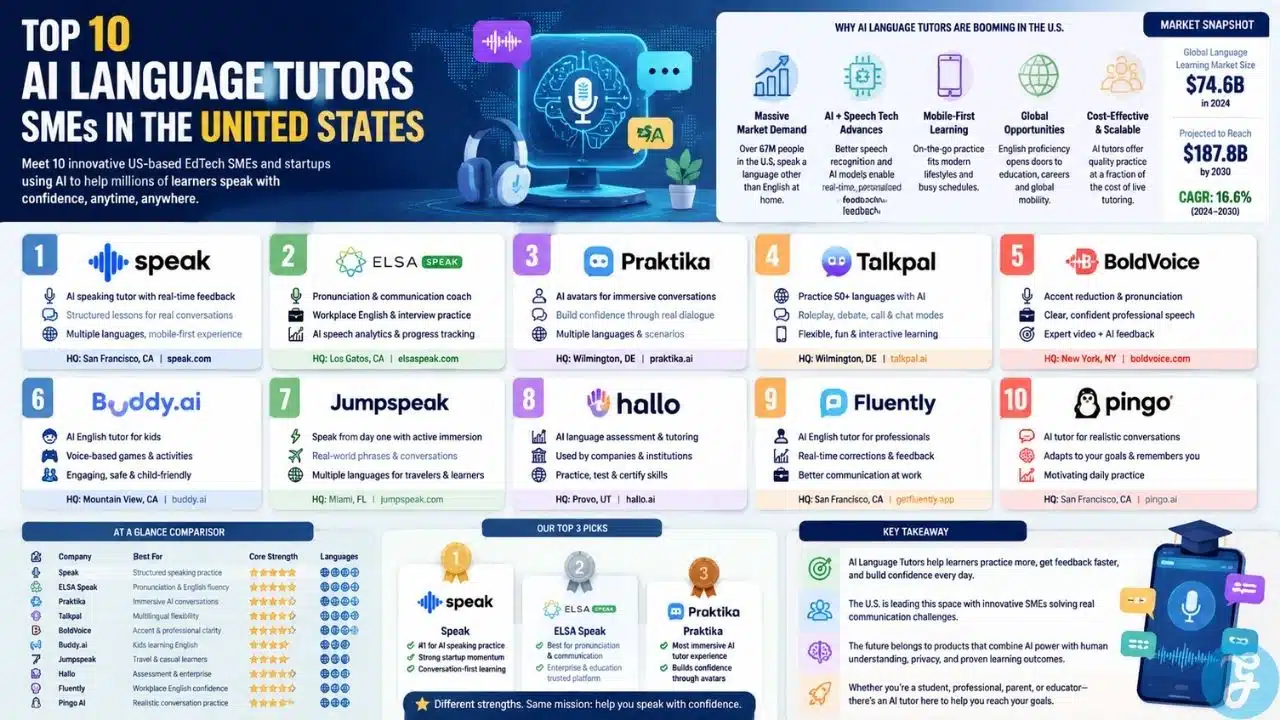
The Top 10 AI Language Tutors SMEs in the United States
The companies below are not identical. Some focus on English pronunciation, some on children, some on professional communication, and some on open conversation practice. That variety is exactly why the United States stands out in this niche.
1. Speak
Headquarters: San Francisco, California, United States
Website: www.speak.com
Email: support@speak.com
Speak is one of the strongest US startups in AI-led speaking practice. Its product is built around getting learners to talk out loud, receive instant feedback, and move through guided lessons with an AI tutor. The company has strong venture backing and has expanded beyond English into multiple languages. It is especially relevant because it treats speaking as the core learning action rather than a bonus activity.
Best for:
- Learners who want structured speaking practice with AI feedback.
- Users who want a polished, mobile-first language learning experience.
Why We Chose It:
- It is clearly positioned around AI tutoring and spoken fluency.
- It has strong startup credibility and global learner traction.
- Its product direction is focused on conversation-first learning.
- It offers a more complete learning path than many lightweight chatbot apps.
Things to consider:
- It may feel too app-driven for learners who want human coaching.
- Pricing and language availability should be checked by market.
2. ELSA Speak
Headquarters: Los Gatos, California, United States
Website: www.elsaspeak.com
Email: support@elsanow.io
ELSA Speak is a mature AI English communication platform focused on pronunciation, fluency, workplace communication, and speaking confidence. It uses speech recognition and AI feedback to help learners identify specific pronunciation issues and improve over time. ELSA also serves businesses and schools, which gives it stronger institutional relevance than many consumer-only apps. Its strength is not just conversation, but measurable communication improvement.
Best for:
- English learners who need pronunciation and speaking clarity.
- Businesses and schools that want scalable English communication training.
Why We Chose It:
- It has a long track record in AI-powered English learning.
- It serves individual learners, schools, and enterprise customers.
- It offers targeted practice for interviews, meetings, presentations, and workplace communication.
- It has strong brand recognition in the AI language learning space.
Things to consider:
- It is strongest for English rather than broad multilingual learning.
- Some learners may want freer conversation than pronunciation-focused coaching.
3. Praktika
Headquarters: Wilmington, Delaware, United States
Website: www.praktika.ai
Email: support@praktika.ai
Praktika uses AI avatars to create a more immersive private tutor experience. The app is designed around conversation, confidence, and daily language practice rather than traditional drills. Its avatar-based approach can make practice feel warmer and less mechanical for learners who struggle with speaking anxiety. Praktika is also one of the more visible AI tutor startups in this category.
Best for:
- Learners who want realistic tutor-style practice with AI avatars.
- Users who prefer conversation over textbook-style exercises.
Why We Chose It:
- Its AI tutors are central to the product, not an afterthought.
- It focuses on real-world speaking confidence.
- It has strong consumer visibility and mobile app traction.
- Its avatar format gives it a distinctive product identity.
Things to consider:
- Avatar-based learning may not appeal to everyone.
- Learners should review subscription terms carefully before committing.
4. Talkpal
Headquarters: Wilmington, Delaware, United States
Website: www.talkpal.ai
Email: support@talkpal.ai
Talkpal is an AI-powered language tutor platform built for broad language practice. It supports many languages and offers different practice modes, including chat, roleplay, call mode, debates, sentence practice, and character-based conversations. This makes it useful for learners who want variety and flexibility. Its biggest advantage is accessibility across many languages rather than deep specialization in one language.
Best for:
- Learners who want to practice multiple languages with AI.
- Users who like roleplay, debate, and conversation-based learning.
Why We Chose It:
- It offers one of the broadest language selections in this group.
- It gives learners multiple ways to practice speaking and writing.
- It is easy to access through web and mobile.
- It fits casual learners, travelers, students, and professionals.
Things to consider:
- Broad coverage can sometimes mean less depth per language.
- Learners preparing for high-stakes exams may need extra human feedback.
5. BoldVoice
Headquarters: New York, New York, United States
Website: www.boldvoice.com
Email: support@boldvoice.com
BoldVoice focuses on English pronunciation, accent clarity, and confident professional speech. Instead of trying to be a full language-learning platform, it goes deep into one painful learner problem: being understood clearly. The app combines expert-led video lessons with AI pronunciation feedback. This makes it especially useful for international professionals, job seekers, students, and speakers who already know English but want to sound clearer.
Best for:
- Non-native English speakers who want clearer pronunciation.
- Professionals preparing for interviews, meetings, presentations, or customer-facing roles.
Why We Chose It:
- It solves a very specific and valuable communication problem.
- It combines human expertise with AI feedback.
- It is useful for advanced learners who are past basic vocabulary.
- It has a strong workplace communication angle.
Things to consider:
- It is not a general multilingual learning app.
- Learners looking for full grammar and vocabulary courses may need another tool.
6. Buddy.ai
Headquarters: Mountain View, California, United States
Website: www.buddy.ai
Email: support@mybuddy.ai
Buddy.ai is built for children and uses a voice-based AI character to help young learners practice English. Its approach is playful, interactive, and designed around child-friendly engagement. Instead of expecting kids to follow adult-style lessons, Buddy uses games, voice interaction, and guided activities. This makes it one of the clearest examples of AI tutoring adapted for younger learners.
Best for:
- Children learning English through playful voice interaction.
- Families and educators looking for early speaking practice.
Why We Chose It:
- It specializes in child-focused AI tutoring.
- Its voice-based design fits young learners better than text-heavy apps.
- It has a clear EdTech use case for early English practice.
- It combines learning, speech practice, and game-like engagement.
Things to consider:
- Parents should supervise usage and review privacy settings.
- It is not designed for adult professional language learning.
7. Jumpspeak
Headquarters: Miami, Florida, United States
Website: www.jumpspeak.com
Email: support@jumpspeak.com
Jumpspeak is an AI-powered language learning app focused on speaking from day one. It uses active immersion, real-world phrases, and conversational practice to help learners feel comfortable using a new language quickly. The product is especially appealing to travelers and casual learners who want practical speech, not long theory. Its positioning is more direct and action-oriented than many older language apps.
Best for:
- Learners who want quick speaking practice for real situations.
- Travelers and casual learners who prefer active immersion.
Why We Chose It:
- It is focused on speaking confidence and practical usage.
- It supports multiple languages.
- It has a clear consumer app presence and public user feedback.
- It offers a different style from grammar-heavy platforms.
Things to consider:
- User reviews show mixed feedback around subscriptions and billing.
- Serious learners may still need structured grammar support elsewhere.
8. Hallo
Headquarters: Provo, Utah, United States
Website: www.hallo.ai
Email: support@hallo.ai
Hallo has evolved from language learning into a broader AI-powered language assessment and communication platform. It supports language practice, AI assessments, and skills evaluation, which gives it a stronger B2B and hiring-related angle. For learners, it offers AI-supported speaking practice across many languages. For companies, it can help evaluate language ability at scale.
Best for:
- Organizations needing language assessment and communication screening.
- Learners who want AI-supported speaking and language practice.
Why We Chose It:
- It connects AI language learning with assessment and employability.
- It supports many languages and professional use cases.
- It has a clear US startup profile.
- It shows how AI language tutoring is expanding beyond consumer apps.
Things to consider:
- Its current positioning is more assessment-heavy than some learner-first apps.
- Individual learners may prefer apps that focus only on daily tutoring.
9. Fluently
Headquarters: San Francisco, California, United States
Website: www.getfluently.app
Email: support@getfluently.app
Fluently is an AI English tutor built for people who already know some English but struggle to speak naturally and confidently. It focuses on realistic speaking practice, instant corrections, vocabulary improvement, pronunciation, and grammar feedback. Its main audience appears to be non-native professionals who need English for work, interviews, meetings, and everyday communication. The product is young, but its focus is sharp.
Best for:
- Non-native English speakers who need workplace fluency.
- Learners who want corrections after real speaking practice.
Why We Chose It:
- It targets an important gap between knowing English and using English confidently.
- It is designed around speech, not passive memorization.
- It has startup backing and a clear AI tutor identity.
- It is especially relevant for professional communication.
Things to consider:
- It is newer than ELSA, Speak, or BoldVoice.
- Learners should test whether its feedback style matches their goals.
10. Pingo AI
Headquarters: San Francisco, California, United States
Website: www.pingo.ai
Email: founders@mypingoai.com
Pingo AI is a newer AI language learning startup focused on helping users build fluency through realistic conversations. Its AI tutor adapts to learner goals, remembers progress, and encourages low-pressure speaking practice. The company has reported strong early traction, which makes it worth watching even though it is younger than most companies on this list. Its biggest promise is making daily language practice feel more like a natural conversation than a classroom task.
Best for:
- Learners who want realistic AI conversation practice.
- Early adopters looking for a newer AI-first language tutor.
Why We Chose It:
- It is built directly around conversational AI tutoring.
- It has a clear startup profile and accelerator backing.
- It focuses on motivation, memory, and realistic dialogue.
- It represents the next wave of smaller AI-native language learning companies.
Things to consider:
- It is still early compared with more mature platforms.
- Product depth and language coverage may change quickly.
An Overview of United States AI Language Tutors SMEs
The US market is not leading because every company is perfect. It is leading because it has enough startup density, capital access, AI talent, consumer app distribution, and global learner demand to produce many different versions of the same core idea.
Overview Comparison Table
The snapshot below makes it easier to compare these companies by learner type, product focus, and practical strength.
| Rank | Company | Headquarters | Core Focus | Best Fit |
| 1 | Speak | San Francisco, California | AI speaking tutor | Structured speaking practice |
| 2 | ELSA Speak | Los Gatos, California | English pronunciation and communication | English fluency and workplace clarity |
| 3 | Praktika | Wilmington, Delaware | AI avatar tutors | Immersive conversation practice |
| 4 | Talkpal | Wilmington, Delaware | Multi-language AI tutor | Flexible multilingual learning |
| 5 | BoldVoice | New York, New York | Accent and pronunciation coaching | Professional English clarity |
| 6 | Buddy.ai | Mountain View, California | AI English tutor for kids | Young learners and families |
| 7 | Jumpspeak | Miami, Florida | Active immersion language learning | Travel and casual speaking practice |
| 8 | Hallo | Provo, Utah | AI language assessment and tutoring | B2B language screening and practice |
| 9 | Fluently | San Francisco, California | AI English tutor for professionals | Workplace English confidence |
| 10 | Pingo AI | San Francisco, California | AI conversation tutor | Realistic dialogue practice |
From that snapshot, three companies stand out for different reasons: one for scale, one for speech intelligence, and one for immersive AI tutoring.
Our Top 3 Picks and Why?
1. Speak
Speak is the strongest overall pick because it is deeply focused on AI speaking practice and has the clearest startup momentum. It is not just adding AI to an old model. Its whole product philosophy is built around making learners speak out loud as much as possible.
2. ELSA Speak
ELSA Speak is the best pick for English pronunciation and measurable communication improvement. It has a strong product history, enterprise relevance, and a practical focus on real-world English moments such as meetings, interviews, presentations, and workplace conversations.
3. Praktika
Praktika is the most interesting pick for immersive AI tutor experiences. Its avatar-based format makes language practice feel more personal, which matters because many learners fail not from lack of content, but from fear of speaking.
Why Are AI Language Tutors Booming in the United States
This category is growing because it solves a very human problem at software scale. People do not just want to “study” a language anymore. They want to speak it without freezing, embarrassing themselves, or paying for a private tutor every week.
Several forces are pushing the boom in the United States. The country has a large immigrant population, a huge international student market, global companies with multilingual teams, and strong demand for English communication training. At the same time, US startups have easy access to cloud AI infrastructure, speech recognition tools, app distribution channels, and venture capital.
The strongest products in this category are not selling AI for the sake of AI. They are selling confidence. That is why pronunciation feedback, interview practice, roleplay, accent coaching, and workplace English are becoming so important.
What’s Special About Them?
Their secret sauce is the shift from passive learning to active speaking. Traditional apps made learners tap, match, translate, and memorize. These startups are trying to make learners talk, listen, respond, fail safely, and try again.
Another strength is personalization. A good AI tutor can adjust to a learner’s level, native language, weak sounds, job goals, travel needs, and confidence gaps. That is hard to do with static lessons.
The third advantage is availability. A human tutor may be better in many ways, but a human tutor is not always awake, affordable, patient, or available at the exact moment a learner wants to practice. AI tutors win on convenience.
Still, the uncomfortable truth is that convenience can be mistaken for mastery. Talking to an AI every day can help a learner improve, but it does not fully replace real human conversation, cultural nuance, live correction, and natural pressure. The best future is probably not AI instead of human teachers. It is AI for daily practice and human teachers for depth, nuance, and accountability.
What Comes Next for AI Language Tutors in the United States
AI Language Tutors are moving from novelty to infrastructure. In the next few years, the winners will not be the apps with the flashiest avatars or the loudest marketing. The winners will be the companies that can prove real learning progress, protect learner data, handle accents fairly, and avoid turning education into another subscription trap.
My honest view is that the category has huge promise, but also a trust problem. Many learners are tired of apps that overpromise fluency, hide billing details, or make practice feel productive without proving progress. The next serious phase will need better assessment, clearer learner outcomes, and more honest positioning.
The best US SMEs in this space are already pointing toward that future. Speak is pushing conversation-first learning. ELSA is making pronunciation measurable. Praktika is making AI practice feel more human. BoldVoice is showing that accent clarity is not vanity, but career access.
The future belongs to companies that remember one thing: language is not just content. It is identity, confidence, culture, and human connection. AI can help people practice more often, but it must not pretend that fluency is only a feature inside an app.
Frequently Asked Questions (FAQs) About AI Language Tutors
These quick answers address the most common questions learners, parents, and businesses may have before choosing a platform.
Are AI Language Tutors replacing human teachers?
Answer: Not fully. They are better for daily practice, instant feedback, and low-pressure repetition. Human teachers are still stronger for cultural nuance, emotional understanding, advanced correction, and accountability.
Which US AI language tutor is best for English pronunciation?
Answer: ELSA Speak and BoldVoice are two of the strongest options for pronunciation and clarity. ELSA is broader for English communication, while BoldVoice is especially useful for accent and professional speech.
Which AI language tutor is best for children?
Answer: Buddy.ai is the clearest child-focused option on this list. It uses voice interaction, games, and a playful AI character to help young learners practice English.
Are AI language tutors good for business English?
Answer: Yes, especially for meetings, interviews, presentations, and customer-facing communication. ELSA Speak, BoldVoice, Fluently, and Praktika are especially relevant for professional English practice.
What should learners check before paying for an AI language app?
Answer: Check supported languages, refund rules, subscription renewal terms, privacy policies, and whether the app gives useful feedback beyond generic encouragement. A free trial is helpful, but only if the cancellation terms are clear.






















