The evolution of the role-playing game is essentially the story of video gaming itself. What started as a humble attempt to translate the complex math and collaborative storytelling of tabletop games into digital code has grown into the most dominant force in modern entertainment.
Today, the mechanics born in the niche computer labs of the late twentieth century have spread into almost every corner of the gaming industry. Progression loops, skill trees, and narrative choices are no longer exclusive to traditional fantasy adventures. They serve as the foundational scaffolding that holds together everything from multiplayer competitive shooters to yearly sports simulations.
Yet, as the genre has expanded, its definition has become increasingly muddy and difficult to pin down. If a video game features a leveling system and customizable gear, does that automatically make it a role playing game? Not necessarily. To truly understand this massive ecosystem, we have to look past the superficial elements and examine the core structures that define these virtual worlds. By looking at the authentic history, analyzing the distinct RPG subgenres, and breaking down the complex mechanics that drive player engagement, we can trace a clear line from the foundational classics to the sophisticated hybrids of today.
The True Foundations of the Digital Role Playing Game
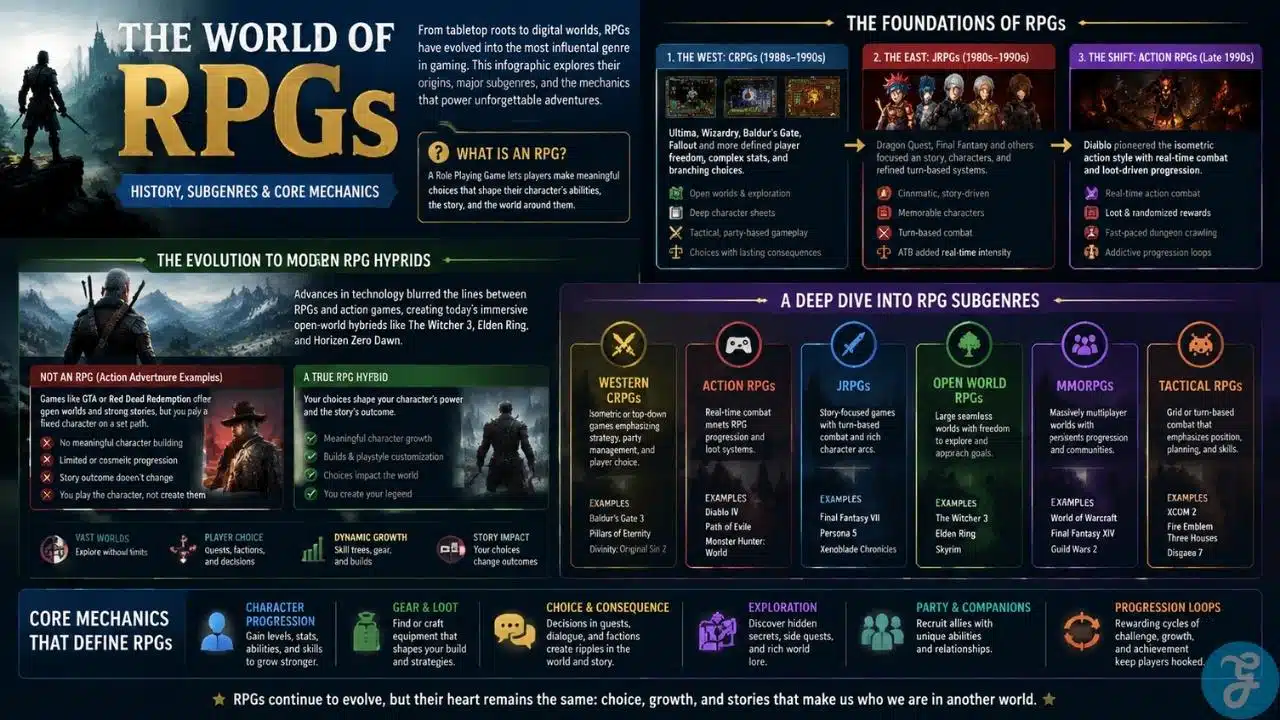
To understand where the genre stands today, we must first correct the historical timeline and recognize the original pioneers that built the foundation. The true bedrock of the digital role playing game was poured in the late 1980s and 1990s through two distinct geographical and stylistic design philosophies. These early interactive experiences did not just introduce basic mechanics. They established the fundamental ways players interact with digital environments and narrative structures.
In the West, early computer gaming was defined by the classic Computer Role Playing Game. Crucial titles like Ultima, Wizardry, and later the original Baldur’s Gate and Fallout releases focused heavily on player agency and tactical simulation. These games attempted to replicate the total freedom of a human tabletop game master. They gave players open fields, complex character sheets packed with traditional statistics like strength and charisma, and branching quest lines where moral choices had tangible, permanent consequences on the virtual world state. Success in these games relied heavily on understanding the underlying math and optimizing your party composition to survive brutal encounters.
Simultaneously across the Pacific Ocean, Japanese developers were creating an entirely different mechanical lineage. The Japanese Role Playing Game streamlined the obtuse menus of early personal computer systems to focus on highly curated, beautifully cinematic narratives. Juggernauts like Dragon Quest and Final Fantasy traded open ended player agency for deeply authored stories, memorable character casts, and highly structured turn based combat systems. Eventually, franchises like Final Fantasy introduced the Active Time Battle system. This innovation injected a thrilling sense of urgency and real time pressure into traditional turn based decision making, forcing players to think quickly under fire.
By the late 1990s, the genre fractured once again with the arrival of Diablo. This monumental release pioneered the isometric action style, stripping away slow tactical planning in favor of real time clicking, dark dungeon crawling, and an incredibly addictive loot driven reward loop. These foundational games established the baseline definitions of progression and mechanical mastery that still govern the global industry.
The Anatomy of Modern Action and Open World Hybrids
As hardware capabilities expanded during the early 2000s and beyond, the rigid boundaries separating role playing games from pure action titles began to erode completely. This inevitable cross pollination created the modern action hybrid space we see dominating sales charts today. Titles like The Witcher 3, Elden Ring, and Horizon Zero Dawn represent this evolution perfectly. They blend real time physics, dodge mechanics, and reflex driven combat with traditional narrative depth and statistical character growth.
This hybrid evolution has caused significant confusion regarding genre classification among modern players. For example, popular action adventure games like Grand Theft Auto or Red Dead Redemption are frequently mislabeled as role playing experiences because they feature massive open worlds, deep stories, and light progression elements like clothing customization or minor stamina increments. However, these blockbuster titles completely lack the foundational systems of a true role playing game. In an action adventure sandbox, you are piloting a specific, pre written character through a tightly scripted narrative path. You can cause chaos in the open world, but you cannot change the fundamental mechanics of who your character is. In a genuine hybrid, your mechanical choices drastically alter the capabilities of your avatar, and your narrative decisions rewrite the actual outcome of the story.
Modern hybrids succeed by balancing two distinct elements which are spatial freedom and mechanical flexibility. Players are no longer confined to linear corridors or rigid turn based combat grids. They explore vast, seamless landscapes, choosing which quests to pursue and which political factions to support. Character growth happens dynamically. Instead of simply watching a generic number increase after a boss battle, players allocate points into sprawling skill trees, craft bespoke armor sets that complement highly specific playstyles, and navigate complex dialogue wheels that determine the fate of entire virtual cities.
A Deep Dive into Distinct RPG Subgenres
The modern gaming landscape is far too large to view as a single uniform entity. Over the decades, the overarching genre has split into highly specialized RPG subgenres, each catering to a completely different player mindset and psychological reward mechanism. Understanding these divisions is crucial for finding the exact type of experience you want to invest your time into.
Classic Computer Role Playing Games
Modern iterations of the classic computer style, such as Baldur’s Gate 3 and Disco Elysium, remain incredibly faithful to their tabletop roots. These games prioritize deep narrative reactivity and complex dialogue trees over fast paced action. They utilize isometric camera angles and rely heavily on behind the scenes dice rolls to determine the success or failure of your actions. Every single stat point matters, and players can often talk their way out of a violent confrontation if they have invested heavily into speech and charisma skills.
Tactical Strategy Experiences
Tactical role playing games shift the focus away from individual reflexes and place it entirely on macro level strategy and spatial positioning. Games like Fire Emblem, Final Fantasy Tactics, and Tactics Ogre treat combat like a highly complex game of fantasy chess. Arenas are divided into strict grids, and players must carefully manage terrain height, directional facing, and specialized character classes. A single misstep can lead to permanent character death, forcing players to prioritize long term foresight over immediate, flashy gratification.
The Roguelite Progression Loop
The revival of classical design philosophies has made the roguelite category incredibly popular among independent developers. Highly acclaimed titles like Hades or Dead Cells retain the procedural generation and high difficulty of traditional arcade games but introduce permanent progression systems. When you die in a roguelite, you return to a central base hub where you can use collected resources to permanently upgrade your overall health, unlock better weapons, or gain passive defensive buffs. This design loop creates a highly satisfying rhythm, ensuring that failure always feels like a step toward ultimate victory rather than a punishing setback.
Massively Multiplayer Online Worlds
Massively multiplayer online games, like World of Warcraft and Final Fantasy XIV, turn digital progression into a deeply social, cooperative experience. In these persistent online worlds, character growth is designed to span months or even years of dedicated play time. The core gameplay loop shifts away from isolated, single player storytelling and moves toward community cooperation, massive economic management, and highly coordinated endgame dungeon raids. Social interaction is not just an auxiliary feature. It functions as a primary, required gameplay mechanic for anyone looking to see the most challenging content available.
The Core Systems that Drive Player Engagement
Regardless of which specific category a game falls into, every successful title relies on a delicate balance of foundational pillars. When these specific systems work in harmony, they create an intoxicating sense of total immersion. When they fail, the game quickly feels like a tedious, mathematical grind.
Responsive progression loops are the heartbeat of the genre. A great game must make the player feel the tangible weight of their time investment. This is achieved by combining vertical progression, which includes traditional level-ups and raw stat increases, with horizontal progression, which gives players access to entirely new tactical abilities, devastating magic spells, or stealth options that fundamentally change how combat is approached.
Furthermore, narrative resonance and true player choice must be present. The story cannot simply act as pretty window dressing for the combat sequences. Player decisions must have real, systemic weight in the virtual world. When a player makes a difficult choice during a major quest line, that single decision should ripple outward. It should alter faction reputations, change local vendor prices, completely lock out certain subsequent storylines, and organically open up entirely new narrative paths.
Finally, compelling world design is absolutely required. The game world must function as an active participant in the overarching experience rather than a static, passive backdrop. Excellent world design naturally rewards organic curiosity. It encourages players to venture off the strictly beaten path by deliberately hiding unique lore documents, subtle environmental storytelling cues, hidden boss fights, and incredibly rare equipment deep within the landscape.
Choosing the right experience requires a solid understanding of what your personal gaming preferences actually are. Because the various RPG subgenres have become so specialized over the years, they demand completely different skills and mindsets from the player. The table below breaks down the primary focus of these distinct categories so you can find the perfect match for your playstyle.
| Game Category | Primary Player Reward | Core Skill Required |
| Tactical Strategy | Intellectual satisfaction from flawless execution | Spatial awareness and long term planning |
| Action Hybrids | Visceral thrill of mechanical mastery over time | Adaptability and reflex driven execution |
| Computer Classic | Deep narrative immersion and total freedom | Critical thinking and text comprehension |
| Massively Multiplayer | Social prestige and long term community status | Cooperation and rigid daily scheduling |
The Future of Virtual Storytelling
Role-playing games continue to innovate at a blistering pace, refusing to stay confined to their historical boundaries. As development studios integrate advanced procedural generation, dynamic dialogue systems driven by reactive design, and incredibly seamless physics engines, the line between developer authorship and true player agency will only continue to blur. The genre remains incredibly vital because it directly addresses the fundamental human desire for personal growth, meaningful agency, and compelling escape.
Whether you are carefully planning a grid-based attack in a tactical simulator, optimizing a highly complex character build in a dark dungeon crawler, or navigating a morally gray political landscape in a text-heavy space epic, the underlying magic remains exactly the same. A properly crafted game provides an unparalleled canvas for personal expression, ensuring that no two players will ever experience the exact same digital journey.