AI tools for passive income have compressed the build phase in ways that weren’t possible even two years ago: what used to take months of writing, designing, recording, and packaging now takes days. Passive income has always followed the same logic: build once, earn repeatedly, but the cost and timeline of that build have shifted fundamentally. AI has restructured creation economics in ways that matter most to solopreneurs working alone, and that shift is one of the defining changes in the creator economy in 2026.
The problem is that most articles covering AI side hustles recycle the same tool names without telling you the actual setup time, the realistic earnings ceiling, or which tools produce sellable outputs versus which ones just help you think faster. That gap between capability and outcome is where most people stall.
Building Rankpilot.ai and ImagineLab.art gave us a firsthand view into which tools actually belong in a passive income stack and which ones look impressive in demos but fall apart in production. That’s an honest, anecdotal observation based on our own build process, not a formal benchmark. This article shares what that experience taught us, combined with what the broader creator community is reporting in 2026. By the end, you’ll have one concrete workflow, a realistic income range, and a clear 30-day starting point. No coding required.
What Makes an AI Tool Worth Building a Passive Income Stack Around
Not every AI tool is a passive income tool. That distinction matters more than most guides acknowledge, and getting it wrong is how people spend weekends building workflows that require daily attention to generate any revenue at all.
Three qualities that separate income-generating tools from productivity aids
Every tool in this article was evaluated against three criteria. The first is automation depth: can the tool continue working without you after the initial setup, or does it need constant prompting and supervision? The second is monetization clarity: does the tool produce a sellable output directly, an ebook draft, an image pack, or a course video, or does it only help you produce that output faster?
The third is compounding potential: does the asset build value over time? SEO content earns traffic for years. A growing image library generates more listings. These are compounding assets. A productivity shortcut is not.
Tools that score well on all three criteria are genuinely useful for building AI-generated digital products. Tools that only score well on one are productivity aids, and the difference matters before you invest setup time.
Why most “AI income” advice fails solopreneurs
The advice fails because it conflates capability with automation. A tool that drafts emails faster is not a passive income machine. A tool that produces a finished digital product you can list on a marketplace and sell while you sleep is a different category entirely. Solopreneurs with limited hours need that distinction spelled out before they invest setup time. The tools below meet all three criteria, which is why they made this list.
AI Tools for Passive Income: Writing and SEO Content Assets
Content is the most defensible passive income asset in the creator economy because it compounds. A well-optimized article earns traffic in month one, month twelve, and month thirty-six. That compounding dynamic is what separates content-driven income from one-time product launches, and it’s why AI writing and SEO tools belong at the center of any serious passive income stack.
Rankpilot.ai and the SEO-first content income model
SEO-optimized content functions as a passive income asset because the effort is front-loaded and the returns are extended. You write and optimize once; the article earns affiliate commissions or ad revenue for months and years without ongoing work. Rankpilot.ai is built specifically for this workflow, handling keyword research, content structure, and on-page optimization inside a single pipeline.
That means you’re not switching between five tools to produce one publishable piece. Editorialge uses Rankpilot.ai to publish across multiple verticals without adding headcount. Based on our internal production experience, the workflow consolidation is meaningful compared to running separate SEO and writing tools manually.
Based on self-reported figures in creator communities and 2026 platform surveys, creators using AI writing and SEO tools are reporting monthly earnings in the $500 to $5,000 range, with established creators tending to cluster around $2,000 per month. Beginners typically land between $500 and $1,000 before their content library reaches critical mass.
Claude and ChatGPT for ebooks and sellable long-form products
For digital product creation, Claude is the stronger choice for long-form drafting. Ebook chapters, comprehensive guides, and workbooks all benefit from Claude’s ability to sustain coherent structure across thousands of words. ChatGPT handles outlines, section variants, and multimodal tasks well and works effectively as a complement. A usable ebook draft can be produced in two to eight hours.
Adding a cover, formatting, and a Gumroad or Payhip checkout adds another day. This is the lowest-barrier AI monetization entry point for most creators, precisely because the product type is familiar, the tools are accessible, and the sales platforms are already built.
AI Tools for Passive Income: Image and Creative Product Workflows
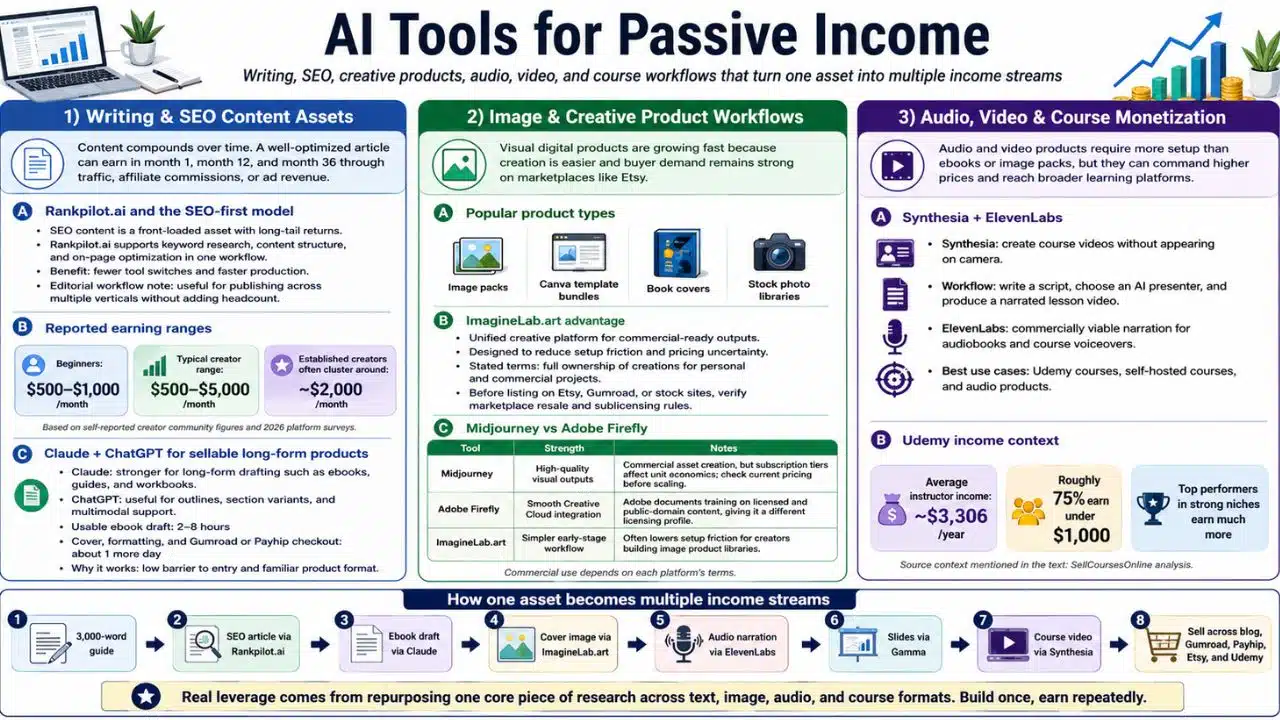
Visual digital products are one of the fastest-growing categories in AI-generated income because the creation barrier has dropped dramatically while buyer demand on platforms like Etsy continues to rise. Image packs, Canva template bundles, book covers, and stock photo libraries are all viable product types for creators who can generate quality visual assets consistently. Choosing the right AI tools for creators in this category comes down to commercial licensing clarity and setup cost.
ImagineLab.art and the AI creative platform advantage
ImagineLab.art functions as a unified creative platform designed for creators who want commercial-ready outputs without per-image pricing anxiety or a steep learning curve. According to the platform’s stated terms, it grants full ownership of your creations for personal and commercial projects, which is the licensing clarity that matters most when you’re listing products for sale.
Before listing any AI-generated image on a third-party marketplace, verify the specific resale terms for that platform. ImagineLab.art’s commercial-use rights provide a solid starting point, but checking whether sublicensing terms apply to your specific marketplace (Etsy, Gumroad, stock sites) is a five-minute step worth taking before you list.
Midjourney and Adobe Firefly: where the market compares
Midjourney produces high-quality visual outputs and is widely used for commercial asset creation. It requires Discord familiarity to operate, and at higher usage volumes its subscription tiers affect unit economics for image pack sellers; check Midjourney’s current pricing page for the plan-specific details before committing to a volume-heavy workflow.
Adobe Firefly integrates cleanly with Creative Cloud and, according to Adobe’s documentation, is trained on licensed and public domain content, which gives it a different commercial licensing profile than tools trained on scraped data. Midjourney’s terms permit commercial use of the assets you generate, but they separately prohibit reselling service access, so selling a finished image pack is a different situation from reselling Midjourney itself. For creators starting out, ImagineLab Art tends to reduce setup friction and pricing uncertainty at the early stages of building an image product library.
Automated Pipelines for Audio, Video, and Digital Courses
Audio and video products have a higher setup ceiling than ebooks or image packs, but they also command higher prices and reach platforms where text-based products can’t compete. The AI tools in this category have matured enough in 2026 to produce commercially viable outputs without on-camera presence or professional recording equipment.
Synthesia and ElevenLabs for course and audio monetization
Synthesia allows course creation without appearing on camera. You write the script and select an AI presenter; the tool then produces a narrated video suitable for Udemy or a self-hosted course platform. ElevenLabs handles narration for audiobooks and course voiceovers at a quality level that’s commercially viable and largely indistinguishable from human narration in most listening contexts.
The Udemy platform context is worth knowing: according to analysis from SellCoursesOnline, the average instructor earns around $3,306 per year, with roughly 75% earning under $1,000. Top performers and niche-specific courses significantly outperform those averages. The income variable is niche selection and positioning, not just the quality of the AI tools used.
How content pipelines turn one asset into multiple income streams
The real leverage in AI automation for income comes from multiplying a single content asset across formats. A 3,000-word guide becomes an ebook draft via Rankpilot.ai and Claude. The ebook cover comes from ImagineLab.art. A narrated audio version is produced with ElevenLabs. The same content, structured as slides in Gamma and narrated via Synthesia, becomes a short course on Udemy.
Each format sells on a different platform, multiplying income from the same core research and writing investment. This is where the “build once, earn repeatedly” premise actually holds up, because the core intellectual work only happens once.
What the Income Numbers and Setup Time Actually Look Like
Honest income expectations are more useful than motivational estimates. The data points to realistic ranges, and knowing those ranges helps you pick a workflow that fits your timeline and risk tolerance rather than chasing an outlier result.
Realistic earnings ranges by product type
A paid community of 300 members can generate $6,000 to $8,000 per month, but building that audience takes months of consistent output and relationship-building. Digital download income starts modest and compounds with volume and SEO distribution. The fastest revenue typically comes from digital products on established marketplaces like Etsy and Amazon KDP, where platform traffic does some of the discovery work for you.
These are honest benchmarks, not discouraging ones. The goal is calibration: pick a workflow that produces your first $200 to $500 in month one, then scale from there. If you want a broader set of passive income business ideas and formats to consider, the chamber’s roundup is a useful reference for traditional and digital options.
Setup time follows a predictable pattern. A simple digital download can go from idea to live checkout in a single day if the asset is ready. Subscriptions and memberships take one to three days because recurring billing and access control add configuration steps. Course products using Synthesia and ElevenLabs typically take three to seven days for a minimum viable version, including scripting, production, and platform setup.
IP and copyright basics you need to know before selling
The U.S. Copyright Office’s position is that purely AI-generated content, without meaningful human contribution, is generally not eligible for copyright protection. This matters for enforcement and exclusivity: if you can’t register a copyright, your ability to prevent copying and issue takedowns is limited. The practical solution is to add meaningful human editing, curation, and arrangement to establish authorship.
Selection and arrangement can qualify as human authorship even when the underlying generation was AI-assisted. Platform terms of service govern commercial use rights separately from copyright law, so you need to check both. Review the TOS for any tool you use before listing products for sale, particularly for image-based products where licensing clarity varies across platforms. For a deeper look at policy and rights implications around AI-generated content, see this analysis of AI-generated content and IP rights challenges.
How to Pick One Workflow and Start within 30 days
Picking one workflow and committing to it produces better results than studying ten workflows and starting none of them. The sections below are structured to help you match a starting point to what you already know, which is consistently the fastest path to a first sellable product when you’re using AI tools for passive income.
Matching the right workflow to your existing skills
Content writers should start with Rankpilot.ai for SEO-driven content income or Claude for an ebook. Designers and visual creatives should start with ImagineLab.art for an image pack or Canva template bundle. Educators and subject matter experts should start with Synthesia and Gamma for a short course on a platform with built-in traffic.
The fastest path to passive income is always the one that extends what you already know. Learning a new skill set while simultaneously building a product and setting up a sales pipeline multiplies both the time required and the friction involved.
The minimum viable passive income stack
A three-tool starting configuration covers most use cases: one creation tool (Rankpilot.ai, ImagineLab.art, or Claude); one sales platform (Gumroad, Etsy, or Amazon KDP, depending on product type); and one delivery automation (most platforms handle this natively). The setup-to-earning window is one to three days for digital downloads once the asset is ready. That timeline is the main reason digital products remain the recommended entry point for anyone new to AI-generated income streams.
Start with Rankpilot.ai if your background is writing or content strategy; it handles keyword research, content structure, and on-page optimization in a single pipeline, which removes the tool-switching overhead that slows most content creators down. Start with ImagineLab.art if your background is visual or design, the commercial licensing terms and consolidated platform reduce the setup decisions you’d otherwise face across multiple tools.
Where the Opportunity Stands in 2026
The AI tools for passive income that actually work share the same qualities: compounding assets, real automation depth, and monetization clarity from day one. The highest-leverage starting points in 2026 are content pipelines anchored by SEO-first writing tools like Rankpilot.ai and creative asset libraries built with platforms like ImagineLab.art. Those two categories have the clearest path from setup to recurring income with the lowest barrier to entry.
The income numbers take time to build. To illustrate how compounding works in practice: a content library earning $2,000 per month at month twelve likely looked closer to $200 per month at month two; the early numbers are not the final numbers, and the growth is a function of consistent output, not luck. That pattern is real, and it requires starting rather than optimizing indefinitely.
Pick the workflow that matches your existing skills from the sections above. Set up the minimum viable stack this week. The 30-day window is a realistic production timeline for a first sellable product, not a marketing device. The solopreneurs who are building durable AI-monetization positions right now are doing so by executing on a single workflow rather than researching all of them.