Most SEO problems do not start with writing. They start before writing. A site owner picks a topic because it sounds useful. A writer builds a long article around it. The editor publishes it, adds a few internal links, and waits. A few weeks later, Search Console shows almost nothing. Low impressions. No meaningful clicks. Maybe the page is indexed, but nobody seems to care.
That is usually not just a content problem. It is often a keyword research problem. Keyword research fundamentals are not about collecting a long list of phrases and stuffing them into headings. That version of SEO belongs in the past. In 2026, keyword research is about understanding demand, search intent, topic depth, language patterns, competition, and the reader’s next step.
A keyword tells you what someone typed. Good research tells you why they typed it. That difference matters now more than ever. Search results are no longer just blue links. People see AI Overviews, featured snippets, videos, images, shopping panels, forums, social results, and brand pages. Some users click. Some scan. Some refine their query. Some ask AI tools before they ever land on a website.
So the goal is not only to “find keywords.” The goal is to find the right search opportunities, match them with the right page type, and build content that deserves to be chosen. That is where real keyword strategy begins.
Why Keyword Research Still Matters in 2026
Keyword research is still one of the most important parts of SEO, but the way we use it has changed. Older SEO workflows often treated keywords like targets on a wall. Pick one. Repeat it. Add variations. Hope for rankings. That approach created a lot of stiff, repetitive content that looked optimized but did not actually help anyone. Modern SEO needs a better approach.
Search engines are better at understanding meaning, context, related entities, and intent. AI search features can interpret broader questions and show synthesized answers. Users are also more specific now. They search with full questions, comparison phrases, problem-based queries, and conversational prompts.
Still, keywords matter because they reveal demand. They show how people describe a topic in their own language.
A content team may call something “organic discoverability planning.” Real people may search “how to get more traffic from Google.” A SaaS company may say “workflow automation solution.” Customers may search for “best tools to automate invoices.”
Keyword research keeps you honest. It forces your content strategy to meet the reader where they are, not where your internal team wishes they were.
What Keyword Research Actually Means
Keyword research is the process of finding, studying, grouping, and prioritizing the search terms people use when they look for information, products, services, comparisons, or solutions. But that definition is only the surface.
In real SEO work, keyword research answers practical questions:
- What are people searching for?
- What problem are they trying to solve?
- Are they beginners or experienced users?
- Do they want a quick answer, a guide, a comparison, a product, or a service?
- Which keywords deserve separate pages?
- Which keywords should be grouped into one article?
- Which topics support the main pillar?
- Which terms are too competitive right now?
- Which low-volume terms may still bring valuable traffic?
- Which keywords fit the business goal?
That last question matters. A keyword can have search volume and still be wrong for the site. A beginner blog about SEO does not need to chase every enterprise SEO software keyword. A small e-commerce shop does not need to target every broad shopping term.
A media site should not publish dozens of near-identical articles just because tools show slight keyword variations. Good keyword research is not just data collection. It is editorial judgment.
Keyword Research Basics: Start With the Reader, Not the Tool
The easiest mistake is opening a keyword tool too early. Tools are useful, but they do not know your reader the way you should. They can show search volume, keyword difficulty, cost-per-click, related terms, and trends. They cannot always tell you which question is most urgent, which angle is more useful, or which page your audience actually needs. Start with the reader first.
Ask:
- Who is searching this?
- What do they already know?
- What are they confused about?
- What result would actually satisfy them?
- What should they do after reading?
- Would this topic help build trust, traffic, leads, sales, or authority?
For this article, the searcher looking for “keyword research fundamentals” is likely not an advanced technical SEO. They probably want a clear explanation of keyword research basics, how to find keywords, how to group them, and how to build a keyword strategy without getting lost in tools.
That means this article should not begin with advanced formulas or tool screenshots. It should explain the foundation first, then move into practical steps. Search intent decides the article shape.
The Difference Between Keywords and Search Intent
A keyword is the phrase someone types. Search intent is the reason behind the search. This is where many SEO articles fail. They target the keyword but miss the intent.
Take the keyword “best keyword research tools.” The searcher probably wants comparisons, pricing notes, use cases, strengths, limitations, and recommendations. A simple definition of keyword research would not satisfy them.
Now, take “what is keyword research?” That searcher likely wants a beginner-friendly explanation. If you throw them into advanced competitor gap analysis immediately, they may leave.
For “keyword research fundamentals,” the intent is educational and strategic. The reader wants to understand the basics, but they also want a workflow they can use. That means the article needs both explanation and practical guidance.
Four Common Search Intent Types
Most keywords fall into a few broad intent groups.
- Informational intent means the user wants to learn. Examples include “what is keyword research,” “keyword research basics,” and “how search engines crawl.”
- Commercial intent means the user is comparing options. Examples include “best keyword research tools” or “Ahrefs vs Semrush.”
- Transactional intent means the user may be ready to buy, sign up, download, or contact someone.
- Navigational intent means the user wants a specific brand, website, product, or page.
These categories are useful, but they are not perfect. Some searches are mixed. A person searching “keyword strategy basics” may want education now, but may later need an SEO tool, template, or service. That is why content should not only answer the current query. It should also guide the next step naturally.
Finding Keywords Without Turning the Process Into a Mess
Finding keywords starts with seed ideas. A seed keyword is a broad phrase that describes the main topic. For this cluster, seed terms could include:
- Keyword research
- Keyword research fundamentals
- Keyword research basics
- Finding keywords
- Keyword strategy basics
- SEO keyword research
- Search intent
- Content keyword planning
These are not all final targets. They are starting points. From there, you expand.
Use Google autocomplete, People Also Ask, related searches, Google Trends, Search Console, Keyword Planner, SEO tools, competitor pages, Reddit threads, YouTube search suggestions, and customer questions. For editorial sites, your own site search data can also reveal what readers want but cannot find easily. Do not collect keywords blindly. That creates a spreadsheet nobody wants to open.
Instead, look for patterns:
- Are people asking for definitions?
- Are they comparing tools?
- Are they looking for templates?
- Are they searching by industry?
- Are they searching by problem?
- Are they asking for beginner steps?
- Are they looking for examples?
The pattern is more valuable than the phrase alone.
How to Use Keyword Tools Without Letting Them Control the Strategy
Keyword tools are helpful. They are not the boss. Google Keyword Planner is useful for discovering related keywords and checking estimated search demand. Google Trends is useful for comparing interest over time, by region, and across related terms. Paid SEO tools can help with keyword difficulty, competitor rankings, SERP analysis, content gaps, and keyword clustering.
But every tool has limits. Search volume is an estimate. Difficulty scores vary from tool to tool. Some long-tail keywords show low volume but still bring strong traffic when grouped properly. Some broad keywords look attractive but are too vague to produce meaningful results.
A tool can tell you that a keyword exists. It cannot always tell you whether your site deserves to rank for it. That part requires judgment.
A practical way to use tools is to treat them like evidence, not instruction. If several tools, search results, and real customer questions point in the same direction, you probably have a useful topic. If only one tool shows a keyword and the SERP looks irrelevant, be careful. SEO strategy gets weaker when tools replace thinking.
Search Volume Is Useful, But It Can Mislead You
Search volume is one of the most tempting keyword metrics. Everyone wants to know how many people search for a term each month. That is understandable. But search volume can create bad decisions.
A high-volume keyword may be too broad, too competitive, or too vague. A low-volume keyword may be specific, easier to rank for, and closer to conversion. A keyword with zero or low reported volume may still be useful if it belongs to a growing topic or supports a larger content cluster.
For example, “SEO” is huge. It is also too broad for most sites to target with one article. “Keyword research fundamentals” is narrower, but it has a clearer intent. “Keyword research basics for small business blogs” may have less volume, but the reader’s need is more specific. The smaller keyword may bring fewer visitors, but better visitors.
That is why volume should be balanced with:
- Intent
- Relevance
- Competition
- Business value
- Topical fit
- Content depth required
- Ranking difficulty
- Internal linking opportunities
Search volume starts the conversation. It should not end.
Keyword Difficulty Needs Context
Keyword difficulty scores can help you avoid impossible battles, especially on newer sites. But they should not be treated as perfect.
Different tools calculate difficulty in different ways. Most look at the strength of ranking pages, backlinks, domains, and other signals. That helps, but it does not fully measure content quality, freshness, topical authority, brand trust, SERP intent, or user satisfaction.
A keyword may look difficult because big sites rank for it. But if their content is outdated, shallow, poorly structured, or not aligned with the real intent, there may still be an opportunity.
The opposite is also true. A keyword may look easy, but the SERP may be filled with strong niche sites that answer the query perfectly. Do not judge difficulty from the score alone. Open the search results.
Look at who ranks. Study the page type. Check whether the top results are guides, tools, videos, product pages, forums, or category pages. Read the top pages and ask a blunt question: Can we make something meaningfully better?
If the answer is no, choose another angle.
SERP Analysis: The Part Many Beginners Skip
SERP analysis means studying the actual search results page before writing. This is not optional anymore.
If you search your target keyword and the results are mostly tool pages, writing a basic blog post may not work. If the results are mostly beginner guides, a product landing page may struggle. If Google shows videos and image results, the topic may need visual support. If forums rank strongly, users may want practical discussion, not polished brand copy.
For “keyword research fundamentals,” you would expect beginner guides, SEO learning pages, and practical how-to content. That tells us the article should be educational, clear, and workflow-focused. But there is another layer. Look at what the top pages are missing.
Maybe they explain search volume, but not intent. Maybe they list tools, but do not show how to choose keywords. Maybe they tell readers to find keywords, but do not explain how to group them into a content plan. Maybe they ignore AI search behavior.
That gap becomes your advantage. Good SERP analysis is not copying competitors. It is finding what they failed to explain properly.
Short-Tail, Long-Tail, and Middle Keywords
Keywords are often grouped by length and specificity.
- Short-tail keywords are broad terms like “SEO” or “keyword research.” They usually have higher volume and stronger competition.
- Long-tail keywords are more specific phrases like “how to do keyword research for a new blog” or “keyword research basics for local businesses.” These often have lower volume, but clearer intent.
- Middle keywords sit between the two. “Keyword research fundamentals” is a good example. It is specific enough to show intent but broad enough to support a detailed guide.
Long-tail keywords are especially useful for newer sites because they give you a way to answer specific questions. Over time, many long-tail pages can support broader topical authority. But do not create separate pages for every tiny variation. That creates thin, overlapping content. Instead, group similar keywords by intent.
If “keyword research basics,” “keyword research fundamentals,” and “how keyword research works” all show similar intent, they may belong in one strong guide. If “best keyword research tools” shows a comparison intent, that deserves a separate article. The goal is not more pages. The goal is cleaner pages.
Keyword Clustering: Turning Research Into a Content Plan
Keyword clustering means grouping related keywords based on shared intent and topic meaning. This is where keyword research becomes strategy.
A messy keyword list might include:
- Keyword research fundamentals
- Keyword research basics
- How to find keywords
- Keyword strategy basics
- Best keyword tools
- Keyword mapping
- Search intent in SEO
- Long-tail keywords
- Keyword difficulty
- Keyword cannibalization
Some of these belong together. Some need separate articles.
For example, this article can cover the basics of keyword research, finding keywords, search intent, keyword grouping, and beginner strategy. But “best keyword research tools” probably deserves its own listicle or comparison article. “Keyword cannibalization” may deserve a separate troubleshooting guide. “Keyword mapping” could become a practical cluster article.
A smart cluster might look like this:
Pillar: Modern SEO Fundamentals
Cluster 1: How Search Engines Crawl and Index Pages
Cluster 2: Keyword Research Fundamentals Explained
Cluster 3: Title Tag Optimization Best Practices
Cluster 4: Meta Description Writing Guide
Cluster 5: Header Tags Hierarchy Explained
Cluster 6: URL Structure Best Practices
Cluster 7: On-Page SEO Elements Explained
Inside the keyword research cluster, you can naturally support smaller subtopics without turning them all into separate posts. That is how topical authority grows without creating content clutter.
Keyword Mapping: Matching Keywords to the Right Page
Keyword mapping means assigning target keywords to specific pages. This prevents two common problems. First, it prevents keyword cannibalization. That happens when multiple pages target the same intent and compete against each other. Second, it keeps the site organized. Every important keyword group has a clear home.
For example:
| Keyword Group | Best Page Type | Notes |
| keyword research fundamentals | Beginner guide | Main cluster article |
| keyword research basics | Same beginner guide | Secondary keyword |
| finding keywords | Same guide or sub-section | Practical workflow |
| keyword strategy basics | Same guide or separate strategy page | Depends on depth |
| best keyword research tools | Listicle/comparison | Separate commercial article |
| keyword mapping | How-to guide | Separate tactical cluster |
| keyword cannibalization | Troubleshooting guide | Separate technical SEO article |
A common mistake is creating three articles that all say almost the same thing:
- What Is Keyword Research?
- Keyword Research Basics
- Keyword Research Fundamentals
Unless each has a distinct purpose, they may compete with each other. One strong page is usually better than three weak overlapping pages.
How to Choose a Primary Keyword
The primary keyword is the main search phrase the page is built around. For this article, the primary keyword is keyword research fundamentals.
A good primary keyword should have:
- Clear search intent
- Strong relevance to your site
- Enough demand to matter
- Realistic ranking potential
- Room for depth
- Natural fit in the title and headings
- Connection to your broader content plan
Do not choose a keyword only because it has the highest volume. Choose the keyword that best matches the page you should create.
A strong primary keyword gives the article direction. It does not need to appear in every paragraph. Use it in the title, introduction, one heading if natural, body text, meta description, and URL. After that, write normally. Readers can smell forced SEO. So can editors.
How to Use Secondary Keywords Naturally
Secondary keywords support the main topic. For this article, the secondary keywords are:
- Keyword research basics
- Finding keywords
- Keyword strategy basics
These fit naturally because they describe what the reader wants to learn. The key is to use them where they help the article, not where they interrupt it. “Keyword research basics” works well in an early section. “Finding keywords” fits in the practical workflow. “Keyword strategy basics” belongs in the section where research becomes a plan. Do not create awkward sentences just to include a phrase.
Bad sentence:
“To understand keyword research basics, finding keywords and keyword strategy basics is important.”
Better sentence:
“Once you understand keyword research basics, finding keywords becomes easier because you know what kind of intent and page type to look for.”
Natural placement beats exact-match repetition.

A Practical Keyword Research Workflow for 2026
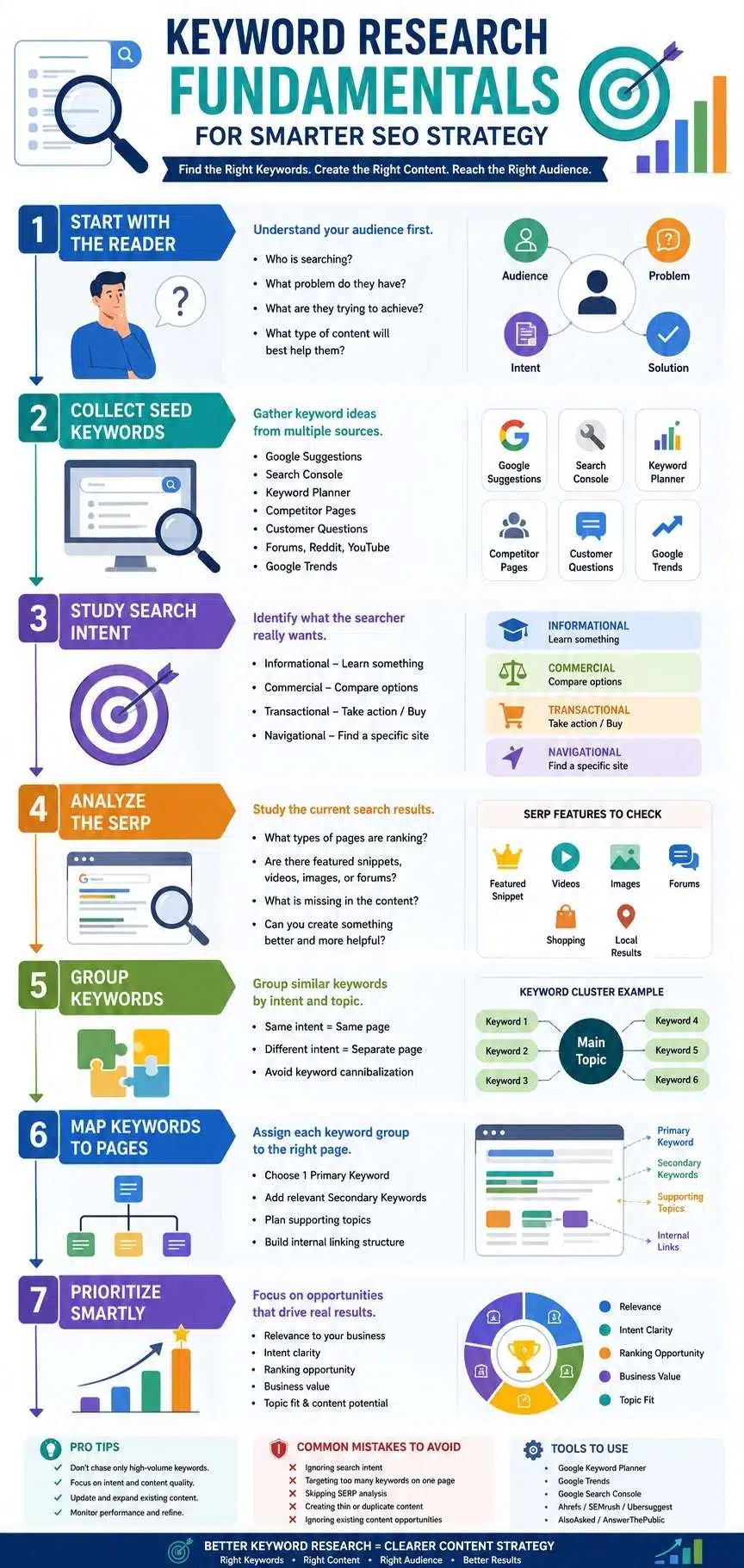
Keyword research can become overwhelming, so keep the workflow simple. Start with the topic. Define what the page should help the reader do. Then collect seed keywords. Use your knowledge, Google suggestions, Search Console, competitor pages, Google Trends, Keyword Planner, customer questions, and SEO tools.
Next, separate keywords by intent. Do not mix informational, commercial, transactional, and navigational searches without thinking.
After that, analyze the SERP. Check what types of results are ranking and what the reader seems to expect. Then group keywords into clusters. Decide which phrases belong on the same page and which deserve separate pages.
Finally, prioritize. You do not need to write everything at once. Start with pages that match your authority, fill real gaps, and support your pillar.
A simple workflow looks like this:
| Step | What To Do | Why It Matters |
| 1. Define the topic | Clarify the reader’s problem | Prevents random keyword chasing |
| 2. Collect keyword ideas | Use tools and real user questions | Builds the research base |
| 3. Identify intent | Study what the searcher wants | Shapes the article format |
| 4. Analyze the SERP | Review ranking page types | Shows what Google currently rewards |
| 5. Cluster keywords | Group similar intent terms | Prevents content overlap |
| 6. Map keywords | Assign groups to pages | Keeps the site organized |
| 7. Prioritize pages | Choose realistic opportunities | Saves time and budget |
This is not flashy, but it works.
Where AI Fits Into Keyword Research
AI tools can help with keyword research, but they should not replace verification. AI can brainstorm keyword ideas, organize search intent, group keywords, suggest content angles, and generate outline options. That saves time. But AI can also invent demand, overgeneralize intent, or miss what the live SERP is actually showing.
Use AI for thinking support. Use real data for decisions. A practical AI-assisted workflow might look like this:
- Ask AI for seed keyword ideas.
- Expand them with Keyword Planner, Trends, Search Console, or SEO tools.
- Check the live SERP manually.
- Group keywords by intent.
- Use AI again to test outline coverage.
- Edit with human judgment.
That balance matters in 2026. AI can speed up the early research stage, but it cannot replace the editor’s job. The editor still has to decide what deserves to be published.
Common Keyword Research Mistakes to Avoid
Keyword research mistakes are usually quiet. They do not always break a site immediately, but they weaken the content plan over time.
Chasing Volume Without Intent
High search volume looks attractive, but broad keywords often bring unclear traffic. If the page does not match what users want, rankings and engagement will suffer.
A smaller, clearer keyword can be more valuable than a broad keyword that your site has no realistic chance of satisfying.
Creating Too Many Similar Pages
This is one of the easiest ways to create SEO clutter. If five articles all target the same intent with slightly different wording, they may compete with each other. Merge, redirect, or differentiate when needed.
Ignoring the SERP
You cannot understand a keyword from a spreadsheet alone. The search results show what kind of content users and search systems expect. Skipping SERP review is like writing blindfolded.
Forcing Keywords Into Headings
A heading should guide the reader. If it sounds strange because a keyword was forced into it, rewrite it. SEO should make the article clearer, not uglier.
Treating Keyword Difficulty as Absolute Truth
Difficulty scores are useful, but they are not destiny. A strong niche page can sometimes outperform a weaker page on a stronger domain if it matches intent better and offers more useful depth.
Ignoring Existing Content
Before creating a new page, check what your site already has. Sometimes the right move is not a new article. It is updating and expanding an existing one. Old content with some visibility can be a better opportunity than starting from zero.
How Keyword Research Supports Topical Authority
Topical authority is built through organized depth. One article about SEO will not make a site an SEO authority. A clear pillar supported by strong cluster pages can. Keyword research helps you decide which pages belong in the cluster. It shows which subtopics deserve full articles, which ones belong as sections, and which ones are too small to target alone.
For the Modern SEO Fundamentals, keyword research supports the whole structure. It helps connect crawling, indexing, title tags, meta descriptions, header hierarchy, URL structure, and on-page SEO into one clean learning path.
That is much stronger than publishing random SEO articles whenever an idea appears. A strong content cluster should feel like a guided library, not a pile of posts.
How to Prioritize Keywords for a Real Website
Not every keyword deserves immediate attention. Prioritize keywords using five filters.
Relevance: Does the keyword match your site, audience, and business goal?
Intent clarity: Can you clearly understand what the searcher wants?
Opportunity: Can your site realistically compete?
Content value: Can you create something genuinely useful?
Cluster fit: Does the keyword support your broader topical map?
If a keyword passes all five, it is worth considering. If a keyword has volume but no relevance, skip it. If it fits the topic but the SERP is dominated by tools and product pages, you may need a different format. If the keyword is useful but too competitive, support it with long-tail cluster content first.
This is where keyword strategy basics become practical. You are not just picking phrases. You are deciding where to spend editorial energy.
A Simple Keyword Research Example
Let’s say you are building a content cluster around beginner SEO. You start with the pillar: “modern SEO fundamentals.” Then you research related searches and find topics around crawling, keyword research, title tags, meta descriptions, headers, URLs, and on-page SEO.
Now you decide page roles:
- The pillar explains the full SEO foundation.
- The crawling article explains discovery, indexing, and technical access.
- The keyword research article explains how to choose search targets.
- The title tag article explains how to improve click relevance.
- The meta description article explains snippets and search pitches.
- The header article explains the page structure.
- The URL article explains clean, readable URLs.
- The on-page SEO article pulls visible page elements together.
This is how keyword research turns into architecture. Without that step, you may still publish good articles, but the site will feel disconnected. With it, each page supports the next.
Frequently Asked Questions About Keyword Research Fundamentals
1. What Are Keyword Research Fundamentals?
Keyword research fundamentals are the basic steps used to find, understand, group, and prioritize search terms. They include studying search intent, checking demand, reviewing competition, grouping related keywords, and matching each keyword group to the right page.
2. Why Is Keyword Research Important for SEO?
Keyword research helps you understand what people are actually searching for. Without it, you may write useful content that has little demand or does not match the searcher’s intent.
3. What Is the Difference Between a Primary Keyword and a Secondary Keyword?
A primary keyword is the main phrase a page targets. Secondary keywords support the main topic and help cover related ideas naturally. They should improve clarity, not make the article feel stuffed.
4. How Do I Start Finding Keywords?
Start with seed topics related to your audience. Then use Google suggestions, Search Console, Google Trends, Keyword Planner, competitor pages, customer questions, and SEO tools to expand your list. After that, group keywords by intent.
5. Should I Target High-Volume Keywords First?
Not always. High-volume keywords are often broad and competitive. Newer or smaller sites may get better results by targeting clearer, lower-competition keywords that match specific search intent.
6. How Many Keywords Should One Page Target?
One page should usually target one main intent, not a fixed number of keywords. A strong article can naturally rank for many related phrases if those phrases belong to the same topic and intent.
7. Can AI Tools Do Keyword Research for Me?
AI tools can help brainstorm ideas, group topics, and build outlines. But you still need real data, live SERP analysis, and human judgment before choosing final keywords.
Build Keyword Strategy Around Real Search Behavior
Keyword research is not a spreadsheet exercise. It is the bridge between what people search and what your site should publish.
The best keyword plans in 2026 are not built around stuffing exact-match phrases. They are built around useful pages, clear intent, topical depth, and honest prioritization. That is why keyword research fundamentals still matter even in an AI-driven search environment.
A keyword gives you a clue. The SERP gives you context. The reader gives you the real purpose. If you understand all three, your content becomes easier to plan, easier to write, and easier for search engines to understand. Do not chase every keyword. Do not publish five versions of the same article. Do not let tools make every decision for you.
Find the searcher’s problem. Match the right page to the right intent. Build clusters that support your bigger SEO foundation. Then write the page in a way that actually helps. That is how keyword research turns from a list of phrases into a working SEO strategy.