Reading body signals workout advice sounds simple until you are halfway through a session wondering, “Is this normal effort, or am I doing something wrong?” That moment is very common for beginners. Your breathing changes. Your heart beats faster. Your thighs burn during squats. Your arms shake during push-ups. Your lower back feels stiff after sitting all day.
Your legs feel heavy during cardio. Some of these signals are normal signs that your body is working. Some are signs that you need to slow down. A few are warning signs that mean you should stop. This is where many beginners get confused. Some stop too early because every uncomfortable feeling feels scary. Others push through obvious warning signs because they think pain proves discipline. Neither approach is ideal. Fitness for beginners should teach you how to challenge your body without ignoring it.
Listening to your body is not laziness. It is a skill. It helps you know when to push, when to modify, when to rest, and when to stop completely. The better you become at reading body signals during workout sessions, the easier it becomes to train consistently without turning every session into a risk.
In my experience, beginners improve faster when they stop treating workouts like a punishment test and start treating them like a feedback system. Your body is constantly giving information. The question is whether you know how to read it.
This article is part of the larger Beginner’s Complete Fitness Guide. It connects naturally with setting realistic fitness goals, cardio vs strength beginners, beginners workout routine, warm-up cool-down essentials, nutrition basics fitness beginners, and sleep recovery beginners. All of those topics shape how your body feels during exercise.
For desk workers, founders, creators, and busy professionals, this topic matters even more. Long sitting, screen fatigue, poor posture, tight hips, low daily movement, and weak sleep can all change your workout signals. A Corporate Athlete does not simply push through everything. A Corporate Athlete learns when the body is ready, when it needs adjustment, and when recovery is the smarter move.
HappinessFit.com can naturally support this practical wellness mindset for readers who want fitness habits that fit real life.
Why Reading Body Signals During Workouts Matters?
Reading body signals during workouts matters because your body usually gives early feedback before a small issue becomes a bigger problem. Beginners often miss that feedback because every sensation feels new. A burning muscle, faster breathing, or shaking arms can feel alarming when you have not trained consistently before. But not every uncomfortable sensation is dangerous.
A good workout should create effort. Your breathing should become faster. Your muscles may burn near the end of a set. Your heart rate may rise. You may sweat. You may feel challenged. These are often normal signs that the body is working.
The problem starts when beginners cannot separate effort from warning signs. They either stop at the first sign of discomfort or push through pain that should have been respected. That is why body awareness is one of the most underrated beginner fitness skills.
From practical experience, the beginners who stay consistent longest are not always the most intense. They are the ones who learn how to respond. They slow down when breathing gets out of control. They stop a set when form breaks. They modify when a joint feels uncomfortable. They rest when fatigue is too high.
Reading your body also makes your workouts more personal. A plan on paper cannot know how much sleep you got last night, how stressful your workday was, whether you ate enough, or whether your hips are stiff from sitting. Your body signals help you adjust the plan to the day you are actually having.
This does not mean making excuses. It means training with intelligence. If the signal is safe effort, keep going. If the signal is warning pain, adjust. That balance is what makes fitness sustainable.
| Body Signal Skill | What It Helps You Do | Beginner Example |
| Notice effort | Understand normal workout challenge | Muscles burn near the end of a set |
| Notice fatigue | Know when quality is dropping | Push-ups start losing form |
| Notice pain | Stop before small problems grow | Sharp knee pain during lunges |
| Notice breathing | Manage cardio intensity | Slow down when gasping |
| Notice posture | Improve movement safety | Back rounds during hip hinges |
| Notice energy | Adjust workout difficulty | Choose a lighter session after poor sleep |
| Notice recovery | Plan rest days better | Soreness lasts longer than expected |
| Notice confidence | Reduce fear and confusion | Learn which sensations are normal |
The goal is not to fear your body. The goal is to understand it well enough to train better.
Normal Workout Effort vs Warning Signs
Normal workout effort and warning signs can feel similar to beginners, but they are not the same. Normal effort usually feels controlled. You are working hard, but you still feel aware, stable, and able to adjust. Warning signs feel sharp, strange, sudden, or unsafe. Normal effort can include faster breathing, sweating, muscle burn, mild shaking during hard reps, and tiredness after exercise. These sensations should usually reduce when you slow down, rest, or finish the set. They should not make you feel frightened or out of control.
Warning signs are different. Sharp pain, chest pressure, dizziness, faintness, numbness, swelling, severe shortness of breath, sudden weakness, or pain that changes your movement should not be ignored. These signals are not signs of commitment. They are signs that your body needs attention.
A useful beginner question is, “Is this feeling in the working muscle, or is it in the joint?” Muscle effort during squats, rows, or push-ups can be normal. Sharp knee pain, shoulder pinching, or lower-back pain is different. Another useful question is, “Does it improve when I slow down or rest?” Normal fatigue usually improves with rest. Warning pain often stays, worsens, or returns immediately when you repeat the movement.
Beginners should not gamble with warning signs just to finish a workout. Ending one set early is far better than forcing through pain and losing weeks of training.
| Workout Feeling | Usually Normal | Warning Sign |
| Muscle burn | Happens near the end of a set | Sharp or tearing sensation |
| Breathing | Faster but controlled | Gasping, chest pressure, dizziness |
| Sweating | Normal during effort | Sudden cold sweat with weakness |
| Shaking | Mild shaking during hard reps | Loss of control or collapse risk |
| Soreness | Mild muscle ache later | Severe pain or swelling |
| Joint pressure | Mild effort feeling | Sharp knee, hip, shoulder, or back pain |
| Fatigue | Tired but steady | Sudden weakness or confusion |
| Heart rate | Increases with activity | Irregular symptoms or faintness |
Normal effort should feel challenging. Warning signs feel like your body is asking you to stop.
Exercise Pain Signs Beginners Should Never Ignore

Exercise pain signs matter because beginners often hear dangerous advice like “no pain, no gain.” That phrase sounds motivating, but it can create poor decisions. Effort is part of training. Pain is information. Some pain means stop. Sharp pain is one of the clearest warning signs. If you feel a stabbing, tearing, pinching, or electric sensation during an exercise, stop that movement. Do not try to finish the set just because the plan says 10 reps. Your written plan is not more important than your body.
Joint pain also needs attention. Muscle effort around the thighs during squats can be normal. Sharp pain inside the knee is different. Chest and shoulder effort during push-ups can be normal. A sharp pinch in the shoulder is different. Lower-body fatigue during lunges can be normal. Hip or knee pain that changes your movement is different.
Pain that changes your form is another major sign. If you start limping, twisting, shifting weight away from one side, rounding your back suddenly, or protecting a joint, the exercise is no longer clean. Continuing can teach bad compensation patterns. Pain with dizziness, chest discomfort, severe breathlessness, faintness, swelling, numbness, tingling, or sudden weakness should be treated seriously. Beginners should not self-diagnose these symptoms mid-workout.
The practical rule is simple: muscle effort can be trained through if controlled; sharp pain should be respected immediately.
| Pain Sign | What It May Mean | What Beginners Should Do |
| Sharp pain | Possible strain or joint irritation | Stop the exercise immediately |
| Pinching pain | Poor position or joint stress | Modify range or movement |
| Joint pain | Load may not suit the joint | Reduce intensity or change exercise |
| Pain that worsens | Body is not tolerating movement | Stop and reassess |
| Pain that changes form | Compensation is happening | End the set |
| Swelling | Possible injury response | Rest and monitor carefully |
| Numbness or tingling | Nerve irritation possible | Stop and seek guidance if persistent |
| Chest pain or dizziness | Potential serious warning sign | Stop and seek urgent help if severe |
A beginner should not train through warning pain. That is not discipline. That is poor risk management.
Understanding Workout Fatigue Signs
Workout fatigue signs tell you how much stress your body is handling. Fatigue is normal during exercise, but unmanaged fatigue can make your form worse and increase the chance of doing movements poorly. Beginners need to learn when fatigue is productive and when it is becoming a problem. Normal fatigue usually builds gradually. Your muscles feel tired, your breathing increases, your pace slows a little, and the exercise becomes harder. You still feel in control. You can rest, breathe, and continue with decent form.
Problem fatigue feels different. Your form collapses. You cannot control your movement. You feel dizzy, mentally foggy, unusually weak, or shaky in a way that feels unsafe. You start rushing reps just to finish. At that point, the quality of the workout is gone.
I have noticed that beginners often push hardest when they are already too fatigued. They think the final sloppy reps are where progress happens. In reality, those reps often teach poor movement and create unnecessary strain. Stopping one or two good reps earlier is usually smarter.
Fatigue also depends on the rest of your life. Poor sleep, low food intake, dehydration, stress, and long desk hours can all make you fatigue faster. That does not mean you failed. It means your body is giving honest feedback. A good beginner routine should leave you tired but stable, challenged but not crushed, and ready to return after recovery.
| Fatigue Sign | Usually Acceptable | Time to Adjust |
| Muscle tiredness | Builds gradually | Sudden weakness |
| Breathing | Faster but manageable | Gasping or dizziness |
| Form | Slightly challenged | Technique collapses |
| Focus | Working hard but aware | Foggy or confused |
| Shaking | Mild effort shake | Uncontrolled trembling |
| Pace | Slows slightly | Cannot continue safely |
| Recovery between sets | Improves with rest | Does not recover after rest |
| Motivation | Workout feels hard | You feel unusually drained or unwell |
Fatigue should guide your workout. It should not control it.
Listening to Your Body Without Quitting Too Early
Listening to your body does not mean stopping every time exercise feels hard. This is one of the biggest misunderstandings beginners have. If you stop the moment your muscles burn or your breathing increases, your body never gets enough challenge to adapt. At the same time, listening to your body does not mean pushing through every signal. Ignoring pain is not bravery. It is how beginners turn a small issue into a long break from training. The skill is learning which signals are acceptable and which signals require adjustment.
A beginner workout should include manageable discomfort. Your muscles may work hard. Your breathing may become heavier. You may feel challenged near the end of a set. That is normal. The body adapts when stress is controlled and recoverable. The key word is controlled. If the signal feels like effort and your form is still clean, continue. If the signal feels like sharp pain, dizziness, instability, or danger, stop. If the signal feels awkward but not dangerous, modify the movement.
A simple method works well: notice, pause, adjust, and decide. Notice the signal. Pause or reduce intensity. Adjust form, load, pace, or range of motion. Then decide whether to continue or stop. Over time, confidence grows. The same muscle burn that scared you in week one may feel normal by week four because you understand it better.
| Body Signal | Beginner Reaction | Smarter Response |
| Muscles burning | “I should stop immediately” | Finish with good form if controlled |
| Breathing harder | “I am too unfit” | Slow pace and use talk test |
| Mild soreness next day | “I injured myself” | Recover, walk gently, monitor |
| Form getting sloppy | “Push through” | Stop the set or reduce load |
| Sharp pain | “Maybe it is normal” | Stop immediately |
| Low energy | “I failed” | Adjust intensity and check sleep or food |
| Nervousness | “I cannot do this” | Start with easier version |
| Heavy fatigue | “I need discipline” | Rest, hydrate, and reduce volume |
Listening to your body means responding intelligently, not quitting automatically.
How Breathing Tells You About Workout Intensity?
Breathing is one of the easiest body signals beginners can read. You do not need a smartwatch to know whether your cardio is too intense. Your breathing tells you a lot in real time. During easy movement, you should be able to talk comfortably. During moderate cardio, you should be able to speak in short sentences but not sing. During hard effort, talking becomes difficult. Beginners should spend most of their early workouts in the easy to moderate range.
If you are gasping early in a workout, you probably started too fast. This is common during jogging, treadmill walking, cycling, stair climbing, and even brisk walking. Beginners often start at the pace they want to maintain instead of the pace their body is ready for. A slower start usually fixes this.
Breathing also matters during strength training. Many beginners hold their breath without realizing it. During basic exercises, try to breathe steadily. Exhale during the harder part of the movement and inhale during the easier part. You do not need to make it complicated. Just avoid freezing your breath on every rep.
Breathing can also show stress. If your breath feels panicked, rushed, or uncontrolled, slow down. A workout should challenge your body, but you should still feel mentally present. Using your breathing as feedback makes training safer and more practical. It gives you a simple way to adjust pace before the workout becomes overwhelming.
| Breathing Signal | What It Means | Beginner Adjustment |
| Easy talking | Low intensity | Good for warm-up or recovery |
| Short sentences | Moderate intensity | Good beginner cardio zone |
| Cannot talk | High intensity | Reduce pace if beginner |
| Gasping early | Started too fast | Slow down and rebuild gradually |
| Holding breath | Too tense or focused | Exhale during effort |
| Breathing feels panicked | Intensity or anxiety too high | Pause and reset |
| Breath recovers quickly | Fitness is handling effort | Continue if form is good |
| Breath stays uncontrolled | Recovery is poor | Rest longer or stop |
Your breathing is a built-in intensity meter. Use it.
Heart Rate, Effort Scale, and the Talk Test
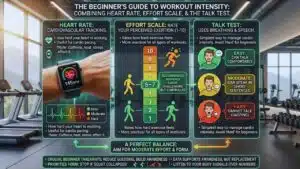
Heart rate, effort scale, and the talk test are three practical ways to understand workout intensity. Beginners do not need to obsess over numbers, but these tools can reduce guessing. Heart rate can be useful, especially during cardio. A fitness tracker or smartwatch can show how hard your cardiovascular system is working. But heart rate is not perfect. Stress, caffeine, dehydration, heat, poor sleep, and anxiety can all affect it. That is why heart rate should support awareness, not replace it.
The effort scale is often more practical. Rate your effort from 1 to 10. A 1 feels extremely easy. A 10 feels like maximum effort. Most beginner workouts should stay around 5 to 7. That means challenging but controlled. You are working, but you are not losing control.
The talk test is the simplest tool. If you can talk comfortably, the intensity is easy. If you can speak in short sentences, it is moderate. If you cannot talk, it is hard. For beginners, spending too much time at very hard intensity is usually unnecessary.
A form check is just as important as heart rate. If your watch says your effort is fine but your squat form is collapsing, stop the set. If your pace looks good but you feel dizzy, stop. Data is useful, but your body signals still matter. The best approach is to combine tools. Use heart rate if available, effort scale for overall difficulty, talk test for cardio, and form check for strength training.
| Intensity Tool | How It Works | Beginner Use |
| Heart rate | Tracks cardiovascular effort | Useful for cardio pacing |
| Effort scale | Rates how hard exercise feels | Aim for 5–7 most days |
| Talk test | Uses breathing and speech | Easy way to manage cardio |
| Form check | Watches movement quality | Stop when form breaks |
| Recovery check | Measures how fast you settle | Rest longer if needed |
| Mood check | Notices mental strain | Adjust on stressful days |
| Sleep check | Shows readiness | Train easier after poor sleep |
| Pain check | Separates effort from warning | Stop if sharp pain appears |
Beginners should use tools to support awareness, not replace it.
Muscle Burn, Soreness, and DOMS Explained Simply
Muscle burn during exercise and soreness after exercise are not the same thing. Beginners often mix them up, which can lead to fear, confusion, or bad training decisions.
Muscle burn usually happens during the workout. Your thighs may burn during squats. Your chest and arms may burn during push-ups. Your shoulders may burn during a long hold. This can be normal when the working muscles are challenged. The burn should reduce when you stop, rest, or lower the intensity.
Soreness usually appears later. Delayed muscle soreness can show up the next day or even two days after a new workout. This is common when beginners try unfamiliar exercises, increase volume, or use muscles in new ways. Mild soreness is usually not a problem.
However, soreness is not required for progress. This is one of the biggest beginner myths. A workout can be effective without making you sore. In fact, if you are severely sore after every workout, your routine may be too aggressive.
DOMS simply means your body experienced unfamiliar stress. It does not automatically mean the workout was perfect. Beginners should judge progress by consistency, form, strength, stamina, and recovery, not only soreness.
A smart approach is to ask whether soreness is manageable. Can you move normally? Does it improve with gentle movement? Does it fade over a few days? If yes, it is likely normal beginner soreness. If it is severe, sharp, swollen, or worsening, take it seriously.
| Sensation | When It Happens | What It Usually Means |
| Muscle burn | During exercise | Muscle effort |
| Mild soreness | 1–3 days after workout | Normal response to new training |
| Stiffness | After rest or next day | May improve with light movement |
| Severe soreness | Limits normal movement | Workout may have been too much |
| Sharp pain | During movement | Stop and reassess |
| Joint pain | During or after exercise | Modify exercise |
| Swelling | After exercise or injury | Monitor and seek help if serious |
| Soreness fading | Over days | Recovery is happening |
Soreness is not the scorecard. Consistency and quality matter more.
Body Signals During Strength Training
Strength training creates specific body signals that beginners should learn. You may feel muscle effort, pressure, shaking, and fatigue. Some of that is normal. But form breakdown, sharp pain, and joint discomfort need attention. During strength exercises, the main signal to watch is form. If your form changes badly, the set should stop. For example, if your back rounds during a hinge, your knees cave strongly during squats, or your shoulders pinch during push-ups, pause and adjust.
Muscle effort is expected. Your thighs should work during squats. Your chest and arms should work during push-ups. Your upper back should work during rows. But pain in joints or sharp sensations are not the same as muscle effort.
Beginners should also pay attention to tempo. If you can only complete reps by rushing, bouncing, swinging, or using momentum, the exercise may be too hard. Slower controlled reps usually teach better movement and reduce sloppy patterns.
A useful rule is to leave 2 or 3 good reps in reserve. That means you stop before failure. Beginners do not need to max out every set. Clean practice builds more useful strength than sloppy struggle. Strength training should feel controlled. You should feel like you are practicing a skill while building strength, not just fighting the weight or rushing to finish.
| Strength Signal | Usually Normal | Adjustment Needed |
| Muscle effort | Target muscles working | Continue if form is good |
| Mild shaking | Hard but controlled effort | Rest longer if needed |
| Form breakdown | Not ideal | Stop the set |
| Joint pain | Not normal | Modify or stop exercise |
| Back rounding | Form issue | Reduce load or range |
| Holding breath | Common beginner habit | Breathe steadily |
| Rushing reps | Too hard or unfocused | Slow down |
| Sharp pain | Warning sign | Stop immediately |
Strength training should feel controlled, not chaotic.
Body Signals During Cardio Workouts
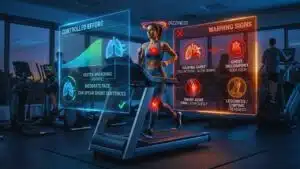
Cardio workouts give different body signals than strength training. You need to watch breathing, pace, heart rate, leg fatigue, dizziness, and overall control. Beginners often make cardio too hard too early, especially with running, treadmill incline, stair climbing, or high cycling resistance.
The first signal is breathing. If you are gasping within the first few minutes, slow down. A cardio warm-up should gradually build intensity. Your body usually performs better when effort rises like a ramp, not a jump.
Leg heaviness is common during cardio, especially for beginners. It may simply mean your muscles are not used to repeated movement yet. But sharp pain in the knee, ankle, hip, or lower back is different. If pain changes your stride or makes you limp, stop and reassess.
Dizziness is never something to push through. It may happen from intensity, dehydration, low food intake, heat, poor breathing, or other issues. Slow down, stop safely, sit if needed, and recover. For beginners, cardio should build confidence. Walking, cycling, swimming, elliptical, and easy intervals can all work. You do not need to prove fitness by suffering through every session.
The best cardio signal is controlled effort. You should feel like you are working, but not like your body is panicking.
| Cardio Signal | Usually Normal | Adjustment Needed |
| Faster breathing | Normal during effort | Continue if controlled |
| Can speak short sentences | Moderate effort | Good beginner zone |
| Gasping early | Too intense | Slow down |
| Heavy legs | Common fatigue | Reduce pace if form changes |
| Side stitch | Common in some beginners | Slow down and breathe |
| Dizziness | Warning sign | Stop safely |
| Chest discomfort | Serious warning sign | Stop and seek help if needed |
| Limping | Pain or poor tolerance | End session and reassess |
Cardio should challenge your stamina, not scare your body.
How Desk Workers Should Read Body Signals Differently?
Desk workers often bring different body signals into workouts because long sitting changes how the body feels. Tight hips, stiff ankles, rounded shoulders, sleepy glutes, neck tension, and lower-back stiffness are common. These signals do not always mean you should avoid exercise, but they do mean you need better preparation.
A desk worker may feel awkward during squats because the hips and ankles are stiff. They may feel shoulder discomfort during push-ups because the upper back is tight and the chest is shortened. They may feel lower-back tension because the glutes are not engaging well.
This is why warm-ups matter so much for desk-based beginners. Hip circles, glute bridges, shoulder circles, band pull-aparts, easy walking, and ankle rocks can change how the first set feels. If the signal improves after warm-up, it was likely stiffness. If it gets worse, adjust the exercise.
Desk workers should also watch for mental fatigue. After a long day of screens, meetings, writing, editing, calls, or deadlines, your body may be physically underused but mentally tired. That can affect coordination, patience, and motivation. On those days, a moderate workout may be smarter than a hard one.
The Corporate Athlete approach is about training with awareness. Your body is not separate from your workday. The way you sit, breathe, sleep, eat, and recover changes how workouts feel. A desk worker does not always need more intensity first. Often, they need better warm-ups, more daily movement, posture support, and smarter recovery.
| Desk-Worker Signal | Possible Cause | Better Response |
| Tight hips | Long sitting | Hip mobility and glute bridges |
| Rounded shoulders | Laptop posture | Band rows and chest stretch |
| Lower-back stiffness | Sitting and weak glutes | Warm up hips, reduce load |
| Neck tension | Screen fatigue | Shoulder circles and posture reset |
| Heavy legs | Low daily movement | Easy walk before workout |
| Low motivation | Mental fatigue | Shorter session or active recovery |
| Wrist discomfort | Keyboard and push-up load | Modify push-up angle |
| Stiff ankles | Sitting and low movement | Ankle rocks before squats |
Desk workers do not need harder workouts first. They often need smarter preparation.
When to Push, When to Modify, and When to Stop?
One of the most useful beginner skills is knowing whether to push, modify, or stop. This decision-making skill keeps workouts productive without becoming reckless. It also removes a lot of confusion during training.
Push when the signal is normal effort. If your muscles are working, breathing is controlled, form is good, and the discomfort feels manageable, continue. That is how fitness improves. You do not need to stop just because the workout feels hard.
Modify when the exercise feels awkward, too hard, or slightly uncomfortable but not dangerous. You can reduce weight, shorten range of motion, slow down, change the angle, take longer rest, or choose an easier variation. Modification is not failure. It is smart training.
Stop when the signal is sharp pain, dizziness, chest discomfort, numbness, swelling, loss of control, or form collapse that does not improve with rest. Ending one exercise early is better than forcing through a warning sign and losing weeks to injury.
I often tell beginners to respect the first warning, not the fifth. You do not need to wait until pain becomes serious before adjusting. Early adjustment is what keeps training consistent. This is also how you build trust with your body. When your body learns that you respond intelligently, workouts feel less scary and more manageable.
| Situation | Best Choice | Example |
| Muscle burn with good form | Push carefully | Finish the set |
| Breathing hard but controlled | Continue | Maintain pace |
| Form starts slipping | Modify or stop set | Reduce reps or weight |
| Exercise feels too hard | Modify | Use easier variation |
| Mild stiffness improves | Continue | Warm-up helped |
| Sharp pain appears | Stop | End exercise immediately |
| Dizziness or chest pressure | Stop | Rest and seek help if needed |
| Fatigue is unusually high | Modify | Do lighter workout |
Smart beginners do not push everything. They push the right things.
How to Use a Simple Body Check During Workouts?
A simple body check helps beginners avoid guessing. You can use it before, during, and after workouts. It only takes a few seconds, but it can prevent many bad decisions. Before the workout, check sleep, energy, soreness, pain, and mood. If everything feels good, follow the plan. If sleep was poor or soreness is high, reduce intensity. If pain is present, modify or skip the painful movement.
During the workout, check breathing, form, pain, and focus. If breathing is controlled and form is clean, continue. If form breaks or pain appears, adjust. If dizziness appears, stop. These quick checks keep you from training blindly. After the workout, check how your body responds. Do you feel tired but stable? That is usually fine. Do you feel shaky, painful, unusually drained, or mentally wiped out? The session may have been too much.
The next day matters too. If soreness is mild and improves with movement, that is usually manageable. If soreness is severe, pain is sharp, or your joints feel irritated, reduce intensity next time.
I like this method because it teaches beginners to train with awareness, not fear. You are not constantly worrying. You are simply checking signals and making better decisions.
| Body Check Time | What to Ask | What to Do |
| Before workout | How did I sleep? | Adjust intensity if needed |
| Before workout | Am I sore or in pain? | Modify exercises |
| Warm-up | Does stiffness improve? | Continue if better |
| During sets | Is my form still clean? | Stop when form breaks |
| During cardio | Can I speak short sentences? | Adjust pace |
| During workout | Is this muscle effort or pain? | Continue or stop |
| After workout | Do I feel stable? | Note response |
| Next day | Is soreness manageable? | Plan recovery or progress |
Body checks turn “listening to your body” into a practical system.
Common Mistakes Beginners Make With Body Signals

Beginners often make predictable mistakes with body signals. The first mistake is ignoring pain because they want to finish the plan. The plan is not sacred. If the body gives a warning, the plan should change.
The second mistake is fearing all discomfort. Exercise can feel uncomfortable at first. Muscles working, breathing harder, and sweating are normal. If you stop every time effort appears, progress becomes difficult.
The third mistake is copying someone else’s tolerance. A workout that feels moderate for an experienced person may be too intense for a beginner. Your body signal matters more than someone else’s routine.
Another common mistake is using soreness as proof. Beginners often think a workout failed if they are not sore. That belief leads to overtraining. Progress is better measured through consistency, strength, stamina, movement quality, and recovery.
The final mistake is not connecting body signals to sleep, food, hydration, stress, and desk posture. If you feel weak, it may not be the exercise. It may be poor fuel, poor sleep, dehydration, or a stressful day.
Beginners should treat body signals like information. One signal does not tell the whole story, but repeated patterns do.
| Mistake | Why It Hurts | Better Beginner Choice |
| Ignoring sharp pain | Can worsen injury risk | Stop and modify |
| Quitting at first effort | Limits progress | Learn normal muscle effort |
| Chasing soreness | Encourages overtraining | Track performance instead |
| Comparing with others | Creates unsafe expectations | Follow your own baseline |
| Skipping warm-ups | Makes body signals worse | Prepare before training |
| Training tired every time | Fatigue accumulates | Improve sleep and recovery |
| Using poor form | Increases strain | Reduce load or reps |
| Ignoring patterns | Misses repeated warning signs | Track signals weekly |
The goal is not to become fearless. The goal is to become informed.
A Beginner-Friendly Body Signal Tracking System
Tracking body signals helps beginners see patterns. You do not need a complicated app. A simple note after each workout is enough. The goal is to learn what your body responds to.
Track sleep, energy, soreness, pain, workout difficulty, and recovery. Over time, you may notice patterns. Maybe workouts feel worse after poor sleep. Maybe your knees feel better after longer warm-ups. Maybe evening workouts feel harder when lunch is too light. Maybe heavy cardio after a stressful day feels like too much.
A body signal log also prevents emotional guessing. Beginners often say, “I am not improving,” even when the notes show better reps, easier breathing, less soreness, and more confidence. Tracking gives proof. You can use a 1 to 5 scale for sleep, energy, soreness, and pain. Use a 1 to 10 scale for workout effort. Add one sentence about form or any unusual signal. That is enough.
The best tracking system is the one you actually use. Keep it short and practical. If tracking takes too long, you will stop doing it. This system also helps you decide when to progress. If energy is good, soreness is low, and form is clean, you may add reps or time. If soreness and fatigue are high, you may need recovery instead.
| Tracking Item | Rating or Note | Why It Helps |
| Sleep | 1–5 | Shows recovery quality |
| Energy | 1–5 | Helps explain workout performance |
| Soreness | 1–5 | Shows recovery needs |
| Pain | Location and type | Helps spot warning patterns |
| Workout effort | 1–10 | Tracks intensity |
| Form quality | Good, okay, poor | Helps adjust load |
| Breathing | Easy, moderate, hard | Tracks cardio intensity |
| Next-day response | Better, same, worse | Shows if plan is working |
A simple log turns body awareness into useful data.
Exercise Pain Signs That Need Professional Guidance
Some exercise pain signs should not be handled with guesswork. Beginners should know when to seek professional guidance. This does not mean panicking over every ache. It means respecting symptoms that are outside normal workout effort.
Seek guidance if pain is sharp, persistent, worsening, or linked with swelling, numbness, tingling, weakness, or loss of movement. If pain keeps returning every time you do a certain exercise, something needs assessment. It could be form, mobility, load, injury, or a movement that does not suit your current body.
Chest pain, faintness, severe dizziness, trouble breathing, or sudden severe weakness during exercise should be treated seriously. Stop the workout and seek appropriate help. Beginners should never try to prove toughness through symptoms that could be serious.
People with existing medical conditions, recent surgery, heart concerns, uncontrolled blood pressure, pregnancy, major joint problems, or a history of serious injury should be extra careful with intensity. Getting professional advice before pushing harder can save a lot of trouble later.
A qualified coach, physical therapist, sports medicine professional, or healthcare provider can help you modify safely. Asking for help is not failure. It can help you train with more confidence. Pain that keeps returning deserves attention. Repeating the same painful movement and hoping it magically disappears is not a good plan.
| Sign | Why It Matters | What to Do |
| Sharp pain | Not normal training effort | Stop and assess |
| Pain lasting many days | May need evaluation | Reduce training and seek advice |
| Repeated pain with same exercise | Pattern suggests issue | Modify and get guidance |
| Swelling | Possible injury response | Rest and seek help if serious |
| Numbness or tingling | Possible nerve involvement | Stop and consult professional |
| Loss of strength | Could be more than soreness | Seek guidance |
| Chest pain or faintness | Serious warning sign | Stop and seek urgent help |
| Pain affects walking or daily tasks | Function is affected | Get professional assessment |
Pain that keeps returning deserves attention, not denial.
Final Thoughts
Reading body signals workout beginners need to understand is one of the most important skills in fitness. Exercises matter. Nutrition matters. Sleep matters. But if you do not know how to interpret your body during training, you will always be guessing.
Your body is not trying to stop you from getting fit. It is giving feedback. Some signals say, “Keep going.” Some say, “Slow down.” Some say, “This movement needs adjustment.” A few say, “Stop now.”
The goal is not to become afraid of exercise. The goal is to become more skilled at it. Learn the difference between effort and pain. Learn how breathing shows intensity. Learn how fatigue changes form. Learn how sleep, food, hydration, stress, and desk posture affect performance.
For beginners, this awareness is what makes fitness sustainable. You stop chasing punishment and start building skill. You stop copying every workout and start understanding your own body.
For the Corporate Athlete lifestyle, this matters even more. Your body supports your work, focus, creativity, movement, and long-term health. Treat it like a system worth listening to.
Train with effort. Adjust with intelligence. Stop when needed. Come back better.
Frequently Asked Question (FAQs) About Reading Body Signals Workout
What Does Reading Body Signals During a Workout Mean?
Reading body signals during a workout means paying attention to effort, breathing, pain, fatigue, form, soreness, and recovery. It helps beginners know when to keep going, when to modify, and when to stop. It is not about avoiding challenge. It is about training with awareness.
How Do I Know If Workout Pain Is Normal?
Muscle effort, mild burn, and manageable soreness can be normal. Sharp pain, joint pain, swelling, numbness, dizziness, chest discomfort, or pain that changes your movement is not something to ignore. When in doubt, stop and reassess.
Should I Stop Exercising If My Muscles Burn?
Not always. Muscle burn near the end of a set can be normal if your form is controlled and the feeling is in the working muscle. Stop if the burn becomes sharp, painful, or makes your form collapse.
What Are Common Workout Fatigue Signs?
Common workout fatigue signs include slower movement, heavier breathing, tired muscles, reduced focus, and weaker form. Mild fatigue is normal. Severe fatigue, dizziness, confusion, or loss of control means you should stop or reduce intensity.
Is Soreness a Good Sign After Exercise?
Mild soreness can happen after new or harder exercise, but it is not required for progress. A workout can be effective without soreness. Severe soreness after every session usually means your routine may be too intense.
How Can Beginners Listen to Their Body Without Being Lazy?
Use a simple rule: push through controlled effort, modify when form or comfort drops, and stop for sharp pain or warning signs. Listening to your body is not an excuse to avoid work. It is a way to train smarter.
Why Do I Feel Dizzy During Workouts?
Dizziness can happen for many reasons, including high intensity, dehydration, low food intake, heat, poor breathing, or medical issues. Stop safely, sit or rest, drink water if appropriate, and do not continue until you feel normal. Seek help if dizziness is severe or repeated.
How Do I Track Body Signals After Workouts?
Use a simple note. Track sleep, energy, soreness, pain, effort, and next-day response. Over time, patterns will show you whether your routine is too hard, too easy, or just right.