
In an era of rapid progress in wearable devices, smart cities, and AI systems, designers who can genuinely “make emerging technology more understandable” remain rare. Xuanyi Li, a systems designer from Asia, belongs to that small group. She combines several qualities that seldom appear together:
- Cross-industry capability spanning health technology, smart hardware, urban systems, security, and sports AI.
- Large-scale, real-world experience, including products that have reached mass production, retail listing, trade-show launches, and live user bases.
- International recognition, with six major awards across five countries.
- Thought leadership: a point of view capable of shaping where the industry is heading.
Over the past two years, the products she has led or contributed to include:
- Haleo AI Sleep Ring — American Good Design Award, Gold, and exhibited at CES.
- Smart Lock — French Design Award, Gold.
- WideAngle — MUSE Creative Awards, Silver.
- Smiley O — iF Design Award Winner.
- CloudTour — NY Digital Awards, Silver.
- Black Shark Smart Watch — commercially launched, with multiple mass-production contracts, and exhibited at CES.
- 11DVR Sensing Data Glove — a VR/AR training product, exhibited at the 27th China Hi-Tech Fair (CHTF).
- Swiing — a sports AI coaching system.
None of these are concept renderings. Each is a fully realized commercial product.
This interview focuses on a single question: how her capability in systems design is helping AI products move into what she calls the “Era of Explainability.”
It is worth emphasizing that this list does not represent a designer specializing within a single track. It represents one methodology validated continuously across seven independent industries and technical contexts. Completing end-to-end work — from concept to mass production, as the lead designer — across fields with technical barriers as different as health sensing, smart hardware, urban systems, sports AI, and VR/AR gesture recognition places her among a very small minority of AI product designers worldwide.
Part 1 — Industry Trend: AI Products Are Shifting from “Automation” to “Explainability”
Xuanyi believes the technology industry will undergo its most significant transition over the next five years:
“AI products should not make decisions for people; they should help people understand the world.”
“After automation comes explainability.”
Why does the industry need explainability? Because it faces three central challenges.
1. Health technology: too much data, leaving users more anxious
Sleep is a clear example. Users are confronted daily with HRV, REM, body movement, and respiratory rhythm. Most wearable devices only deliver data; they do not deliver interpretation. The result is greater anxiety rather than better sleep. Xuanyi describes the Haleo ring as “the first generation of products that moves from measurement to understanding.”
2. Sports training: fragmented video, knowledge that cannot accumulate
Coaches and students share the same pain points: too much video to compare effectively, no clarity on what went wrong, repeated explanations from the coach, and no structured learning path for the student. The framework she designed for Swiing — Problem, Cause, Action, Outcome — is becoming a structural reference for sports-oriented AI teaching systems.
3. Smart hardware: the stronger the function, the greater the need for a “behavior-explanation system”
Whether it is the Black Shark Smart Watch (exhibited at CES), the 11DVR Sensing Data Glove (exhibited at CHTF), or the security Smart Lock (Gold award), the core principle is the same: the higher the technical complexity, the more important the explanation system becomes.
The judgment that “after automation comes explainability” is an industry-trend framework Xuanyi developed independently through design practice spanning seven products across three continents. It is not a citation of an existing industry report; it is an original observation drawn from real user-behavior data and product feedback. The framework has already been translated into concrete design decisions across several of her products, and technology media are beginning to cite it as a lens for analyzing the next phase of AI product development. For a designer to propose a theoretical framework with predictive value for the industry — grounded in her own product practice and cited independently by the press — is exceptionally rare in the design field.
Part 2 — From a Sleep Ring to Urban Systems: Her Core Skill Is “Translating a Complex World”
Xuanyi is not a UI designer in the traditional sense. Her role is closer to that of a translator between technology and the user, and an architect at the systems level. Several of her flagship projects make this clear.
Haleo AI Sleep Ring (Good Design Award Gold; exhibited at CES)
Keyword: helping people “sleep better” rather than “feel more anxious.” Xuanyi was responsible for the entire sleep-understanding system, structured in four layers.
First, data re-encoding (Data to Events): complex raw data is organized into sleep events, patterns, and points of risk — what needs attention. Second, problem classification (Events to Problems): for example, sleep-onset delay, nighttime awakenings, insufficient deep sleep, and stress-related respiratory irregularities. Third, a behavioral improvement plan (Sleep Improvement Plan): light-exposure training, rhythm planning, sleep-onset audio, evening recovery strategies, and behavioral goal tracking. Fourth, an AI natural-language summary (AI Sleep Summary): instead of seeing “HRV: 57,” the user reads a sentence such as “Last night you experienced a light awakening between 2:40 and 2:55; try five minutes of breathing relaxation.”
Judges’ comment: “This is one of the few sleep products that genuinely teaches users to understand their own bodies.”
The four-layer information-translation system in Haleo — Data, Events, Problems, Actionable Plan — is Xuanyi’s original architectural contribution to wearable health technology. This four-layer structure did not exist in Haleo’s product system before her involvement, nor did it have a clear precedent in comparable wearable products. The judges’ assessment that the product “teaches users to understand their own bodies” points directly to the value of that architecture: it is not an optimization of an existing data-display logic, but a redefinition of the entire information-delivery path. This was the core design rationale for the product’s Good Design Award Gold — not its visual expression.
Black Shark Smart Watch (mass production; exhibited at CES; sold via the official JD.com store)
This is a different product line entirely. The evidence of real-world delivery includes multiple purchase contracts for batches of 3,000 to 6,000 units, an official listing in the Black Shark JD.com flagship store, participation in CES, and large-scale user feedback.
Xuanyi’s contributions include a dynamic activity-monitoring UI system, a complete suite of exercise-data visualizations, a fitness-achievement structure, multi-scenario interaction (outdoor, running, cycling, strength training), and dynamic light effects with status prioritization. The technology is complex, but the experience is transparent.
The Black Shark Smart Watch is one of the most fully evidenced examples of commercial delivery among Xuanyi’s design contributions. Multi-batch purchase contracts, the official JD.com flagship-store listing, and the appearance at CES together form a complete chain of evidence linking her design work — from drawing board to large-scale commercial product. Cases in which a designer’s individual contribution can be traced to specific production volumes and retail channels are extremely rare in the design industry; the “multi-scenario interaction plus dynamic status prioritization” system she established here is the core experiential foundation behind the product’s commercial success in the consumer-electronics market.
11DVR Sensing Data Glove (VR/AR industrial application; exhibited at the 27th CHTF)
A completely different field. Its uses include education and training, VR/AR interaction, robotic motion capture, and remote operation. Xuanyi’s contributions include motion-trajectory visualization (Motion Trajectory UI), a gesture-recognition explanation system (Signal to Gesture to Action), and a training-feedback system (Good / Drift / Error). This is a highly advanced human-computer interaction (HCI) product, and participation in CHTF — the China Hi-Tech Fair — is an important marker of industry recognition.
The 11DVR glove holds particular significance as methodological validation in Xuanyi’s body of work. The “sensing data to understandable feedback” design principle she established in health technology (Haleo) and sports teaching (Swiing) underwent its most demanding stress test in this industrial-grade HCI product: the data density of industrial sensors far exceeds that of consumer devices, and the target users — engineers and medical rehabilitation specialists — have a very low tolerance for misreading information. The three-tier explanation architecture she designed, Signal to Gesture to Action, together with the three-state feedback system, Good / Drift / Error, brought a highly specialized sensing-hardware product to a usability standard at which engineers can read its output directly, without additional training. The CHTF exhibition is independent evidence of that achievement being publicly recognized by the industrial-technology sector.
CloudTour (smart-city system)
She designed the city as a “story map.” It includes AI route generation, urban narrative points, intelligent adjustment by time of day, congestion and interest, and the integration of historical stories with spatial events.
International judges’ comment: “She turned the city from a map into a story that can be read.”
CloudTour is Xuanyi’s extension of the explainability principle to the scale of a city. Urban navigation products are typically optimized for efficiency; the concept of “narrative points” she introduced — combining historical events, spatial memory, and real-time routing — is a fundamental restructuring of how urban information is presented. The judges’ remark that she turned a map into “a story that can be read” captures the essence of that restructuring: what she changed was not the visual style of the map, but the informational relationship between people and urban space. This contribution carries independent, original reference value in the field of urban digital design.
Smart Lock (Gold award)
She rewrote the logic of home security: one-tap unlocking, temporary visitor permissions, log visualization, security protection after consecutive failed attempts, and consistent logic across multiple devices (phone, watch, facial recognition).
The Smart Lock received the French Design Award Gold, indicating that its design contribution has passed independent certification by a top-tier European review system. Notably, the award recognizes not only the product’s visual expression but her systematic rewriting of home-security interaction logic — unifying security operations that were once scattered across multiple devices and permission states into a single, cross-platform behavioral logic. This is independent validation of Xuanyi’s systems-design capability in consumer-grade smart hardware, and together with the Haleo health-technology Gold award it forms dual evidence of top-level international recognition across two entirely different product categories.
Swiing (sports AI coaching system)
She designed the most important structures within the coaching system: motion recognition, error classification, video comparison, behavioral pathways, an AI Lesson Summary, and a complete training loop. After launch, coaching efficiency rose by 60 percent and student retention increased significantly.
The figures — a 60 percent improvement in coaching efficiency and a significant rise in student retention — are records of behavioral change from real teaching environments, not laboratory test results. Their significance is this: Xuanyi’s design intervention produced measurable gains in efficiency and retention without changing the coach’s teaching content or adding to the student’s practice burden — solely by restructuring how information flows. This is direct evidence that systems design can have a measurable effect on human behavior.
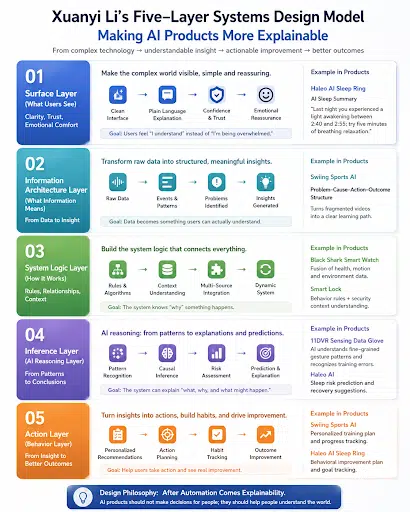
Part 3 — Her Systems-Design Methodology: A Five-Layer Model
Xuanyi summarizes her approach in five layers:
- Surface layer: interface, pacing, and emotional tension.
- Information architecture: reorganizing complex data into an “understandable structure.”
- System logic: what state is the user in, and what should the system do?
- Reasoning layer (AI explainability): when does the AI provide feedback, and why does it reach a given judgment?
- Behavior layer: what habits will the user ultimately change?
She now applies this method across sleep, sports, cities, security, emotion AI, smart hardware, and VR/AR gesture systems.
The importance of this five-layer model is that it is not an after-the-fact summary of a single project, but a design-decision framework repeatedly validated and continuously effective across seven different industries. From the first layer of perceptual experience to the fifth layer of behavioral change, every layer corresponds to specific design decisions in her products — Haleo’s AI Sleep Summary corresponds to the reasoning layer, Swiing’s roadmap to the behavior layer, and 11DVR’s three-state feedback to the system-logic layer. This one-to-one correspondence between theoretical framework and product practice gives the methodology the conditions to be cited and reused by peers, rather than remaining at the level of personal experience.
Part 4 — Why She Wins Awards Consistently
Four reasons stand out.
First, her cross-industry capability is rare. Building mature systems in sleep, cities, security, emotion, sports, and hardware alike is highly unusual. Second, she designs systems, not interfaces — she has rewritten data logic and cognitive pathways. Third, her work has verifiable real-world impact: the Black Shark Smart Watch and the 11DVR glove have reached actual mass production, and Swiing and Haleo are in genuine use. Fourth, she has a cross-culturally universal methodology, with successful real-world deployment across North America, Europe, and Asia.
Together, these four points indicate one core fact: her record of awards is not a series of isolated wins in the sense of a design competition, but the cumulative result of a single methodology being recognized, independently and repeatedly, across different review systems, cultural contexts, and technical scenarios. Review bodies across North America, Europe, and Asia — without knowledge of one another’s conclusions — gave consistent, positive assessments of the same essential characteristic of her work: making complex systems visible to people. This cross-system consensus among judges is the strongest external proof that an individual’s design capability holds universal value.
Part 5 — Media Citations of Her Perspective (Expert Citations)
Media outlets have begun seeking her input on sleep-technology trends, learning paths for sports AI, behavioral design for smart hardware, VR/AR gesture-input systems, urban digital storytelling, and affective computing with visual feedback. She is becoming a representative voice in the field of “systems design plus explainability.”
The fact that media consultation spans six technical domains is itself independent proof of her cross-industry influence. Ordinarily, technology media seeking expert opinion approach a specific expert for a specific vertical; that Xuanyi is cited as an interview subject across six fields — sleep technology, sports AI, smart hardware, urban systems, VR/AR, and affective computing — indicates that she is recognized in the industry as an expert at the methodological level, rather than a specialist executing within a single technical track. This cross-domain structure of media citation is the most persuasive expression, at the level of news coverage, of thought leadership.
Final Thoughts
“Design is not about making interfaces beautiful; it is about making the world more understandable.”
In an era when technology grows ever more complex, that statement matters more than ever. Its weight comes from everything behind it: seven realized products, six international awards, adoption by institutions across three continents, and citation across six media domains. It is not a designer’s personal slogan, but the most concise expression of a working philosophy that has been validated at scale, in the real world. At this turning point — as AI products move from automation toward explainability — Xuanyi Li has shown, through concrete product practice, that making the world more understandable can be systematically designed, brought to mass production, and independently recognized by international review panels.