
Cyberbullying is not just “kids being mean online.” That phrase is lazy, outdated, and usually said by someone who has not seen what school conflict looks like after it moves into group chats, shared docs, gaming spaces, school devices, and social platforms. The school hallway now has Wi-Fi, screenshots, and a memory longer than most adults would like to admit.
That is why Cyberbullying Detection SMEs matter. Schools and parents now need tools that can detect harmful messages, bullying signals, self-harm language, threats, harassment, toxic behavior, and risky digital patterns before problems quietly turn into crises. But this market is messy. Some platforms are built for parents. Some are built for school districts. Some focus on AI alerts. Some use human review. Some are broader student-safety platforms that include cyberbullying detection as one part of a bigger safety system.
For this final list, I only included entries that could be publicly verified for company identity, location or U.S. market presence, product relevance, website/contact route, target market, and cyberbullying or harmful-content safety connection. Your uploaded draft list included GoGuardian, Lightspeed Systems, Gaggle, Bark, Securly, Navigate360, ManagedMethods, Deledao, Ativion/StudentKeeper, and Linewize by Qoria; I merged that with the stricter verified research and added Cyber Dive as a usable U.S.-based child online safety entry.
One note before we begin: this is not a list of perfect tools. Cyberbullying detection software can help, but it can also create privacy risks, false positives, and over-monitoring problems if schools or parents treat every AI alert like gospel delivered from the cloud. A dashboard can flag a signal. Adults still have to respond wisely.
Our Selection Criteria
Before ranking the companies, I separated real cyberbullying detection and student-safety tools from generic “online safety” claims. A platform does not make this list just because it says “AI-powered” on a homepage. That bar is low enough to trip over.
The selection focused on:
- Publicly verified company identity.
- U.S. headquarters, U.S. origin, or strong U.S. school/family market presence.
- Publicly confirmable cyberbullying, bullying, toxic-language, threat, harmful-content, or student-wellness monitoring features.
- Clear use case for parents, K–12 schools, districts, or youth safety programs.
- Evidence of product maturity, school/family adoption, or public recognition.
- Contact route, website, and product information that can be checked.
- No fictional companies, no invented emails, and no “sounds real enough” filler.
I also kept caveats where needed. For example, Ativion/StudentKeeper and Linewize by Qoria are valid broader U.S.-market safety platforms, but they are not the same type of U.S.-founded cyberbullying-specific startup as Bark, ReThink, or ManagedMethods.
Why The United States Leads This Market
The United States leads this market because it has the clearest cluster of K–12 student safety vendors, parental monitoring products, school cloud monitoring tools, AI-powered alert systems, and broader digital threat detection platforms. Securly says it supports more than 20 million students and 20,000 schools, while Lightspeed Systems says it serves more than 23 million students across 31,000 schools in dozens of countries. That is not a small niche. That is a full student-safety technology ecosystem with dashboards, alert queues, and enough privacy questions to keep school boards busy for years.
The U.S. also has visible demand from parents and schools. Bark says it helps protect millions of children and thousands of schools and districts, while Gaggle positions itself around K–12 monitoring using machine learning and trained safety experts. These tools are not hypothetical. They are already operating inside homes, school-issued accounts, classroom platforms, and district safety workflows.
Now, does that mean the U.S. has solved cyberbullying? Absolutely not. It means the country has built a large commercial market around trying to detect it. Those are very different things, and pretending otherwise is how bad procurement decisions happen.
Top 10 Cyberbullying Detection SMEs And Safety Platforms In The United States
The companies below are ranked by relevance, verification strength, product fit, practical use case, and public credibility. Some are pure cyberbullying-prevention tools. Others are broader K–12 safety platforms where cyberbullying detection is part of a larger monitoring or threat-detection system.
1. Bark Technologies
Founder: Brian Bason
Headquarters: Atlanta, Georgia
Website: bark.us
Email: Not publicly listed; use official contact/support route
Core Services: AI parental monitoring, school monitoring, app monitoring, text alerts, screen-time controls, web filtering, child online safety
Target Market: Parents, families, schools, districts
Track Record: Bark is publicly associated with large-scale child online safety monitoring and school safety use cases.
Bark is one of the strongest U.S. companies in this category because it directly focuses on child online safety across home and school environments. Bark uses AI to scan texts, social media, images, videos, and audio for risks such as cyberbullying and pornography.
Best for:
- Parents who want cyberbullying alerts across texts, apps, and online activity
- Schools looking for child-safety monitoring beyond basic web filtering
Why We Chose It:
- Its product relevance to cyberbullying detection is direct and easy to verify.
- It covers multiple communication channels instead of only web searches.
- It works for both family and school use cases.
- It has strong public visibility in child online safety.
Things to consider:
- Monitoring children’s private communication creates privacy and trust questions.
- Parents and schools should understand what gets scanned, who receives alerts, and how false positives are handled.
2. Securly
Founder: Vinay Mahadik, Bharath Madhusudan, Nikita Chikate
Headquarters: San Jose, California
Website: securly.com
Email: Not publicly listed; use official contact/demo route
Core Services: Student wellness monitoring, AI alerts, web filtering, classroom tools, device management, school safety analytics
Target Market: K–12 schools and districts
Track Record: Securly publicly reports large-scale school use, including 10 billion+ analyzed activities, while Securly Aware is positioned for student wellness and safety monitoring.
Securly is a major K–12 student safety and wellness company. Its Securly Aware product is described as an AI engine that analyzes students’ online activities for signs of anxiety, depression, cyberbullying, self-harm, and potential violence.
Best for:
- Districts that want cyberbullying detection connected to student wellness
- Schools already using filtering, device, or safety tools
Why We Chose It:
- Securly Aware directly includes cyberbullying among its AI risk categories.
- The platform is built specifically for K–12 education.
- It connects wellness, filtering, classroom tools, and safety workflows.
- It has strong visibility in the U.S. edtech market.
Things to consider:
- Districts should ask how alerts are reviewed, escalated, and audited.
- Student monitoring tools need strong privacy, consent, and data retention policies.
3. Gaggle Safety Management
Founder: Jeff Patterson
Headquarters: Bloomington, Illinois / U.S. operations are also associated with Dallas and Chicago
Website: gaggle.net
Email: Not publicly listed; use official contact route
Core Services: Student safety monitoring, machine-learning review, trained safety expert review, alert escalation, student wellness support
Target Market: K–12 school districts
Track Record: Gaggle has supported K–12 student safety for more than 20 years and is widely used for monitoring student activity on school-provided devices.
Gaggle is one of the longest-running names in K–12 student safety monitoring. It uses machine learning and trained safety experts to review student activity on school-provided technology; district descriptions mention alerts for self-harm, depression, suicide, substance abuse, cyberbullying, threats of violence, and other harmful situations.
Best for:
- Districts that want AI detection plus trained human review
- Schools monitoring student communication across school-managed platforms
Why We Chose It:
- Its K–12 student safety use case is clear and verified.
- It combines machine learning with human review.
- It focuses on school-provided technology.
- Its long operating history gives it category credibility.
Things to consider:
- Human review helps, but it does not remove privacy concerns.
- Schools should ask how sensitive student information is stored, accessed, reviewed, and escalated.
4. Lightspeed Systems
Founder: Rob McCarthy and Joel Heinrichs are publicly referenced as co-founders
Headquarters: Austin, Texas
Website: lightspeedsystems.com
Email: Not publicly listed; use official contact/demo route
Core Services: Web filtering, student safety alerts, safety specialist review, classroom management, device management, reporting
Target Market: K–12 schools and districts
Track Record: Lightspeed Systems has served education for decades and supports large-scale school safety, filtering, and device-management workflows.
Lightspeed Systems is a mature K–12 technology company with a strong student-safety product suite. Lightspeed Alert is described as an early detection solution that monitors student online activity for signs of self-harm, violence, and bullying; its cyberbullying materials describe real-time analysis of text, images, and interactions.
Best for:
- Districts that want cyberbullying detection tied to filtering and student safety workflows
- Schools need safety alerts plus human response support
Why We Chose It:
- Lightspeed directly connects Alert with cyberbullying, self-harm, violence, and student safety.
- It has a mature K–12 technology footprint.
- It offers safety workflows beyond simple keyword detection.
- It fits districts already using filtering and device-management tools.
Things to consider:
- Buyers should verify which cyberbullying-related features are included in the exact plan.
- Like other school-monitoring tools, it requires careful policy, training, and oversight.
5. GoGuardian
Founder: Advait Shinde, Aza Steel, R. Todd Mackey, Tyler Shaddix
Headquarters: El Segundo / Greater Los Angeles, California
Website: goguardian.com
Email: Not publicly listed; use official contact/demo route
Core Services: Student safety alerts, web filtering, classroom management, device management, browsing/search risk detection
Target Market: K–12 schools and districts
Track Record: GoGuardian is widely recognized in K–12 filtering, classroom management, and student safety tools.
GoGuardian is a major K–12 edtech company with a strong school-safety footprint. Its Beacon/Gemini product identifies searches related to self-harm, suicide, guns, violent acts, bullying, cyberbullying, and more, while GoGuardian Beacon is positioned for alerts around student risk and possible harm.
Best for:
- Districts already using GoGuardian filtering or classroom products
- Schools are looking for alert workflows around student online risk signals
Why We Chose It:
- Beacon is a verified student-safety alert product.
- Bullying and cyberbullying are directly included in product messaging.
- It connects safety alerts with broader digital learning management.
- It fits schools already using the GoGuardian ecosystem.
Things to consider:
- GoGuardian is a mature platform, not a small startup.
- Privacy criticism around student monitoring tools means schools should review data practices before adoption.
6. ManagedMethods
Founders: Charlie Sander and Al Aghili
Headquarters: Boulder, Colorado
Website: managedmethods.com
Email: Not publicly listed; use official contact/demo route
Core Services: Google Workspace monitoring, Microsoft 365 monitoring, cloud security, student safety monitoring, cyberbullying monitoring, compliance
Target Market: K–12 IT and safety teams
Track Record: ManagedMethods is publicly positioned as a K–12 cybersecurity and student safety platform for school cloud environments.
ManagedMethods is a K–12-focused cybersecurity and student safety company. It provides cloud monitoring for Google Workspace and Microsoft 365 environments, with school-safety visibility across email, file sharing, chat, video apps, and cloud activity.
Best for:
- K–12 IT teams managing Google Workspace and Microsoft 365
- Districts that want cyberbullying monitoring inside school cloud apps
Why We Chose It:
- It fits the exact environment where many students communicate: the school cloud tools.
- It connects cybersecurity with student safety.
- It is a stronger SME-style fit than several larger edtech platforms.
- It is useful for IT teams that need visibility without building a custom system.
Things to consider:
- It is more IT-team-focused than parent-focused.
- Schools should ask who receives alerts, how cases are reviewed, and how long data is retained.
7. Deledao
Founder: Shuang Ji is publicly identified as CEO and central creator; official materials describe Deledao as founded by Silicon Valley veterans
Headquarters: Los Gatos / Santa Clara, California
Website: deledao.com
Email: Not publicly listed; use official contact/demo route
Core Services: Real-time AI web filtering, student wellness monitoring, cyberbullying detection, toxic-language detection, and classroom management
Target Market: K–12 schools and districts
Track Record: Deledao supports educational institutions across the U.S. and other global markets, with patented real-time AI filtering and student safety products.
Deledao is a California-based K–12 AI filtering and student-safety company. Its materials say ActivePulse uses patented InstantAI technology to detect student activity indicative of self-harm, and its profile describes student safety and classroom management solutions for K–12 success.
Best for:
- Schools that want real-time AI content analysis
- Districts are looking for cyberbullying and toxic-language alerts across online activity
Why We Chose It:
- It goes beyond traditional domain blocking.
- It has specific K–12 student safety and wellness use cases.
- It uses real-time AI content analysis.
- It fits schools focused on online behavior and digital safety.
Things to consider:
- Founder details are less straightforward than some other entries, so wording should stay careful.
- Buyers should verify alert accuracy, escalation workflows, and data handling.
Founder: Navigate360 was formed through the combined school-safety organizations; JP Guilbault is publicly listed as CEO
Headquarters: Richfield, Ohio
Website: navigate360.com
Email: Not publicly listed; use official contact/demo route
Core Services: Digital threat detection, behavioral threat assessment, school safety training, violence prevention, case management
Target Market: Schools, districts, communities, safety teams
Track Record: Navigate360 describes itself as a K–12 health and safety management platform, with digital threat detection and broader prevention tools.
Navigate360 is a broader school safety and threat detection company. Its Digital Threat Detection product helps schools identify and address potential risks early, while its Detection & Prevention suite includes support for self-harm, bullying, and escalating threats.
Best for:
- Districts that need broader digital threat detection
- Schools looking for cyberbullying, harassment, violence, and self-harm risk visibility in one safety system
Why We Chose It:
- It fits the broader student safety and digital threat detection category.
- It addresses early signs of risk rather than only filtering content.
- It can support cyberbullying-related intervention within a wider safety workflow.
- It has a clear school safety positioning.
Things to consider:
- It is not a pure cyberbullying detection startup.
- It belongs in a broader cyberbullying detection and student safety platforms list.
9. ReThink
Founder: Trisha Prabhu
Headquarters: U.S.-based / Naperville, Illinois origin
Website: rethinkwords.com
Email: Not publicly listed; use official contact/support route
Core Services: Real-time offensive-message detection, behavioral nudging, anti-cyberbullying keyboard, digital citizenship education
Target Market: Teens, parents, educators, youth safety advocates
Track Record: ReThink is a patented anti-cyberbullying technology known for its proactive “pause before posting” model.
ReThink is different from the school-monitoring platforms above because it focuses on prevention before the harm is posted. Harvard describes ReThink as an AI-powered app that gives teens a second chance before sending offensive words in email, text, or social media messages.
Best for:
- Families and educators focused on prevention before cyberbullying happens
- Digital citizenship programs for teens and schools
Why We Chose It:
- It addresses cyberbullying before the message is sent.
- The founder and product story are publicly recognizable.
- It uses behavioral nudging instead of only surveillance.
- It fills a prevention gap that school dashboards often miss.
Things to consider:
- It is not a school-wide monitoring dashboard.
- It works best as a prevention and education tool, not as a full incident-response system.
10. Cyber Dive
Founders: Jeff Gottfurcht and Derek Jackson
Headquarters: Mesa, Arizona
Website: cyberdive.co
Email: Not publicly listed; use official contact/support route
Core Services: Child smartphone monitoring, parent dashboard, text monitoring, deleted-message visibility, screen/activity monitoring, nudity prevention, mental health check
Target Market: Parents, families, child-safety organizations
Track Record: Cyber Dive created Aqua One, a monitored smartphone for children with parent visibility into activity.
Cyber Dive is an Arizona-based child online safety company behind Aqua One, a monitored smartphone for children. Public coverage identifies Jeff Gottfurcht and Derek Jackson as co-founders, while Cyber Dive materials describe Aqua One as a child-focused smartphone with parental monitoring and safety visibility.
Best for:
- Parents who want deeper visibility into a child’s phone activity
- Families looking for a monitored child-safe smartphone instead of only an app
Why We Chose It:
- Founder, product, website, and company story are publicly verifiable.
- It targets child online safety and parent monitoring.
- Aqua One gives parents visibility into phone activity.
- It is a useful adjacent option for cyberbullying-risk monitoring at home.
Things to consider:
- It is not a pure cyberbullying detection platform like Bark or Securly.
- Deep monitoring can create parent-child trust issues if handled badly.
An Overview Of The Best Cyberbullying Detection SMEs And Platforms
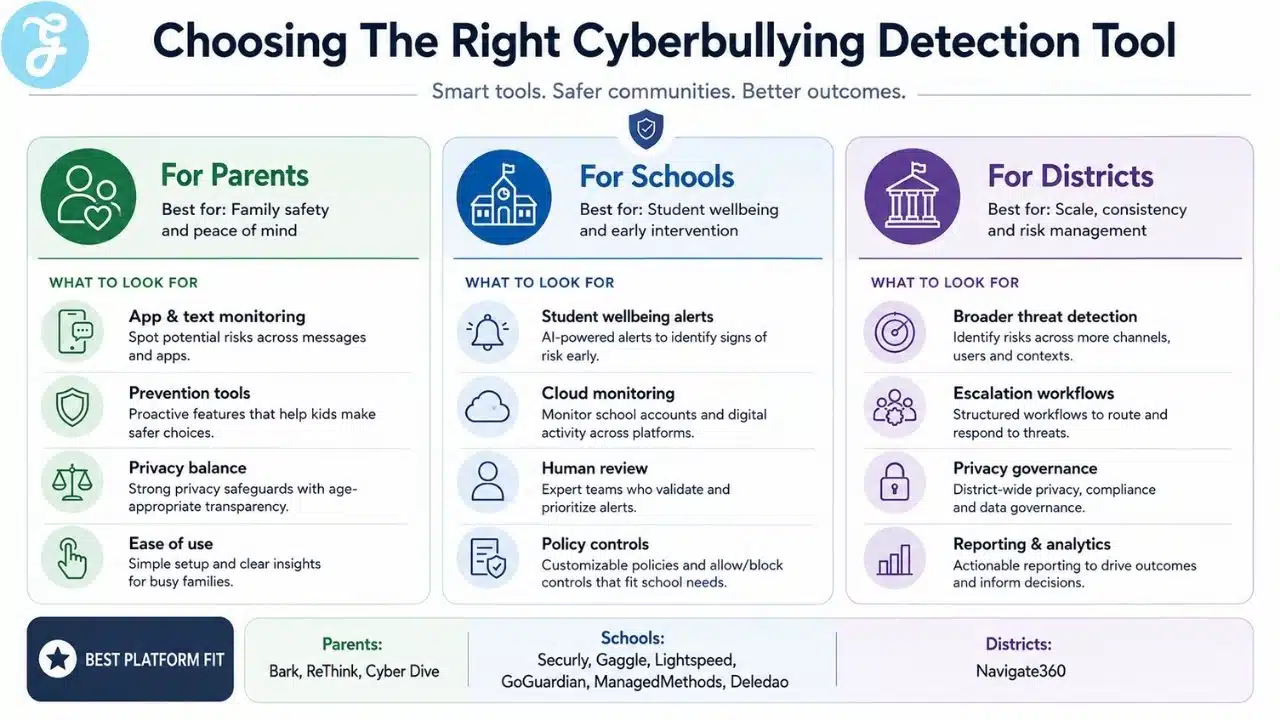
The companies below do not all solve the same problem. Bark, ReThink, and Cyber Dive are stronger for families and prevention. Securly, Gaggle, Lightspeed, GoGuardian, ManagedMethods, Deledao, and Navigate360 are stronger for schools and districts. That distinction matters because buying a school dashboard for a parenting problem is like bringing a forklift to move a lunchbox.
Overview Comparison
| Company | Verified Location | Best For | Core Strength |
|---|---|---|---|
| Bark Technologies | Atlanta, Georgia | Parents and schools | Multi-channel child online safety alerts |
| Securly | San Jose, California | K–12 districts | AI wellness and cyberbullying-risk monitoring |
| Gaggle | Bloomington / U.S. operations | School districts | Machine learning plus trained human review |
| Lightspeed Systems | Austin, Texas | K–12 schools | Filtering, alerting, and safety specialist workflows |
| GoGuardian | El Segundo / Greater Los Angeles | Schools using GoGuardian tools | Student risk alerts and school monitoring ecosystem |
| ManagedMethods | Boulder, Colorado | K–12 IT teams | Google/Microsoft cloud monitoring |
| Deledao | California / Silicon Valley | Schools needing real-time analysis | AI cyberbullying and toxic-language detection |
| Navigate360 | Richfield, Ohio | Broader school safety teams | Digital threat detection and case management |
| ReThink | U.S.-based / Naperville origin | Prevention and education | Offensive-message nudge before posting |
| Cyber Dive | Mesa, Arizona | Parents and families | Monitored child-safe smartphone |
Why Are Cyberbullying Detection Startups Booming In The United States?
Cyberbullying Detection Startups are booming in the United States because schools, parents, and districts are dealing with a problem that no longer stays inside the classroom. Bullying now happens across school devices, shared documents, gaming chats, social media, emails, text messages, and private groups. Basically, the old schoolyard got upgraded into a 24/7 digital mess. Wonderful progress, obviously.
The U.S. also has one of the largest K–12 edtech markets in the world, which makes it a natural home for student safety platforms, AI monitoring tools, parental control apps, and digital threat detection systems. Schools are under pressure to act earlier, parents want more visibility, and districts need tools that can flag possible risks before they become serious incidents.
Another reason is the rise of AI-powered monitoring. Traditional keyword filters are not enough anymore because students do not always use obvious words. Modern platforms now look for context, tone, behavioral patterns, repeated harmful language, self-harm signals, threats, harassment, and toxic exchanges. That is why companies like Bark, Securly, Gaggle, Lightspeed Systems, GoGuardian, ManagedMethods, Deledao, Navigate360, ReThink, and Cyber Dive are gaining attention in this space.
What’s Their Secret Sauce?
The secret sauce is not just “AI,” because everyone says AI now. A toaster could launch tomorrow and call itself AI-powered. The real strength of these platforms is how they combine detection, context, escalation, and intervention.
The strongest cyberbullying detection tools usually stand out because they offer:
- Multi-channel monitoring: They track risks across texts, apps, emails, cloud files, browsers, school platforms, or child-safe devices.
- Context-aware detection: They look beyond simple keywords and try to understand intent, tone, patterns, and severity.
- Human review: Some platforms use trained safety experts to verify serious alerts before escalation.
- School workflow integration: District-focused tools route alerts to counselors, administrators, or safety teams.
- Parent visibility: Family-focused tools help parents spot warning signs without needing to become full-time digital detectives.
- Prevention-first design: Tools like ReThink try to stop harmful messages before they are sent, which is smarter than cleaning up damage afterward.
- Privacy and governance controls: The better platforms understand that protecting students should not mean turning every child into a data file with homework.
That is what makes the U.S. market strong. These companies are not all doing the same thing, but they are responding to the same reality: cyberbullying is faster, quieter, more persistent, and harder to detect manually than traditional bullying. The best platforms help adults see the warning signs earlier — without pretending the software can replace judgment, empathy, or actual human intervention.
Our Top 3 Picks And Why
The best choice depends on who is buying. A parent does not need the same tool as a district IT director. A cyberbullying prevention program does not need the same platform as a school threat-assessment team. Yes, use case still matters. Terribly old-fashioned, I know.
1. Best Overall For Family And School Cyberbullying Detection: Bark Technologies
Bark is the strongest overall pick because it clearly targets cyberbullying and online child-safety risks across texts, apps, email, browsers, and online activity. It fits both family and school use cases, which gives it broader practical value than most single-environment tools.
2. Best For District-Scale Student Safety: Securly
Securly is the strongest district-scale option because Securly Aware directly includes cyberbullying, self-harm, depression, anxiety, and potential violence among its AI-monitored student risk signals. It has also publicly stated scale across millions of students and thousands of schools.
3. Best For Human-Reviewed Student Monitoring: Gaggle
Gaggle stands out because it combines machine learning with trained safety experts. In a category where AI can misunderstand context faster than a teenager clears a browser tab, human review is not a nice bonus. It is necessary adult supervision.
Choosing the right tool starts with one question: Are you trying to protect a child at home, monitor school-managed devices, detect risky behavior across school cloud tools, prevent harmful messages before they are sent, or manage broader digital threats across a district?
If you skip that question, you are not buying strategically. You are shopping by panic, which is usually how schools and parents end up with expensive dashboards and unclear intervention plans.
The Final Checklist
- Does the tool specifically detect cyberbullying or harmful digital behavior?
- Does it monitor the actual places where students communicate?
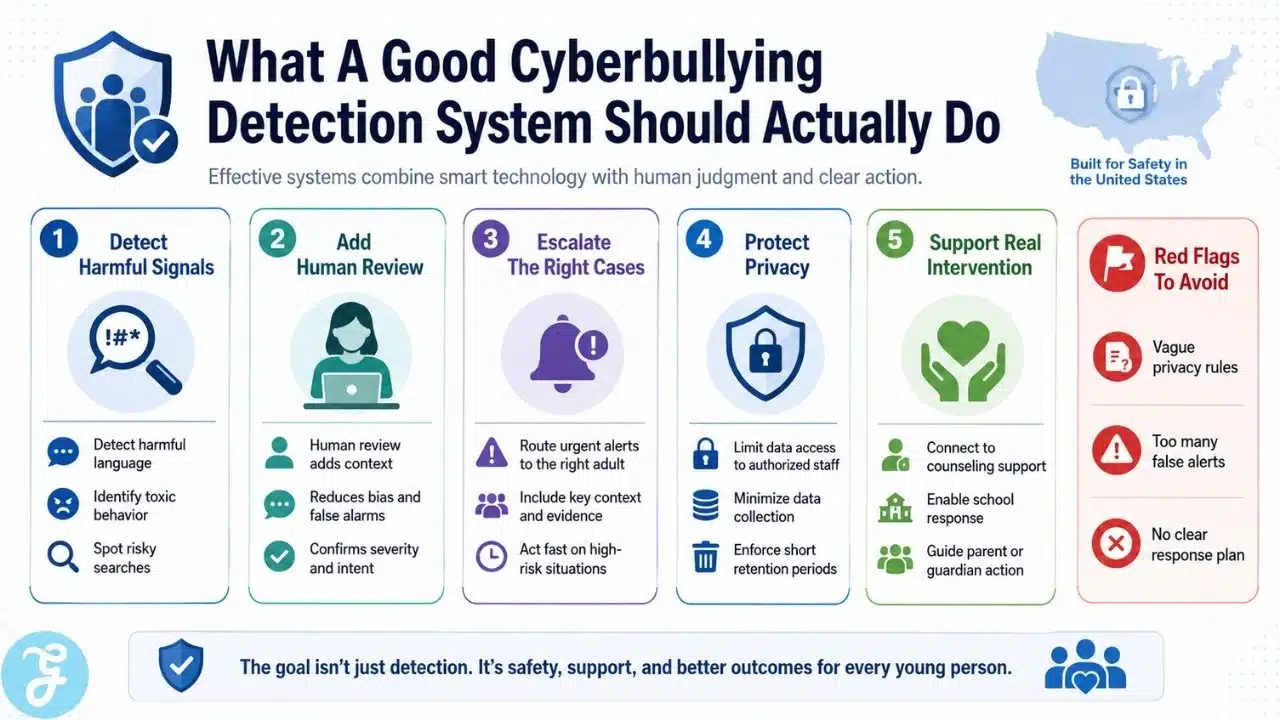
- Does it provide human review or clear escalation rules?
- Are privacy, consent, and retention policies easy to understand?
- Can adults respond wisely after receiving an alert?
The Final Word Before You Trust The Dashboard
Cyberbullying Detection SMEs and student-safety platforms can help parents and schools detect early warning signs, but they are not magic. AI can flag harmful language, toxic behavior, risky searches, concerning files, and possible threats. It can also misunderstand jokes, miss context, over-flag harmless content, and create privacy risks if adults treat every alert like courtroom evidence.
The strongest U.S. entries for this list are Bark Technologies, Securly, Gaggle, Lightspeed Systems, GoGuardian, ManagedMethods, Deledao, Navigate360, ReThink, and Cyber Dive. Ativion/StudentKeeper and Linewize by Qoria are also verified broader platforms, but they should be used carefully depending on the article angle.
The best tool is not the one with the most dramatic demo. It is the one that fits the real environment, respects privacy, gives adults usable context, and supports responsible intervention. A dashboard can detect a signal. It cannot replace judgment, counseling, trust, or the hard human work of keeping children safe online.
Frequently Asked Questions (FAQs) About Cyberbullying Detection SMEs
What Are Cyberbullying Detection SMEs?
Cyberbullying detection SMEs build tools that identify harmful messages, bullying behavior, toxic language, threats, harassment, or risky digital patterns. Some focus on parents and families, while others serve schools and districts.
Which Country Leads In Cyberbullying Detection SMEs?
The United States is the strongest country for this market because it has a dense cluster of K–12 student safety vendors, parental monitoring tools, school cloud monitoring platforms, and digital threat detection companies.
Are Cyberbullying Detection Tools Accurate?
They can be useful, but they are not perfect. AI can miss context, create false positives, or flag harmless activity. Human review, escalation rules, and privacy safeguards are essential.
Are These Tools Only For Schools?
No. Bark, ReThink, and Cyber Dive are more parent/family-friendly. Securly, Gaggle, Lightspeed, GoGuardian, ManagedMethods, Deledao, and Navigate360 are more school or district-focused.
What Should Schools Check Before Buying A Cyberbullying Detection Tool?
Schools should review detection coverage, privacy policy, data retention, human review process, false-positive handling, escalation workflows, parent/student transparency, and staff training.