I started paying closer attention to Canva business strategy when I noticed something strange: Canva was no longer just the tool people used for quick social media posts. It had quietly become the design layer for students, marketers, startups, teachers, small businesses, and even large enterprise teams.
That is what makes Canva’s rise so interesting. This was not the usual startup story of burning cash, shouting about disruption, and rushing toward an IPO because investors were breathing down the founder’s neck. Canva did raise venture funding, but it did something many VC-backed companies struggle to do: it kept the product simple, the market broad, and the business disciplined.
Instead of chasing only professional designers, Canva went after everyone who needed to communicate visually but did not want to fight with complicated design software. That patient, product-led approach turned a simple online design tool into one of the most powerful creative platforms in the world.
I’m going to walk you through the Canva business model, the growth engine behind it, and the lessons readers can borrow for startups, brands, and modern teams.
Founding Vision of Canva
Canva started with a very clear idea: design software should feel simple enough for a beginner, not like a test you have to pass before you can make a flyer or presentation.
The cofounders, Melanie Perkins, Cliff Obrecht, and Cameron Adams, built around that belief. Perkins and Obrecht had already seen the problem up close while building Fusion Books, a school yearbook business, where students and teachers struggled with complex design tools and slow production workflows.
Simplifying design for everyone
That early insight shaped everything that followed. Canva did not try to win by impressing trained designers first. It went after the far larger group of people who needed to make something useful and good-looking fast: teachers, marketers, small business owners, nonprofit teams, students, and office workers.
The product choices were practical from day one. Drag-and-drop editing, ready-made templates, quick font pairing, and one-click resizing all reduced the fear that usually comes with blank-canvas design tools.
- Templates lowered the skill barrier, so users could start from a structure instead of from scratch.
- Simple controls kept the editor approachable on a first visit.
- Fast results made users more likely to share designs, invite teammates, and come back.
That matters for growth because ease of use becomes customer acquisition. When people finish a design in minutes, they tell coworkers, classmates, and clients. Canva’s product became its own marketing channel.
Simple tools, big ideas, endless creativity.
Focus on accessibility and usability
Canva kept widening the funnel instead of narrowing it. The interface stayed friendly even as the company added whiteboards, docs, presentations, websites, print products, brand tools, and AI features.
This is where many startups lose focus. They add more features and end up making the product harder to use. Canva’s edge came from doing the opposite: expanding the platform while hiding complexity behind clean defaults.
The founders also kept pushing accessibility as a business advantage, not a side project. In practice, that meant bringing design into schools, nonprofits, and small teams that could never justify expensive legacy software or long training cycles.
The lesson for readers is straightforward: if your product serves non-experts, usability is not decoration. It is the business model.
Canva’s Unique Business Model
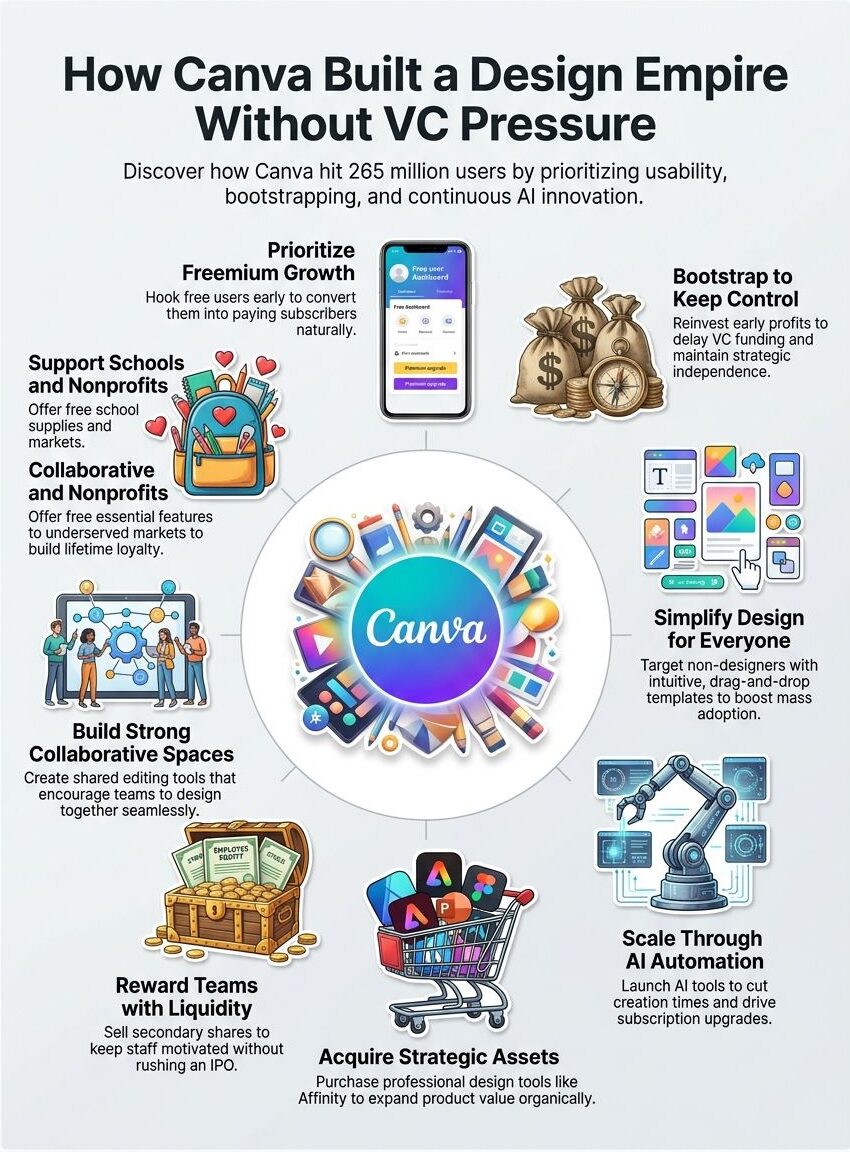
Canva’s business model looks simple on the surface: free product on the front end, paid upgrades on the back end, but the strength comes from how well each layer feeds the next one.
Free users give Canva reach. Paid users fund innovation. Team plans and enterprise features raise account value without breaking the easy entry point that made the product popular in the first place.
Freemium approach
The freemium model worked because the free plan was useful enough to become part of daily work. Users could create social posts, classroom materials, slide decks, flyers, and basic brand assets without hitting a wall in the first hour.
Once people depended on Canva, premium features became a practical upgrade instead of a forced upsell. Brand Kit, Background Remover, Magic Resize, approval workflows, premium templates, and stronger AI tools all save time, which is why people pay.
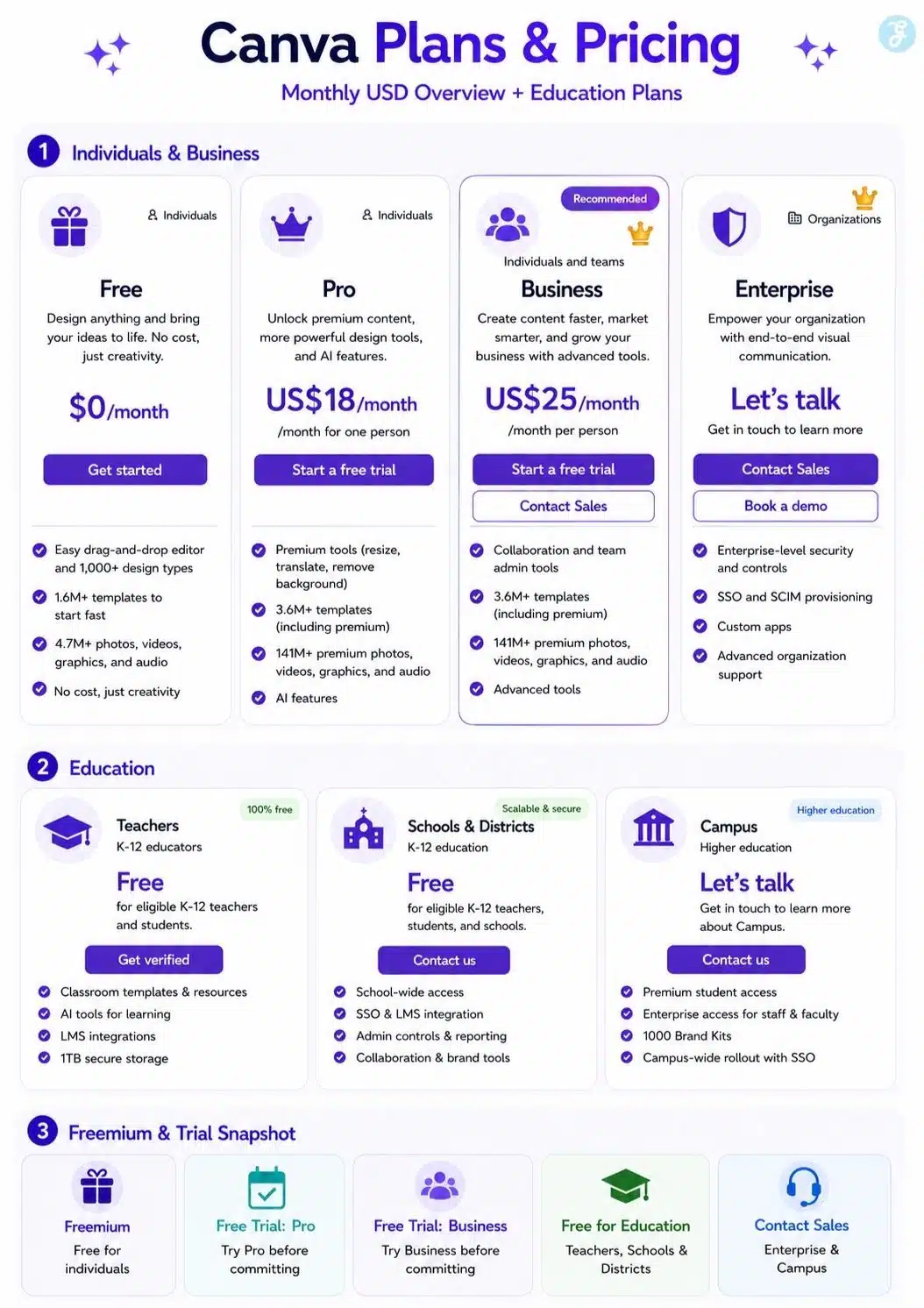
| Plan layer | What users get | Why it matters to Canva |
|---|---|---|
| Free | Core editor, free templates, collaboration basics | Mass adoption and strong word-of-mouth growth |
| Pro | Premium templates, brand tools, advanced editing, 40+ AI tools | Converts individual power users into recurring revenue |
| Business | Shared workspaces, approvals, brand controls, unlimited team invites | Turns personal use into team-wide adoption |
| Enterprise | Admin controls, SSO, permissions, multi-team governance | Raises contract value and keeps large organizations inside one system |
This structure also keeps customer acquisition efficient. One designer can invite a marketer, a teacher can invite a class, and a small business owner can invite a whole team. The product spreads before a sales team needs to step in.
Canva wins because people get useful work done before they ever reach for a credit card.
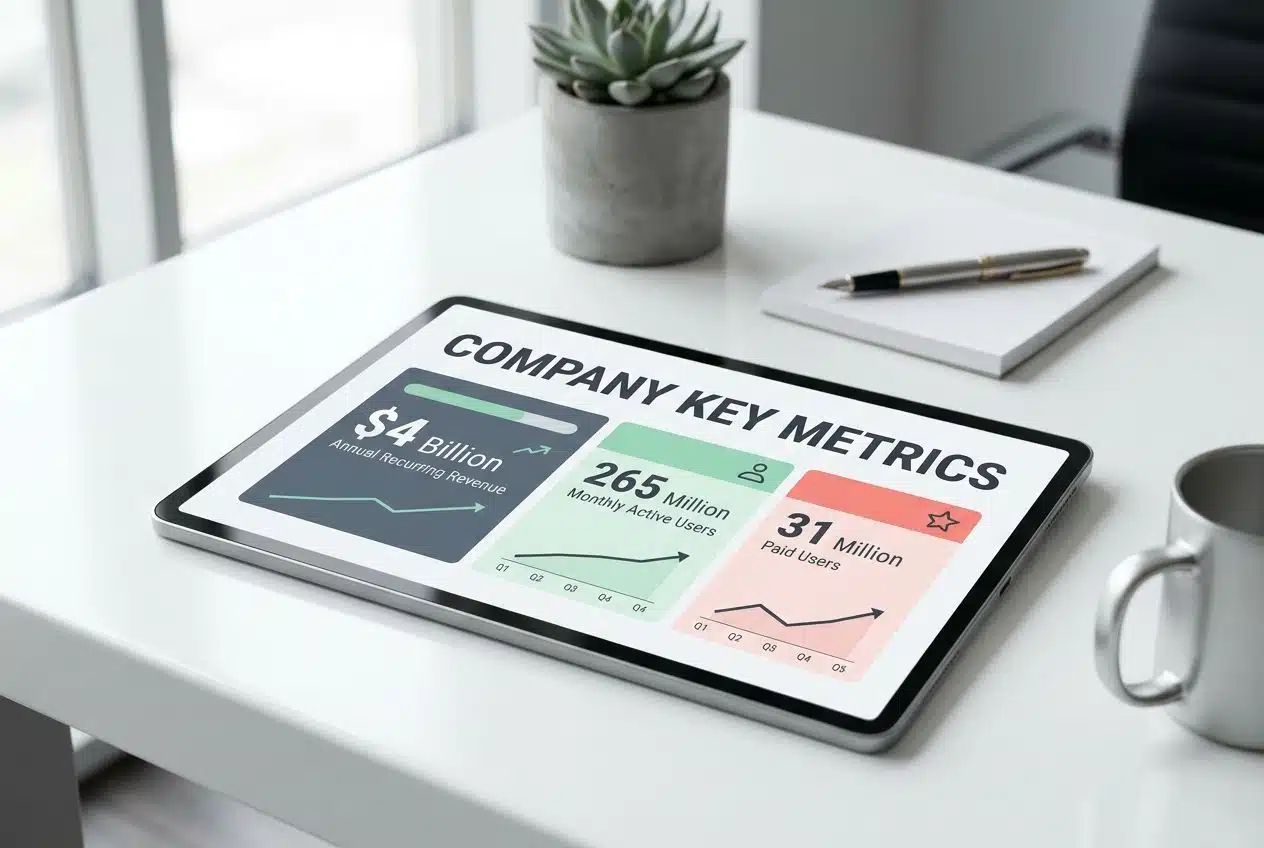
By February 2026, Canva leaders said paid users had grown past 31 million, while annual recurring revenue reached $4 billion. That tells you the upgrade path is working at a massive scale, and it also shows why Canva can fund growth without acting like a company desperate for the next round of venture capital.
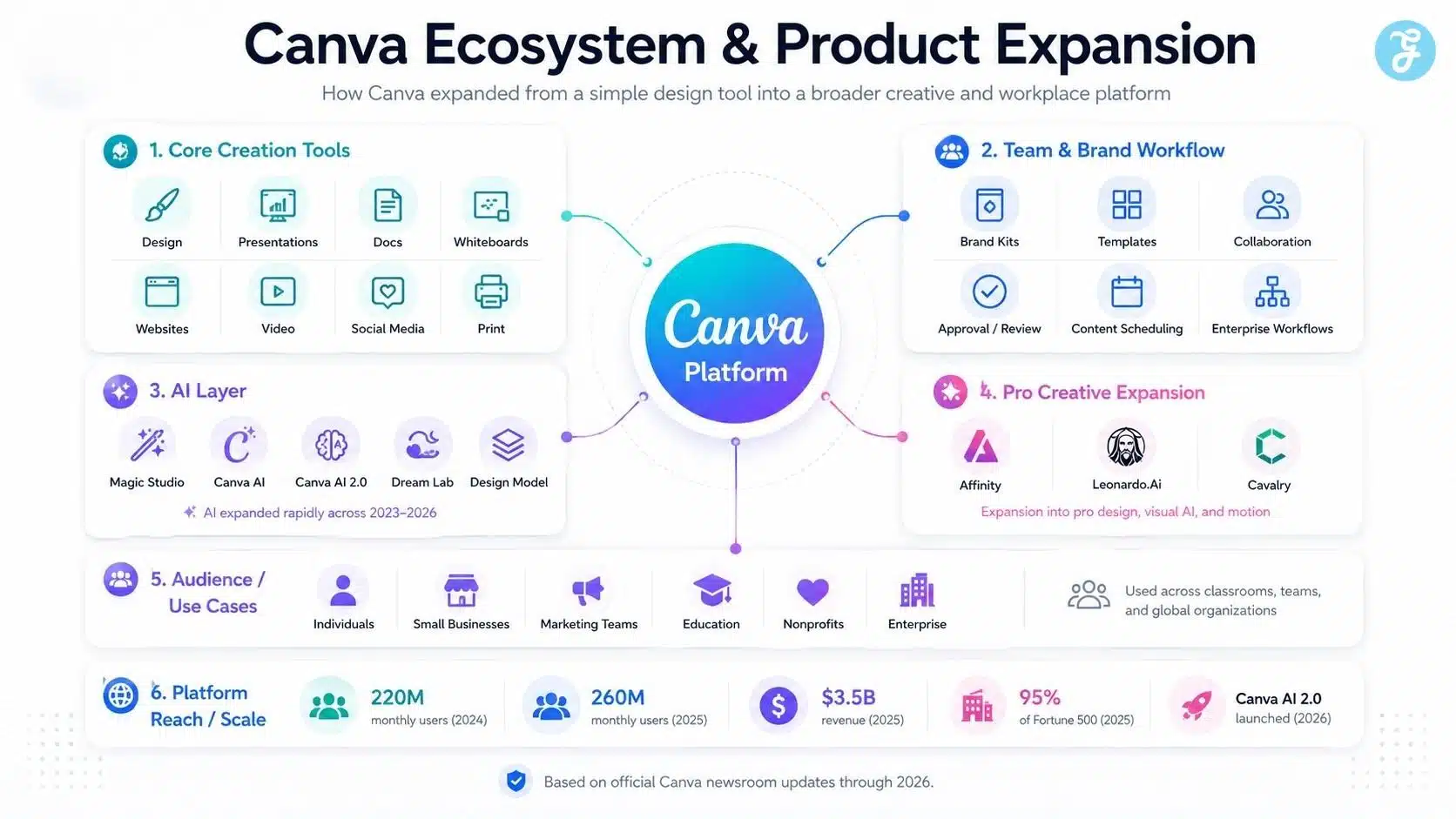
The paid layer is broader than many quick summaries suggest. Canva makes money from Pro subscriptions, Business and Enterprise plans, Canva Print, premium content, and tools that help teams stay on-brand and move faster.
Its B2B segment is an especially important part of the story. In that same February 2026 update, Canva said business revenue had reached $500 million in ARR after doubling year over year. That matters because team customers are harder to replace, more likely to buy governance features, and more likely to expand inside an account.
- Individuals pay for speed and polish.
- Small teams pay for shared brand control.
- Large companies pay for security, approvals, and admin visibility.
- Print buyers turn digital designs into physical orders inside the same ecosystem.
That is a strong monetization engine. Each paid layer solves a different problem, which keeps revenue diversified and resilient.
Growth Without Venture Capital Pressure
This part needs a little honesty. Canva did take venture funding. What makes the company unusual is that it did not let venture capital dictate the entire pace, culture, or roadmap. Canva’s growth story is really about leverage. Profitability, product-led growth, and secondary share sales gave the founders more room to say no to rushed decisions.
Bootstrapping in the early days
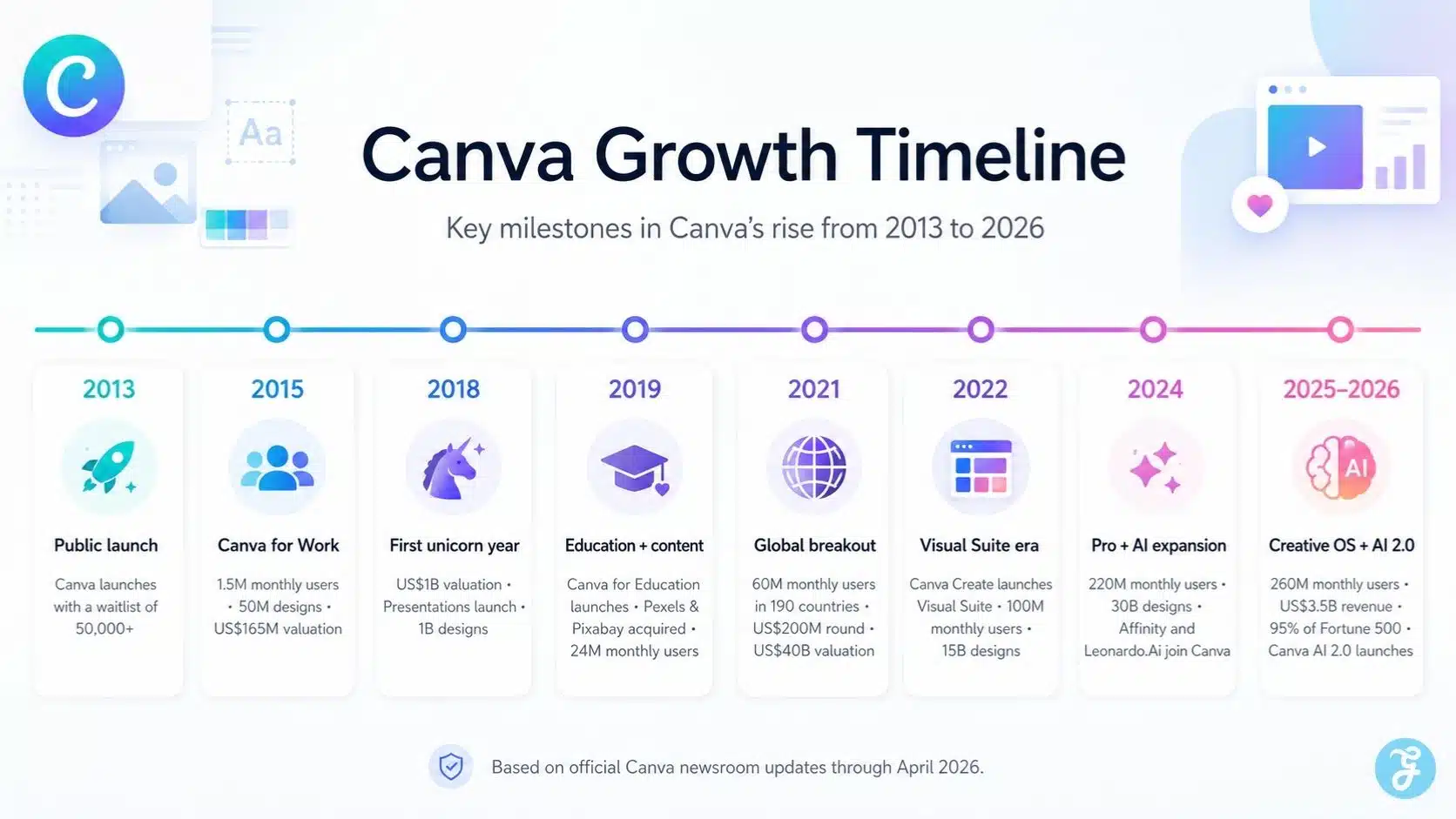
Before Canva became a global platform, the founders were building lean, pitching hard, and hearing “no” a lot. Canva’s own San Francisco campus story says Perkins and Obrecht faced more than 100 investor rejections before the right backing came together.
That rejection phase mattered. It forced the team to sharpen the pitch, prove demand, and stay close to the product instead of building a company around investor expectations.
There is another useful detail here. When Canva announced a $40 million round in 2018, Melanie Perkins said the company was already profitable and still had earlier investment money untouched. For a startup, that is rare. It meant outside capital was fuel, not oxygen.
Strategic partnerships and reinvestment
Canva chose investors and partners who helped it build, not just spend. Early supporters like Bill Tai and Lars Rasmussen opened doors, and the search for stronger technical leadership helped bring Cameron Adams into the founding team.
Once growth kicked in, Canva kept reinvesting in product depth. Affinity brought professional photo, vector, and layout tools. Leonardo added more serious generative AI capability. MagicBrief, MangoAI, Ortto, Simtheory, and Cavalry pushed Canva deeper into marketing intelligence, automation, collaboration, and motion design.
- Use funding to widen the moat, not to hide weak product-market fit.
- Reinvest profits into capabilities that make the platform harder to replace.
- Offer employee liquidity through secondary sales if you can, instead of forcing a rushed exit.
- Keep founders close to product choices when the market gets noisy.
The August 2025 employee share sale is a good example. That transaction valued Canva at $42 billion and gave staff a path to liquidity without handing over strategic control. For employees, that can feel like progress. For leadership, it buys time to keep building without IPO pressure taking over every decision.
Key Strategies Behind Canva’s Success
Canva did not win with one clever growth hack. It stacked several durable strategies on top of each other: user-centric design, global execution, fast product expansion, and disciplined business model choices.

User-centric design
Canva was built for people who needed output, not complexity. That sounds obvious, but it is where many software companies drift. They optimize for power users, then wonder why regular customers bounce.
Canva kept flipping that logic. A school admin can make a newsletter. A restaurant owner can build a menu. A recruiter can create an onboarding deck. A marketing team can publish on-brand assets without waiting for a designer every time.
That focus also translated well into business accounts. Canva said in 2025 that 95% of the Fortune 500 now use the platform, which shows the product did not lose credibility when it moved upmarket.
Leveraging global remote teams
Canva’s product is used globally, and its operating model reflects that. In late 2025, the company described itself as spanning 40-plus cities across 30-plus countries on five continents.
That geographic spread matters because it shortens the gap between user behavior and product decisions. Teams hear what educators need, what enterprise buyers ask for, and what creators complain about in different markets, then turn those signals into product updates.
Canva also has enough scale to make internal learning part of the operating system. A 2025 company update said more than 5,000 Canvanauts spent a week going deep on AI. That kind of company-wide reset helps explain why Canva can move quickly without looking scattered.
Continuous innovation and feature expansion
Canva’s innovation pattern is easy to miss if you only look at one product launch. The real move was to keep broadening the platform while staying simple at the point of use.
| Year | Move | Why it mattered |
|---|---|---|
| 2025 | Visual Suite 2.0 and Creative Operating System | Brought productivity, design, and AI into one connected workflow |
| October 2025 | All-new Affinity goes free | Expanded Canva into professional-grade creative work |
| February 2026 | MangoAI and Cavalry acquisitions | Added marketing intelligence and motion design depth |
| April 2026 | Canva AI 2.0 | Shifted Canva closer to a conversational, agentic creative platform |
The practical takeaway for startups is this: innovation works better when each new feature strengthens the core promise. Canva’s promise stayed consistent: to make creation faster, simpler, and more collaborative, even as the product got much bigger.
Role of Canva AI in Scaling the Platform
AI did not replace Canva’s strategy. It accelerated a strategy that was already working. Because Canva already had templates, collaboration, publishing, and brand tools in one place, AI could improve real workflows instead of acting like a flashy extra.
AI-powered design tools
In April 2026, Canva launched Canva AI 2.0 as a research preview and described it as the biggest product evolution since the company launched in 2013. The point was bigger than image generation. Canva wanted people to start with an idea, a brief, or a sketch, then move to a finished result inside one system.
That launch included conversational design, Canva Code 2.0, Sheets AI, scheduling, web research, connectors, brand intelligence, and a “living memory” layer that gets smarter with use. In plain English, Canva is trying to cut out the old workflow of bouncing across five different tools to finish one campaign.
- Conversational design helps users start with intent instead of a blank page.
- Sheets AI turns structured data into usable content faster.
- Canva Code 2.0 lets non-developers create interactive experiences.
- Brand intelligence helps outputs stay consistent across teams.
That is powerful for scale because it brings more kinds of work into the same subscription.
Enhancing user experience with automation
Canva’s newer AI features focus on reducing friction. In February 2026, the company rolled out updates like image-to-video conversion, smoother publishing workflows, and automatic page breaks for Letter and A4 documents. Those sound small, yet they save real time in the middle of work.
In March 2026, Canva also launched Magic Layers in public beta across the US, UK, Canada, and Australia. That feature turns flat AI images into editable layered designs, which matters because users often want AI speed without losing control over the final output.
Melanie Perkins said in April 2026 that Canva’s AI products had been used more than 27 billion times, with usage tripling over the prior year. That number helps explain why AI is now a retention tool, a premium feature driver, and a competitive moat all at once.
The best Canva AI features do not ask users to become more technical. They remove steps so the work feels lighter.
Community and Collaboration
Canva is not just a design editor. It is a networked product. The more people who can open, edit, comment on, and publish work together, the stronger the business becomes.
Building a strong user community
Canva grew by serving communities that share work naturally: classrooms, nonprofits, startups, creators, and business teams. Those groups do not use design in isolation. They teach it, review it, remix it, and pass it along.
That community flywheel is easy to see in education. Canva said in 2025 that 100 million teachers, students, and education leaders were using the platform every month across more than 190 countries.
- Education creates early habit formation.
- Nonprofits build loyalty by getting strong tools without crushing software costs.
- Creators spread templates, ideas, and tutorials.
- Teams invite coworkers, which pushes account expansion.
Canva’s January 2026 Impact Wrap adds an important detail here: more than 935,000 nonprofits receive Canva Pro free for up to 50 team members, and donated product value has passed $2.5 billion. That is generous, yes, but it is also smart. The company builds goodwill, market reach, and long-term brand preference at the same time.
Encouraging team collaboration through tools
Collaboration is where Canva becomes hard to replace. Shared workspaces, comments, approvals, permissions, brand controls, and live editing make the product stickier once teams start using it together.
There is good proof of that in enterprise accounts. Canva said FedEx rolled out the platform across 1,400 teams in 45 countries and cut brand review time by 77%.
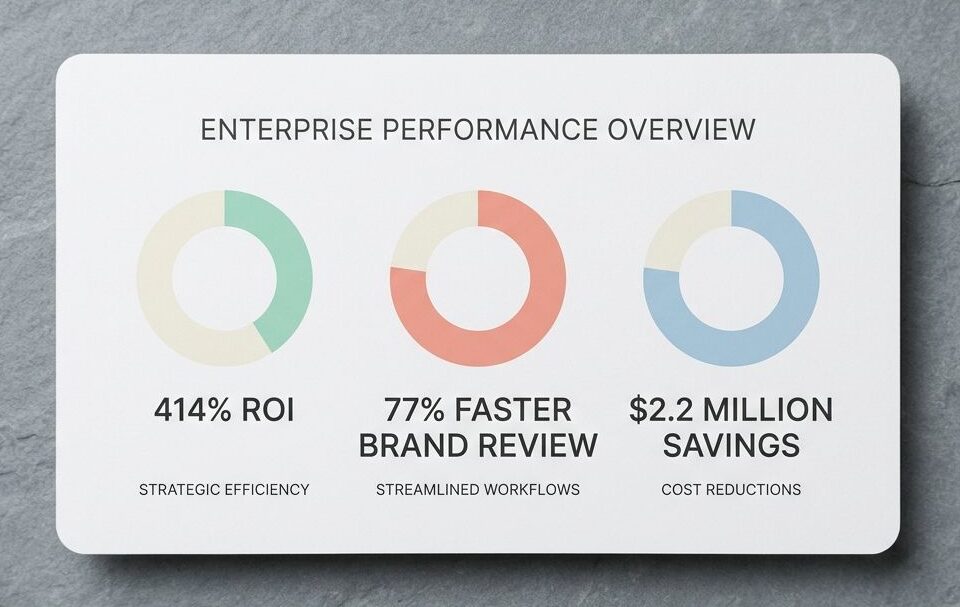
A commissioned Forrester study published in late 2025 estimated a 414% ROI for Canva Enterprise over three years, along with a 300% increase in marketer productivity and $2.2 million in agency cost savings. Even if you treat commissioned research with healthy caution, those numbers point to the same thing: collaboration features are not soft perks. They can change the economics of content production.
For readers building a startup or brand, that is the real lesson. If your product helps one person create faster, you have a tool. If it helps a team coordinate faster, you have a growth engine.
Canva’s Social and Environmental Initiatives
Canva’s social impact work is not separate from the business story. It is built into the company’s identity through its Two-Step Plan: build something valuable, then use that value to do measurable good.
Commitment to sustainability
Canva has tied sustainability to operations, not just marketing language. Its January 2026 Impact Wrap says the company has powered its own operations with 100% renewable energy since 2022 and is working toward net zero emissions by 2040.
A March 2026 company update added another concrete step: four Illinois community solar farms are now live, each producing about 4 to 5 megawatts of renewable energy to match electricity used in Canva’s print supply chain.
That matters because print is one of Canva’s heavier footprint areas. By tackling supplier energy use instead of only office waste, Canva is working on a more meaningful emissions lever.
- 13 million-plus trees planted through One Print, One Tree
- 2040 net zero goal for scopes 1, 2, and 3 emissions
- 100% of current US and Canadian print partners are in the shared climate commitment
- Public sustainability framework that partners can follow
Supporting education and nonprofits
Canva has been just as aggressive on access. Its January 2026 Impact Wrap said more than 35 million students and teachers use Canva Education for free each month across 191 countries.
That sits alongside the broader 100 million monthly education community milestone from 2025, which includes teachers, students, and education leaders. For nonprofits, the free Pro access for eligible organizations removes a real software burden and gives small teams tools they would otherwise skip.
There is also a bigger strategic point here. Access programs help Canva build design habits early. Students carry the product into work. Nonprofit leaders bring it into campaigns. Small organizations that start free often become paying customers later when their needs get more complex.
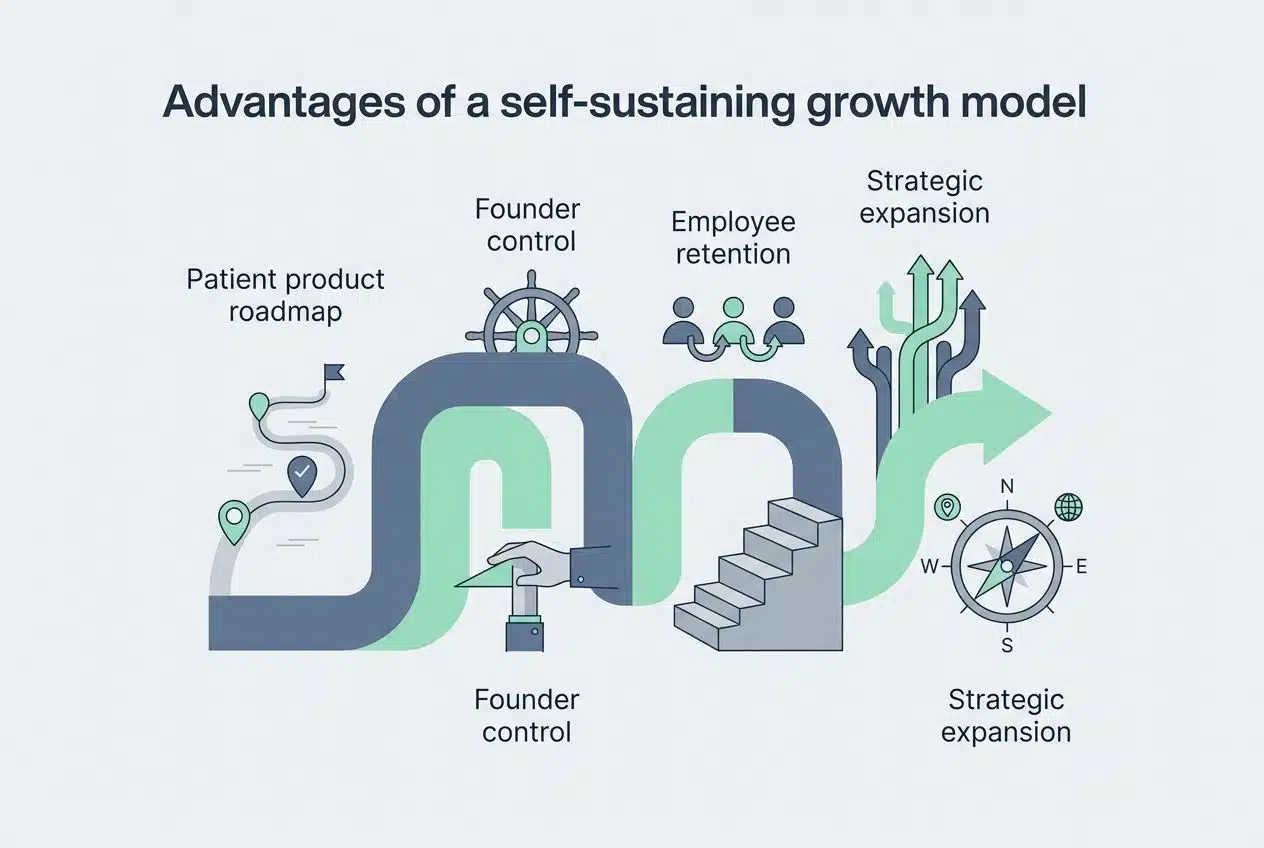
The Benefits of a Self-Sustaining Growth Model
Canva’s self-sustaining growth model did not mean zero outside capital. It meant building enough internal strength that capital did not become the boss. That gave the company more patience, more choice, and more resilience when markets changed.
| Benefit | How Canva used it | Why it matters |
|---|---|---|
| Patient product roadmap | Kept investing in AI, collaboration, print, and Pro Tools | Let’s have the company build for long-term value instead of quick vanity metrics |
| Founder control | Used profitability and strong revenue to avoid rushed strategic shifts | Protects the original mission and culture |
| Employee retention | Used secondary share sales, including the 2025 tender offer | Rewards staff without forcing an early IPO |
| Strategic expansion | Bought Affinity, Leonardo, MangoAI, Ortto, Simtheory, and Cavalry | Adds capabilities without waiting for outside pressure to approve the move |
There is a clear startup lesson in that table. If you can reach profitability, or at least credible cash discipline, you earn the right to make better decisions. You can turn down bad deals, take more thoughtful product bets, and treat funding like a tool instead of a rescue plan.
That also makes the business more resilient. Canva’s freemium engine, growing enterprise base, and strong brand gave it room to keep expanding even as the software market got more crowded and AI competition heated up.
Wrapping Up: The Real Lesson Behind Canva’s Calm Rise
Canva’s rise taught me one simple thing: smart growth does not always need startup panic.
The way Canva built a design empire without letting VC pressure take over came down to a few disciplined choices. It solved a problem millions of people actually had. It kept the design simple for non-designers. It made the free product useful enough to spread naturally. And when it charged users, it charged for real value, not artificial restrictions.
Yes, Canva raised serious funding. But from what I see, funding was never the whole strategy. The real strategy was the product. Then came trust, habit, team adoption, brand tools, education, enterprise, AI, and a much wider creative ecosystem.
That is why Canva feels different from many startup success stories. It did not scale by shouting louder than everyone else. It scaled by becoming useful in everyday work. The company’s real lesson is not “avoid investors.”
The lesson is: build enough product strength, revenue discipline, and user trust so investors do not get to decide your future for you.
Frequently Asked Questions About Canva Business Strategy
1. What Made Canva’s Business Strategy So Successful?
Canva’s growth strategy worked because it solved a very common problem: people needed good-looking designs without learning complicated design software. The company used a freemium model, simple templates, team collaboration features, and product-led growth to turn everyday users into loyal customers. Instead of only targeting professional designers, Canva made design accessible to students, marketers, small businesses, educators, and enterprise teams.
2. Did Canva Grow Without Venture Capital?
No, Canva did raise venture capital from major investors. However, the important point is that Canva did not let venture capital pressure fully control its direction. It focused on building a useful product, growing sustainably, reaching profitability, and staying private longer instead of rushing toward an IPO or chasing growth at any cost.
3. Why Is Canva Considered a Product-Led Growth Example?
Canva is a strong product-led growth example because the product itself became the main driver of adoption. Users could try it for free, create something useful quickly, share their work, invite teammates, and gradually move into paid plans. This made Canva grow through real usage, not just heavy advertising or investor-backed hype.
4. How Did Canva Make Money While Keeping the Product Free?
Canva used a freemium model. The free version gave users enough value to create designs, while paid plans offered premium templates, brand kits, team collaboration, advanced tools, stock assets, and AI features. This helped Canva grow fast without forcing every user to pay from day one.
4. Why Did Canva Stay Private for So Long?
Canva stayed private because it had strong revenue, large user growth, and enough business stability to avoid rushing into an IPO. By staying private, the company could focus on long-term product expansion, employee liquidity, AI development, and enterprise growth without facing the short-term pressure of public markets.
5. What Can Startups Learn From Canva’s Business Strategy?
Startups can learn that funding is useful, but it should not become the strategy. Canva grew by solving a real problem, keeping the product simple, building trust with free users, and monetizing only when users needed more value. The biggest lesson is to build a business strong enough that investors support the vision instead of controlling it.