Being a chef myself, I always like to stay prepared by doing my mise en place (the practice of gathering, measuring, and organizing all of your ingredients, tools, and equipment before you actually begin cooking). But just being prepared doesn’t cut it. You always need to pay attention to food safety and hygiene. So you should pay attention so that your food prep into a does not turn into a bacteria party. That is why the Bamboo Vs Plastic cutting board debate matters. It is not only about which board looks nicer beside your sourdough loaf. It is about germs, knife marks, durability, microplastics, cleaning habits, and whether the board still feels safe after months of real use.
Here is the honest answer: both bamboo and plastic cutting boards can be safe if cleaned properly, but they behave very differently over time. Plastic is easy to sanitize and often dishwasher-friendly, but it scars deeply and may shed microplastics as it wears. Bamboo is harder, more natural, and usually more durable for daily chopping, but it needs hand washing, drying, and occasional oiling. So no, there is no perfect board. There is only the board that fits your kitchen habits without quietly becoming disgusting.
Bamboo Vs Plastic: What The Germ Tests Actually Suggest
Most lab research compares wood and plastic, not bamboo specifically. That matters because bamboo is a grass, not hardwood, although it behaves more like wood than plastic in kitchen use. Classic cutting-board research studied wooden and plastic boards for cross-contamination risks in home kitchens, and later food-safety guidance still treats proper washing, sanitizing, drying, and replacement as the real non-negotiables.
The practical germ lesson is simple: material matters, but maintenance matters more. A clean plastic board is safer than a neglected bamboo board. A well-maintained bamboo board is safer than a plastic board full of deep, stained grooves from five years of emotional chopping.
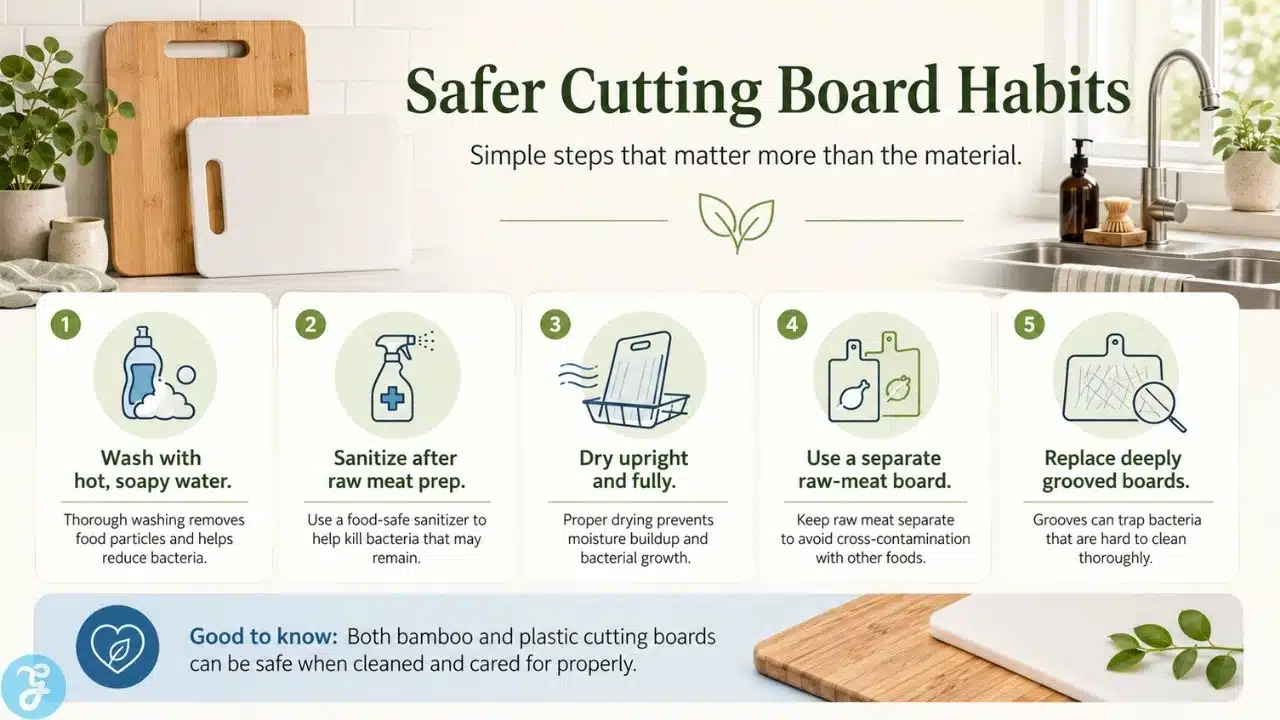
USDA-linked food safety guidance says both wooden and plastic cutting boards can be sanitized with a solution of 1 tablespoon unscented liquid chlorine bleach per gallon of water, then rinsed and dried. It also says worn boards with hard-to-clean grooves should be discarded.
So if your plastic board looks like a crime scene map, please do not call it “seasoned.” Replace it.
Quick Comparison: Bamboo Vs Plastic Cutting Boards
Before getting into the details, here is the clean side-by-side view.
| Feature | Bamboo Cutting Board | Plastic Cutting Board |
|---|---|---|
| Germ control | Good if washed and dried properly | Good when new and sanitized well |
| Knife marks | More resistant to deep grooves | Scratches and grooves more easily |
| Durability | Long-lasting with care | Needs replacement when scarred |
| Dishwasher use | Usually not recommended | Often dishwasher-safe |
| Microplastic concern | No plastic shedding | Can release microplastics during use |
| Knife friendliness | Firm surface; may dull knives faster than softer woods | Softer than bamboo but damaged more easily |
| Maintenance | Hand wash, dry, oil occasionally | Wash, sanitize, replace when worn |
| Eco angle | Plant-based, reusable, lower-plastic swap | Petroleum-based unless recycled or bioplastic |
| Best use | Daily chopping, fruits, vegetables, bread | Raw meat backup board, dishwasher users |
Germ Test Result: Bamboo Wins Only If You Dry It Properly
Bamboo boards have a big advantage over plastic when it comes to surface wear. They resist deep knife grooves better, so there are fewer cuts where food residue and moisture can hide. That helps, but it does not make bamboo magically self-cleaning. If you leave a wet bamboo board flat on the counter, you are not being eco-friendly. You are just farming regret.
Wood and bamboo-style boards work best when they are washed with hot, soapy water, rinsed, and dried upright so moisture can escape. A 2020 review on antimicrobial characteristics of wood materials discusses wood and bamboo cutting boards in the wider context of microbial behavior on wood-based surfaces, but the takeaway for home kitchens is still care-dependent: clean it, dry it, and do not let it stay damp.
Plastic Boards Are Easy To Sanitize, But They Age Badly
Plastic boards are popular for a reason. They are light, cheap, color-coded, and often dishwasher-safe. For raw meat, many people like plastic because it can be washed and sanitized aggressively. That convenience is real.
The problem is what happens after repeated chopping. Plastic boards develop grooves. Those grooves can hold moisture, food residue, and bacteria if they are not cleaned thoroughly. Food-safety guidance is clear here: once boards become excessively worn or develop hard-to-clean grooves, they should be discarded.
Plastic also has the microplastic problem. A 2023 Environmental Science & Technology study identified plastic chopping boards as a source of microplastics in food and estimated annual exposure of 14.5 to 71.9 million polyethylene microplastics and 79.4 million polypropylene microplastics from plastic boards, depending on use.
That does not mean everyone must throw away every plastic board today. But if your plastic board is scarred, fuzzy, stained, or shedding little bits, the board has retired. It just forgot to tell you.
Durability Result: Bamboo Lasts Longer, Plastic Is Easier To Replace
Bamboo usually wins in terms of durability for daily home prep. It is dense, hard, and resistant to deep cuts. That means it can stay smoother longer than a basic plastic board. With normal care, a bamboo board can last for years.
But bamboo has rules. Do not soak it. Do not put it in the dishwasher unless the manufacturer specifically says so. Do not leave it wet overnight. Oil it occasionally with food-safe mineral oil or board conditioner. It is not high-maintenance, but it is not “throw it anywhere and hope” either.
Plastic wins on convenience. You can often put it in the dishwasher, sanitize it easily, and replace it cheaply. But that cheap replacement cycle is also the problem if you are trying to reduce plastic waste.
Build a lower-waste kitchen with Eco-Friendly Kitchen Essentials.
Which Board Is Better For Raw Meat?
This is where I would be practical, not dramatic.
For raw meat, poultry, or fish, I like having a separate board that is easy to sanitize. Many households use plastic for that reason. But if the plastic board is deeply grooved, it loses that advantage because those cuts become harder to clean.
A bamboo board can be used safely if washed and sanitized properly, but I would not use the same board for raw chicken and then salad prep without serious cleaning. Separate boards are smarter. One for raw proteins, one for ready-to-eat foods. Very boring. Very effective.
The USDA-style cleaning rule still applies: wash with hot, soapy water, rinse, sanitize when needed, and dry completely.
Which Board Is Better For Vegetables, Bread, And Daily Prep?
For daily vegetables, fruit, herbs, bread, and cooked foods, bamboo is the better choice for me. It feels sturdier, looks better, avoids plastic shedding concerns, and holds up well when cared for properly.
Plastic can still work for messy jobs, staining foods, or quick dishwasher cleanup. But for everyday low-waste cooking, bamboo gives the better balance of durability, hygiene, and sustainability.
This is also where your kitchen swaps can go beyond cutting boards.
Pair your kitchen upgrade with sustainable products for an easier low-waste routine.
My Practical Verdict
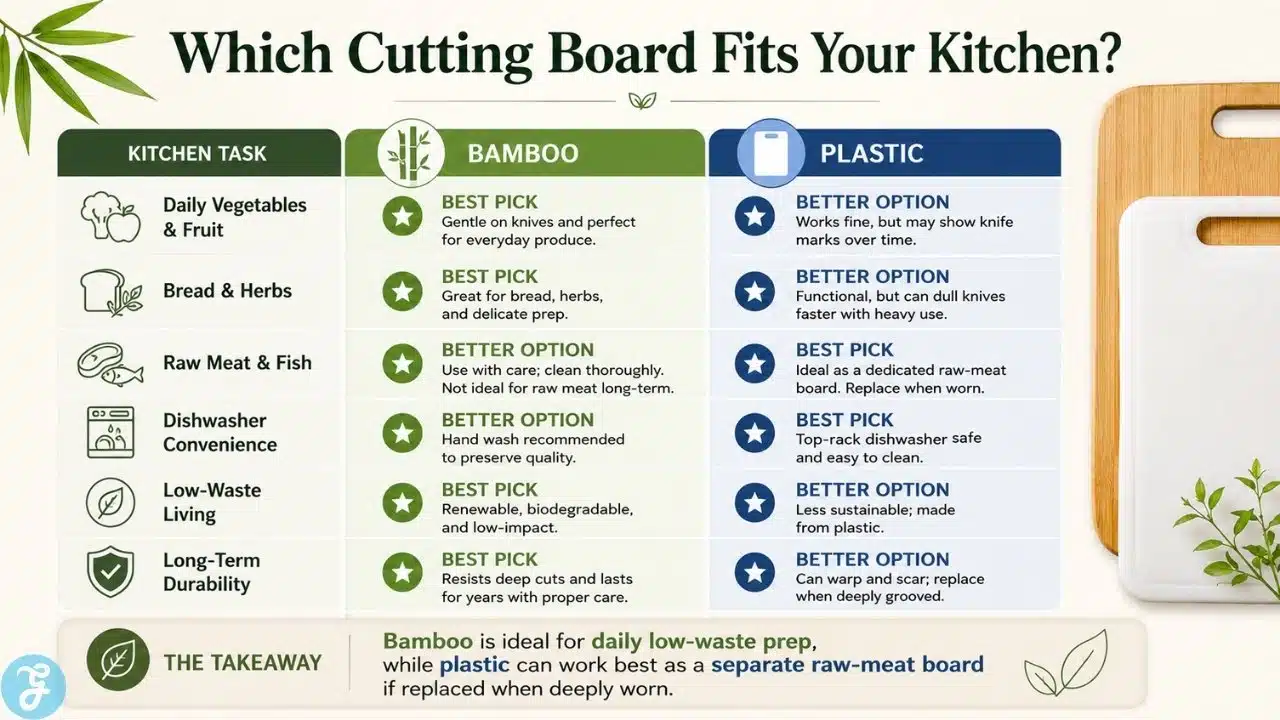
If I had to choose one board for daily prep, I would choose bamboo. It is durable, reusable, plastic-free, and better aligned with a low-waste kitchen. For fruits, vegetables, bread, herbs, and everyday chopping, bamboo simply makes more sense.
But I would still keep one separate, easy-to-sanitize board for raw meat if the household cooks meat often. That board can be plastic, but it should be replaced as soon as it develops deep grooves. Keeping an old, scarred plastic board because “it still works” is how kitchens develop trust issues.
The Better Board For A Cleaner, Greener Kitchen
The Bamboo Vs Plastic debate does not need a fake winner for every situation. Bamboo is the better everyday board if you want durability, fewer plastic concerns, and a greener kitchen setup. Plastic is convenient for dishwasher cleaning and raw protein prep, but it wears down faster and raises microplastic concerns as it ages.
My best recommendation is simple: use bamboo for daily prep, keep raw-meat prep separate, clean every board properly, dry boards fully, and replace anything with deep grooves or damage. That is how you get the real win: fewer germs, less waste, and fewer questionable kitchen decisions pretending to be convenience.